“The world is full of things to wonder at, and things to be afraid of. But in the end, wonder always wins.”
— A general theme about the nature of the world Peter discovers.

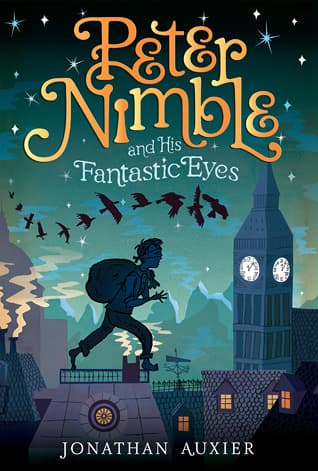
Jonathan Auxier (2011)
Genre
Fantasy / Children's / Mystery / Young Adult
Reading Time
500 min
Key Themes
See below
Sign in to track this book
A blind orphan thief finds magical eyes that take him to a hidden island, starting a quest with a horse-cat knight to save a kingdom and find his destiny.
Peter Nimble, a ten-year-old blind orphan, has lived as a master thief under Mr. Seamus Lopper. Despite his blindness, Peter has a strong sense of touch and hearing, making him very skilled. One day, in the busy port city, Peter meets a strange haberdasher. Peter is curious about the man's mysterious presence and the valuable-looking box he carries, so Peter skillfully steals the box. He goes to his hiding spot and opens the box to find three pairs of spectacles, each with different eyes. Curious, he puts on the first pair, which changes his life.
When he puts on the first pair of eyes, Peter instantly goes from his dirty city to a hidden island. There, he meets Professor Cake, an eccentric but kind scholar, who tells him about the eyes and Peter's unexpected future. Professor Cake explains that the eyes are old artifacts, and Peter has been chosen for a mission: to go to the distant and dangerous Vanished Kingdom and save its people from a terrible curse. The kingdom, once successful, has fallen into darkness, its true ruler, the rightful King, missing. Peter, despite being unsure and blind, accepts the quest, feeling drawn to this unknown adventure.
Before starting his journey, Peter meets his companion: Sir Tode. Sir Tode is a knight who became a strange creature—half horse, half cat—because of a magic accident. Despite his odd look and grumpy mood, Sir Tode is a loyal and surprisingly quick steed. Together, Peter and Sir Tode leave the hidden island, guided by the magical eyes and Professor Cake's instructions. Their path has many challenges, taking them through dangerous places and past strange people as they go towards the Vanished Kingdom, a land of mystery and danger.
As Peter and Sir Tode travel towards the Vanished Kingdom, they meet the sinister Fetchers, monstrous beings who work for the corrupt ruler, Prince Incarnadine. These creatures try to stop anyone from reaching the kingdom and finding out its secrets. Peter's quick thinking and Sir Tode's unexpected fighting skills help them escape several close calls. On their travels, they also meet other characters who tell them about the kingdom's suffering and Prince Incarnadine's cruel rule. Peter starts to understand how serious his mission is and how much the people need help, which makes him more determined.
After a long and difficult journey, Peter and Sir Tode finally arrive at the Vanished Kingdom. They find it a desolate and sad place, its people defeated and scared. The curse on the kingdom is worse than Peter first thought: it is a curse of indifference and forgetting, slowly removing the memories and spirits of the people. Prince Incarnadine, who took power, thrives on this despair. Peter realizes his quest is not just about finding a missing king, but about bringing back hope and memory to an entire population, a task that seems almost impossible for a blind boy.
Peter, using his other magical eyes, starts to find out the truth about Prince Incarnadine. He learns that Incarnadine is not only a cruel ruler but also has a deep, personal connection to the kingdom's royal family. The Prince is the younger brother of the true King, driven by jealousy and bitterness. He made his brother disappear and put the curse on the kingdom to keep his power. Peter also discovers that Incarnadine's power comes from the people's despair and their inability to remember their past, making memory important to breaking his control.
With the second pair of magical eyes, Peter can see hidden things and find the true King, who Prince Incarnadine has locked in a remote, magically protected tower. The King also has the curse, his memories fading, but he holds the key to restoring the kingdom. Peter, with Sir Tode, plans to get into the tower and rescue the King. This involves going through traps and outsmarting Incarnadine's guards, relying on Peter's skills and Sir Tode's strength.
Peter and Sir Tode reach the King's prison. However, they are found, leading to a fight with Prince Incarnadine. The battle is less about physical strength and more about intelligence and the power of memory. Peter, using the third pair of eyes that show truth and the past, challenges Incarnadine's story, reminding the people and even the King of their true history and the Prince's betrayal. This starts to weaken Incarnadine's control and the curse.
During the confrontation, Peter reaches the King and, using the magical eyes and his own words, helps him get back his lost memories. As the King remembers his past and who he is, the curse starts to break. The kingdom's colors return, and the people slowly begin to recall their history, joy, and hope. Prince Incarnadine's power decreases as the curse breaks, and he is defeated, though his future is uncertain, suggesting a chance for him to change rather than be completely destroyed.
With the Vanished Kingdom restored and the rightful King back on the throne, Peter's mission is done. Professor Cake congratulates him. It is then revealed that Peter is not a random orphan; he is the long-lost son of the King's royal mapmaker, separated from his family during Incarnadine's takeover. His blindness was from the same magic that kept him safe from the curse. Peter, no longer a thief, is offered a place in the restored kingdom. He chooses to leave, however, starting new adventures with Sir Tode, now not just a hero, but a boy who has found his true identity and purpose.
The Protagonist
Peter transforms from a cynical, self-serving thief into a courageous hero who discovers his true identity and purpose.
The Supporting
Sir Tode learns to embrace his unusual form and finds renewed purpose in aiding Peter, becoming a true friend.
The Antagonist
Incarnadine's reign of terror is ended, and his power is broken, though his ultimate fate suggests a possibility of redemption.
The Supporting
Professor Cake facilitates Peter's journey and growth, remaining a steady source of guidance.
The Supporting
Lopper remains a static representation of Peter's past, eventually left behind as Peter finds a new path.
The Supporting
The King is rescued from his prison and curse, regaining his memory and restoring his kingdom.
The Mentioned
The Fetchers are obstacles to Peter's quest, ultimately powerless once the curse is broken.
The Mentioned
The Haberdasher serves as a catalyst for the plot and then disappears.
A main idea is Peter's journey to find out who he is beyond his life as a blind orphan thief. His quest to save the Vanished Kingdom is connected to finding his own origins and purpose. He deals with his past, his blindness, and what people expect of him. He learns that his real strength is not in his sight, but in his courage, empathy, and unique abilities. This leads to the discovery of his royal family and a new path in life.
“"He was Peter Nimble, a thief, but now he was something more. He was a hero, a rescuer, and perhaps, a son."”
The curse on the Vanished Kingdom is about forgetting and indifference, slowly removing the memories and stories of its people. Prince Incarnadine's power comes from this loss of memory. Peter's quest involves not just finding the King, but helping the kingdom remember its past, its true history, and the joy it once knew. The magical eyes themselves are tools for seeing truth and the past, showing how memory and shared stories are important for identity, hope, and fighting against harsh rule.
“"A kingdom without memory is a kingdom without a soul."”
Even though he is blind, Peter 'sees' more clearly than many sighted characters. His other senses are stronger, but more importantly, he has an inner vision that lets him see truth, character, and the core of situations. The magical eyes give him literal sight in different ways, but the story always shows that true understanding and courage come from inside. His blindness, at first a weakness, becomes a unique strength, making him rely on instinct and heart.
“"It was not with his eyes that Peter saw, but with his heart and his quick, clever mind."”
The fight between Peter and Prince Incarnadine clearly shows a battle between good and evil, with Incarnadine representing greed, jealousy, and harsh rule. However, the book goes deeper than simple good-versus-bad, especially with Incarnadine's character. While he is the bad guy, his end is not total destruction but a defeat that suggests a chance for him to think, meaning that even those who do bad things might have a way, however hard, to understand or change.
“"Evil, Peter realized, was not a monster in a dark cave, but a whisper in the ear, a promise of power that corroded the soul."”
The bond between Peter and Sir Tode is the emotional center of the adventure. Despite their first differences and Sir Tode's complaints, their relationship becomes one of strong loyalty and friendship. They rely on each other's strengths and weaknesses, offering support, humor, and company through dangerous journeys. Their friendship shows how important connection and trust are in overcoming problems, proving that even unlikely pairs can do great things together.
“"You may be half a horse and half a cat, Sir Tode, but you're all friend to me."”
Three pairs of enchanted spectacles that grant different forms of sight.
The three pairs of magical eyes are the central plot device, serving as the catalyst for Peter's adventure and the primary tools he uses to complete his quest. The first pair transports him, the second allows him to see hidden things and locate the King, and the third reveals truth and memories. They are more than mere magical objects; they symbolize Peter's journey to 'see' beyond his physical blindness and understand deeper truths, both about the world and himself. Their limited use and specific functions drive the narrative forward and create tension.
A knight cursed into a horse-cat hybrid, serving as Peter's companion.
Sir Tode's unusual transformation into a half-horse, half-cat creature is a significant plot device. It provides Peter with a unique and memorable companion, fulfilling the traditional 'steed' role in a fantastical way. Beyond comic relief, his hybrid nature allows for unexpected abilities (cat-like agility, horse-like speed) that aid Peter in various predicaments. His grumpy but loyal personality also provides a foil to Peter's more serious demeanor, enriching their dynamic and highlighting the theme of finding strength in unexpected forms.
A magical curse that erases memories and joy from the Vanished Kingdom.
The curse placed upon the Vanished Kingdom by Prince Incarnadine is a crucial plot device. It provides the central conflict and the specific 'problem' Peter must solve. Unlike a typical physical curse, this one targets the collective memory and spirit of the people, making it a more insidious and challenging foe. It emphasizes the theme of the power of memory and story, as breaking the curse requires restoring these vital elements, not just defeating a villain in combat. It also serves to illustrate the psychological impact of tyranny.
A once-vibrant land now suffering under a curse and a usurper.
The Vanished Kingdom is more than just a setting; it functions as a plot device representing a lost ideal and a challenge to be overcome. Its state of despair and forgetfulness directly reflects the impact of Incarnadine's rule and the curse. Peter's journey to restore it is symbolic of restoring hope, memory, and rightful order. The mystery surrounding its 'vanished' status and the specifics of its curse drive much of the narrative's exploration and Peter's detective work using the magical eyes.
“The world is full of things to wonder at, and things to be afraid of. But in the end, wonder always wins.”
— A general theme about the nature of the world Peter discovers.
“There are some things that cannot be unseen, no matter how hard you try.”
— Peter reflecting on his experiences and the knowledge he has gained.
“A good story is a terrible thing to waste.”
— Often said in relation to the adventures and tales encountered.
“Being brave isn't about not being scared. It's about being scared and doing it anyway.”
— A lesson Peter learns about courage during his journey.
“The greatest treasures are not always found in chests, but in the people you meet along the way.”
— Peter's realization about the importance of friendship and companionship.
“Sometimes the things you lose are the very things you need to find yourself.”
— Peter's journey of self-discovery after losing his eyesight.
“Every lock has a key, and every mystery has a solution, if you're clever enough to find it.”
— A recurring idea about problem-solving and perseverance.
“You can't always choose your path, but you can choose how you walk it.”
— Peter's agency in his own adventure, despite his circumstances.
“The truly blind are those who refuse to see, even when their eyes are open.”
— A commentary on prejudice and narrow-mindedness.
“Even the smallest spark can light the darkest room.”
— A metaphor for hope and the impact of small actions.
“A good map doesn't tell you where to go, it just tells you where you are.”
— Insights on guidance and self-reliance during the quest.
“Some secrets are best left buried, but others demand to be unearthed.”
— The moral dilemma of revealing hidden truths.
“It's a strange thing, a heart. It can break, and still keep beating.”
— Peter's resilience in the face of heartbreak and challenges.
“The world is much larger and stranger than you can ever imagine.”
— A reflection on the vastness and mystery of the world Peter explores.
Ready to see how well you understood this book? Take our interactive quiz with 10 questions.

Biography coming soon.







