“The soil of a man's heart is stonier, Louis.”
— Jud Crandall's ominous warning to Louis Creed about the Micmac burial ground.

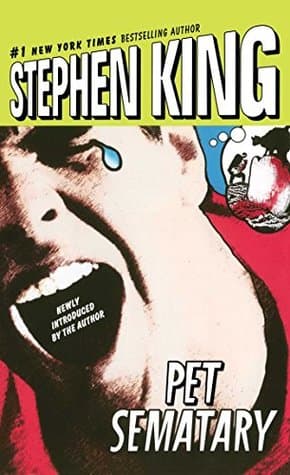
Stephen King (1983)
Genre
Thriller / Fantasy / Mystery
Reading Time
10-12 hours
Key Themes
See below
Sign in to track this book
A father's grief drives him to use an ancient, evil burial ground to bring his dead son back, unleashing horror that shows some things should stay buried.
Dr. Louis Creed moves his family—wife Rachel, daughter Ellie, and infant son Gage—from Chicago to Ludlow, Maine, for a new job at the University of Maine at Orono. Their new house is pleasant, but it sits on a busy highway with frequent, fast traffic. Soon after arriving, their elderly neighbor, Jud Crandall, befriends the family. He shows them a path into the woods behind their property. This path leads to a clearing that is a 'Pet Sematary,' a burial ground for local children's deceased pets, marked with crude, misspelled headstones. Louis is unsettled by this discovery, especially when Rachel shows her deep fear of death, which comes from the traumatic early death of her sister, Zelda. Louis struggles to understand this fear.
During his first week at the university infirmary, Louis tries to save a student named Victor Pascow, who has severe injuries from a traffic accident. Pascow dies in Louis's care, but before he dies, he speaks directly to Louis, despite being in shock, warning him about the 'barrier' and the 'Pet Sematary.' Later that night, Pascow appears to Louis in a vivid, realistic dream. He leads Louis to the pet cemetery and repeats his warning not to go 'beyond' it. Louis wakes up to find mud on his feet, just like in the dream, which deeply disturbs him. He dismisses it as a hallucination but is very shaken by the experience.
While Rachel and the children visit Rachel's parents, Ellie's cat, Church, dies after being hit by a truck on the highway. Louis knows how devastated Ellie will be and does not know what to do. Jud, understanding Louis's problem, takes him beyond the pet cemetery to a much older, deeper burial ground, an ancient Micmac Indian burial ground. Jud explains that this ground can bring things back to life, but warns that what comes back is 'different.' Louis, desperate to spare Ellie pain, buries Church there. Church returns the next day, but he is no longer the same—he smells bad, moves stiffly, and hunts viciously, showing no affection.
Church's return is a chilling success, but a terrifying failure. He is physically present, but his personality is gone; he is a grotesque imitation of his former self. He smells of grave dirt and decay, his purr is a rasp, and he brings dead animals into the house. Louis is disgusted and terrified by the cat, regretting what he did but unable to undo it. He hides the truth from Rachel and Ellie, who are simply relieved to have Church back, though Ellie notices his changed behavior. Louis increasingly senses a dark, evil presence from Church and the burial ground.
During a family picnic, Louis is distracted, and his two-year-old son, Gage, wanders onto the busy highway. Louis sees him just as a speeding truck approaches. Despite Louis's desperate run, Gage is hit and dies instantly. This tragedy shatters the Creed family. Rachel is inconsolable, and Ellie is devastated, struggling to understand death. Louis is consumed by grief and guilt, feeling responsible for not protecting his son. Gage's death pushes Louis to the edge of despair, and his thoughts turn to the Micmac burial ground, despite Jud's earlier warnings.
Consumed by grief and the temptation of the Micmac burial ground, Louis starts to plan Gage's resurrection. He takes Gage's body from the coffin, replacing it with a weighted dummy. Jud, sensing Louis's despair and recognizing the signs, tries to warn him away from the burial ground. He tells Louis the story of Timmy Baterman, a local boy killed in WWII. Timmy's father, Bill, buried him in the Micmac ground, and Timmy returned as an evil, demonic entity, terrorizing the town with his unnatural presence and knowledge of their darkest secrets. Jud reveals that the horrors of Timmy's return led Bill to kill his resurrected son and then himself, saying that 'sometimes dead is better.'
Despite Jud's chilling story, Louis is too deep in his grief and obsession. He drugs Jud to prevent interference and takes Gage's body to the Micmac burial ground, burying him deep in the ancient, cursed soil. The next day, Gage returns. But it is not his son; it is an evil, demonic entity in Gage's body. The resurrected Gage is a twisted mockery of the innocent child, speaking with an adult's voice, full of cruel taunts and unnatural knowledge, embodying the evil of the burial ground. He smells of the grave and carries a scalpel, a terrifying distortion of Louis's profession.
The resurrected Gage, now a vessel for the evil of the burial ground, first targets Jud Crandall. He breaks into Jud's house and brutally murders him with a scalpel, leaving a gruesome scene. Meanwhile, Rachel, troubled by premonitions and a terrible sense of dread, rushes back to Ludlow after speaking with Ellie, who is terrified by a phone call with Louis. She arrives home to find the house in disarray and encounters the resurrected Gage. Believing it to be her son, she approaches him, only to be savagely attacked and killed by the demonic entity, becoming its second victim.
Louis discovers the horrific murders of Jud and Rachel. He confronts the monstrous Gage, who taunts him with the scalpel and reveals his role in the deaths. In a desperate, horrifying struggle, Louis manages to inject Gage with a lethal dose of morphine, ending the terror of his resurrected son. Overcome with grief, guilt, and the influence of the burial ground, Louis's mind breaks. Despite all the evidence of the burial ground's evil, he holds onto the irrational hope that if he buries Rachel there 'faster,' she will return as her true self, not a demon. He is completely lost to the madness of the Micmac ground.
After Gage's second death, Louis takes Rachel's body to the Micmac burial ground, convinced that this time it will be different. He buries her, and then sits in the house, waiting. The novel ends with Louis playing solitaire, listening to the ominous sounds of the house. Rachel, resurrected and now a horrifying, evil entity, appears behind him, her voice raspy and dead, her touch cold and clammy. She drops a kiss on his lips, and a chilling, final line from Louis implies that he has fully given in to the evil of the burial ground, trapped with the demonic version of his wife, forever haunted by his choices.
The Protagonist
From a rational, loving father, Louis descends into madness and despair, driven by grief to commit acts against nature, ultimately becoming a victim of his own choices.
The Supporting
Rachel is consistently plagued by her past trauma, which intensifies with the family's misfortunes, culminating in her own horrific death and resurrection.
The Supporting
Jud acts as a wise mentor and a tragic figure, inadvertently enabling the horror he knows too well, ultimately becoming one of its victims.
The Supporting
Ellie experiences profound childhood trauma, losing her beloved pet and then her entire family to the horrors of the burial ground, leading to an uncertain and likely scarred future.
The Supporting/Antagonist
Gage's innocent life is tragically cut short, only for his body to be reanimated as a monstrous, demonic entity, becoming the instrument of the burial ground's evil.
The Supporting
Church's innocent life ends, only for him to be reanimated as a grotesque, malevolent parody of his former self, a harbinger of the greater tragedy.
The Mentioned
Pascow appears as a supernatural harbinger, trying to prevent Louis from unleashing evil, but his warnings are tragically dismissed.
The Mentioned
Zelda's tragic life and death continue to haunt Rachel, shaping her character and fears, even long after her passing.
The Mentioned
Timmy's story serves as a tragic precedent, illustrating the corrupting, evil power of the Micmac burial ground and the futility of defying death.
A main theme of 'Pet Sematary' is the destructive power of grief and humanity's difficulty accepting death as a natural part of life. Louis Creed, a doctor who sees death often, cannot cope with the loss of his son, Gage. His refusal to accept this finality, driven by love and sorrow, leads him to defy the natural order. Rachel's lifelong, intense fear of death, from her sister Zelda's traumatic passing, also shows this theme. It illustrates how an unhealthy relationship with mortality can lead to psychological torment and tragedy.
“The soil of a man's heart is stonier, Louis. A man grows what he can, and tends it. 'Cause what you buy, is what you own. And what you own... always comes home to you.”
The Micmac burial ground is not just a place of resurrection; it is a source of ancient, malevolent evil that corrupts everything it touches. What returns from its soil is a grotesque, demonic imitation of the deceased, filled with cruelty and a desire for destruction. Church, Gage, and finally Rachel, all return 'different,' without their former souls and filled with an insidious evil. This theme shows that some forces are best left alone, and that trying to control or use supernatural power inevitably leads to deep corruption and horror, both in the resurrected and in those who use the power.
“The place was bad. It was old. The things that came back from there were bad. They were old. They were hungry. They were not your loved ones.”
Despite Louis's desperate attempts to reverse death, the novel strongly states that death is final and irreversible. Any attempt to bypass this natural law results in a monstrous distortion rather than a true return. The resurrected Church, Gage, and Rachel are not the loved ones Louis lost; they are empty vessels animated by an ancient, evil force. This theme highlights the futility and horror of trying to cheat death, stressing that true healing comes from acceptance and grieving, not from denial and unnatural interference. The 'solution' Louis seeks only deepens his suffering and causes greater devastation.
“Sometimes dead is better.”
Guilt is a constant theme, driving many of the characters' actions. Louis feels immense guilt over Gage's death, blaming himself for his son wandering into the road. This guilt becomes a main reason for his decision to use the burial ground. Rachel feels deep guilt over her feelings toward her sister Zelda during her illness, which fuels her intense fear of death. Jud also feels some guilt for showing Louis the burial ground in the first place, knowing its dark history. This theme explores how unchecked guilt can lead to irrational decisions and a descent into further tragedy, showing how it can be as destructive as any external force.
“He had a sense of being on some sort of invisible, horrible treadmill; he was walking, but the scenery remained the same, it only got darker.”
The supernatural catalyst for resurrection and malevolence.
The Micmac Burial Ground is the central plot device, an ancient, cursed land beyond the Pet Sematary that possesses the power to bring the dead back to life. It serves as the primary source of conflict and horror, driving the entire narrative. Its power is not benevolent; it resurrects bodies but fills them with a malevolent, demonic spirit, twisting love into horror. It acts as a character in itself, an insidious force that corrupts the living and the dead, tempting Louis with false hope while ensuring unimaginable suffering. Its very existence provides the 'what if' scenario that propels the plot.
A supernatural harbinger and ignored warning.
Victor Pascow's appearance, first as a dying patient and then as a ghostly figure in Louis's dream, serves as a crucial supernatural warning. He attempts to dissuade Louis from using the burial ground, explicitly telling him not to go 'beyond' the pet cemetery. This device establishes the supernatural element early in the story and highlights Louis's initial skepticism and ultimate hubris. Pascow's warning, though ignored, provides an external, otherworldly validation of the burial ground's danger, reinforcing the tragic inevitability of Louis's downfall.
A constant, mundane threat that delivers the primary tragedies.
The busy highway running past the Creed house acts as a mundane yet deadly plot device. It is the instrument of death for both Church and Gage, serving as a stark contrast to the supernatural horrors that follow. The highway represents the randomness and inevitability of everyday tragedy, which then becomes the catalyst for Louis's desperate, unnatural acts. Its constant roar and the frequent deaths it causes underscore the theme of death's omnipresence and the fragile nature of life, setting the stage for Louis's misguided attempts to defy it.
A psychological device revealing Rachel's deep-seated trauma.
Flashbacks and vivid memories of Rachel's deformed and suffering sister, Zelda, serve as a psychological plot device. These fragmented, horrifying recollections explain Rachel's profound and often irrational fear of death and decay. They provide insight into her character, her anxieties, and the deep-seated trauma that influences her reactions throughout the story. This device helps the reader understand the depth of Rachel's psychological distress and foreshadows the grotesque nature of the resurrected dead, connecting her past trauma with the present horrors.
“The soil of a man's heart is stonier, Louis.”
— Jud Crandall's ominous warning to Louis Creed about the Micmac burial ground.
“Sometimes dead is better.”
— Jud's desperate plea to Louis, trying to dissuade him from using the burial ground.
“No, there's nothing to be afraid of. It's just a place. A place that was here long before us and will be here long after us.”
— Louis trying to reassure himself about the pet sematary, despite his growing unease.
“The world had teeth and it could bite you with them anytime it wanted.”
— Reflecting on the unpredictable and often cruel nature of life and loss.
“The only thing that matters is that he's alive. And he's here. And we're a family again.”
— Louis's deluded justification for bringing Gage back, ignoring the horrific consequences.
“The ground is sour.”
— Jud's simple but chilling explanation for why things brought back from beyond the pet sematary are wrong.
“Gage, no! Don't look! Don't look at it!”
— Louis's futile cry as Gage runs into the path of the truck.
“He just wanted to be with his family again. That's all he wanted. What's wrong with that?”
— Louis's internal monologue, trying to rationalize his actions after Gage's death.
“It was the only thing that could have brought him back.”
— Louis's conviction that the Micmac burial ground was the sole solution to his grief.
“The dead don't walk. They don't talk. They don't do anything.”
— Rachel Creed's firm belief, which is ultimately shattered by the events of the story.
“The barrier between life and death is thin. Sometimes it's so thin you can almost see through it.”
— Jud explaining the mystical nature of the burial ground to Louis.
“The fear of death is the most basic fear of all.”
— A reflection on the primal human terror that drives many of the characters' actions.
“Darling, I miss you.”
— Rachel's last words, spoken by the reanimated Louis at the very end of the novel, signaling her horrific fate.
Ready to see how well you understood this book? Take our interactive quiz with 10 questions.

Stephen Edwin King is an American author of horror, supernatural fiction, suspense, crime, science-fiction, and fantasy novels. Described as the "King of Horror", his books have sold more than 350 million copies as of 2006, and many have been adapted into films, television series, miniseries, and comic books. King has published over 65 novels/novellas, including seven under the pen name Richard Bachman, and five non-fiction books. He has also written approximately 200 short stories, most of which have been published in book collections.







