“The universe was a vast, cold, indifferent place, and the only warmth in it was the one they made themselves.”
— A recurring theme about humanity's place in the cosmos.

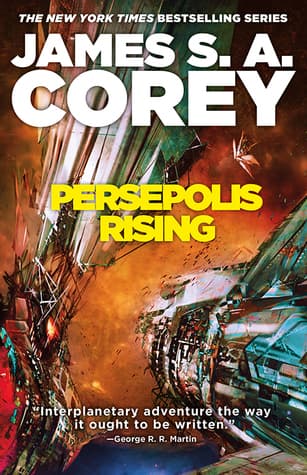
James S.A. Corey (2017)
Genre
Fantasy / Science Fiction
Reading Time
12-15 hours
Key Themes
See below
Sign in to track this book
Humanity's peace across a thousand worlds is about to shatter. The Rocinante crew faces a terrifying power from a lost colony, a power that could redefine human civilization.
Thirty years have passed since the Ring Gates opened, beginning an era of human expansion. James Holden, captain of the *Rocinante*, along with Naomi Nagata, Alex Kamal, and Amos Burton, are now seasoned veterans, working as peacekeepers for the Transport Union in the Sol system. They mediate disputes between inner planets and the Belt, often dealing with the ongoing tensions between different human factions. Naomi, now a respected engineer and diplomat, handles political issues, while Alex pilots and Amos provides muscle and dry wit. The *Rocinante* itself shows its age, but its crew remains a cohesive, if weary, unit, committed to maintaining the fragile peace they helped build.
Far beyond the Transport Union, on the lost colony world of Laconia, Admiral Winston Duarte, previously thought dead during the protomolecule crisis, has not only survived but thrived. He has spent the last three decades building a formidable empire based on advanced protomolecule-derived technology. This technology, including energy shields, hyper-accelerated drives, and devastating weaponry, is far superior to anything else humanity has. Duarte has created a society based on rigid military discipline and a long-term vision for humanity's future, believing he is meant to unify and guide all human worlds, even if by force. His forces are now ready to emerge and impose their will.
The Laconian invasion begins with a swift assault on Medina Station, the central hub of the Ring Gate network. Using their superior technology, especially their impenetrable energy shields and railguns, Laconian battle cruisers, led by Admiral Duarte's formidable flagship, the *Heart of the Tempest*, easily overwhelm the Transport Union's defenses. The station's powerful railguns are useless, and its fleet is destroyed. Laconian forces execute a precise, brutal takeover, controlling the critical choke point for all interstellar travel. This sudden victory immediately shows the vast technological difference and the futility of resistance against Duarte's empire, sending shockwaves through the human systems.
During the Laconian takeover of Medina Station, James Holden is captured. Admiral Duarte sees a strategic advantage in keeping Holden alive. Duarte views Holden as a significant symbolic figure, a hero to many, and believes that his capture and eventual public cooperation could help legitimize the Laconian regime. Holden is imprisoned in comfortable but isolated quarters on Medina, subjected to subtle psychological pressure and attempts by Laconian officers, especially Admiral Duarte himself, to sway him to their cause. Despite the luxurious cage, Holden remains defiant, a silent beacon of resistance against the Laconian occupation.
Following the fall of Medina Station, Naomi Nagata, Alex Kamal, and Amos Burton, aboard the *Rocinante*, manage a daring escape from the Laconian dragnet. They witness the overwhelming power of the Laconian fleet and the brutal efficiency of their occupation. Recognizing the desperate situation, they decide to join the growing resistance movement in the outer systems. This movement, called the 'Free Navy' by some, is a loose collection of independent ships and sympathetic colonies unwilling to submit to Laconian rule. The *Rocinante*, though outmatched, becomes a vital asset to this resistance, its seasoned crew and iconic status offering a glimmer of hope in the face of overwhelming odds.
On Laconia, Dr. Elvi Okoye, a brilliant xenobotanist, continues her research into the protomolecule and the remnants of the ancient alien builders' technology. Under Admiral Duarte's patronage, she has unmatched access to Laconian scientific facilities and captured protomolecule samples. Her work focuses on understanding the protomolecule's nature, its connection to the Ring Gates, and the mysterious 'dark gods' that destroyed the Gate Builders. Okoye's research is critical to Duarte's long-term plans, as he seeks to harness and understand the alien technology to further his vision for humanity. She is increasingly disturbed by the moral implications of Duarte's ambitions and the potential dangers of manipulating such powerful forces.
The Free Navy, with the *Rocinante* as a key component, fights a desperate guerrilla war against the technologically superior Laconian empire. They focus on hit-and-run attacks, disrupting supply lines, and attempting to liberate smaller, less fortified systems. Despite their best efforts, the Laconians' advanced weaponry and shields make direct confrontation suicidal. The resistance suffers heavy losses, but they also achieve small, morale-boosting victories, showing that the Laconian occupation is not absolute. Naomi Nagata, using her engineering genius, works to find vulnerabilities in Laconian technology, while Alex Kamal masterfully pilots the *Rocinante* through dangerous engagements, and Amos provides effective combat support.
Admiral Duarte, through his interactions with Holden and his public statements, gradually reveals his full vision. He believes humanity is too fractured and prone to self-destruction, and that only through a unified, disciplined empire, guided by Laconian principles, can humanity survive the universe's existential threats. He also reveals his personal connection to the protomolecule, implying he has undergone some form of enhancement or communion with it, giving him extended life and a deeper understanding of its power. His ultimate goal is to evolve humanity, using protomolecule-derived technology to overcome its limitations and prepare it for a confrontation with the mysterious entities that destroyed the Gate Builders.
As the Laconians continue to exploit protomolecule technology, their actions begin to attract the attention of the mysterious, extra-dimensional entities that destroyed the Ring Builders. These 'dark gods' appear as intermittent, localized disruptions in space-time, causing ships to disappear or experience bizarre, often fatal, anomalies. Dr. Okoye's research on Laconia confirms that Duarte's aggressive use of protomolecule technology, especially inter-system travel and energy manipulation, is drawing these entities closer. The true nature of these beings remains unknown, but their destructive potential is clear, adding another layer of existential threat to an already desperate situation and highlighting the dangerous path Duarte has chosen.
Despite sustained efforts by Admiral Duarte and his officers to break him, James Holden remains unyielding in his opposition to the Laconian regime. His refusal to cooperate, even under intense psychological pressure, becomes a powerful symbol for the resistance. News of his steadfastness, however fragmented, reaches the Free Navy, bolstering their resolve and reinforcing their belief that Duarte's empire is not invincible. Holden's quiet defiance, even from his gilded cage on Medina, serves as a moral compass, reminding everyone what they are fighting for: freedom, self-determination, and the preservation of human diversity against a monolithic, authoritarian vision.
In a climactic confrontation, the *Rocinante* and its crew face overwhelming Laconian forces. While details of the specific engagement are somewhat ambiguous, the *Rocinante* is severely damaged, pushed to its absolute limits by Laconian weaponry. The crew – Naomi, Alex, and Amos – perform heroic feats of engineering, piloting, and combat to keep their beloved ship in the fight and themselves alive. Though they survive, the *Rocinante* is crippled, showing the brutal effectiveness of Laconian technology and the tenacity of its crew. This encounter highlights the immense challenge the resistance faces and the personal cost of their fight.
Despite their military success, cracks appear within the Laconian empire. Some of Duarte's own officers and scientists, especially those like Dr. Okoye who understand the dangers of manipulating protomolecule technology and provoking the 'dark gods,' grow uneasy with his fanaticism. There are whispers of dissent among the conquered populations, chafing under the rigid Laconian rule. The sheer scale of the empire, and the constant threat of the alien entities, also strain Laconian resources and leadership. These internal pressures suggest that while the Laconian empire appears invincible, its foundations may not be as solid as Duarte believes, hinting at future vulnerabilities.
The Protagonist
From weary peacekeeper to defiant prisoner, Holden's role shifts from active participant to moral beacon for the resistance.
The Protagonist/Supporting
Naomi evolves from a key crew member to a central strategic leader of the resistance, shouldering immense responsibility.
The Supporting
Alex remains a steadfast pilot, his skills becoming even more vital in the face of overwhelming Laconian power.
The Supporting
Amos remains true to his nature, acting as the unwavering protector of his chosen family against the new threat.
The Antagonist
Duarte solidifies his power and begins to enact his grand, authoritarian vision for humanity's future.
The Supporting
Okoye's research deepens her understanding of the protomolecule, forcing her to confront the moral implications of Duarte's actions.
The Supporting
Singh struggles to reconcile his loyalty to Duarte with the harsh realities of Laconian rule, hinting at potential future dissent.
The Mentioned
Not present; his past actions contribute to the historical context of the new conflict.
The novel explores the cyclical nature of empire and the human drive for freedom versus the desire for order. The Laconian Empire, with its technologically superior forces and authoritarian vision, mirrors historical empires, while the growing Free Navy represents the enduring spirit of resistance. The narrative questions whether true peace can be achieved through forced unification or if diversity and self-determination are essential for humanity's long-term survival. This is clear in the stark contrast between the disciplined Laconian forces and the desperate resistance led by the *Rocinante* crew, fighting for the autonomy of individual systems.
““They didn’t want to be ruled. They wanted to be free. It was a simple enough concept, but it was one that the Laconians, for all their grand vision, seemed unable to grasp.””
The theme examines the ethical costs of unchecked technological advancement, especially when derived from alien sources. Laconia's immense power comes from its use of protomolecule technology, offering unmatched advantages but also carrying unknown risks. Dr. Okoye's research highlights the potential for catastrophic unintended consequences, including attracting the 'dark gods.' The narrative suggests that some knowledge and power come at too high a price, questioning whether humanity is truly ready to wield such forces and if the pursuit of ultimate power inevitably leads to destruction. Duarte's ambition, fueled by this alien tech, is both his greatest strength and his potential downfall.
““The protomolecule wasn’t a tool. It was a language. And the Laconians were shouting into the void without understanding the response they might get.””
The novel examines what it means to be human in an expanded, post-Ring Gate era, especially under the threat of authoritarian rule and alien influence. Duarte's vision for a unified, 'evolved' humanity contrasts sharply with the *Rocinante* crew's belief in diversity, freedom, and individual choice. The Laconian regime tries to homogenize human experience, while the resistance fights to preserve humanity's messy, often contradictory, but ultimately rich nature. This theme also touches on the psychological impact of long-term war and peace, and how characters like Holden and Naomi have been shaped by their experiences, clinging to their humanity even in the face of overwhelming odds.
““We’re not a hive. We’re people. And people don’t always agree. That’s not a weakness, it’s what makes us strong.””
The story explicitly connects the Laconian invasion to previous conflicts, such as the struggle against Marco Inaros and the initial protomolecule crisis. It highlights how history, if not learned from, tends to repeat itself, with new empires rising to impose their will. The *Rocinante* crew, having lived through decades of conflict and fragile peace, embodies this theme, recognizing the familiar patterns of war and subjugation. The novel suggests that the struggle for freedom is ongoing, and that even after great victories, vigilance is required to prevent new forms of oppression from emerging. The shadow of past events constantly looms over the present.
““It was the same fight, just with different uniforms. Humanity never changed, only the names of the tyrants.””
The Laconians possess vastly superior, protomolecule-derived technology.
This device immediately establishes the overwhelming power of the Laconian Empire. Their energy shields, hyper-accelerated drives, and devastating weaponry, all derived from protomolecule research, render the Transport Union's conventional fleets obsolete. This disparity creates a sense of dread and near-hopelessness for the resistance, forcing them to rely on guerrilla tactics, ingenuity, and a desperate search for vulnerabilities rather than direct confrontation. It also raises the stakes, as the sheer destructive capability of Laconian forces means any mistake could be catastrophic. This device is central to the conflict, defining the power dynamics and the nature of the war.
Mysterious alien entities that destroyed the Ring Builders, now drawn by Laconian actions.
The 'dark gods' serve as a looming, existential external threat that transcends the human conflict. These unseen, destructive entities, responsible for the demise of the Ring Builders, are slowly re-awakening or being drawn to human space by the Laconians' aggressive manipulation of protomolecule technology. This device elevates the stakes beyond merely human-on-human warfare, suggesting that Duarte's imperial ambitions, while solving one problem (human disunity), are inadvertently creating an even greater, species-ending one. It adds a layer of cosmic horror and urgency, hinting that humanity's petty squabbles might be irrelevant in the face of a truly alien danger.
The aging gunship represents the enduring spirit of humanity and resistance.
The *Rocinante* is more than just a ship; it is a powerful symbol. Having been present at nearly every major historical event in the Expanse series, it represents continuity, resilience, and the enduring spirit of humanity. Its aging but reliable nature contrasts with the sleek, advanced Laconian ships, highlighting the difference between a functional, beloved vessel and mass-produced instruments of war. For the Free Navy, the *Rocinante* and its crew are a beacon of hope and a tangible link to a past where humanity fought for its freedom, not against itself. Its survival, even damaged, reinforces the idea that the spirit of resistance cannot be easily extinguished.
Admiral Duarte's compelling vision and leadership.
Admiral Winston Duarte is not a simple villain; he is a charismatic antagonist with a grand vision. This device makes him a more complex and formidable foe. His ability to inspire loyalty and articulate a seemingly logical, albeit authoritarian, path for humanity complicates the moral landscape. He genuinely believes he is saving humanity, making him more dangerous than a purely evil oppressor. This charisma forces characters and readers alike to consider the appeal of order and unity, even at the cost of freedom, and challenges the simplistic good-versus-evil narrative, adding depth to the ideological conflict.
“The universe was a vast, cold, indifferent place, and the only warmth in it was the one they made themselves.”
— A recurring theme about humanity's place in the cosmos.
“History was written by the survivors, and sometimes the survivors were just the people who were still breathing.”
— Reflecting on the nature of historical narrative and power.
“You can't solve problems by throwing more problems at them.”
— A character's pragmatic take on crisis management.
“Power always finds a way to concentrate, no matter how many walls you build against it.”
— Observations on the inevitable nature of power structures.
“The only thing more dangerous than a fanatic is a fanatic with a good reason.”
— Considering the motivations behind extreme beliefs.
“Hope was a powerful drug, and it could make you do stupid things.”
— Warning about the potential pitfalls of blind optimism.
“There’s always a cost. Always. Even when you think you’ve found a shortcut.”
— A reminder that actions have consequences.
“The universe doesn't care about your plans. It just is.”
— A humbling thought about humanity's insignificance.
“Justice wasn't about what was fair; it was about what you could make stick.”
— A cynical view on the practicalities of legal and moral outcomes.
“Sometimes the best way to win is to make your enemy think they've already won.”
— A strategic insight into deception and warfare.
“The silence between stars was deeper than any ocean, colder than any ice.”
— Describing the vast and alien nature of interstellar space.
“You can't go home again. Not really. Not when home has changed more than you have.”
— Reflecting on the impossibility of truly returning to the past.
“Every system has a breaking point. The trick is knowing where it is before you hit it.”
— An observation on the fragility of systems and the importance of understanding limits.
“Fear was a tool, and like any tool, it could be used for good or ill.”
— Exploring the dual nature of fear as a motivator.
Ready to see how well you understood this book? Take our interactive quiz with 10 questions.

Biography coming soon.







