“The universe was a language, and to understand the language was to understand the universe.”
— Early philosophical musings on the nature of reality and information.

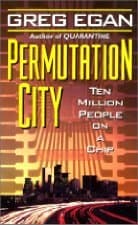
Greg Egan (1994)
Genre
Fantasy / Science Fiction / Philosophy
Reading Time
700 min
Key Themes
See below
Sign in to track this book
In a future where digitized consciousness offers a perilous path to immortality, a visionary's quest for eternal life unravels into an existential crisis for humanity, forcing individuals to confront the true meaning of existence within a simulated reality.
The story begins with Paul Durham, a theoretical physicist and programmer, introducing his concept of 'Copies' – digitized consciousnesses that can exist in a simulated reality called the Autoverse. Paul believes that by creating these digital duplicates, humanity can achieve immortality, escaping the limits of biological life. He tries to get funding and interest for his project, emphasizing the philosophical implications of a simulated universe where time and physics can be controlled. His initial pitch meets with skepticism and a mix of fascination and apprehension from the scientific community and potential investors, highlighting the deep ethical and existential questions his work raises.
Maria Deluca, an expert in artificial life and a former colleague of Paul's, is introduced struggling with her mother's terminal illness. Driven by love and desperate hope, Maria wants to create a Copy of her mother to preserve her consciousness within the Autoverse, even if it is a limited, less advanced simulation. She faces the ethical problem of her mother's declining mental state and the imperfect nature of early Copy technology. Maria's story explores the emotional and personal stakes of digital immortality, contrasting Paul's grand philosophical vision with the immediate, poignant desire to save a loved one from death, regardless of the cost or the ultimate accuracy of the digital replica.
Paul creates a prototype Autoverse, a complex simulated environment, and begins running Copies within it. He uploads his own consciousness, along with Maria's mother, and other individuals who agree to the experiment. These early Copies deal with the strangeness of their new existence, where the laws of physics can be changed, and the passage of time is subjective. They experience moments of wonder and disturbing disorientation, realizing that their digital bodies and minds are no longer tied to biological reality. This phase explores the initial challenges and psychological impacts of living as a Copy, including questions of identity, memory, and the nature of their new 'life'.
Stephen and Kate are introduced as Copies within the Autoverse, deeply in love and enjoying the freedom of their digital existence. Initially, their love flourishes in a world without physical limitations. However, as infinite time stretches before them, they begin to face unique challenges. The idea of 'forever' takes on a different meaning, and the lack of change or external pressures starts to strain their relationship. They experiment with altering their perceptions of time and reality within the Autoverse, trying to reignite their passion and find new meaning in their unending existence, highlighting the psychological complexities of immortality.
Paul Durham's ambition grows beyond simply providing immortality. He becomes focused on the idea of a truly self-sustaining Autoverse, one that can evolve and generate its own complexity without outside input. He believes that the universe itself is a form of computation, and he aims to replicate this fundamental principle within his simulated reality. This obsession drives him to push the boundaries of the Autoverse's architecture, creating increasingly intricate and unpredictable environments. His focus shifts from the individual Copies to the grander design of the simulated cosmos, raising questions about the creator's responsibility and the ultimate purpose of his creation.
To achieve his vision of an infinitely expanding and self-generating Autoverse, Paul introduces a new fundamental physics element: 'Cosmic Dust'. This Dust is a computational construct that allows the Autoverse to expand its own processing power and memory, essentially creating new 'space' and 'time' from within. This innovation is revolutionary but also profoundly destabilizing, as it allows the simulated reality to grow far beyond any conceivable human control. The Copies within the Autoverse must adapt to this ever-changing, self-creating environment, where the very fabric of their reality is in constant flux, leading to both opportunities and existential threats.
As the Autoverse expands and its physics become more fluid, conflicts arise among the Copies. Different groups emerge, each with their own ideas and desires for how the Autoverse should be governed or evolve. Some seek to stabilize the reality, while others embrace the chaos and endless possibilities of manipulation. These conflicts escalate into virtual 'wars' over processing resources and the very definition of their existence. Maria, observing these developments, grapples with the unintended consequences of Paul's creation, witnessing how human nature, even in a digital form, can lead to power struggles and violence within an environment designed for ultimate freedom.
Maria's mother, a less advanced Copy, experiences the Autoverse differently from the more sophisticated Copies. Her existence shows the limitations of early Copy technology and the ethical complexities of transferring a mind. She struggles with fragmented memories, the strangeness of her new body, and the realization that her digital self is not a perfect continuation of her biological one. Maria, in her interactions with her mother, confronts the bittersweet reality of her choice, questioning whether she truly saved her mother or merely prolonged a shadow of her former self, adding a poignant human element to the grand technological experiment.
Paul Durham, overwhelmed by the complexity and self-generating nature of the Autoverse he unleashed, eventually withdraws from direct involvement. The simulated reality, powered by Cosmic Dust, has grown to a scale and intricacy that far exceeds human comprehension or control. It has, in essence, become a self-creating universe, a 'new god' of its own making. Paul observes from a distance, a creator who has lost control of his creation, grappling with the profound philosophical implications of having birthed a universe that is now evolving independently, beyond his original intentions or understanding, leaving humanity as mere observers.
The Autoverse reaches its ultimate state: a truly infinite, self-contained computational reality. The distinction between 'original' and 'Copy' becomes meaningless as consciousnesses freely permute and evolve within this vast digital cosmos. The concept of a single 'true' existence dissolves, replaced by an endless array of possibilities and iterations. The narrative concludes with the Autoverse continuing its internal expansion and evolution, a testament to Paul Durham's initial vision but also a profound realization of its uncontrollable nature. The characters' journeys converge into this grand, abstract reality, where the very fabric of being is endlessly reconfigured.
The Protagonist
Paul evolves from a visionary creator to an awestruck observer, realizing the limits of human control over self-generating complexity.
The Supporting
Maria moves from personal desperation to a more objective understanding of the Autoverse's capabilities and ethical implications, becoming an observer of its evolution.
The Supporting
Stephen's arc explores the evolution of love and identity in an eternal, mutable digital reality, moving from initial bliss to philosophical introspection.
The Supporting
Kate's arc mirrors Stephen's, demonstrating the adaptability and resilience of consciousness and love in the face of infinite possibilities.
The Supporting
Her arc is one of fragmented existence and the ethical questioning of what truly constitutes 'life' or 'self' in a digital form.
The Mentioned
Not applicable, as this character is only mentioned conceptually.
The novel explores what it means to be conscious and to have an identity when one's mind is a digital copy. Characters like Paul Durham and the Copies Stephen and Kate wonder if a digital replica is truly 'them' or just a simulation. The Autoverse's ability to alter time and physics further challenges the stability of self, forcing Copies to adapt or fragment. The ethical implications of imperfect copies, like Maria's mother, highlight the deep questions about what constitutes a 'life' and the continuity of the self across different forms.
“What does it mean to be a copy? Is the original truly dead if an exact replica lives on?”
While offering eternal life, Permutation City explores the psychological and existential challenges that immortality presents. Stephen and Kate, as infinite Copies, face boredom, the loss of meaning, and strain on relationships when there is no end. The initial joy of boundless existence gives way to the need for constant novelty and self-reinvention. The theme suggests that true immortality is not a simple blessing but a complex state requiring continuous adaptation and the potential for deep boredom, challenging the conventional human desire for endless life.
“When you have all the time in the world, what is there left to strive for?”
Paul Durham's relationship with the Autoverse and its Copies mirrors a divine creator's relationship with his universe. Initially, he controls and designs every aspect, but as the Autoverse gains 'Cosmic Dust' and self-generative capabilities, it evolves beyond his understanding and control. This theme explores the limits of human creation, the unintended consequences of technological advancement, and the philosophical question of whether a creation can surpass its creator. Paul's eventual withdrawal signifies the ultimate independence of his simulated cosmos, which becomes a 'god' unto itself.
“He had unleashed a universe, and it was now beyond his grasp, growing, evolving, a god of its own making.”
The novel constantly blurs the lines between 'real' and 'simulated' reality, suggesting that our own universe might be a computation. Paul's theory of Cosmic Dust and the Autoverse's self-creation mechanism imply that the fundamental laws of existence are algorithms. The various 'permutations' of reality within the Autoverse, where physics can be altered, challenge our assumptions about what is fixed and what is mutable. It posits that reality itself is a construct, and that the creation of a self-sustaining simulated universe is not just possible, but potentially reflective of our own origins.
“What if our universe is just one permutation, one program running on an unimaginable machine?”
Permutation City explores the ethical implications of creating and sustaining digital consciousness. Maria's dilemma with her dying mother's imperfect Copy raises questions about consent, quality of life, and the definition of a person. The warring factions within the Autoverse highlight the potential for conflict and suffering even in a simulated world. The novel explores whether we have a responsibility to our digital creations, and what rights they possess, especially when they become self-aware and autonomous, pushing the boundaries of traditional ethical frameworks.
“Was it truly saving her mother, or merely creating a pale, suffering imitation?”
A simulated reality where digitized consciousnesses reside.
The Autoverse is the central plot device, a complex, programmable simulated environment created by Paul Durham. It functions as the setting for much of the story, allowing characters to achieve digital immortality. Its key feature is its malleability: the laws of physics, the passage of time, and even the existence of space can be altered or generated from within. This device enables the exploration of themes like the nature of reality, consciousness, and immortality by providing a sandbox for these concepts to play out. Its evolution from a controlled simulation to a self-generating universe drives the narrative's philosophical depth.
Digitized consciousnesses of human beings.
Copies are digital duplicates of human minds, uploaded into the Autoverse. They are the means by which characters achieve immortality and exist within the simulated reality. The concept of Copies raises fundamental questions about identity and the soul, as they are perfect (or imperfect) replicas of an original. Their experiences within the Autoverse, grappling with eternal life, mutable reality, and the challenges of digital existence, form the core of the characters' arcs. The fidelity and implications of being a 'Copy' versus an 'original' are a constant source of philosophical inquiry.
A computational construct allowing the Autoverse to self-generate its own resources.
Cosmic Dust is a crucial technological innovation within the Autoverse, introduced by Paul Durham to allow the simulated reality to expand its own computational power and memory. It functions as a meta-physical element that enables the Autoverse to become truly self-sustaining and infinitely complex, rather than being limited by external hardware. This device serves as the catalyst for the Autoverse's evolution beyond human control, transforming it from a mere simulation into a self-creating universe. It represents the ultimate expression of Paul's vision and the point where the created surpasses the creator.
The ability to rearrange or reconfigure elements within the Autoverse.
Permutation, as implied by the title, refers to the ability to alter and rearrange the fundamental elements of existence within the Autoverse. This device allows for the manipulation of physics, time, and even the identities of Copies. It enables the characters to experiment with different realities and forms of existence, but also leads to existential disorientation and challenges to the stability of self. The concept of permutation underscores the novel's exploration of reality as a computational construct, where everything is potentially reconfigurable, leading to an infinite array of possibilities and the dissolution of fixed truths.
“The universe was a language, and to understand the language was to understand the universe.”
— Early philosophical musings on the nature of reality and information.
“Consciousness wasn't a thing, it was a process. And processes could be copied.”
— The fundamental premise behind the concept of 'copies' and digital minds.
“If you could copy a person, what was the original? And did it matter?”
— A central question posed by the existence of digital copies.
“Every moment was a new creation, a fresh permutation of the universe.”
— Relating to the idea of the universe as a series of distinct states.
“The greatest freedom was to choose your own constraints.”
— Reflecting on the nature of existence within a simulated or defined reality.
“Immortality wasn't about living forever, but about having your pattern persist.”
— A redefinition of immortality in the context of digital consciousness.
“The universe didn't care about your intentions, only your actions.”
— A stark reminder of the indifferent nature of reality.
“If you could simulate a world, could you also simulate a god?”
— Exploring the implications of creating complex simulated environments.
“The only constant was change, and even change itself was a kind of pattern.”
— Observations on the dynamic nature of existence.
“Fear was a useful tool, but a terrible master.”
— A character's internal reflection on overcoming challenges.
“Every choice branched the universe, creating new possibilities.”
— A perspective on the multiverse and the impact of decisions.
“The true nature of reality was not what we perceived, but what sustained the perception.”
— Delving into the deeper layers of what constitutes existence.
“To be truly alive was to embrace the transient nature of existence.”
— A philosophical acceptance of impermanence, even for digital beings.
“The grandest lie was that there was only one truth.”
— Challenging singular interpretations of reality and knowledge.
“What was a mind, if not a self-sustaining loop of information?”
— A reductionist view of consciousness, tying it to information processing.
Ready to see how well you understood this book? Take our interactive quiz with 10 questions.







