“If my life is going to mean anything, I have to live it myself.”
— Percy reflecting on his destiny and independence.

Rick Riordan (2008)
Genre
Fantasy / Children's / Young Adult
Reading Time
1200 min
Key Themes
See below
Sign in to track this book
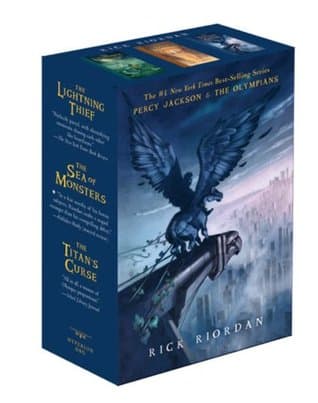
A young demigod discovers his Olympian heritage and goes on dangerous quests, fighting mythological monsters and stopping divine wars while dealing with adolescence and ancient prophecies.
Percy Jackson, a troubled twelve-year-old with ADHD and dyslexia, has a life-changing field trip to the Metropolitan Museum of Art. His pre-algebra teacher, Mrs. Dodds, turns into a Fury and attacks him. His Latin teacher, Mr. Brunner, vaporizes her with a pen that turns into a sword. Everyone else quickly dismisses this strange event as a hallucination. After an incident with a minotaur that seemingly kills his mother, Sally Jackson, Percy arrives at Camp Half-Blood, a secret training ground for demigods. There, he learns his father is Poseidon, making him a powerful demigod and a target. He also meets Annabeth Chase, a daughter of Athena, and Grover Underwood, a satyr who was his protector. News arrives that Zeus's master bolt has been stolen, and Percy is immediately suspected because of who his father is. To stop a war between the gods, Percy goes on a quest with Annabeth and Grover to find the bolt and the real thief.
Percy, Annabeth, and Grover start their quest, traveling across the United States. Their journey is dangerous, as they meet various mythological creatures and figures. They face Medusa, battle the Chimera, and navigate the Lotus Hotel and Casino, which traps visitors in an endless time loop. Along the way, Percy struggles with being accused of stealing the master bolt and the growing understanding of the immense power he has as a son of Poseidon. They eventually go to the Underworld, believing Hades is the thief. Their encounters show that someone else is controlling events, and the real culprit remains hidden, leading them to question the gods' reasons.
In the Underworld, Percy confronts Hades, who says his Helm of Darkness has also been stolen. It becomes clear that a third party is causing the conflict. Percy realizes the master bolt is hidden in a backpack Ares gave him. After escaping the Underworld, Percy confronts Ares, the God of War, on a beach in Santa Monica. Percy defeats Ares in a dramatic duel, getting both the master bolt and Hades's helm. He returns the bolt to Zeus on Mount Olympus and the helm to Hades, stopping a war between the gods. However, the real person behind the theft is Luke Castellan, a son of Hermes and a senior camper at Camp Half-Blood, who serves the Titan Lord Kronos. Luke injures Percy with a poisoned scorpion, setting up future conflicts.
Percy's seventh-grade year is quiet until a game of dodgeball turns into a monster attack, showing that Camp Half-Blood's magical borders are failing. Thalia's pine tree, which provides the camp's magical barrier, has been poisoned. Chiron, the camp director, is fired, replaced by Tantalus, a cursed spirit from the Underworld. The only cure for the tree and the camp's borders is the Golden Fleece, located in the Sea of Monsters (the Bermuda Triangle). A prophecy says that a child of the Big Three will either save Olympus or destroy it. Clarisse La Rue, a daughter of Ares, is given the official quest, but Percy, with Annabeth and his Cyclops half-brother Tyson, secretly go on their own mission to get the Fleece and save Grover, who was captured by the Cyclops Polyphemus while looking for Pan.
Percy, Annabeth, and Tyson sail into the Sea of Monsters on the Princess Andromeda, a cruise ship that turns out to be Luke's headquarters. They escape, eventually finding a ride on a Confederate ironclad with zombies, and later, a ship with Circe, who temporarily turns Percy into a guinea pig. They face dangers, including the Sirens, Scylla and Charybdis, and the dangerous waters. Along the way, Percy struggles with accepting Tyson as his brother and the prophecy that hangs over him. Annabeth reveals more about her past and her complicated relationship with Luke. Their drive to save Camp Half-Blood and Grover moves them forward despite the difficulties and personal conflicts.
The trio eventually reaches Polyphemus's island, where Grover is held captive, disguised as a female Cyclops. They find Clarisse, who has failed her quest and is also captured. Working together, Percy, Annabeth, Tyson, and Clarisse outwit Polyphemus, rescue Grover and Clarisse, and get the Golden Fleece. Tyson shows his bravery and loyalty during the escape, strengthening his bond with Percy. They escape the island and head back to Camp Half-Blood with the Fleece. The journey back is still dangerous, but the Fleece's healing powers start to work, offering hope for the poisoned tree.
When they return to Camp Half-Blood, the Golden Fleece is placed on Thalia's pine tree. Its strong magic heals the tree and revives Thalia Grace, Zeus's daughter who had been turned into the tree years ago to protect the camp. This event has big implications for the Great Prophecy, as there are now two children of the Big Three (Percy and Thalia) alive, increasing the stakes for Olympus's future. Luke, however, escapes and continues to gather his forces for Kronos. The camp is safe for now, but Thalia's return signals that the prophecy is speeding up, and the war against the Titans is coming, making Percy's role more important.
Percy, Annabeth, and Thalia answer a distress call from Grover, who has found two powerful demigods, Bianca and Nico di Angelo, at Westover Hall, a boarding school. They arrive to find the siblings in danger from a Manticore named Dr. Thorn. During the battle, Annabeth is badly hurt and falls off a cliff, seemingly to her death. The goddess Artemis and her Hunters arrive, saving Percy, Thalia, Grover, and the di Angelos. Artemis, however, is captured by Dr. Thorn, who works for Luke and Kronos. The Hunters take Bianca di Angelo into their group, while Nico is left at Camp Half-Blood, unaware of who his parents are or the dangers ahead.
Zoe Nightshade, Artemis's first lieutenant, gets a prophecy from the Oracle of Delphi about rescuing Artemis: 'Five shall go west to the goddess in chains, / One shall be lost in the land without rain, / The bane of Olympus shows the trail, / Campers and Hunters combined prevail, / The Titan's curse must one withstand, / And one shall perish by a parent's hand.' Despite being told not to, Percy joins the quest to find Annabeth, believing she is alive. The quest party has Zoe, Thalia, Grover, and Bianca. They go on a dangerous cross-country journey, facing mythological creatures and the hard realities of their quest, all while the prophecy's words weigh on their minds.
The quest party travels across the country, meeting various mythological figures and monsters. They battle the Nemean Lion, get help from Apollo, and navigate the Junkyard of the Gods, where Bianca sacrifices herself to defeat a giant automaton. They reach Hoover Dam, where they encounter the Ophiotaurus, a sea cow whose sacrifice could give the power to destroy Olympus, and Percy promises to protect it. They also meet Rachel Elizabeth Dare, a mortal who can see through the Mist. Throughout their journey, the group deals with the prophecy's meaning and the pressure of their mission, while Percy secretly tries to find Annabeth.
The quest party eventually arrives at the Garden of the Hesperides, where they find Artemis is being forced to hold up the sky by the Titan General Atlas. Annabeth is also there, captured and forced to watch Atlas's torment. Percy takes the sky from Artemis to let her fight Atlas, feeling great pain from the weight of the heavens. In a fierce battle, Thalia fights Luke, and Zoe confronts her father, Atlas. Zoe is badly wounded by Atlas. Before she dies, Artemis turns her into a constellation, honoring her bravery and sacrifice. The Ophiotaurus is given to Grover, who hides it in the Labyrinth.
The heroes return to Mount Olympus, where the gods hold a war council. They report on their quest and the growing threat of Kronos. Zeus decides not to destroy the Ophiotaurus, recognizing its power could be misused. Thalia, fearing the prophecy, joins the Hunters of Artemis, removing herself as a potential child of the prophecy. Back at Camp Half-Blood, Nico di Angelo, grieving Bianca's death and blaming Percy, accidentally shows his ability to summon the dead, revealing he is a son of Hades. This shocking revelation means there are now three children of the Big Three alive (Percy, Thalia, and Nico), making the Great Prophecy more important and the war against Kronos closer.
The Protagonist
Percy transforms from a confused outsider into a confident demigod hero, accepting his identity and embracing his destiny while struggling with the weight of the Great Prophecy.
The Supporting
Annabeth grows from a somewhat guarded and ambitious demigod into a more trusting and emotionally open friend, confronting her past and her feelings for Luke.
The Supporting
Grover evolves from a timid protector into a more confident and determined satyr, actively pursuing his dream to find Pan and proving his courage in dangerous situations.
The Antagonist
Luke's arc is one of descent into villainy, as his bitterness and desire for change lead him to fully embrace Kronos's cause, becoming a primary antagonist.
The Supporting
Chiron remains a consistent source of wisdom and guidance, adapting to new threats while maintaining his role as a protector and educator.
The Supporting
Tyson grows in confidence and self-acceptance, proving his worth and solidifying his bond with Percy as a trusted and powerful ally.
The Supporting
Thalia is resurrected and grapples with her past and destiny, ultimately choosing to join the Hunters of Artemis to avoid the prophecy's burden.
The Supporting
Nico transforms from an innocent child to a grieving, vengeful demigod, struggling with his powers and the loss of his sister, and ultimately accepting his heritage as a son of Hades.
The Supporting
Artemis's arc in these books primarily involves her capture and rescue, showcasing her vulnerability and the loyalty of her Hunters.
The Supporting
Zoe's arc is one of sacrifice, as she bravely leads the quest to rescue Artemis and ultimately perishes, achieving a heroic end.
The series explores Percy's journey to understand and accept his identity as a demigod, son of Poseidon. He struggles with feeling like an outsider in the mortal world and then finding his place among other demigods at Camp Half-Blood. This theme extends to other characters like Annabeth, who wants to prove her worth as a daughter of Athena, and Tyson, who struggles with being accepted as a Cyclops. Realizing his divine parentage forces Percy to confront who he is and what his destiny involves, leading to personal growth and a deeper understanding of his strengths and weaknesses.
“You are a demigod. You are the son of Poseidon.”
Family is a central theme, including both birth and chosen bonds. Percy's relationship with his mortal mother, Sally, is important, showing the strength of human love. His discovery of his divine father, Poseidon, and later his Cyclops half-brother, Tyson, expands his understanding of family. The community at Camp Half-Blood represents a chosen family for many demigods who feel alienated from their mortal relatives. The loyalty among Percy, Annabeth, and Grover shows this chosen family, as they consistently risk their lives for each other. Even the dysfunctional Olympian gods show the complexities of family dynamics.
“Families are messy. Immortal families are eternally messy. Sometimes the best way to help is to just be there.”
Loyalty is a very important trait for demigods, tested throughout the series. Percy's strong loyalty to his friends, especially Annabeth and Grover, drives many of his actions and quests, even when it means going against the gods. Betrayal is a repeated idea, most notably with Luke Castellan, whose anger towards the gods leads him to betray Camp Half-Blood and join Kronos. This theme explores the results of broken trust and the deep emotional scars left by deceit, showing how important it is to choose allies carefully in a world where loyalties constantly change.
“Even strength has to bow to loyalty sometimes. My friends, you see, are my power.”
The Great Prophecy, which says a child of the Big Three will make a choice that will either save or destroy Olympus, greatly influences the characters' lives. Percy, Thalia, and later Nico, deal with the weight of this destiny. The series questions whether their actions are set or if they have free will to make their own paths. Characters like Luke believe they are breaking free from their set roles as pawns of the gods, while Percy often chooses to go against prophecies and act based on his own moral compass, suggesting that choices, not fate, ultimately shape character and future.
“The prophecy said a child of the Big Three would make a choice. It didn't say it had to be me.”
The series looks at the complexities of good and evil, often blurring the lines between heroes and villains. While Kronos is clearly an antagonist, characters like Luke are shown with complex reasons, driven by a legitimate feeling of injustice and neglect from the gods. The Olympians themselves are not always shown as purely good, often acting petty, selfish, or uncaring. This theme encourages readers to look past simple labels, question authority, and understand that even 'evil' can come from understandable complaints, making the protagonists' moral choices more challenging and meaningful.
“The gods aren't perfect, Percy. They're just like us, only more powerful.”
A magical veil concealing the mythological world from mortals.
The Mist is a magical force that obscures the true nature of mythological creatures, gods, and events from the eyes of mortals. It makes monsters appear as mundane objects or people, and it causes mortals to rationalize fantastical occurrences. For example, a battle with a Minotaur might appear as a car crash to a mortal. This device allows the mythological world to coexist secretly with the modern world, creating a sense of wonder and danger for Percy, who can see through it. It also highlights the isolation of demigods, who live between two realities, and provides a constant challenge for them to navigate the mortal world without exposing their true identities.
A central prophecy dictating the fate of Olympus.
The Great Prophecy is a pivotal plot device foretelling that a child of the 'Big Three' (Zeus, Poseidon, Hades) will reach sixteen years old and make a decision that will either save or destroy Olympus. This prophecy creates immense tension and drives much of the overarching plot across the series, especially as Percy, Thalia, and later Nico, are all identified as potential children of the Big Three. It places an enormous burden on the protagonists and fuels the gods' paranoia and infighting. The prophecy's ambiguity and the characters' attempts to interpret or defy it are central to their development and the unfolding conflict with Kronos.
Structured journeys undertaken by demigods to achieve a specific goal.
Quests are the primary narrative structure of the Percy Jackson series. Each book features Percy and his friends embarking on a perilous journey to accomplish a specific goal, usually involving retrieving a powerful artifact or rescuing someone. These quests are often sanctioned by the Oracle of Delphi and involve specific prophecies or instructions. They serve as a mechanism to introduce new mythological creatures, gods, and locations, allowing Percy to develop his powers and relationships. The challenges faced during quests force the characters to grow, make difficult decisions, and confront their fears, pushing the plot forward through a series of escalating adventures.
A magical weapon disguised as a seemingly mundane object.
Percy's sword, Riptide (Anaklusmos), is a celestial bronze sword that appears as a simple ballpoint pen in its disguised form. When uncapped, it transforms into a powerful sword, and when dropped, it always reappears in Percy's pocket. This device symbolizes the hidden power within Percy and the constant presence of the mythological world in his life. It also serves as a practical tool, allowing him to carry a powerful weapon discreetly. The pen-to-sword transformation is a recurring visual motif that underscores the sudden shifts from mundane to magical in Percy's world and his readiness for battle at a moment's notice.
Integrating ancient Greek myths into a contemporary American landscape.
This series ingeniously blends classic Greek mythology with modern American culture and geography. Famous mythological figures, monsters, and locations are recontextualized into contemporary settings: the Underworld is beneath Hollywood, Mount Olympus is atop the Empire State Building, and the Sea of Monsters is the Bermuda Triangle. This device makes ancient myths accessible and exciting for a modern audience, creating a unique and engaging world. It adds humor and relatability while also highlighting the timelessness of these stories and their continued relevance in the modern world, making the fantastical feel grounded in reality.
“If my life is going to mean anything, I have to live it myself.”
— Percy reflecting on his destiny and independence.
“Even strength must bow to wisdom sometimes.”
— Annabeth advising Percy on strategy.
“The real world is where the monsters are.”
— Chiron explaining the nature of demigod life.
“Families are messy. Immortal families are eternally messy.”
— Percy observing the gods' dysfunctional relationships.
“With great power... comes great need to take a nap. Wake me up later.”
— Nico di Angelo after a taxing use of his powers.
“You deal with mythological stuff for a few years, you learn that paradises are usually places where you get killed.”
— Percy being cynical about seemingly perfect situations.
“Knowing too much of your future is never a good thing.”
— Chiron warning about the dangers of prophecies.
“The sea does not like to be restrained.”
— Percy describing his connection to water and freedom.
“I'm not going to die for you. I'm going to live for you.”
— Percy to Annabeth, emphasizing survival and love.
“Even monsters have a story.”
— Percy showing empathy towards mythical creatures.
“A true hero isn't measured by the size of his strength, but by the strength of his heart.”
— Zeus (or Hermes) imparting a lesson on heroism.
“Sometimes mortals can be more horrible than monsters.”
— Annabeth commenting on human cruelty.
“The most dangerous flaws are those which are good in moderation.”
— Chiron discussing fatal flaws of heroes.
“I'd rather fight a hundred monsters than face my stepdad.”
— Percy comparing mythological threats to personal struggles.
Ready to see how well you understood this book? Take our interactive quiz with 10 questions.
Biography coming soon.







