“Every book has a soul, Sera, and the soul of this one is in the ink, not the paper.”
— Hanna Heath's mother explaining the significance of the Haggadah's physical elements.

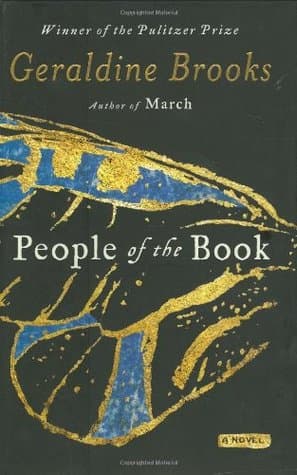
Geraldine Brooks (1991)
Genre
Historical Fiction / Spirituality / Mystery
Reading Time
620 min
Key Themes
See below
Sign in to track this book
A rare-book conservator uncovers centuries of human drama, sacrifice, and artistic wonder hidden within an ancient illuminated manuscript, tracing its journey through inquisitions, wars, and the people who risked everything to preserve its beauty and secrets.
In 1996, Hanna Heath, an Australian book conservator, is hired to analyze and restore the Sarajevo Haggadah, a rare 15th-century Jewish manuscript recently saved from destruction during the Bosnian War. Working in a lab in Sarajevo, Hanna examines the book carefully. As she cleans and repairs the ancient pages and binding, she finds several tiny artifacts embedded within the book's structure: a white human hair, salt crystals, a wine stain, an insect wing, and a piece of a child's button. These items make Hanna curious, leading her to believe each artifact holds a clue to the Haggadah's long past. Her initial findings suggest a richer and more dramatic history than previously known, making her look deeper into the manuscript's origins and journey.
The story moves to Sarajevo in 1940, during World War II. Derviš Kadić, the chief librarian of the National Museum, has the Sarajevo Haggadah. As the city is occupied by Nazis, Derviš, a Muslim, is ordered by Colonel von Schwieger to hand over all valuable Jewish artifacts. Instead, Derviš, with his assistant, secretly substitutes a less valuable manuscript and smuggles the real Haggadah out of the museum. He takes it to a remote Muslim village mosque, where the Imam, a friend, agrees to hide it. Derviš's act of defiance against the occupying forces shows interfaith solidarity in protecting cultural heritage during a time of danger and persecution, ensuring the Haggadah's survival.
The story goes back to Vienna in 1894. The Haggadah is with the wealthy Reinman family, assimilated Jews facing rising anti-Semitism. Lola Reinman, a young woman, sees her family's declining fortunes and social standing. Her father, an art collector, has to sell parts of his collection to keep up appearances. When their financial situation gets bad, he uses the Sarajevo Haggadah as collateral for a loan from a wealthy physician, Dr. Anton Gorjan. This deal is full of tension, as Lola feels her family's heritage is being sold and endangered. The white hair Hanna found later belongs to Lola, shed during an emotional moment with the book.
In Venice, 1609, the Catholic Church's Inquisition is active, checking and often burning Jewish texts seen as offensive. Father Vistorini, a censor for the Holy Office, is tasked with examining the Sarajevo Haggadah. Despite his duty to identify and destroy forbidden books, Vistorini is drawn to the manuscript's beauty and art. He finds a small insect wing, later identified by Hanna as a butterfly wing, pressed between its pages. Recognizing its cultural and artistic value, and perhaps moved by justice or aesthetic appreciation, Vistorini purposely leaves the Haggadah off the list of books to be burned, saving it from destruction and allowing its journey to continue.
The story moves to Tarragona, Spain, in 1492, during the Spanish Inquisition and the expulsion of Jews. Benjamín, the Jewish scribe who wrote the text of the Sarajevo Haggadah, is a young man who loves his family and his work. He sees the decree that expels all Jews from Spain. As his family prepares for a dangerous journey into exile, they hold a final Passover Seder, using the Haggadah. The salt crystals Hanna discovered are linked to the tears shed by Benjamín or his family during this traumatic period. The experience affects Benjamín, giving the Haggadah the sorrow and resilience of his people's forced displacement.
Further back in time, Seville, 1480, shows the creation of the Haggadah's illuminations. Hannah, a young Jewish woman, is the artist responsible for the book's unique illustrations. Unconventionally for the time, she includes subtle Christian iconography and even a self-portrait into the Jewish text, mixing cultural influences. The wine stain Hanna found on the book is later from Hannah's Seder, where she felt a deep connection to her work and heritage. This section explores the artistic process and the personal reasons behind the Haggadah's visual elements, revealing Hannah's secret defiance and artistic vision in a restrictive society.
Back in 1996, Hanna's research and discovery of the artifacts start to challenge established historical theories about the Haggadah. Her findings are met with skepticism and even hostility from some in the academic community, especially from Professor Ozren Karaman, a Bosnian historian who initially dismisses her interpretations. However, a romantic tension develops between Hanna and Karaman, mixing their professional disagreements and personal connection. Hanna's dedication to the truth makes her continue her investigation, despite the resistance, slowly putting together the fragmented story of the book's journey through time and cultures.
Hanna's investigation reveals that the child's button found in the binding is modern, leading her to suspect a recent alteration or forgery. Her inquiries uncover a network of art forgers and ultra-nationalist groups who tried to manipulate the Haggadah's history for political gain during the Bosnian War. These groups want to claim the Haggadah as exclusively their own, erasing its multi-cultural past. Hanna realizes that the book's survival is not only historical preservation but also a contemporary fight against those who would twist its narrative for divisive purposes. She finds herself in increasing danger as she gets closer to exposing the truth about the recent tampering.
As Hanna and Karaman manage their personal relationship, they also find common ground in their shared interest in the Haggadah. Karaman, initially resistant, eventually appreciates Hanna's forensic approach and the insights she brings. Together, they put together the full, complex history of the manuscript, acknowledging its diverse caretakers and the many cultures that have touched it. They confirm the modern forgery was an attempt to hide the book's true journey and its symbolism of shared heritage. Their collaboration shows a reconciliation of different perspectives and a unified effort to protect the Haggadah's integrity against those who wish to exploit it.
Hanna successfully completes the conservation of the Sarajevo Haggadah, stabilizing its fragile pages and binding. Her work not only physically preserves the book but also fully restores its historical narrative, revealing its journey through centuries of Jewish, Muslim, and Christian hands. The Haggadah is eventually returned to the National Museum in Sarajevo, now celebrated not just as a Jewish artifact, but as a symbol of shared human history, resilience, and the power of art to overcome conflict. Hanna, having found professional fulfillment and personal love with Karaman, thinks about the impact the book has had on her own life, leaving her with a new sense of purpose and connection.
The Protagonist
From a caustic loner, Hanna learns to trust and open herself to love and collaboration, finding personal fulfillment alongside professional success.
The Supporting
Initially resistant to new interpretations, he evolves to embrace a more nuanced understanding of history and finds love with Hanna.
The Supporting
He demonstrates unwavering courage in protecting the Haggadah, solidifying its survival during a critical historical period.
The Supporting
She experiences the decline of her family's fortunes and the threat of rising anti-Semitism, forming a deep, personal connection to the Haggadah.
The Supporting
He uses his position to protect the Haggadah, prioritizing its artistic and cultural value over the demands of the Inquisition.
The Supporting
He endures the devastation of the Spanish Inquisition and the expulsion of his people, leaving an indelible mark of suffering and hope on the Haggadah.
The Supporting
As a pioneering female artist, she imbues the Haggadah with unique, personal illuminations, subtly challenging cultural norms.
The Mentioned
His actions underscore the precariousness of the Haggadah's ownership and the social pressures faced by Jewish families in Vienna.
The Mentioned
Represents the destructive force that the Haggadah must be protected from.
The main theme is the human effort to preserve cultural artifacts and knowledge against destruction, persecution, and neglect. The Sarajevo Haggadah itself is the symbol of this theme, saved by individuals across centuries and diverse faiths—a Muslim librarian from Nazis, a Catholic priest from the Inquisition, and finally, Hanna Heath from decay. Each 'savior' understands the book's value beyond its religious context, seeing it as human artistry, history, and resilience. This theme shows that cultural heritage belongs to all humanity, not just one group.
“''It is not a Jewish book, Derviš. It is a book of mankind. It belongs to us all.'”
The book explores the relationship between different faiths, especially Judaism, Islam, and Christianity, throughout history. While detailing periods of conflict and persecution (the Spanish Inquisition, WWII), it also shows acts of interfaith solidarity. A Muslim librarian hides the Haggadah from Nazis; a Catholic priest saves it from burning. The Haggadah itself, with its subtle Christian iconography illuminated by a Jewish artist, embodies this mix. The story suggests that despite historical divides, there is a shared humanity and a capacity for mutual respect and protection of shared heritage.
“'Every single one of us, in some way, has been a 'person of the book.'”
Characters deal with their individual and group identities as history changes things. Hanna Heath, initially a loner, finds belonging through her work and her connection to the Haggadah's story. The Jewish characters, like Benjamín and Lola Reinman, face their identity amid persecution and forced exile, finding comfort and strength in their heritage symbolized by the book. The Haggadah itself, a Jewish text touched by Muslim and Christian hands, reflects a fluid, shared identity that goes beyond narrow definitions, challenging the idea of exclusive ownership and creating a broader sense of human connection.
“'The book had been a witness to so much, and now it was telling its story, not just of a people, but of all people who had touched it.'”
The novel itself shows how stories and history connect past and present. Hanna's investigation is a process of 'reading' the book's physical history, each artifact a clue to a narrative. The individual historical vignettes are stories within the larger story, showing how objects carry the memories and experiences of those who touched them. The book argues that understanding history, even its painful parts, is important for understanding the present and shaping the future, and that objects can be powerful ways to tell these stories.
“'Every object has a story, a memory embedded in its fibres. You just have to know how to listen.'”
Art, especially the illuminations of the Haggadah, is a way to resist and express oneself. Hannah, the illuminator, subtly includes Christian imagery and her own likeness into the Jewish text, defying conventions and expressing a unique artistic vision. Her art goes beyond religious boundaries and speaks to a universal human experience. In later periods, preserving the Haggadah itself becomes an act of resistance against those who try to destroy or suppress culture. The book emphasizes art's ability to communicate across generations and cultures, offering beauty and meaning even in times of adversity.
“'Perhaps all art is an act of defiance, a way to make something beautiful and lasting in the face of what is ugly and transient.'”
Hanna's scientific analysis of the book's physical components to uncover its history.
Hanna Heath's meticulous work as a book conservator acts as a primary plot device. By examining minute physical details—a white hair, salt crystals, a wine stain, an insect wing, a button—she uncovers clues that unlock the Haggadah's various historical chapters. This 'forensic' approach grounds the fantastical journey in tangible evidence, making the historical shifts feel credible and interconnected. It allows the narrative to move seamlessly between time periods, with each artifact serving as a bridge to a specific moment in the book's past and the characters who touched it.
Alternating between Hanna's present-day investigation and the Haggadah's historical journey.
The novel employs a dual timeline structure, alternating between Hanna Heath's present-day conservation work in 1996 Sarajevo and various historical vignettes tracing the Haggadah's journey backward through time. Each artifact Hanna discovers in the binding triggers a new historical chapter, creating a compelling mystery that unfolds both forward (Hanna's personal and professional discoveries) and backward (the book's origin story). This structure builds suspense and allows for a rich exploration of history and character, revealing the Haggadah's full, complex narrative piece by piece.
The rare illuminated manuscript acts as the central 'character' and unifying symbol.
The Sarajevo Haggadah itself functions almost as a character, silently witnessing centuries of human history, conflict, and connection. It is the tangible link between all the disparate timelines and characters, embodying resilience, cultural survival, and the shared heritage of humanity. Its physical journey and the stories embedded within its binding are the driving force of the entire narrative. As Hanna uncovers its past, the book becomes a symbol of hope, the power of art, and the enduring human spirit against forces of destruction and intolerance.
Small physical clues embedded in the book's binding that trigger historical flashbacks.
The tiny artifacts Hanna Heath discovers within the Haggadah's binding—a white human hair, salt crystals, a wine stain, an insect wing, and a child's button—are crucial plot devices. Each artifact serves as a literal and metaphorical 'bookmark' to a specific historical period and character. They are the tangible evidence that allows Hanna to reconstruct the book's journey and provides the narrative's structure for shifting between timelines. These seemingly insignificant details become powerful symbols of human connection, emotion, and historical events, making the past feel intimately tangible.
“Every book has a soul, Sera, and the soul of this one is in the ink, not the paper.”
— Hanna Heath's mother explaining the significance of the Haggadah's physical elements.
“The greatest gift a parent can give a child is to allow them to be themselves.”
— Through the story of Lola, a Jewish woman in Sarajevo protecting the Haggadah.
“History is not what happened, but what survived.”
— A recurring theme as Hanna reconstructs the Haggadah's journey.
“What is a life, if not a series of choices, each one leading to the next?”
— Reflecting on the various individuals who guarded the Haggadah through centuries.
“Sometimes, the most precious things are hidden in plain sight.”
— Referring to the tiny artifacts found within the Haggadah's binding.
“The past is never dead. It's not even past.”
— The echoes of historical events impacting contemporary characters.
“To be human is to be flawed, to be beautiful in our imperfections.”
— Exploring the motivations and struggles of the various protectors of the book.
“A book is a world, and to enter it is to be transformed.”
— Hanna's deep immersion in the history and mysteries of the Haggadah.
“Fear is a powerful master, but love is even more so.”
— Examining acts of bravery and sacrifice made for the Haggadah and its people.
“Every object holds a story, if only we know how to listen.”
— Hanna's work as a conservator, analyzing the physical traces on the ancient book.
“The greatest miracles are often the quietest ones.”
— The Haggadah's improbable survival through centuries of conflict.
“Sometimes, the only way to save something is to let it go.”
— Reflecting on the necessity of passing the Haggadah from one guardian to the next.
“Truth is not always found in the grand narratives, but in the small, forgotten details.”
— Hanna's meticulous examination of the Haggadah's physical anomalies.
“The human spirit, like a flame, can endure the darkest storms.”
— The perseverance of the Jewish people and the book's guardians through persecution.
Ready to see how well you understood this book? Take our interactive quiz with 10 questions.

Biography coming soon.







