“A penny for Hitler? No, pennies for Hitler. That's what they said. They wanted to send him pennies to help the war.”
— Georg's confusion about the phrase used by other children to mock him as a German refugee.

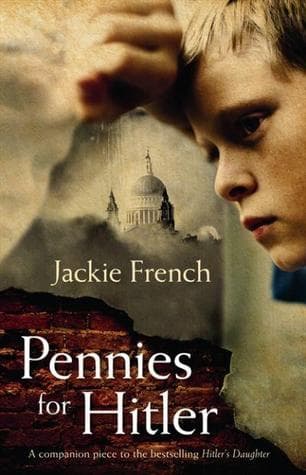
Jackie French (2012)
Genre
Children's / Historical Fiction / Young Adult
Reading Time
420 min
Key Themes
See below
Sign in to track this book
From cream cakes in Nazi Germany to rationing in wartime London and the unknown of Australia, a young boy's journey through WWII reveals how kindness can be as contagious as hatred.
In 1939, six-year-old Georg lives a privileged life in Germany with his English academic father and German mother. He attends school, where a teacher, Herr Professor Doktor Major Schneider, measures the children's heads to determine 'Aryan' traits, a concept Georg finds confusing. His best friend is Wolfgang, whose family are ardent Nazis. Georg's parents shield him from the worst realities, but he observes the increasing presence of Nazi ideology, such as the swastika flag and the 'Heil Hitler' salute. He enjoys cream cakes and playing, mostly unaware of the rising political tensions that are beginning to fracture society, though he senses an underlying unease from his parents.
Georg's stable world crumbles when his parents reveal a secret: his father is not his biological father. His biological father was Jewish, and his mother married his English father to protect him. The family realizes they are no longer safe in Germany, especially after a university graduation ceremony turns into a violent pro-Nazi demonstration where Georg's father, an outspoken critic, is targeted. With immediate danger, Georg is quickly packed off, first to a safe house, then smuggled out of Germany by train, a bewildering and frightening experience for the young boy who doesn't fully grasp the reasons for his sudden departure.
Georg arrives in London, a city already bracing for war. He is taken in by Mrs. Evans, a kind, elderly woman who lives with her daughter, Elizabeth. Georg struggles to adapt to the new language and customs, and the constant threat of air raids and the Blitz is terrifying. He experiences the reality of war firsthand, hearing bombs fall and seeing the destruction. Despite the danger, Mrs. Evans and Elizabeth provide him with a sense of safety and family, teaching him English and helping him adjust. He learns to count pennies, a new currency, symbolizing his new life.
As the war intensifies in London, Georg is deemed safer in Australia. He is placed on a ship, the 'Duntroon,' filled with other child evacuees, for the long and dangerous journey across enemy-infested seas. The voyage is challenging, marked by crowded conditions, seasickness, and the constant fear of U-boat attacks. Georg befriends another boy, Paul, and together they navigate the ship's routines and the emotional toll of leaving everything behind. He carries with him memories of Germany and the longing for his parents, unsure if he will ever see them again.
Upon arrival in Sydney, Georg is taken to a rural property in the Australian bush, a stark contrast to his European upbringing. He is placed with the Dunkel family, consisting of the stern but ultimately caring Mrs. Dunkel, her younger children, and the older, more understanding Mr. Dunkel. The family runs a farm, and Georg is expected to help with chores, something entirely new to him. He struggles with the heat, the unfamiliar surroundings, and the different way of life, feeling like an outsider and often misunderstood. The Dunkels, though initially distant, gradually begin to accept him.
Georg slowly begins to adapt to his new life. He learns to milk cows, gather eggs, and ride horses. He befriends the Dunkel children, particularly the youngest, Sally, who is fascinated by his stories of Germany. He attends the local one-room schoolhouse, where he faces some initial teasing for his accent but soon finds acceptance. He forms a close bond with his teacher, Miss Penny, who encourages his learning and helps him overcome his insecurities. He also learns about the local Aboriginal culture from some of the farmhands, broadening his understanding of the world.
Despite the distance, the war continues to cast a long shadow. Georg constantly worries about his parents and feels a deep sense of guilt and confusion about his German heritage. He is aware that Germany is the enemy, and he fears that if his true background is discovered, he will be ostracized or worse. He tries to suppress his memories and language, striving to become 'Australian.' This internal conflict over his identity is a significant struggle, as he tries to reconcile his past with his present, often feeling like he doesn't truly belong anywhere.
Georg and the Dunkels visit a nearby internment camp where German and Italian immigrants are held, regardless of their political leanings. This visit is a stark reminder of the prejudice and suspicion directed towards anyone with enemy ties. He encounters a German man, Karl, who shares stories of his homeland, stirring conflicting emotions in Georg. This experience strengthens Georg's decision to fully embrace his new identity. He decides to change his name from Georg to George, a symbolic act of severing ties with his German past and committing to his new Australian life, believing it is essential for his survival and acceptance.
As the war continues, George grows older and more integrated into the Dunkel family and the community. He works hard on the farm, proving his worth and earning respect. He learns resilience and self-reliance, qualities forged by his journey. He and the Dunkels contribute to the war effort in small ways, such as collecting scrap metal. He forms lasting friendships and begins to feel a true sense of belonging in Australia, the place that has offered him refuge and a new beginning. He still thinks of his parents, but the acute pain of separation begins to lessen with time and the comfort of his new life.
The war eventually ends, bringing relief but also uncertainty. George, now older, hears news of Germany's defeat and the atrocities committed by the Nazis. He grapples with the implications of his heritage and the immense suffering. While the war's end means an end to the immediate danger, it also brings the daunting prospect of what comes next. There is a faint hope that he might one day reunite with his parents, but he knows that even if they survived, their lives, like his, would be irrevocably changed. He has found a home and a family in Australia, and this new identity is now firmly his own.
The Protagonist
Transforms from a sheltered German boy into a resilient Australian farmhand, shedding his past identity to survive and find belonging.
The Supporting
Her character is largely static, defined by her initial sacrifice and unwavering love for Georg.
The Supporting
His character is defined by his initial protective actions and intellectual resistance.
The Supporting
Provides temporary comfort and security for Georg, demonstrating the kindness of strangers.
The Supporting
Softens from a stern guardian to a loving foster mother, embodying quiet acceptance.
The Supporting
Provides a consistent, supportive presence for Georg, helping him adapt to farm life.
The Supporting
Remains a consistent, accepting friend to Georg throughout his time in Australia.
The Supporting
Serves as a consistent source of intellectual and emotional support for Georg.
The Mentioned
Remains in Germany, representing Georg's lost past and the path he avoided.
Georg's journey is about defining himself. Forced to abandon his German identity, language, and name ('Georg' to 'George'), he struggles with who he is in a world that views his heritage with suspicion. He learns that identity is not solely tied to birth but also to experiences, choices, and the communities one embraces. His internal conflict reflects the universal search for belonging, especially when external forces try to dictate one's self-perception. His eventual acceptance of 'George' means finding a new, authentic self.
“He was no longer Georg from Germany. He was George, from the Dunkel farm, in the Australian bush.”
The novel portrays how war shatters the innocence of childhood. Georg experiences the trauma of forced displacement, the terror of air raids in London, the danger of sea travel, and the emotional toll of separation from his parents. His experience shows not only the physical dangers but also the psychological burden of living with constant fear, uncertainty, and the pressure to adapt to survive. The war forces him to grow up too quickly and make choices about his identity and loyalty at a very young age.
“Children, like bombs, landed in different places, exploding with different shrapnel wounds.”
Georg encounters various forms of prejudice, from Nazi ideology in Germany that persecutes based on race to the suspicion he faces in England and Australia for his German accent and heritage. The book explores how fear and propaganda can lead to generalized hatred. Conversely, it also shows acts of acceptance and kindness from strangers like Mrs. Evans, the Dunkels, and Miss Penny, demonstrating that empathy can transcend national boundaries and wartime animosity. His journey is about overcoming prejudice through individual acts of humanity.
“Hatred is contagious, but kindness can be, too.”
Georg's story shows human resilience. He is uprooted multiple times, forced to learn new languages, customs, and ways of life in vastly different environments — from urban London to the rural Australian bush. Despite the trauma, loss, and fear, he continually finds ways to adapt, learn, and build new relationships. His ability to survive and ultimately thrive in challenging circumstances shows the strength of the human spirit, especially in children, to overcome adversity and find hope.
“He had learned to be a survivor. He had learned to be invisible when he needed to be, and to become Australian when that was what was required.”
Initially, Georg's home is a physical place in Germany with his parents. However, as he is displaced, the concept of 'home' changes. It becomes less about a geographical location and more about where he finds safety, love, and acceptance. In London, Mrs. Evans's house becomes a temporary home; in Australia, the Dunkel farm, despite its initial strangeness, gradually becomes his true home. This theme explores how home is built on relationships and a sense of belonging, rather than just a fixed address.
“Home was not just a place. It was the people who loved you, and the memories you made.”
Provides an intimate, often naive, view of complex historical events.
The story is told from Georg's perspective, primarily as a young child. This allows the reader to experience the unfolding horrors of WWII and the Nazi regime through innocent eyes, highlighting the absurdity and cruelty of the adult world. His limited understanding of political nuances makes the personal impact of the war more poignant and relatable, as he focuses on sensory details, immediate dangers, and the kindness or harshness of individuals rather than grand political schemes. This perspective emphasizes the human cost of conflict.
Represents a shift in identity and the severing of ties to the past.
The change of Georg's name to George is a potent symbol of his forced assimilation and the abandonment of his German identity for survival. It marks a conscious decision to shed his past and embrace his new Australian life, believing that his German name makes him an enemy. This act, though initially a survival mechanism, becomes a fundamental part of his self-discovery, illustrating how names can carry immense cultural and personal weight, and how changing them can signify profound internal and external transformations.
A recurring motif representing adaptation, resourcefulness, and a new life.
The pennies Georg learns to count in London, a new currency, symbolize his entry into a new world and his need to adapt. They represent the small, tangible aspects of his new life, a contrast to the abstract horrors of war. Later, the idea of 'pennies' can also subtly refer to the small acts of kindness or survival that accumulate, allowing him to build a new life, penny by penny. They are a concrete representation of his learning and integration into different cultures.
Highlights Georg's journey and the vast differences in his experiences.
The story moves through three vastly different settings: pre-war Nazi Germany (urban, increasingly oppressive), war-torn London (urban, dangerous, resilient), and the rural Australian bush (vast, unfamiliar, isolated). These contrasting backdrops emphasize the magnitude of Georg's displacement and the extent of his adaptation. Each setting presents unique challenges and opportunities for growth, underscoring the universal theme of finding one's place in an ever-changing world.
“A penny for Hitler? No, pennies for Hitler. That's what they said. They wanted to send him pennies to help the war.”
— Georg's confusion about the phrase used by other children to mock him as a German refugee.
“You are not a Nazi. You are a boy. Remember that.”
— A kind adult reassuring Georg that his identity is separate from the enemy forces.
“Home isn't a place. It's the people who love you.”
— Georg reflecting on his displacement and finding belonging with his new family.
“War makes monsters of us all, but we can choose not to be one.”
— A character's observation on the moral challenges faced during wartime.
“Sometimes the bravest thing is to be kind when everyone else is cruel.”
— Highlighting acts of kindness Georg experiences amidst hostility.
“They called me enemy, but I was just a child who lost everything.”
— Georg's internal struggle with being labeled due to his German heritage.
“In the silence of the bush, I found a peace that bombs could not destroy.”
— Georg finding solace in the Australian landscape after escaping war-torn Europe.
“A name is just a word. It's what you do that defines you.”
— Encouragement for Georg to look beyond labels and focus on actions.
“We are all refugees from something, searching for a safe harbor.”
— A broader reflection on the universal experience of seeking safety.
“The past is a shadow, but the future is a light you can walk toward.”
— Georg learning to move forward despite his traumatic memories.
“Even in war, there are pockets of grace where humanity shines through.”
— Noting small acts of decency amidst the chaos of conflict.
“You don't have to forget to forgive. You just have to choose to live.”
— Advice on coping with painful memories and embracing life.
“A single kindness can be a raft in a sea of hatred.”
— Emphasizing the impact of compassionate gestures during difficult times.
“They took my country, but they could not take my soul.”
— Georg asserting his inner strength despite external losses.
Ready to see how well you understood this book? Take our interactive quiz with 10 questions.

Biography coming soon.

Dan Gemeinhart
4.5

Kate O'Hearn
4.4

Jeanne Birdsall
4.4

Jen Wang
4.4

Wendelin Van Draanen
4.3

John Marsden
4.3

Chris Van Allsburg
4.3
Jennifer A. Nielsen
4.2