“I am not a man to be crossed, and those who try will learn the hard way.”
— Mark Castallack asserts his authority early in the novel.

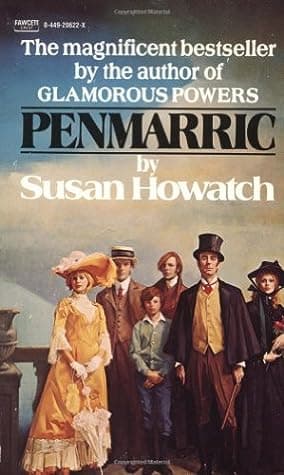
Susan Howatch (1971)
Genre
Historical Fiction / Romance
Reading Time
1200 min
Key Themes
See below
Sign in to track this book
In the windswept grandeur of a Cornish estate, a proud man's marriage ignites a three-generation saga of love, betrayal, and dark secrets, all inextricably bound to the ancient stones of Penmarric itself.
The story begins with Janna, a young and somewhat naive woman, marrying Mark Castallack, a man considerably older and more complex than herself. They move to Penmarric, a grand but isolated estate in Cornwall that has been in Mark's family for centuries. Janna is immediately struck by Mark’s intense, almost spiritual devotion to Penmarric and its past, particularly the story of a previous Castallack family feud. He spends hours researching his ancestors, becoming increasingly withdrawn and absorbed in the estate's history. Janna feels like an outsider, struggling to understand her husband's singular focus and the weight of the family legacy that seems to overshadow their marriage. She soon realizes that Mark's love for Penmarric is a powerful, almost rivalrous force in their relationship, setting the tone for their turbulent life together.
Janna gives birth to their first son, Philip, bringing a brief period of joy, but Mark’s obsession with Penmarric and his family history quickly returns. He is a distant father and an increasingly absent husband, often retreating to his study or wandering the estate, lost in thought about his ancestors. Janna feels neglected and isolated, raising Philip largely on her own. She tries to connect with Mark, but his mind is perpetually elsewhere, fixed on unraveling the mysteries and tragedies of the Castallack past. This growing emotional distance leads to arguments and a deep sense of loneliness for Janna, who wants a deeper connection and for Mark to be present in their shared life, rather than lost in the shadows of the past.
The fragile peace of Penmarric is shattered by the arrival of Maude, Mark’s glamorous and sophisticated cousin. Maude, a stark contrast to the quiet Janna, immediately captivates Mark with her wit, charm, and shared understanding of the Castallack legacy. What begins as a close friendship quickly escalates into a passionate affair, openly flaunted by Mark and Maude. Janna is devastated by the betrayal and public humiliation. The affair becomes an open secret, causing immense pain and scandal within the family and the local community. Janna confronts Mark, but he is unrepentant, completely enthralled by Maude. This period marks a turning point, pushing Janna to the brink of despair and forcing her to consider her future at Penmarric.
Heartbroken and humiliated by Mark’s clear affair with Maude, Janna decides to leave Penmarric, taking her young son, Philip, with her. She finds comfort and stability with Arthur, a kind and dependable man who genuinely cares for her and offers her the emotional security she lacked with Mark. They build a new life together, and Janna eventually gives birth to Arthur’s children. Despite the new happiness, Janna carries the scars of her past and the lingering connection to Penmarric through Philip, who remains Mark’s heir. She tries to move on, but the shadow of her first marriage and the grand, ancient house in Cornwall never completely leaves her or her children.
After years away, Philip, now grown and bearing the emotional scars of his parents' separation, returns to Penmarric. He has inherited his father's deep attachment to the estate and a certain brooding intensity. Philip marries Isabella, a beautiful but manipulative woman who is primarily interested in Penmarric’s wealth and social standing. Their marriage has much tension, mirroring some of the complexities of his parents’ relationship. Isabella struggles to understand Philip's deep connection to the house and its history, often clashing with his rigid traditionalism. Philip, in turn, is drawn to her beauty but struggles with her superficiality and lack of genuine affection for the estate he holds so dear, setting the stage for his own marital drama.
Once settled at Penmarric, Philip, like his father Mark, becomes deeply absorbed in the estate’s history and its preservation. His devotion to the house overshadows his marriage to Isabella, who quickly grows bored and resentful of his preoccupation. Isabella, accustomed to a more lavish and social lifestyle, feels neglected and unappreciated. She begins to seek attention and affection outside their marriage, engaging in discreet flirtations and seeking amusement away from the isolated estate. Philip, blinded by his own obsession and perhaps a lack of emotional insight, fails to fully address her growing discontent, widening the gap between them and echoing the marital patterns of the previous generation at Penmarric.
Years later, Janna returns to Penmarric, drawn back by complex family circumstances and her enduring connection to the estate. Her presence, initially awkward, gradually helps Philip to see the patterns repeating in his own life. Through their conversations and Janna's quiet observations, Philip begins to understand the destructive cycles of obsession, neglect, and infidelity that have plagued the Castallack men and their wives for generations. Janna’s wisdom, born from her own suffering, provides a perspective, allowing Philip to reflect on his relationship with Isabella and his own deep attachment to Penmarric. This interaction is an important moment for Philip, offering him a chance to break free from the past.
Spurred by Janna's insights, Philip tries hard to reconnect with Isabella and save their marriage. He tries to be more present, to understand her needs, and to balance his love for Penmarric with his responsibilities as a husband. However, Isabella, who has already drifted too far and found other attachments, finds herself unable to truly return his affection or accept his unwavering devotion to the ancient estate. Despite Philip's efforts, the damage is too great, and Isabella ultimately decides to leave him for good. Her departure marks the end of their tumultuous marriage, leaving Philip alone at Penmarric, facing the consequences of his choices and the legacy of his family.
The story then transitions to the perspective of Jessica, Philip’s daughter. Jessica, representing the third generation, offers a fresh, more contemporary, and often cynical view of the Castallack family's history and the imposing estate. She is keenly aware of the past traumas and the emotional baggage inherited from her grandparents and parents. Jessica is determined not to repeat the mistakes of her predecessors, seeking independence and a life free from the suffocating influence of Penmarric. Her narrative voice provides a counterpoint to the earlier, more romanticized or melancholic perspectives, offering a critical analysis of the family's self-destructive patterns and the patriarchal hold of the estate.
Jessica, having observed the tragic patterns of her family, struggles with her own identity and her connection to Penmarric. She initially rebels against being tied to the estate, seeking a life defined by her own choices rather than the weight of her ancestors. However, as she matures, she begins to understand the complex beauty and history of Penmarric, and the deep, though sometimes destructive, love her family had for it. Jessica ultimately finds a way to embrace her heritage on her own terms, recognizing the importance of understanding the past without being consumed by it. She seeks to break the cycle of unhappiness, finding a balance between honoring her family's legacy and creating a fulfilling life for herself, representing a hopeful evolution for the Castallack line.
The Protagonist
From a naive young bride, Janna transforms into a resilient woman who builds a new life after heartbreak, eventually becoming a wise observer of her family's cyclical patterns.
The Major Character
Mark remains largely unchanged throughout his life, driven by his unwavering obsession with Penmarric, leading to personal and familial destruction.
The Major Character
Maude successfully secures her place as mistress of Penmarric but finds that the reality of life with Mark is not as fulfilling as she imagined.
The Protagonist
Philip struggles to escape his father's patterns, eventually gaining insight into the family's destructive cycles but only after experiencing similar marital turmoil.
The Major Character
Isabella seeks personal fulfillment and leaves Penmarric, unable to reconcile with Philip's consuming devotion to the estate.
The Protagonist
Jessica evolves from a rebellious young woman to one who acknowledges and incorporates her family's complex history into her identity while forging her own independent path.
The Supporting
Arthur remains a consistently kind and supportive figure, offering Janna a loving and stable life.
The Mentioned
As a historical figure, Sir Jeremy's 'arc' is fixed in the past, serving as a recurring motif and explanation for the present.
The novel explores how the historical legacy of Penmarric, both the physical estate and its ancestral stories, deeply shapes the lives and destinies of the Castallack family. Mark's obsession with his ancestors, particularly Sir Jeremy, dictates his life choices and his neglect of Janna. Philip, in turn, is similarly bound by this inherited connection, repeating his father's patterns. The house itself acts as a character, a powerful presence that both defines and traps its inhabitants. Jessica's struggle to embrace her heritage without being consumed by its tragic aspects highlights the ongoing tension between personal freedom and the weight of a powerful family legacy.
“Penmarric was a living thing, a hungry entity that demanded the souls of the Castallack men, binding them, consuming them.”
A central theme is the repetition of destructive patterns across generations within the Castallack family. Mark's obsession with Penmarric leads to his neglect of Janna and his affair with Maude, mirroring the ancestral feuds he studies. Philip, despite knowing his parents' story, falls into similar patterns, prioritizing the estate over Isabella, leading to her departure. The novel details how unresolved traumas and emotional deficiencies from one generation are passed down, creating a cyclical narrative of unfulfilled love, infidelity, and emotional isolation. Jessica's attempts to break this cycle offer a glimmer of hope for future generations.
“It was as if Penmarric itself had a curse, ensuring that every Castallack man would love the stones more than the flesh-and-blood beside him.”
The characters constantly deal with their sense of identity, often defined by or in opposition to Penmarric. Janna feels like an outsider, struggling to belong in Mark's world. Mark's identity is linked to the estate and his ancestors. Philip tries to find his place within this complex lineage, while Isabella feels alienated by it. Jessica's journey focuses on forging an identity that acknowledges her heritage but is not entirely dictated by it. The search for belonging, whether within the family, the estate, or independently, is a driving force for many characters, showing the deep impact of place and lineage on self-perception.
“How could one ever truly escape Penmarric? It was in my blood, in my very bones, whether I wanted it or not.”
The novel explores various forms of love and the complexities of marriage, often contrasting consuming obsession with genuine affection. Mark's 'love' for Penmarric is a possessive, almost pathological force that destroys his marriages. His love for Maude is passionate but ultimately unstable. Janna's love for Mark is deep but unrequited, and her eventual love for Arthur is one of quiet, stable companionship. Philip's marriage to Isabella is a blend of attraction and duty, ultimately failing because of his inherited obsessions. The book scrutinizes how individual desires, family history, and the allure of a place can corrupt or sustain marital bonds, questioning what truly constitutes a fulfilling partnership.
“I loved Mark, truly, but it was a love that was always secondary to his first, true mistress: Penmarric.”
Penmarric, the ancestral estate, is arguably the most powerful 'character' in the novel. It is not merely a setting but a living, breathing entity that exerts an almost mystical hold over the Castallack men. Its ancient stones, its history, and its very atmosphere shape the lives and destinies of generations. The isolation of Penmarric contributes to the intense, insular nature of the family's problems. It represents both a source of pride and a curse, a place of beauty and despair. The novel demonstrates how a physical location can become imbued with so much meaning and history that it dictates the psychological state of its inhabitants, becoming a force unto itself.
“Penmarric was not just a house; it was a memory, a spirit, a demanding presence that consumed all who dared to love it too fiercely.”
Allows for different perspectives on the same events and characters across generations.
The novel employs a unique narrative structure, shifting between the first-person perspectives of Janna, Philip, and Jessica. This device allows the reader to experience the same historical events and family dynamics from distinct viewpoints, enriching the understanding of character motivations and the impact of the past. Janna provides the initial, often naive perspective of an outsider marrying in; Philip offers the perspective of a son caught between his parents' legacies; and Jessica provides a more modern, analytical, and critical view from the third generation. This multi-vocal approach highlights the cyclical nature of the story and the subjective interpretation of family history.
Repetition of themes, conflicts, and character traits across generations.
Howatch masterfully uses parallelism, creating strong echoes between the experiences of different generations. Mark's obsession with Penmarric and his affair with Maude are deliberately mirrored in Philip's similar devotion to the estate and the subsequent alienation of Isabella. The ancestral feud between Sir Jeremy and Richard Castallack serves as a historical parallel for the later marital conflicts. This device emphasizes the cyclical nature of the Castallack 'curse' and suggests that the family's past is constantly replaying itself, creating a sense of inescapable destiny until Jessica attempts to break the pattern. It underscores the theme of inherited trauma and the power of legacy.
The estate of Penmarric functions as a living, influential entity in the story.
Penmarric is far more than just a setting; it acts as a central character in the novel. Described with immense detail and imbued with a powerful, almost sentient presence, the ancient Cornish estate exerts a profound influence over the Castallack family. It demands loyalty, inspires obsession, and seemingly shapes the destinies of its inhabitants. Mark and Philip's lives are consumed by their devotion to Penmarric, often at the expense of their human relationships. The house symbolizes the weight of tradition, the allure of the past, and the claustrophobia of inherited responsibility, becoming a source of both pride and profound unhappiness for generations.
Mark's study of his ancestors' lives predicts future events for his own family.
Mark's extensive historical research into the lives of his Castallack ancestors, particularly Sir Jeremy and his brother, serves as a significant plot device. As he uncovers their feuds, passions, and betrayals, these historical narratives subtly foreshadow the events that will unfold in his own life and the lives of his descendants. The ancient conflicts over Penmarric, the marital infidelities, and the intense, often destructive, family bonds that Mark studies provide a blueprint for the present. This device not only deepens the theme of inherited legacy but also creates a sense of tragic inevitability, as the characters seem destined to repeat the mistakes of their past.
“I am not a man to be crossed, and those who try will learn the hard way.”
— Mark Castallack asserts his authority early in the novel.
“Love is not a gentle thing; it is a fire that can burn or warm, and sometimes it does both.”
— Reflection on the tumultuous relationships in the story.
“The past is a ghost that haunts us all, but we must learn to live with its whispers.”
— A character contemplates family history and legacy.
“In this house, secrets are the bricks and lies the mortar.”
— Describing the deceptive atmosphere at Penmarric.
“We are all prisoners of our own desires, chained to what we think we want.”
— Philosophical musing on human nature in the novel.
“A woman's strength is often mistaken for weakness, but it is the quietest storms that do the most damage.”
— Comment on the resilience of female characters.
“The land does not care for our petty squabbles; it endures long after we are gone.”
— Reflection on the enduring nature of the Cornish landscape.
“To inherit is not just to receive wealth, but to bear the weight of expectation.”
— Discussion of inheritance and family pressure.
“Sometimes the heart chooses a path the mind cannot follow, and that is when we are most alive.”
— On following passion over reason in relationships.
“A house divided against itself cannot stand, but it can crumble slowly, painfully.”
— Describing the familial conflicts at Penmarric.
“There is no victory in revenge, only a hollow echo of what was lost.”
— Warning against the futility of vengeance in the plot.
“We write our own stories, but the ink is often spilled by those who came before us.”
— On the influence of ancestry and history.
“In the end, it is not the grand gestures but the small kindnesses that are remembered.”
— Reflection on what truly matters in relationships.
“To love is to risk everything, and sometimes that risk is worth more than safety.”
— Advocating for emotional courage in the face of heartbreak.
Ready to see how well you understood this book? Take our interactive quiz with 10 questions.

Biography coming soon.







