“To be oneself is: to slay oneself.”
— The Great Boyg's riddle to Peer Gynt, challenging his self-serving nature.

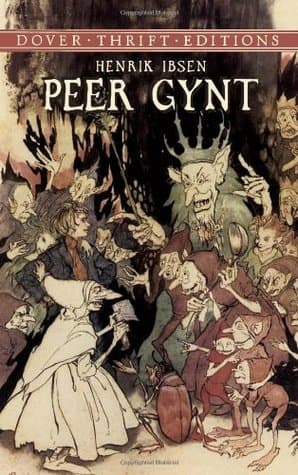
Sign in to track this book
A charming, wild peasant travels the world, encountering trolls and emperors, only to find meaning and a hidden truth in the lasting love he left behind.
The play starts with Peer Gynt telling his mother, Åse, a wild story about riding a buck over a mountain. She scolds him for his laziness and vivid imagination. They are going to the Hegstad farm wedding, where Ingrid, the farmer's daughter, is marrying Mads Moen. At the wedding, people mock Peer for his boasting and lack of prospects. He is drawn to Solveig, a modest and religious girl new to the area, but she rejects his attempts to dance. Feeling humiliated and acting on impulse, Peer carries off Ingrid, the bride, into the mountains, leaving her soon after.
After leaving Ingrid, Peer meets a mysterious Green-Clad Woman, who says she is the Mountain King's daughter. He is drawn into the troll kingdom, where he meets the grotesque Troll King. The King offers Peer his daughter's hand in marriage, along with wealth and power, if Peer will give up being human and accept the troll belief of 'to thyself be enough.' Peer is tempted but refuses to fully conform, especially when he learns trolls see 'crooked' as 'straight.' Trolls nearly blind and torture him before church bells save him, driving the trolls away.
Peer returns to the human world, now an outcast and a fugitive. Solveig, despite his past and reputation, finds him in his mountain hut, having left her family to be with him. She declares her steady love and commitment. However, just as Peer is about to accept her love and settle down, the Green-Clad Woman and her visible, ugly child confront him, reminding him of his past wrongs and their possible results. Overwhelmed by guilt and fear of harming Solveig, Peer flees into the wilderness, leaving Solveig alone. He then returns to his dying mother, Åse, and comforts her with a final, elaborate fantasy of their journey to heaven before she dies.
Years pass, and Peer Gynt is a successful, middle-aged businessman in America. He has made a fortune through various unethical ventures, including the slave trade and the opium trade. He hosts a lavish party on the coast of Morocco, bragging about his self-made wealth and his philosophy of always taking the easiest path. He is surrounded by four international friends – Mr. Cotton, Monsieur Ballon, Herr von Eberkopf, and Trumpeter Huhu – who represent different parts of European society. Peer reveals his latest plan: funding a new religion based on profit. However, his 'friends' betray him, stealing his yacht and his fortune, leaving him stranded and penniless on the Moroccan coast.
After his betrayal, Peer finds himself in the desert. He tries to become a prophet, wandering among Bedouin tribes and gaining followers, only to be exposed as a fraud by Anitra, a chieftain's daughter, who seduces him and steals his remaining possessions. Later, Peer travels to Egypt, where he acts as an archeologist and scholar. He sees the statue of Memnon and the Sphinx, discussing philosophy with 'Begriffenfeldt,' a director of a lunatic asylum. Begriffenfeldt declares Peer the 'King of Self,' believing him to be the embodiment of absolute self-sufficiency, and Peer embraces this idea.
Peer is taken to a lunatic asylum in Cairo, where Begriffenfeldt, the director, crowns him 'Emperor of Self' among the other patients, each lost in their own delusions. The madmen, including Huhu and a Fellah with a mummy, show various forms of self-absorption and fragmented identities. Peer, at first confused, eventually accepts the role, finding a strange sense of belonging and validation in this kingdom of the insane. He believes he has finally found a place where his true, unburdened self can rule, ironically, among those who have lost their minds.
An old Peer, returning to Norway after decades of travel, experiences a shipwreck. He clings to a life raft, pushing a ship's cook into the sea to save himself, only to lose the raft to the cook. Clinging to a mast, he meets a strange figure, the Button-Molder, who tells Peer he will be melted down and recast. He has failed to be a true sinner or a true saint, and has not lived as a distinct 'self.' Peer is terrified by this, as it means losing his individuality and being absorbed into the general mass of humanity, having never truly reached his potential.
Desperate to avoid the Button-Molder's furnace, Peer searches for proof of his 'self.' He meets various figures from his past: the Old Man of the Mountains (the Troll King), who reminds him of his troll-like nature, and the Lean One (the Devil), who tells Peer he isn't wicked enough for hell, as he never truly committed to evil. Peer tries to find evidence of his distinct identity, thinking about his life's choices and failures. He realizes his life has been a series of evasions, never fully committing to any path, always finding a way around instead of through.
Cornered by the Button-Molder, Peer hears a song. He follows the sound and finds Solveig, now an old woman, still waiting for him in the same hut, singing. She has kept his home and his memory alive for decades. Peer, broken and despairing, confronts her, asking where his 'self' has been all this time. Solveig, with steady love and faith, tells him that his true self has been in her faith, her hope, and her love for him. As she holds his head, the Button-Molder admits that Peer has found his true identity through Solveig's lasting love, offering a glimmer of redemption and a sense of belonging at last.
The Protagonist
Peer begins as an irresponsible youth, wanders the world accumulating wealth and adopting various identities, and returns an old, disillusioned man, ultimately finding a form of redemption and his 'self' through Solveig's steadfast love.
The Supporting
Solveig remains constant in her love and faith throughout Peer's long absence, ultimately providing the home and redemption he needs.
The Supporting
Åse lives a life of frustration and love for Peer, dying with him at her side after a final, comforting fantasy.
The Antagonist/Supernatural
The Button-Molder serves as the catalyst for Peer's final journey of self-discovery, ultimately yielding when Peer finds his 'self' in Solveig's love.
The Antagonist/Supernatural
The Troll King represents a path Peer almost takes, a life of self-serving delusion, and reappears to remind Peer of his past choices.
The Supporting
The Green-Clad Woman appears at critical junctures, representing the allure of the troll world and the lasting consequences of Peer's choices.
The Supporting
Begriffenfeldt provides Peer with a false sense of identity and power within the madhouse, highlighting Peer's own delusions.
The Supporting
Anitra briefly ensnares Peer, highlighting his susceptibility to flattery and his inability to form genuine connections.
Peer Gynt's entire journey is a search to discover and define his true 'self.' He constantly reinvents himself, taking on different roles – the peasant, the troll prince, the businessman, the prophet, the scholar – but these are often external masks rather than reflections of an inner core. His fear of being 'melted down' by the Button-Molder shows his worry about losing his individuality. The play suggests that a true self is not found in accumulating experiences or wealth, nor in self-absorption (the troll motto), but in commitment, sacrifice, and connection to others, ultimately found in Solveig's lasting love. His life is a series of evasions, never fully committing to any identity, which leaves him empty.
“What is it, then, to be oneself? / It is to be oneself. / But how? / To be oneself in the full force of the word.”
Peer Gynt is a master of escapism, both through his imaginative stories and his avoidance of responsibility. From his youthful tales of riding bucks to his later delusions of being a prophet or 'Emperor of Self' in the madhouse, Peer consistently retreats into fantasy instead of facing reality. His journey through the troll kingdom, where 'crooked' is seen as 'straight,' symbolizes a life lived in moral delusion. This theme highlights the dangers of avoiding truth and consequence, showing how a life built on self-deception can lead to spiritual emptiness and a fragmented identity, as seen in his inability to present a true 'self' to the Button-Molder.
“To be oneself is to ignore oneself.”
Despite Peer's many failures, redemption comes through Solveig's steady, unconditional love. Her steadfastness, patience, and faith act as a moral guide and a constant, pure presence throughout his chaotic life. While Peer seeks wealth, fame, and self-gratification, Solveig embodies a different kind of value – lasting human connection and selfless devotion. In the end, her love provides him with refuge, a true home, and the answer to his existential search for identity. Her declaration that his 'self' has been in her faith and hope makes a strong statement about love's redemptive power.
“Where was my self, the whole, the true one? Where was I, with God's stamp on my brow?”
The play explores the unclear lines between good and evil, and the results of moral ambiguity. Peer is neither purely good nor purely evil; he is a man of convenience, always choosing the easiest path. The Button-Molder's judgment that Peer is not 'wicked enough' for hell, nor 'good enough' for heaven, underscores this point. The troll philosophy of 'to thyself be enough' twists individualism, promoting selfishness over moral responsibility. Peer's journey suggests that a failure to commit to either good or evil, a life lived in a morally gray area, can lead to a loss of identity and spiritual emptiness, worse than outright sin.
“God's stamp on your brow? No, it's the Button-Molder's mark you bear.”
Incorporation of mythical creatures and supernatural events.
Ibsen integrates elements from Norwegian folklore, such as trolls, the Fossegrimen (a water spirit), and the Boyg (a shapeless, evasive obstacle), into Peer's journey. These elements serve not merely as fantastical embellishments but as symbolic representations of Peer's inner struggles, temptations, and the moral landscape he navigates. The troll kingdom, for instance, embodies a philosophy of self-absorption and moral relativism, while the Boyg represents the elusive and unidentifiable obstacles Peer faces due to his own lack of commitment and direction. They externalize Peer's internal conflicts and the consequences of his choices.
Characters and events represent abstract ideas or moral qualities.
Peer Gynt's journey is highly allegorical. Peer himself represents humanity's struggle with identity, self-delusion, and the search for meaning. Solveig embodies unwavering love and faith, while the Button-Molder personifies divine judgment or the ultimate reckoning for an unfulfilled life. The troll kingdom, with its motto 'to thyself be enough,' is an allegory for selfishness and moral compromise. The various roles Peer adopts (businessman, prophet, emperor of the madhouse) are allegories for different societal archetypes and the dangers of superficiality and ambition without substance, making the play a commentary on universal human follies.
Objects, characters, and settings carry deeper meanings.
Key symbols abound in 'Peer Gynt.' The onion that Peer peels, revealing layer after layer but no core, symbolizes his fragmented and ultimately hollow 'self.' The button-molder's ladle and furnace symbolize the melting down of unformed souls and the loss of individuality. Solveig's hut represents home, constancy, and the redemptive power of love. The ship Peer abandons (and later crashes on) symbolizes his reckless journey through life and the consequences of his self-serving actions. These symbols enrich the play's philosophical depth, illustrating Peer's internal state and the overarching themes.
Humorous critique of societal values and human behavior.
Ibsen uses satire to critique various aspects of society and human nature through Peer's adventures. Peer's ventures as a slave trader, a false prophet, and a businessman exploiting religion satirize greed, hypocrisy, and opportunism. The madhouse scene, where Peer is crowned 'Emperor of Self' by Begriffenfeldt, offers a biting satire on the absurdity of self-absorption and the intellectual pretenses of the modern world. The play humorously exposes the follies and vices common to humanity, using Peer's exaggerated journey to highlight the superficiality and moral compromises prevalent in society.
“To be oneself is: to slay oneself.”
— The Great Boyg's riddle to Peer Gynt, challenging his self-serving nature.
“You are a lie!”
— Peer Gynt's confrontation with the Button-Molder, who deems him unworthy of heaven or hell.
“The world is a riddle, and I am the answer.”
— Peer Gynt's youthful boasting and inflated self-importance.
“I will build a city, and it shall be called Peeropolis!”
— Peer Gynt's grand, but ultimately unfulfilled, entrepreneurial dreams in America.
“To go round about!”
— The Great Boyg's evasive and circular advice to Peer Gynt.
“My mind is a kingdom, and I am its king.”
— Peer Gynt's internal world, where he often retreats from reality.
“He who has no tears, has no heart.”
— Solveig's lament for Peer Gynt's emotional detachment.
“You are like a button, without the hole to make it useful.”
— The Button-Molder's metaphorical assessment of Peer Gynt's lack of true purpose.
“What is life but a dream, and love but a shadow?”
— Peer Gynt's philosophical musings in his later years, reflecting on his past.
“My kingdom is not of this world.”
— Peer Gynt's spiritual longing and his search for something beyond the material.
“Give me a horse, and I will ride to the end of the world!”
— Peer Gynt's youthful exuberance and desire for adventure.
“There are always two sides to every story, and I am usually on both.”
— Peer Gynt's characteristic ability to adapt and justify his actions from multiple perspectives.
“The greatest joy is to be truly oneself, without fear or compromise.”
— Solveig's unwavering love and acceptance of Peer Gynt, despite his flaws.
“I have been a troll, a prophet, a king, and a beggar.”
— Peer Gynt's reflection on his varied and often contradictory life experiences.
Ready to see how well you understood this book? Take our interactive quiz with 10 questions.
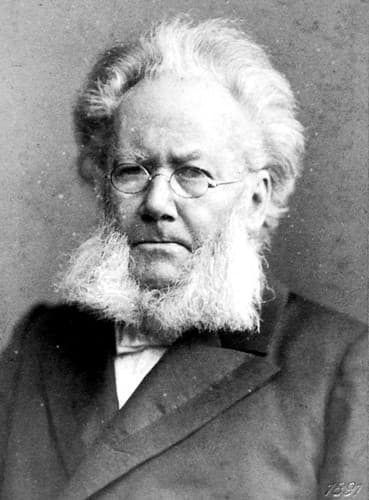
Henrik Johan Ibsen was a Norwegian playwright and theatre director. As one of the founders of modernism in theatre, Ibsen is often referred to as "the father of realism" and one of the most influential playwrights of his time. His major works include Brand, Peer Gynt, An Enemy of the People, Emperor and Galilean, A Doll's House, Hedda Gabler, Ghosts, The Wild Duck, When We Dead Awaken, Rosmersholm, and The Master Builder. Ibsen is the most frequently performed dramatist in the world after Shakespeare, and A Doll's House was the world's most performed play in 2006.







