“The past is a pebble in my shoe.”
— Spoken by Joseph Schwartz, reflecting on his displacement in time.

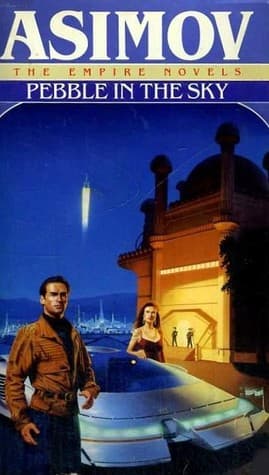
Isaac Asimov (1950)
Genre
Fantasy / Science Fiction
Reading Time
450 min
Key Themes
See below
Sign in to track this book
A 1949 tailor, accidentally sent 20,000 years into the future, must navigate a radioactive, ageist Earth in a vast Galactic Empire that despises its origins, all while trying to avoid a mandatory death sentence for being two years too old.
Joseph Schwartz, a sixty-two-year-old retired tailor, is walking in 1949 Chicago when a sudden, bright flash of light engulfs him. He finds himself disoriented in a completely alien environment. The air, structures, and people are unfamiliar, and they speak a language he does not understand. He tries to communicate, but his English is met with confusion and fear. He is quickly apprehended by futuristic authorities who assume he is mentally ill due to his old-fashioned appearance and inability to speak their language, Galatic Basic. This event is his abrupt and involuntary transition into a future where Earth is a forgotten planet within a vast Galactic Empire.
Schwartz is taken to a 'Farm,' a facility for those deemed useless or insane. He learns, through observation and limited understanding, that Earth is an outcast planet within the Galactic Empire, despised for its claim as humanity's origin. The planet is poor, much of its surface is radioactive, and its population lives under strict control. The most shocking revelation for Schwartz is the 'Sixty' law: all citizens are euthanized upon reaching their sixtieth birthday to conserve resources. As Schwartz is sixty-two, he is immediately marked for this fate, adding urgency to his situation.
While at the Farm, Schwartz is accidentally exposed to an experimental device called the Synapsifier by a young scientist named Arbin Maren. Maren believes the Synapsifier can enhance mental abilities, but its effects are unpredictable. Instead of the intended slight improvement, Schwartz's brain undergoes a transformation. He gains the ability to read minds, influence thoughts, and project mental commands, becoming a powerful telepath. This accidental empowerment is initially terrifying but soon becomes his only hope for survival and understanding his new reality.
Using his new mental powers, Schwartz escapes the Farm. He soon meets Bel Arvardan, a young archeologist from the planet Baronn, who is on Earth studying its ancient ruins and controversial history. Arvardan is initially wary of Schwartz, but after seeing his powers and hearing his incredible story, he begins to believe him. Arvardan, who secretly believes Earth is the true origin of humanity, sees Schwartz as a key to unraveling ancient mysteries and potentially challenging the Empire's biased view of Earth. Their alliance forms out of mutual need and a shared sense of injustice.
Arvardan and Schwartz look deeper into Earth's society and discover a radical, xenophobic movement known as the 'Earth-Born.' This group, led by the fanatical Minister of Earth, believes Earth should reclaim its former glory and openly defy the Galactic Empire. They are secretly planning to use a devastating biological weapon — a contagious, rapidly fatal disease — to exterminate the non-Earthling population of the galaxy, asserting Earth's dominance. The discovery of this plot reveals the true danger facing not only Earth but the entire Empire.
As Arvardan continues his research, he deals with the scientific and political implications of his findings. His initial idea that Earth is the ancestral home of humanity is considered heresy by the Empire, which promotes a narrative of diverse planetary origins. The evidence he uncovers, especially with Schwartz's help in deciphering ancient texts and understanding the true history, increasingly supports Earth's claim. This puts Arvardan in a difficult position, as revealing his discoveries could jeopardize his career and life, while also potentially starting further conflict.
The Earth-Born fanatics, under the leadership of the Minister of Earth, are finalizing their plans to deploy the 'radiant plague.' This engineered disease is designed to be specific, targeting only non-Earthlings, ensuring the survival of Earth's population while devastating the rest of the Empire. They intend to release it during a major inter-planetary conference, ensuring maximum spread. Schwartz and Arvardan realize the catastrophic scale of this impending genocide and are desperate to prevent it, knowing that failure would lead to galactic civil war and the likely destruction of Earth in retaliation.
Schwartz, using his advanced telepathic abilities, and Arvardan, using his knowledge of the Earth-Born's plans, infiltrate the core of the conspirators' operations. They confront the Minister of Earth and his inner circle, attempting to expose their genocidal plot. The Minister, convinced of his righteousness and the superiority of Earthlings, is unyielding. A tense standoff follows, with Schwartz using his mental influence to cause discord and confusion among the conspirators, while Arvardan tries to appeal to any remaining sense of reason or fear of galactic retribution.
In a climactic struggle, Joseph Schwartz uses the full extent of his Synapsifier-enhanced mental powers. He influences the minds of the Earth-Born leaders, and subtly manipulates key individuals within the Earth government and some Imperial officials. His goal is not just to stop the plague's release but to dismantle the conspiracy and prevent future conflicts. He creates a complex web of mental commands and suggestions, causing the conspirators to turn on each other, reveal their plans, and ultimately incapacitate themselves, ensuring the plague is not deployed.
The radiant plague is successfully contained and destroyed, preventing a galactic catastrophe. The Earth-Born movement is exposed and dismantled, though the underlying prejudice against Earth remains a significant challenge. Arbin Maren, the scientist who accidentally gave Schwartz his powers, is recognized for his Synapsifier research, with a new understanding of its potential dangers. Joseph Schwartz, unable to return to his own time, accepts his new reality. He decides to use his extraordinary abilities to subtly guide humanity towards a more peaceful and enlightened future, becoming a silent guardian of the galaxy.
The Protagonist
Schwartz transforms from a bewildered, helpless anachronism into a powerful, benevolent telepath who becomes a silent guardian of galactic peace.
The Supporting
Arvardan evolves from an ambitious scholar into a courageous truth-seeker who risks his career and life for historical accuracy and galactic peace.
The Supporting
Maren shifts from an overly confident, ethically questionable scientist to one who understands the profound and potentially dangerous implications of his research.
The Antagonist
The Minister remains steadfast in his fanaticism, ultimately defeated but unrepentant in his desire for Earth's supremacy.
The Supporting
The Grand Councilman begins to question his ingrained prejudices as evidence mounts, suggesting a potential for the Empire to re-evaluate its stance on Earth.
The Supporting
Bor Alon maintains his ethical stance, serving as a foil to Maren's ambition and highlighting the dangers of unchecked scientific experimentation.
The novel explores prejudice and xenophobia, especially through the Galactic Empire's treatment of Earth. Earth is an outcast planet, scorned by the 200 million other planets of the Empire because its people claim it as humanity's original home. This prejudice appears in the 'Sixty' law, Earth's poverty, and the general disdain shown by Imperial citizens like Bel Arvardan's initial view. Conversely, Earth's own xenophobia, shown by the 'Earth-Born' movement, reveals how the oppressed can become oppressors, planning genocide against the Empire that despises them. This duality shows the destructive cycle of hatred.
“Earth is a legend, a myth, a joke to the rest of the Galaxy. A pebble in the sky.”
A central theme is humanity's search for its true origins and identity. Bel Arvardan's entire academic career is dedicated to proving Earth as the ancestral home of humanity, an idea fiercely resisted by the Empire. Joseph Schwartz, stripped of his own identity and time, struggles to understand his place in this alien future. Earth's people cling to their claim of origin as a source of pride amidst their subjugation, leading to both a desperate longing for recognition and dangerous extremism. The story suggests that understanding one's past is important for shaping a peaceful future.
“To forget the past is to court disaster, to ignore the foundations upon which we stand.”
The novel examines the ethical implications of scientific advancement and the power it gives. Arbin Maren's Synapsifier, meant to enhance minds, accidentally transforms Joseph Schwartz into a telepath of immense power. This raises questions about the responsibility of scientists for the unforeseen consequences of their inventions. Also, the 'Earth-Born' movement's development of a biological weapon highlights the misuse of scientific knowledge for destructive purposes. Schwartz's struggle to control and ethically use his powers emphasizes the moral requirement that comes with great ability.
“Power is a dangerous thing, Arvardan. It corrupts the mind and distorts the soul.”
Joseph Schwartz's displacement from 1949 to the distant future immediately introduces the theme of time and the vastness of change. He is a living anachronism, showing how profoundly society, language, and technology can evolve over millennia. His struggle to adapt, and the future society's inability to understand him, highlight the immense gap between different eras. The narrative also touches on the cyclical nature of history, with old prejudices and nationalisms reappearing in new forms, even across vast spans of time and space, suggesting that while technology changes, human nature often does not.
“The past is a foreign country; they do things differently there.”
Joseph Schwartz's instantaneous and inexplicable jump through time.
This device is the inciting incident, immediately thrusting the protagonist into an alien future. It creates profound culture shock, fuels the initial conflict of misunderstanding, and isolates Schwartz, making him a 'man out of time.' It also serves as a narrative shortcut to introduce the reader to the far future through the eyes of an ordinary person, allowing for exposition of the new world without it feeling forced. The lack of explanation for the displacement itself adds to the mystery and the sense of overwhelming forces beyond human control.
A device designed to enhance mental capabilities, accidentally granting Schwartz telepathy.
The Synapsifier is a classic 'macguffin' that serves as the catalyst for Schwartz's transformation into a powerful telepath. It's a scientific invention with unpredictable effects, providing the means for Schwartz to overcome his initial helplessness. It functions as a source of both danger and salvation, as its power is immense and its full implications are not understood. This device directly enables the plot's resolution by giving Schwartz the abilities necessary to confront the antagonists and avert the galactic catastrophe, while also raising ethical questions about scientific experimentation.
Earth's law mandating euthanasia for all citizens at age sixty.
This law is a crucial element of the world-building, highlighting the dire conditions and harsh social controls on future Earth. For Joseph Schwartz, who is sixty-two, it immediately establishes a personal, life-or-death stakes in the narrative, driving his need to escape and understand his new environment. It also serves to underscore the Empire's prejudiced view of Earth, as such a law is presented as a consequence of Earth's perceived overpopulation and lack of resources, reinforcing its status as a pariah planet.
A bio-weapon designed to target and eliminate non-Earthlings.
This plot device serves as the primary external conflict and ticking clock in the story. It represents the ultimate manifestation of the 'Earth-Born' movement's xenophobia and their desperate attempt to reclaim dominance. The threat of the plague raises the stakes to a galactic level, forcing Schwartz and Arvardan to act decisively to prevent mass genocide. Its specificity (targeting only non-Earthlings) highlights the depth of the prejudice and the horrifying potential of advanced biological warfare when fueled by extremist ideologies.
“The past is a pebble in my shoe.”
— Spoken by Joseph Schwartz, reflecting on his displacement in time.
“Ignorance is not bliss, it is oblivion.”
— A philosophical observation within the narrative.
“Humanity has a peculiar talent for making things worse when it tries to make them better.”
— A general societal critique.
“The greatest tragedy is not death, but life without purpose.”
— A character's reflection on meaning.
“History repeats itself, not because it has to, but because we refuse to learn.”
— A comment on historical patterns.
“Fear is the most potent weapon, for it turns men against themselves.”
— An observation on the nature of fear and control.
“To be truly free, one must first be free from the shackles of one's own mind.”
— A thought on internal freedom.
“The universe is not obliged to make sense to you.”
— A reminder of the vastness and indifference of the cosmos.
“Sometimes the greatest discoveries are made by accident, by those who aren't looking for them.”
— Reflecting on serendipity in scientific progress.
“Prejudice is a disease of the mind, and like all diseases, it can be cured, but only if the patient desires it.”
— A commentary on overcoming prejudice.
“The future is not fixed; it is a tapestry woven by the choices we make today.”
— Emphasizing free will and consequence.
“Even a pebble can start an avalanche if it falls in the right place.”
— Metaphorical reference to the title, highlighting small causes with large effects.
“It is not enough to survive; one must live.”
— A distinction between mere existence and a meaningful life.
Ready to see how well you understood this book? Take our interactive quiz with 10 questions.
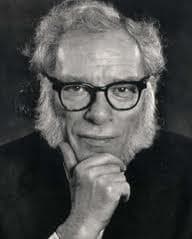
Isaac Asimov was an American writer and professor of biochemistry at Boston University. During his lifetime, Asimov was considered one of the "Big Three" science fiction writers, along with Robert A. Heinlein and Arthur C. Clarke. A prolific writer, he wrote or edited more than 500 books. He also wrote an estimated 90,000 letters and postcards. Best known for his hard science fiction, Asimov also wrote mysteries and fantasy, as well as much non-fiction.







