“It's the only world we've got. You have to work to make it better. Even if it's just a little bit.”
— Trevor explaining his project to his mom.

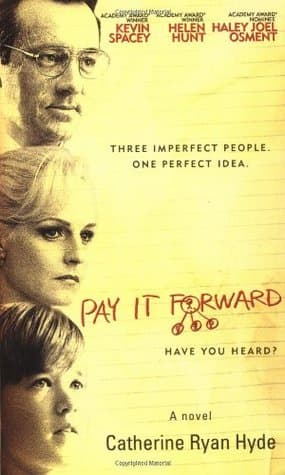
Catherine Ryan Hyde (1999)
Genre
Young Adult
Reading Time
360 min
Key Themes
See below
Sign in to track this book
A hopeful young boy starts a chain reaction of selfless acts, showing that one simple idea can mend broken lives and spread to transform the world.
Twelve-year-old Trevor McKinney lives in Atascadero, California, with his single, alcoholic mother, Arlene. His new social studies teacher, Reuben St. Clair, gives the class an assignment: create a plan to improve the world and act on it. Trevor, inspired by the challenge, develops a simple idea he calls 'Pay It Forward.' The concept is that instead of paying back a good deed, the recipient 'pays it forward' by doing three good deeds for three different people. These three people then each pay it forward to three more, creating a growing chain of kindness. Trevor believes this simple chain reaction could make the world a better place, starting with his own actions.
Trevor starts his plan by helping Jerry, a homeless man he finds sleeping in a dumpster near his home. He brings Jerry food, gives him money, and offers him his garage to sleep in, much to Arlene's initial disapproval. Jerry, touched by Trevor's kindness, eventually pays it forward by preventing a woman, Mrs. Greenberg, from committing suicide by jumping off a bridge. Mrs. Greenberg is saved and given a new chance at life. Trevor's second act of paying it forward is to help Mrs. Greenberg with her garden, though this interaction is less direct in starting a chain.
Arlene discovers Jerry living in their garage and is angry with Trevor, demanding Jerry leave. Trevor explains his 'Pay It Forward' project, but Arlene is skeptical and worried about his safety. Meanwhile, Reuben St. Clair notices Trevor's unique take on the assignment. Although Trevor struggles to explain the full scope of his plan in class, Reuben is intrigued by the earnestness and potential of the idea, especially after seeing Trevor's genuine efforts to help Jerry. Reuben begins to see a deeper meaning in Trevor's actions beyond a simple school project.
Reuben, aware of Arlene's struggles and her son's project, visits their home to discuss Trevor's progress. He and Arlene, both with emotional scars, begin to connect. Arlene, still wary of the world, is surprised when Jerry, having paid it forward to Mrs. Greenberg, returns to their house and gives her his refurbished truck. This act of kindness is a 'Pay It Forward' for Trevor's initial help. This unexpected gift affects Arlene, making her begin to see the tangible effects of Trevor's idea, even if she does not fully understand the concept yet.
Arlene realizes that Jerry's gift of the truck was a direct result of Trevor's kindness. Touched and inspired, Arlene decides to 'pay it forward' by helping Reuben. She sees his physical scars from a fire, but also senses his deep emotional pain. She reaches out to him, offering comfort and support, and helps him confront his own personal problems and loneliness. This act of compassion from Arlene becomes an important link in the 'Pay It Forward' chain, showing how emotional support can be as impactful as material aid, and begins to heal Reuben's long-held wounds.
In a parallel storyline, Chris Chandler, a Los Angeles journalist, receives a new car from a stranger after his own breaks down. The stranger simply tells him to 'pay it forward.' Intrigued and skeptical, Chris begins to investigate this phrase. His journalistic curiosity leads him on a cross-country journey, tracing the chain of kindness. He interviews various people who have either given or received a 'Pay It Forward' deed, slowly piecing together the origins of this growing movement. His investigation ultimately leads him back to Atascadero, to the source of the idea.
As the 'Pay It Forward' movement slowly spreads, Reuben and Arlene's relationship grows. They both find comfort and understanding in each other, sharing their past traumas and vulnerabilities. Reuben, still dealing with the physical and emotional scars from a fire that disfigured him, finds Arlene's acceptance and love to be healing. Arlene, in turn, finds stability and genuine affection with Reuben, something she has lacked in her life. Their growing bond shows the transforming power of connection, a direct 'Pay It Forward' effect stemming from Trevor's initial idea.
Chris Chandler's investigation ends in Atascadero, where he interviews many people who have been part of the 'Pay It Forward' chain. He eventually connects the dots back to Trevor McKinney, realizing that this young boy started the entire phenomenon. Chris is moved by Trevor's simple yet powerful vision and its widespread impact. He interviews Trevor, who explains his dream of changing the world one act of kindness at a time. This interview becomes the basis for Chris's story, bringing the 'Pay It Forward' movement to national attention.
Chris Chandler's article about Trevor and the 'Pay It Forward' movement is published, putting the idea into the national spotlight. People across the country are inspired, and the movement gains momentum. Trevor, Arlene, and Reuben are suddenly in the public eye, celebrating the success of Trevor's vision. However, during a televised event celebrating the movement in Washington D.C., Trevor sees a young boy being bullied. True to his compassionate nature, Trevor intervenes to help the boy, but in the ensuing struggle, he is fatally stabbed by the bullies. His death shocks the community and the nation.
Trevor's death is a devastating blow, especially to Arlene and Reuben. The nation mourns the young boy who inspired so many. However, even in grief, the 'Pay It Forward' movement does not die with Trevor. Instead, his sacrifice inspires people even further. Thousands of people gather for his funeral, each carrying a candle, symbolizing the light he brought to the world. The movement continues to spread, with many individuals committing to perform acts of kindness in his memory. Trevor's legacy is a sign of the lasting power of a single, simple idea to change the world, even in the face of tragedy.
The Protagonist
Trevor evolves from a hopeful boy with an idea to a national inspiration whose sacrifice ultimately solidifies his legacy of kindness.
The Supporting
Arlene transforms from a cynical, struggling alcoholic into a hopeful, loving individual who embraces kindness and finds stability.
The Supporting
Reuben moves from a scarred, emotionally closed-off individual to a loving, hopeful partner, healed by the 'Pay It Forward' movement and Arlene's love.
The Supporting
Chris evolves from a cynical journalist to a believer in the power of human connection, becoming instrumental in spreading the 'Pay It Forward' message.
The Supporting
Jerry is lifted from homelessness and despair by Trevor's kindness, becoming an active participant in the 'Pay It Forward' chain.
The Supporting
Mrs. Greenberg's life is literally saved by the 'Pay It Forward' chain, moving her from despair to a second chance at life.
The Mentioned
His singular act initiates the journalistic investigation that brings 'Pay It Forward' to national prominence.
The Supporting
Ricky remains largely unchanged, serving as a recurring negative force that Trevor and Arlene must contend with.
The central theme of 'Pay It Forward' is the transforming power of simple acts of kindness. Trevor's idea shows that a single good deed, when paid forward, can create a ripple effect that touches many lives. From Jerry's rescue of Mrs. Greenberg to Arlene's support for Reuben, the story consistently shows how compassion can heal wounds, inspire hope, and break cycles of despair. Trevor's unwavering belief in this power, even when others are cynical, is the driving force behind the entire movement, proving that kindness is a powerful way to make change.
“'You do a good deed for three people, and then they pay it forward to three more people. And so on, and so on. It's like a chain reaction.'”
Despite the harsh realities faced by its characters—alcoholism, homelessness, physical disfigurement, and emotional trauma—the novel maintains a strong sense of hope. Trevor's innocent optimism is contagious, inspiring even the most jaded characters like Arlene and Chris Chandler. The 'Pay It Forward' movement itself shows that positive change is possible, even in a seemingly bleak world. The story suggests that by choosing to believe in and actively create good, individuals can overcome personal struggles and contribute to a brighter collective future, even if personal tragedy occurs.
“'I think it's possible to change the world. It's just a lot of people don't try.'”
The 'Pay It Forward' concept highlights how people are connected. The story illustrates how seemingly different individuals—a homeless man, an elderly woman, a struggling mother, a scarred teacher, a cynical journalist—are all linked by a chain of kindness from one boy. This theme emphasizes that no one exists alone and that every action, positive or negative, has far-reaching consequences. The growing 'Pay It Forward' movement creates a sense of global community, where strangers are united by a shared commitment to mutual aid and support, showing the strength found in collective good will.
“'It's not about paying back. It's about paying it forward. You do something good for someone, and they pay it forward to three other people.'”
Many characters in 'Pay It Forward' get chances for redemption and new beginnings. Jerry, the homeless man, finds purpose and dignity through Trevor's help, allowing him to save Mrs. Greenberg. Arlene finds sobriety and love, escaping her cycle of self-destruction. Reuben, scarred both physically and emotionally, finds healing and connection through Arlene's love. The 'Pay It Forward' movement itself provides a way for individuals to actively seek redemption by doing good deeds, showing that the past does not have to define one's future and that it is always possible to improve one's life through positive action.
“'Sometimes it takes a kid to show you how to be a grown-up.'”
The central concept and driving force of the narrative.
This is the core plot device and the title of the book. It's Trevor's idea that one good deed should not be repaid to the giver, but instead 'paid forward' to three other people, who then each pay it forward to three more. This concept serves as the narrative structure, dictating the progression of kindness throughout the story and linking seemingly unrelated characters. It's both a philosophical idea and a literal chain of events that unfolds, allowing the author to explore the ripple effects of human connection and altruism across various social strata.
Following both Trevor's local story and Chris Chandler's national investigation.
The novel employs a dual narrative structure. One storyline follows Trevor, Arlene, and Reuben in Atascadero, showing the origin and initial impact of the 'Pay It Forward' idea. The second storyline follows journalist Chris Chandler as he investigates the growing phenomenon from a national perspective, tracing the chain of kindness backward to its source. This device allows the reader to witness both the intimate, personal growth spurred by the movement and its broader, societal spread, building suspense as Chris's investigation slowly converges with Trevor's story.
The catalyst for Trevor's world-changing idea.
Reuben St. Clair's seemingly simple extra credit assignment—to come up with a plan to change the world and put it into action—acts as the initial catalyst for the entire 'Pay It Forward' movement. It provides Trevor with the framework and motivation to articulate and implement his revolutionary idea. Without this specific assignment, Trevor might never have formalized his thoughts or taken the concrete steps necessary to begin the chain, making it a crucial inciting incident that sets the entire plot in motion.
Representing both physical and emotional trauma, and the potential for healing.
Reuben St. Clair's physical scars from a fire are a prominent symbol in the novel. They represent not only his past trauma but also the emotional wounds that have caused him to withdraw from the world. Arlene also carries emotional scars from her abusive past and struggles with addiction. These scars highlight the characters' vulnerabilities and the pain they carry. However, the healing and acceptance they find through love and the 'Pay It Forward' movement symbolize that even deep wounds can be overcome, and that true beauty lies beyond superficial appearances.
“It's the only world we've got. You have to work to make it better. Even if it's just a little bit.”
— Trevor explaining his project to his mom.
“It has to be a real sacrifice. Something you wouldn't ordinarily do.”
— Mr. Simonet explaining the 'Pay It Forward' concept in class.
“Just because you can't see the whole path, doesn't mean it's not there.”
— Arnie, the homeless man, offering wisdom to Trevor.
“One good deed for three other people. And they have to do it for three more. And so on.”
— Trevor outlining the basic premise of 'Pay It Forward'.
“Every person has the power to change the world. They just don't always know it.”
— Reuben Simonet reflecting on Trevor's project.
“The hardest part is getting started. Once you start, it just keeps going.”
— Trevor talking about the momentum of good deeds.
“It wasn't about getting something back. It was about giving.”
— Jerry, the reporter, understanding the core of the movement.
“You don't get to choose who needs help. You just help.”
— Trevor's mom, Arlene, learning to embrace the idea.
“Sometimes, the smallest act of kindness can have the biggest ripple effect.”
— A general observation about the 'Pay It Forward' movement.
“What if it's not just a school project? What if it's real?”
— Arlene questioning the true scope of Trevor's idea.
“You never know what good you're doing, just by being you.”
— A comforting thought shared between characters.
“It's hard to be angry when you're helping someone.”
— A character experiencing the positive emotional effects of giving.
“The world isn't perfect, but that doesn't mean we stop trying to make it better.”
— A recurring theme of resilience and hope.
“It's like a chain. You do something for someone, and they do something for someone else.”
— Trevor's simple explanation of the 'Pay It Forward' mechanism.
Ready to see how well you understood this book? Take our interactive quiz with 10 questions.