“The past is a stubborn thing.”
— Elias speaks this to Etta, highlighting the difficulty of altering history and the persistence of past events.

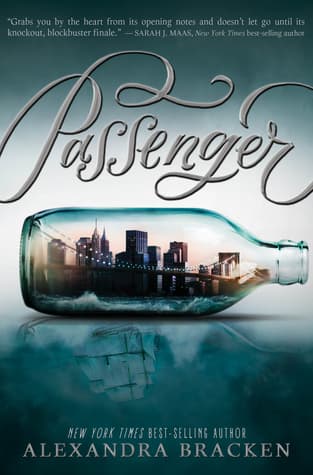
Alexandra Bracken (2016)
Genre
Fantasy / Historical Fiction / Science Fiction / Young Adult / Romance
Reading Time
992 min
Key Themes
See below
Sign in to track this book
A violin prodigy is pulled across centuries by a stranger, forcing her on a dangerous, time-traveling quest with a reluctant sailor to find a hidden legacy and escape a powerful family determined to reclaim a stolen, invaluable artifact.
Etta Spencer, a seventeen-year-old violin prodigy, prepares for her debut concert at Carnegie Hall in present-day New York City. Suddenly, a mysterious woman attacks her and pulls her through a shimmering portal, landing her in an unfamiliar, grand room. She quickly realizes she is no longer in her own time when she meets Julian, who tells her she is a 'Passenger' – a time traveler – and has been brought to 1776. Julian explains that Etta's mother, Rose, is also a Passenger and has been hiding Etta's true background. Etta is confused and scared, struggling to understand the impossible reality of time travel and the dangerous legacy she has unknowingly inherited from a powerful, old family of Travelers known as the Ironwoods.
Julian tells Etta she must find a stolen artifact, a powerful astrolabe called the 'Astrolabe of the Aeons,' which is vital for the Ironwoods to control time travel. He takes her onto a ship, the 'Ironwood,' where she meets Captain Nicholas Carter, a freeborn African-American man bound by a debt to the Ironwood family, specifically to Julian's father, Cyrus Ironwood. Nicholas is at first hostile and wary of Etta, seeing her as another privileged Ironwood. He is tasked with taking her across the Atlantic to the colonies, where their search for the astrolabe is to begin. Etta, desperate to go home, slowly realizes her only way back is to work with Nicholas.
Etta and Nicholas arrive in colonial New York, a city nearing war. Julian, who traveled ahead, meets them and urges Etta to start her search. Their first clue leads them to a hidden space in a large estate, where they find a coded message and a small, old music box. The message hints that the astrolabe's thief, a rogue Traveler named Sophia, Etta's grandmother, is leaving clues specifically for Etta. Nicholas, initially motivated only by his debt and wish for freedom, begins to see Etta as more than just a means to an end, especially as they face the dangers of their mission and the coming revolution.
Following Sophia's cryptic clues, Etta and Nicholas travel to 1887 London. They navigate the city's busy, gaslit streets and meet various people, some helpful, others dangerous. Their search leads them to a hidden society of Travelers and a complex puzzle involving a famous violinist. Julian reappears, seemingly to help them, but his real intentions are unclear. During a tense confrontation, Julian betrays Etta and Nicholas, trying to take the clues they have gathered for himself. They manage to escape, but the betrayal leaves Etta deeply shaken and makes her rely more on Nicholas.
Etta and Nicholas arrive in 1899 Paris, a city full of art and new ideas. Their clues lead them to a famous salon visited by artists and thinkers, where Sophia had left a notable mark. Etta, using her musical talent, deciphers a complex musical piece that holds the next instructions. Here, Etta learns more about Sophia's rebellion against the Ironwoods and why she stole the astrolabe. She starts to understand that Sophia was not just a thief, but someone trying to protect the timeline and, perhaps, Etta herself. This discovery deepens Etta's commitment to the mission, not just to go home, but to understand her family's true history.
The next clue takes Etta and Nicholas to ancient Egypt, specifically 1599 BC. They endure the harsh desert, relying on each other to survive. Here, they discover the astrolabe's origins and its immense power, which can not only allow time travel but also change time itself. They uncover a hidden room with ancient texts and pictures that further explain Sophia's detailed plan. The dangers of this era test their growing bond, and they realize the Ironwoods want the astrolabe not just for control, but possibly for destructive reasons. The historical details of this period also show Nicholas's toughness and knowledge.
Their journey continues to Edo period Japan in 1711. Here, they must navigate a society with strict rules and hidden dangers. The clues lead them to a master swordsman, an old acquaintance of Sophia, who tests their determination and gives them a key piece of the puzzle: a map. This meeting also introduces them to a skilled female warrior who becomes an unexpected ally. Etta, through these experiences, becomes more adaptable and resourceful, learning to fit into different eras and cultures. Nicholas, meanwhile, finds his own skills and knowledge very useful in these diverse historical settings.
Following the map, Etta and Nicholas arrive in the Amazon rainforest in the late 17th century. They brave the dangerous environment and finally find a hidden temple, where the Astrolabe of the Aeons is hidden. However, their success is short-lived as Julian and his forces, having tracked them, appear to claim the astrolabe. A tense standoff follows, during which Julian reveals more about his father's goals and the extent of the Ironwoods' power. Etta and Nicholas must make a hard choice, knowing that simply giving over the astrolabe would be disastrous.
In the fight in the Amazon, Julian manages to take the astrolabe. Etta tries to fight back, but Ironwood guards overpower and capture her. Nicholas, despite his efforts, cannot stop her capture and is badly hurt. He watches helplessly as Julian takes Etta and the astrolabe, disappearing through a time portal. Nicholas is left alone, wounded, and upset, but determined to find a way to rescue Etta and stop the Ironwoods from using the astrolabe for their evil plans. His bond with Etta has become love, and he vows to follow her.
Etta is dragged through time to a future Ironwood base, a cold, high-tech facility. Here, she meets Cyrus Ironwood, Julian's father and the family head. Cyrus reveals his terrifying plan to control time and secure the Ironwoods' absolute power across all eras, using the Astrolabe of the Aeons. Etta learns that her mother, Rose, is also a prisoner here, and that Sophia's entire plan was to keep Cyrus from getting the astrolabe. Etta desperately tries to reach her mother and form a plan to stop Cyrus, realizing the stakes are far higher than just her own return home.
Back in the past, Nicholas, having recovered from his injuries, is focused on finding Etta. He seeks out old allies, including members of the free black community and other Travelers who secretly oppose the Ironwoods. He discovers a resistance network and begins to figure out how to track Etta and the astrolabe. Despite the huge odds, Nicholas's resolve is firm. He understands that his freedom is tied to Etta's, and that stopping Cyrus is not just about personal revenge but about protecting time itself. He prepares for a dangerous journey, determined to rescue the woman he loves.
The story ends with both Etta and Nicholas ready for their battles. Etta, imprisoned but defiant, plans with her mother, Rose, to disrupt Cyrus's plans from inside the Ironwood stronghold. Nicholas, gathering his allies, prepares to launch an assault through time to reach Etta and reclaim the Astrolabe of the Aeons. The stage is set for a multi-temporal conflict, with the fate of all timelines in the balance. The immediate end of their individual journeys remains open, but their commitment to each other and to stopping Cyrus's tyranny is clear, promising a continuation of their fight against the Ironwoods.
The Protagonist
Etta transforms from a sheltered musician into a resourceful and determined time traveler, embracing her heritage and fighting for the greater good.
The Protagonist/Love Interest
Nicholas moves from a life of constrained freedom to actively fighting for a greater cause, finding true love and a purpose beyond his own liberation.
The Antagonist/Supporting
Julian's character reveals the corrupting influence of power and familial pressure, as his initial guidance devolves into outright antagonism.
The Supporting/Mentioned
Sophia's story, revealed through clues, establishes her as a heroic figure who sacrificed her own freedom to safeguard the balance of time.
The Antagonist
Cyrus's character remains steadfast in his ambition, serving as the immovable force Etta and Nicholas must overcome.
The Supporting
Rose's arc involves her forced re-engagement with her past, moving from hiding to actively fighting for her daughter's future.
The Supporting
Li Min serves as a temporary ally, demonstrating the widespread impact of Sophia's network and offering a glimpse into other independent Travelers.
The Supporting/Mentioned
Mr. Beckett provides a foundation of support and wisdom for Nicholas, reinforcing his moral compass and commitment to freedom.
This theme is central, especially through Nicholas Carter's character. He is freeborn but owes a debt to the Ironwoods, always seeking true freedom. His journey with Etta makes him confront what freedom means, not just for himself but for others and for time's integrity. Etta, too, finds herself bound by her heritage, at first wanting freedom from the Traveler world, but eventually choosing to fight for a broader freedom from the Ironwoods' control. The Ironwoods themselves represent the ultimate enslavers, trying to control time and, by extension, all lives within it, as seen in Cyrus's ambition to manipulate history.
““I’d rather die on my feet than live on my knees.””
Etta's struggle with who she is is a core part of the story. She starts as a modern violinist, unaware of her true background as a Traveler and an Ironwood. Her journey forces her to face a legacy she did not ask for, one filled with power, responsibility, and danger. She must reconcile her old life with her new reality, understanding that her identity is deeply linked to her family's history and the choices made by her mother and grandmother. Nicholas also deals with his identity as a free man living under the influence of a powerful, slave-owning family, and how his actions will shape his own legacy.
““You are a Passenger, Etta. And your blood runs deeper than you know.””
The Ironwood family, especially Cyrus, shows this theme. Their great power as Travelers has led to an endless desire for more control, ending in Cyrus's plan to use the Astrolabe of the Aeons to reshape history for their benefit. Julian's ambition and willingness to betray Etta to gain his father's approval also show how power can corrupt. The story explores the moral questions of wielding such power, contrasting the Ironwoods' oppressive use with Sophia's attempt to protect the timeline and Etta's eventual choice to fight against tyranny.
““History is written by the victors, Etta. And the Ironwoods intend to be victorious in every era.””
The growing romance between Etta and Nicholas is central to this theme. Their love grows amidst danger and across centuries, showing its ability to cross time. Their individual sacrifices for each other – Nicholas risking his life and freedom for Etta, and Etta choosing to fight against the Ironwoods instead of just seeking her own way home – highlight how deep their bond is. Sophia's entire plan, set up from the past, also represents a great sacrifice for future generations and the integrity of time, driven by a protective love for her descendants and the world.
““I would follow you to the end of time, Etta Spencer.””
The idea of time travel itself highlights this theme. Every trip Etta and Nicholas make to a different era shows how past events affect the present and future. Sophia's detailed plan, using historical figures and events as clues, emphasizes that history is not separate incidents but a complex whole. The Ironwoods' desire to control time highlights the dangerous results of changing this interconnectedness, suggesting that altering one part can unravel everything. The diverse historical settings show humanity's shared experiences and how cultures and ideas connect across centuries.
““Every choice we make ripples through time, Etta. Every single one.””
A powerful artifact that facilitates and controls time travel.
The Astrolabe of the Aeons is the central MacGuffin of the story. It is an ancient, powerful artifact that not only allows Travelers to move through time but also grants significant control over the timeline itself. Stolen by Sophia Ironwood, its retrieval is the primary objective of both Etta and the Ironwoods. Its immense power makes it a highly coveted and dangerous object, capable of both preserving and destroying the fabric of time, making its possession crucial for determining the fate of all eras. It serves as the catalyst for the entire plot, driving the characters' journeys and conflicts.
Sophia's elaborate trail of puzzles and historical references.
Sophia Ironwood's method of hiding the Astrolabe involves a meticulously crafted series of cryptic clues, puzzles, and historical references spread across different centuries and continents. This device creates a compelling scavenger hunt narrative, forcing Etta and Nicholas to travel to diverse historical settings and engage with various cultures and historical figures. It not only propels the plot forward but also allows for rich world-building and showcases Etta's intelligence and Nicholas's resourcefulness, as they must decipher each clue to progress. This also serves to reveal Sophia's character and motivations posthumously.
The unique method and limitations of temporal displacement.
The novel establishes specific rules for its time travel, primarily through 'Passages' – shimmering portals that allow Travelers to jump between eras. The mechanics involve innate abilities tied to bloodlines, but also the need for precise temporal calculations and, eventually, the Astrolabe for greater control. The limitations and dangers of time travel, such as the risk of being stranded or altering the timeline, are consistently present, adding tension and stakes to their journeys. This device defines the fantastical element of the story and dictates the challenges and opportunities faced by the characters.
A powerful, ancient family controlling the flow of time.
The Ironwood family functions as a powerful, near-monopolistic organization that controls the majority of known time travel. Their vast influence, resources, and ruthlessness serve as the primary antagonistic force. Their desire to maintain and expand their power creates the central conflict. This device highlights themes of control, oppression, and rebellion, as Etta and Nicholas fight against a seemingly insurmountable system. The family's internal dynamics, particularly Julian's loyalty to Cyrus, also add layers of intrigue and betrayal to the narrative.
“The past is a stubborn thing.”
— Elias speaks this to Etta, highlighting the difficulty of altering history and the persistence of past events.
“Every traveler knows that time is not a river, but a sea.”
— A common saying among travelers, emphasizing the non-linear and expansive nature of time when one can traverse it.
“We are all just stories in the end, aren't we?”
— Etta contemplates the ephemeral nature of life and the lasting impact of the narratives we create or become a part of.
“Some things are worth risking everything for.”
— Etta's internal thought, reflecting her growing determination and willingness to make sacrifices for what she believes in and for those she cares about.
“You can’t outrun your past, no matter how many centuries you put between you and it.”
— A recurring theme, often spoken or thought by characters who are haunted by their origins or previous actions.
“The world is a vast, complicated tapestry, Etta. And you are just one thread.”
— Julian advises Etta on the grander scheme of time and the intricate connections within history.
“It’s not about finding the right path, but making your own.”
— Etta's realization about agency and forging her own destiny amidst predetermined paths and expectations.
“There are some things that even time can’t heal.”
— A character's somber reflection on deep-seated wounds and losses that persist despite the passage of centuries.
“History is not a straight line, but a series of ripples.”
— Another analogy used by travelers to describe the interconnected and fluctuating nature of historical events.
“To change the past is to unravel the future.”
— A warning about the dangerous consequences of altering historical events and the potential for paradoxes.
“Home isn't a place, it's a feeling.”
— Etta's evolving understanding of belonging and where she finds comfort, especially as she travels through different eras.
“Sometimes, the greatest strength is knowing when to let go.”
— A moment of introspection for a character facing an impossible choice or a painful truth.
“Every journey begins with a single step, no matter how far you have to go.”
— A classic adage that encourages Etta as she embarks on her daunting quest across time.
“The past is a whisper, the future a dream, and the present is all we truly have.”
— A philosophical reflection on the nature of time and the importance of living in the moment, despite the constant time travel.
Ready to see how well you understood this book? Take our interactive quiz with 10 questions.

Alexandra Bracken is a "New York Times" bestselling author of "The Darkest Minds" series, which was adapted into a feature film. Her other notable works include the "Passenger" series and "In Time." Bracken's fiction often explores themes of power, identity, and survival within fantastical or dystopian settings.







