“He who would live in joy and free from care, let him but think upon the good and fair.”
— A general reflection on the path to happiness.

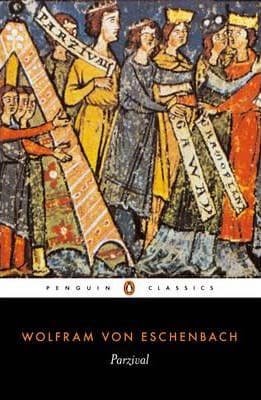
Wolfram von Eschenbach (1883)
Genre
Fantasy / Historical Fiction
Reading Time
1200 min
Key Themes
See below
Sign in to track this book
Parzival's journey, from a naive youth to a knight, takes him through Arthurian courts and jousting, becoming a spiritual quest for humility that leads him to the Grail Stone.
Herzeloyde, Queen of Waleis and Norgals, grieves her husband Gamuret's death in battle. To keep her son, Parzival, from a similar fate, she moves to the secluded forest of Soltane, raising him without knowledge of chivalry, knighthood, or his noble background. Parzival grows up as a simple, innocent boy, skilled at hunting with javelins. One day, he sees a group of knights. Their shining armor and grand presence captivate him, and he immediately wants to become one, despite his mother's pleas and made-up stories about them.
Ignoring his mother's attempts to keep him, Parzival leaves for King Arthur's court, dressed in fool's clothing Herzeloyde gave him as a last effort to deter him. Along the way, he meets Jeschute, a noblewoman. He enters her tent, taking her ring and a kiss, following his mother's naive advice about greeting ladies. He then arrives at Arthur's court, where he sees the Red Knight, Ither, insult Arthur and steal a goblet. Parzival, still in his fool's clothes, challenges Ither, kills him with a javelin, and takes his armor, fulfilling a prophecy and showing his raw skill.
After his chaotic start, Parzival meets Gurnemanz, a wise and experienced knight who mentors him. Gurnemanz teaches Parzival true chivalry, courtly manners, and the importance of kindness and humility, advising him not to ask too many questions. Parzival learns quickly and, now a refined knight, travels to Pelrapeire, the kingdom of Queen Condwiramurs, which is under siege. He defends her kingdom, falls in love with her, and marries her, becoming king. Despite his happiness, a longing for his mother and an unexplained sadness make him leave Condwiramurs to find his destiny.
During his travels, Parzival finds the mysterious Grail Castle, Munsalvaesche, ruled by the sick Fisher King, Anfortas. He is welcomed to a grand feast where he sees a procession of sacred objects, including a bleeding lance and the Holy Grail, a miraculous stone providing food. Anfortas is in great pain from a wound. Parzival, remembering Gurnemanz's advice not to ask too many questions, does not ask about the King's suffering or the procession's meaning. He thinks it is rude to pry. The next morning, he wakes to find the castle empty and is scolded by a squire for his lack of kindness.
Parzival returns to King Arthur's court, now known for his bravery. However, his triumph is short-lived. The Grail messenger, Cundrie la Surziere, appears and publicly shames Parzival for his failure at the Grail Castle. She reveals his silence caused Anfortas to keep suffering and brought shame upon him. Cundrie's harsh words break Parzival's pride and drive him to despair. He turns from God, believing divine justice has left him, and vows to find the Grail again, not for glory, but to make up for his mistake and ease Anfortas's pain. This event marks a major shift in his spiritual journey.
For five long years after Cundrie's curse, Parzival wanders aimlessly through the wilderness, fighting in battles but losing his spiritual path. He becomes more isolated and bitter, convinced God has abandoned him. He neglects his religious duties and focuses only on his quest for the Grail, driven by a desire for redemption rather than faith. During this time, he meets various knights, including Gawain, and takes part in tournaments, but his inner conflict remains. His once strong belief in chivalry and divine purpose is severely tested, leading to a deep spiritual crisis.
On Good Friday, Parzival, still in despair, meets pilgrims who tell him to seek spiritual guidance. He is directed to the hermit Trevrizent, who is, unknown to Parzival, his maternal uncle and Anfortas's brother. Trevrizent reveals the Grail's true history, its divine origin, and the lineage of the Grail Kings. He explains Anfortas's sin (seeking love outside God's will) and the nature of his wound. Trevrizent patiently guides Parzival, helping him understand his past mistakes, the importance of humility, kindness, and true faith. Parzival confesses his sins and reconnects with God.
While Parzival has his spiritual awakening, the story often shifts to the adventures of Gawain, Arthur's nephew. Gawain is a model of courtly chivalry, undertaking many quests and romantic relationships. One of his main challenges involves the Castle of Marvels (Schastel Marveil), a magical fortress with enchanted beds, lions, and other creatures. He faces various trials, including a magical siege and a battle with a mysterious knight, eventually freeing the castle's inhabitants, including the beautiful Orgeluse, and breaking its spells, showing his worldly skill and courtly virtues.
During his five years of wandering, Parzival's wife, Condwiramurs, has given birth to twin sons, Kardeiz and Loherangrin. While Parzival is on his spiritual journey, she faithfully rules her kingdom, Pelrapeire, and raises their children. The story occasionally reminds the reader of her steady love and the family Parzival left behind. The eventual reunion with his wife and children is a key part of his final redemption, highlighting the importance of earthly duties and family love alongside his spiritual quest. This adds depth to his character, showing he is not just a spiritual seeker but also a loving husband and father.
Spiritually cleansed and with new humility and kindness, Parzival is guided back to the Grail Castle, Munsalvaesche. This time, seeing the suffering Anfortas, Parzival asks the question: 'What troubles you, dear uncle?' This simple act of true empathy, not curiosity or politeness, immediately heals Anfortas's wound and lifts the curse from the Grail Kingdom. The castle fills with joy, and the knights celebrate Parzival's return as their prophesied savior.
With Anfortas healed and the Grail Kingdom restored, Parzival is named the new Grail King. His journey from naive boy to misguided knight and finally to a kind, spiritually aware leader ends with this divine appointment. He reunites with his wife, Condwiramurs, and their sons, Kardeiz and Loherangrin, at the Grail Castle, bringing his earthly and spiritual lives into balance. Loherangrin, one of his sons, later becomes the famous Swan Knight, continuing the noble line and legacy of the Grail family.
The Protagonist
From an ignorant, naive boy to a proud but misguided knight, Parzival undergoes a profound spiritual crisis before achieving humility, compassion, and becoming the Grail King.
The Supporting
Herzeloyde attempts to create a perfect, safe world for Parzival, but her efforts are ultimately undone by his innate drive and destiny, leading to her tragic death.
The Supporting
From a suffering, static figure, Anfortas is ultimately healed and freed from his torment by Parzival's compassion, allowing him to retire from his duties.
The Supporting
Trevrizent acts as a catalyst for Parzival's spiritual awakening, imparting the knowledge necessary for his nephew's redemption.
The Supporting
Condwiramurs remains a constant, loving presence, symbolizing the steadfastness of true love and the importance of family, patiently awaiting Parzival's return.
The Supporting
Gawain consistently upholds the ideals of courtly chivalry and serves as a model of worldly excellence, remaining a steadfast figure throughout his adventures.
The Supporting
From a figure of harsh judgment, Cundrie eventually becomes a guide, demonstrating the Grail's capacity for both judgment and guidance.
The Supporting
Gurnemanz successfully transforms Parzival from a wild boy into a skilled knight, fulfilling his role as a worldly mentor.
The Mentioned
Ither serves as a sacrificial figure whose death allows Parzival to claim his first armor and begin his knightly career.
The main theme of Parzival is the hero's journey from spiritual ignorance and pride to humility, kindness, and divine grace. Parzival's first failure at the Grail Castle comes from his literal following of Gurnemanz's advice not to ask questions, along with a lack of empathy for Anfortas's suffering. His later despair and turning from God lead to a period of wandering and spiritual crisis. His meeting with Trevrizent is key, as it gives him the theological understanding and moral guidance needed for his redemption. This journey shows that true knighthood needs not just physical strength but also deep spiritual understanding and a kind heart, leading to his healing of Anfortas and becoming Grail King.
“What troubles you, dear uncle?”
Wolfram von Eschenbach explores the many sides of chivalry, comparing worldly bravery with spiritual purpose. Parzival's early experiences show the superficiality of mere strength and the importance of courtly manners, as taught by Gurnemanz. However, the true test of his knighthood is not on the battlefield, but in his capacity for empathy and his spiritual honesty at the Grail Castle. Gawain's adventures, focused on courtly love and fighting skill, serve as a contrast, showing a more traditional, worldly ideal of knighthood. The story ultimately suggests that true chivalry combines both earthly virtue and a deep spiritual connection, ending with Parzival's role as the Grail King, a protector of both body and soul.
“Where there is no shame and no honor, there is no God.”
Kindness is the highest virtue for spiritual healing and leadership. Parzival's first failure at the Grail Castle is his lack of empathy for Anfortas's suffering, which stops him from asking the healing question. He cares more about courtly manners than true human connection. Cundrie's curse calls out his 'heart of stone.' His long period of wandering and spiritual re-education, especially with Trevrizent, teaches him the deep importance of kindness. When he returns to Munsalvaesche and asks 'What troubles you, dear uncle?' it is an act of pure, selfless empathy that instantly heals Anfortas and restores the Grail Kingdom, showing its power.
“Your heart was too hard, your mouth too dumb, when you saw such suffering.”
The story weaves together fate and individual choice. Parzival's destiny as Grail King is set, hinted at by prophecies and his noble family. However, his journey is not a passive unfolding of fate; his choices, mistakes, and efforts toward redemption shape it. His first failure at the Grail Castle is a result of his own choices, showing free will. Yet, divine guidance, like Trevrizent's appearance and Cundrie's, also helps steer him toward his ultimate purpose. The poem suggests that while destiny may call, individual moral and spiritual growth are essential to fulfilling that destiny.
“He whom God has chosen for the Grail, his name shall be revealed.”
Love, in its forms—family, courtly, and divine—is a key theme. Herzeloyde's strong maternal love, though misguided, shapes Parzival's early life. His love for Condwiramurs is a model of steady courtly love and loyalty, keeping him grounded in the earthly world even as he seeks his spiritual quest. Anfortas's suffering is a direct result of seeking love outside divine will, showing the dangers of misplaced desire. Ultimately, Parzival's journey combines these loves: his kind love for Anfortas, his renewed faith in God, and his reunion with his loyal wife, showing a complete and balanced life.
“Love is a strong cord, which binds many hearts together.”
A miraculous, life-giving stone that is the object of Parzival's quest.
Unlike Chrétien de Troyes's chalice, Wolfram's Grail is a mysterious stone (lapsit exillis) that provides sustenance, youth, and immortality to its keepers. It is a divine object, guarded by a special order of knights, and its power is directly linked to God's will. The Grail serves as the central MacGuffin and spiritual symbol of the entire epic. Its presence at Munsalvaesche, and the suffering of its king, Anfortas, drives Parzival's quest for redemption and spiritual understanding. It represents divine grace and the ultimate spiritual reward for a worthy knight.
The suffering Fisher King whose healing is tied to Parzival's compassion.
Anfortas, the Fisher King, is afflicted with an unhealing wound, a divine punishment for his sin of seeking love outside of God's prescribed path for a Grail King. His physical suffering reflects a spiritual malaise that extends to his entire kingdom. He is a 'soteriological figure' whose healing is contingent upon a specific act of compassion from a pure knight. Anfortas functions as a living symbol of spiritual brokenness and the need for redemption, representing the brokenness of the world that only true empathy and faith can mend.
The specific question Parzival must ask to heal Anfortas and the Grail Kingdom.
The 'question of compassion' ('What troubles you, dear uncle?') is the pivotal plot device that drives Parzival's spiritual arc. His initial failure to ask it, due to naive adherence to Gurnemanz's advice not to be too inquisitive, demonstrates his lack of empathy and spiritual maturity. The subsequent curse and his long quest are a direct consequence of this failure. The eventual asking of the question, born of genuine compassion after his spiritual re-education, signifies his complete transformation and brings about the healing of Anfortas and the restoration of the Grail Kingdom. It emphasizes the power of empathy over mere protocol.
Characters who highlight Parzival's qualities through contrast.
Gawain serves as a foil to Parzival by embodying the ideal of worldly chivalry and courtly success. His adventures showcase traditional knightly virtues, contrasting with Parzival's more profound, spiritual journey. Gurnemanz, while a mentor, also acts as a foil in his limited understanding of spiritual knighthood, his advice inadvertently leading to Parzival's initial failure. These characters emphasize Parzival's unique path, highlighting that his ultimate achievement transcends mere earthly glory and requires a deeper, more spiritual understanding of his purpose.
“He who would live in joy and free from care, let him but think upon the good and fair.”
— A general reflection on the path to happiness.
“Where there is doubt, there is no faith; where there is faith, there is no doubt.”
— A statement about the nature of belief and its opposition to uncertainty.
“The man who seeks the Holy Grail must be a man of purity, without deceit or guile.”
— Describing the necessary qualities for the quest for the Holy Grail.
“Sorrow and joy, they walk hand in hand; one cannot know the one without the other.”
— A commentary on the duality of human experience and emotion.
“Courage is not the absence of fear, but rather the judgment that something else is more important than fear.”
— A definition of true courage in the face of danger.
“He who learns from his mistakes is wise, but he who avoids them altogether is a master.”
— A reflection on wisdom gained through experience and foresight.
“The heart of a knight is measured not by his strength, but by his mercy.”
— Highlighting mercy as a key virtue for a true knight, beyond physical prowess.
“Though the path be long and fraught with woe, a steadfast heart will see you through.”
— An encouragement to perseverance despite difficulties encountered on a journey.
“Love, if it be true, can conquer all, even the greatest sorrow and the deepest fall.”
— Emphasizing the powerful and redemptive nature of true love.
“A man's true worth is shown not in his triumphs, but in how he rises after his failures.”
— A statement on resilience and character building through adversity.
“The world is full of wonders, for those who have the eyes to see them.”
— A call to appreciation and observation of the beauty and marvels around us.
“To be silent when one should speak is a fault; to speak when one should be silent is a greater one.”
— A piece of advice regarding the appropriate timing for speech and silence.
“Honor is a fragile thing, easily broken, but hard to mend.”
— Reflecting on the delicate nature of honor and its lasting impact once tarnished.
“The greatest treasure a man can find is not gold or jewels, but a loyal friend.”
— Prioritizing the value of friendship above material wealth.
Ready to see how well you understood this book? Take our interactive quiz with 10 questions.

Biography coming soon.







