“America was a new, raw, unfinished place, and the people were new, raw, unfinished people.”
— Olivier's initial impressions upon arriving in the United States, reflecting on the stark contrast with Europe.

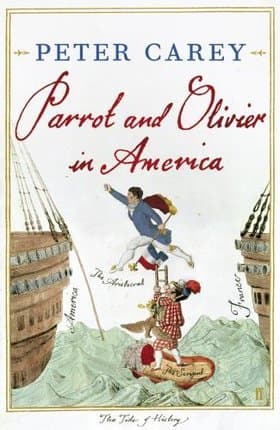
Peter Carey (2009)
Genre
Literary Fiction / Historical Fiction
Reading Time
10-12 hours
Key Themes
See below
Sign in to track this book
A reclusive French aristocrat, haunted by revolution, journeys through early 19th-century America, observed and illustrated by his enigmatic English companion, Parrot.
Olivier-Jean-Baptiste de Clarel, a young French aristocrat, arrives in America in the early 19th century. His mother sent him away to escape the political turmoil following the French Revolution, believing America offers safety and an opportunity to secure his inheritance. John Parrot, a printer and engraver who was once a servant in the de Clarel household, accompanies Olivier. Parrot, a man of humble origins but keen intellect, is tasked with chronicling Olivier's journey. Their arrival in New York immediately highlights the cultural clash between Olivier's refined European sensibilities and the raw, democratic spirit of the burgeoning American nation. Olivier is initially overwhelmed and disoriented by the new world, while Parrot observes everything with a critical, yet often amused, eye.
While Olivier attempts to navigate his new life, Parrot secretly begins to write his own narrative, separate from the official chronicle he is meant to keep for Olivier's mother. This parallel account reveals Parrot's own fascinating and often traumatic past, including his childhood in England, his apprenticeship as a printer, and his experiences with radical political movements. He recounts how his family was entangled with a secret society, and how he was forced to flee England. Parrot's writing is sharp, observant, and frequently ironic, offering a stark contrast to Olivier's more naive perspective. Through his secret writing, Parrot also explores his complex feelings towards Olivier — a mixture of duty, resentment, and a strange, almost paternal affection. His narrative often critiques the very idea of aristocracy and inherited privilege.
Olivier is settled on a large American estate, a property arranged by his mother, which he hopes will provide stability. However, he finds the lack of established social hierarchy and the informal manners of the Americans unsettling. Used to the rigid class distinctions of France, Olivier struggles to understand a society where a servant might speak to him as an equal. He attempts to establish a semblance of his former life, but his efforts often meet with confusion or amusement from the locals. Parrot, in contrast, finds the American freedom both exhilarating and perplexing. He observes Olivier's attempts to maintain his aristocratic demeanor with a mix of sympathy and critical detachment, often noting the inherent absurdity of Olivier's expectations in this new world.
Throughout Olivier's time in America, he receives frequent and lengthy letters from his mother, Mme. de Clarel. These letters are not merely updates; they are directives, filled with her opinions, anxieties, and expectations for Olivier's future. She micromanages his finances, his social interactions, and even his thoughts. Her presence, though distant, is a constant force in Olivier's life, shaping his decisions and reinforcing his sense of duty and his aristocratic identity. Parrot, who often reads these letters (sometimes before Olivier), understands the psychological hold Mme. de Clarel has on her son. He observes how Olivier's mother's influence prevents him from fully embracing the American experience, keeping him tied to the old world and its customs.
Olivier and Parrot encounter Mr. Scat, a rough-hewn, self-made American who embodies many of the qualities Olivier finds most perplexing and distasteful about the new world. Scat is direct, unrefined, and fiercely independent, a stark contrast to the European gentlemen Olivier is accustomed to. Their interactions highlight the cultural chasm between the old world aristocracy and the emerging American identity. Scat's practical approach to life, his bluntness, and his disregard for social niceties are unsettling to Olivier, who is accustomed to elaborate rituals and polite circumlocution. Parrot, however, finds Scat fascinating, recognizing in him a powerful, if sometimes unsettling, force of the new American character. This encounter forces Olivier to confront the realities of American society directly.
Olivier, possessing a gentle and artistic temperament, attempts to pursue his interest in drawing and painting while in America. He seeks to capture the landscapes and the people around him, but his artistic vision is often rooted in European aesthetic traditions, which don't always translate well to the American context. His attempts to depict the raw beauty and the unique character of America are often met with bewilderment or indifference by the locals. Parrot, with his own background as an engraver and his understanding of visual representation, observes Olivier's artistic struggles. He recognizes Olivier's genuine talent but also sees how his aristocratic upbringing and European sensibilities limit his ability to truly connect with and represent the American spirit. This highlights Olivier's ongoing struggle to find his place and purpose.
The past continues to influence both Olivier and Parrot. Olivier is haunted by the French Revolution, the violence and chaos that forced him into exile, and his mother's formidable expectations. He carries the weight of his aristocratic lineage and the perceived decline of his class. Parrot, meanwhile, is tormented by his own past in England, particularly his involvement with radical groups and the lingering guilt from events he witnessed and participated in. He frequently alludes to a 'secret' or a 'crime' that forced him to flee. These past traumas manifest in different ways: Olivier's sometimes paralyzing indecision and Parrot's cynical, watchful demeanor. Their shared history, though experienced from different social strata, binds them together in their exile.
As Parrot continues to write his secret narrative, he gains a stronger sense of his own identity and purpose, distinct from his role as Olivier's chronicler and former servant. His observations of American society, combined with his reflections on his own past, lead him to question established hierarchies and the nature of truth and representation. He begins to see the world not just through Olivier's eyes, but through his own unique, often subversive, lens. This growing intellectual and emotional independence creates a subtle shift in his relationship with Olivier. While still bound by duty and a complex loyalty, Parrot increasingly asserts his own perspective, even if only within the pages of his private journal, hinting at a potential future where he might fully break free.
A central theme of the novel is the fluid and often performative nature of identity, particularly as it relates to social class. Olivier clings to his aristocratic identity, even as the world around him, especially America, offers no clear space for it. He struggles to define himself outside of his inherited status. Parrot, on the other hand, constantly reinvents himself through his narratives, moving from servant to printer to chronicler, and ultimately, to a self-aware author. The novel explores how both characters construct their identities through the stories they tell themselves and others, and how these narratives are influenced by their social positions. The American context, with its emphasis on self-creation, provides a unique backdrop for this exploration, forcing both men to re-evaluate who they are.
The novel is structured around two distinct and often conflicting narratives: Olivier's perspective (primarily through his letters and Parrot's official chronicle) and Parrot's secret, unfiltered journal. This dual narration raises questions about reliability and the subjective nature of truth. Parrot frequently contradicts or subtly undermines Olivier's interpretations of events, offering his own cynical or more pragmatic viewpoint. The reader is constantly forced to weigh the two accounts, piecing together a more complete, yet still ambiguous, picture. This narrative device highlights how personal biases, social standing, and individual experiences shape perception, making it clear that there is no single, objective truth to be found in their shared story. The reader becomes an active participant in constructing the reality of their journey.
The American landscape itself acts almost as a character in the novel. Its vastness, wildness, and burgeoning cities profoundly impact both Olivier and Parrot. For Olivier, America is a bewildering, sometimes frightening, place that lacks the familiar comforts and structures of Europe. He struggles to find beauty in its raw, untamed nature and is often repulsed by what he perceives as its crudeness. For Parrot, America represents a different kind of freedom and possibility, a place where he can potentially shed the shackles of his past. He observes the emerging American character — its independence, ingenuity, and sometimes its vulgarity — with a keen, critical eye. The novel uses their differing reactions to America to explore the nascent national identity and its contrast with the old world.
The relationship between Olivier and Parrot is the emotional core of the novel. It evolves from a master-servant dynamic into something far more intricate and interdependent. While Olivier remains Parrot's nominal employer, Parrot often acts as his protector, confidante, and even his surrogate parent. There is a deep, unspoken bond between them, forged through shared experiences and their mutual exile. However, their relationship is also marked by resentment, class tension, and a constant power struggle, particularly evident in Parrot's secret narrative where he freely critiques Olivier. Despite their differences, they are linked, each serving as a mirror for the other, reflecting their respective vulnerabilities and strengths. Their journey in America forces a redefinition of their roles and their connection.
Both Olivier and Parrot are engaged in a search for meaning and a sense of belonging in a world that has been turned upside down for them. Olivier, stripped of his traditional aristocratic context, struggles to find a purpose beyond his mother's expectations. He yearns for recognition and a place where his refined sensibilities are appreciated. Parrot, having escaped a tumultuous past, seeks a new identity and a safe haven, though he remains deeply cynical about the possibility of true belonging. Their journey across America is not just geographical but existential, a quest to define themselves in a place that offers both immense opportunity and disorientation. They both grapple with what it means to be truly free and where one can truly call home.
The act of writing itself is a central theme and plot device. Parrot is a printer and an engraver, familiar with the mechanics of producing text and images. His dual role as Olivier's official chronicler and his secret, subversive autobiographer highlights the power of the written word to construct reality, shape identity, and challenge official narratives. The novel demonstrates how writing can be a tool for control (Mme. de Clarel's letters), a means of self-discovery (Parrot's journal), and a way to preserve or distort history. Through Parrot's craft and his narratives, Carey explores the impact of literature and the media on human perception and the construction of historical truth, suggesting that history is always a subjective telling.
The novel concludes without a definitive resolution for either Olivier or Parrot, emphasizing the ongoing nature of their journeys and their personal evolution. While Olivier has undergone significant changes, he remains somewhat tied to his past and his mother's influence, yet also shows glimmers of greater independence. Parrot, through his extensive writing, has achieved self-awareness and a clearer sense of his own voice and agency. The future for both men in America remains open-ended, filled with possibilities but also continued challenges. The ending suggests that their lives will continue to be intertwined, even if their paths diverge, and that their experiences in the new world have irrevocably altered their identities and their understanding of themselves and each other. The true 'summary' of their lives is still being written.
The Protagonist
Olivier gradually sheds some of his aristocratic rigidity, slowly beginning to question his inherited beliefs and showing glimmers of independent thought, though he remains profoundly shaped by his past.
The Protagonist/Narrator
Parrot moves from a subservient role to a more independent and self-aware individual through his act of writing, ultimately finding his own voice and purpose outside of Olivier's shadow.
The Supporting
Mme. de Clarel remains largely static, a formidable and unchanging force representing the old world's grip on Olivier.
The Supporting
Mr. Scat remains a consistent representation of American individualism and pragmatism, serving as a catalyst for Olivier's discomfort and Parrot's observations.
The Supporting
This character remains a stable representation of American social norms, providing a consistent environment for Olivier's cultural struggles.
The Supporting/Mentioned
These characters serve as a collective backdrop, illustrating the broader social landscape of America and its impact on the protagonists.
The Mentioned
These characters are static figures from the past, crucial for understanding Parrot's backstory and motivations.
The Mentioned
These figures are episodic, serving to illustrate Olivier's personal and romantic development (or lack thereof) within the American context.
The novel portrays the cultural collision between aristocratic Europe and democratic America in the early 19th century. Olivier's bewilderment at the lack of social hierarchy, the informal manners, and the practical nature of Americans contrasts with his ingrained European sensibilities. Scenes where Olivier struggles to comprehend the directness of Mr. Scat or the egalitarian attitude of American servants exemplify this clash. Parrot, while more adaptable, also observes these differences with a critical eye, highlighting the distinct values and emerging identities of both worlds.
“What struck him most was the absence of deference, the way a stable boy might look you in the eye as if you were his equal.”
The novel explores how identity is shaped by birth, social class, and personal narrative, particularly in exile and a new nation. Olivier struggles to maintain his aristocratic identity in a country that doesn't recognize it, constantly looking to his mother's letters for affirmation. Parrot, by contrast, actively invents and reinvents himself through his secret writing, shedding his past as a servant and a radical to become an author and observer. America, as a land of self-made men, provides fertile ground for this exploration, forcing both characters to question who they are and who they can become outside of their predetermined roles.
“A man could choose to be a new man here, if he had the wit for it, and the will to forget.”
The dual narrative structure—Olivier's perspective (filtered through Parrot's official chronicle) and Parrot's secret journal—highlights the subjective nature of truth and the power of storytelling. Parrot's cynical, often contradictory account challenges Olivier's more naive interpretations, forcing the reader to constantly question what is 'real' and whose version of events can be trusted. The novel demonstrates how personal biases, class perspectives, and individual experiences shape the telling of history and the construction of personal identity. Parrot, as a printer and writer, is aware of how narratives are crafted and manipulated.
“There are two histories to every life, the one you tell, and the one that is true. And sometimes, even the true one is a lie.”
At its heart, the novel is an examination of the complex and evolving relationship between master and servant, and the broader implications of class. Olivier and Parrot's dynamic, while rooted in traditional roles, is challenged by their shared exile and the egalitarian spirit of America. Parrot's secret narrative reveals his resentment and critical observations of Olivier and his aristocratic class, even as he performs his duties. The novel explores the psychological bonds, power imbalances, and hidden emotional currents that exist between individuals from different social strata, showing how these relationships can be both oppressive and deeply intertwined.
“He was my master, yes, but who was truly serving whom, in that wild and foreign land?”
Both Olivier and Parrot are exiles, driven from their homelands by political upheaval or personal pasts, and their journey in America is a search for belonging. Olivier yearns for the familiarity and structure of his lost aristocratic world, struggling to feel at home in the raw American landscape. Parrot, while more adaptable, also seeks a place where he can be truly free and safe from his past. The novel explores the psychological impact of displacement, the longing for a 'home' that may no longer exist, and the challenge of forging a new identity and sense of belonging in a foreign land. Their shared experience of exile creates a unique bond between them.
“To be an exile is to carry your homeland like a ghost, always present, always just out of reach.”
The story is told through two distinct and often conflicting perspectives.
The novel employs a dual narrative structure, presenting events primarily from Olivier's perspective (often through his letters or Parrot's official chronicle) and, crucially, from John Parrot's secret, unfiltered journal. This device immediately establishes a tension between perceived truth and subjective reality, forcing the reader to constantly interpret and weigh the two accounts. It highlights the unreliability of a single narrator and allows for a deeper exploration of class differences, personal biases, and the psychological states of both protagonists, enriching the story's complexity and thematic depth.
Letters serve as a crucial means of communication and control.
Mme. de Clarel's frequent and detailed letters to Olivier act as a significant epistolary element. These letters are not merely plot devices; they are a direct manifestation of her control over Olivier's life, even from afar. They dictate his finances, his social interactions, and his very sense of purpose. For Olivier, they are a lifeline to his past and a source of constant anxiety; for Parrot, they are documents to be observed and critiqued. This device effectively demonstrates the enduring power of the old world over the new, and the psychological hold of a domineering parent, without her physical presence.
Parrot's role as a recorder of events, both official and secret.
Parrot's designated role as Olivier's chronicler, tasked with documenting his American journey for his mother, is a central plot device. This role provides the framework for the 'official' narrative, but it is Parrot's secret, unauthorized journal that truly drives the story's depth. His position as both participant and detached observer allows him unique insight into Olivier's character and the American landscape. This device enables the novel to explore themes of historical record, personal interpretation, and the hidden lives of those in subservient positions, ultimately revealing the power dynamics inherent in who gets to tell the story.
The use of humor and satire to highlight cultural clashes.
Peter Carey frequently employs cultural irony to underscore the vast differences between European aristocracy and American democracy. Olivier's earnest attempts to maintain his 'proper' European demeanor in the face of American informality often lead to situations that are both humorous and poignant. Parrot's internal monologue is particularly rich with ironic observations, subtly mocking Olivier's naiveté and the absurdities of class distinction. This device not only provides comic relief but also serves to sharpen the novel's critique of inherited privilege and the social constructions of identity, making the thematic points more accessible and engaging.
The physical environment reflects the characters' internal states and the nation's identity.
The vast, wild, and ever-changing American landscape serves as a powerful symbolic backdrop. For Olivier, it represents a chaotic, untamed force that mirrors his own internal disarray and sense of displacement. For Parrot, it symbolizes potential freedom and reinvention, though also a source of cynical observation about human nature. The transition from established European cities to the raw American wilderness, and then to its burgeoning towns, reflects the characters' own psychological journeys and the nation's nascent identity. The landscape is not merely a setting but an active element shaping their experiences and perceptions.
“America was a new, raw, unfinished place, and the people were new, raw, unfinished people.”
— Olivier's initial impressions upon arriving in the United States, reflecting on the stark contrast with Europe.
“The past is a foreign country; they do things differently there.”
— A general reflection on the historical setting and the differences in societal norms and understanding.
“I was a man of parts, a collection of useful skills, not a whole.”
— Parrot's self-assessment as a man who serves others, highlighting his fragmented sense of self.
“Every portrait is a lie, a carefully constructed fiction.”
— Parrot's cynical view on the nature of portraiture and representation, particularly as he sketches Olivier.
“To be an artist is to live with a constant, gnawing hunger for the world.”
— Olivier's contemplation on the drive and ambition inherent in artistic creation.
“The new world was not merely new, it was unmade, unwritten, waiting for its story.”
— A rumination on the potential and blank slate offered by America for those arriving from Europe.
“Memory is a trickster, a conjurer of shadows and half-truths.”
— Parrot's thoughts on the unreliability of memory, especially when recounting his own past.
“He carried his past like a physical burden, a sack of stones on his back.”
— Describing Olivier's struggle to escape his aristocratic European background and its expectations.
“There is a freedom in being unknown, a terrifying, exhilarating freedom.”
— Olivier's experience of anonymity in America, contrasting it with his life in Europe.
“The greatest art is not in painting what you see, but in painting what you know.”
— Parrot's philosophy on art, emphasizing internal understanding over mere external observation.
“We are all merely footnotes in someone else's grander narrative.”
— A pessimistic reflection on individual significance within the larger sweep of history.
“To invent oneself, that was the true American dream, the true American lie.”
— A critical observation on the myth of self-invention in America, implying its inherent falsehoods.
“The landscape itself seemed to demand a new language, a new way of seeing.”
— Olivier's struggle to capture the unique American landscape in his art, finding European conventions inadequate.
“He was a man caught between two worlds, neither truly belonging to either.”
— Describing Olivier's liminal state, straddling his European heritage and his American experience.
Ready to see how well you understood this book? Take our interactive quiz with 10 questions.

Peter Carey may refer to:Peter Carey, Australian rules player for Glenelg Peter Carey, English footballer Peter Carey (historian), British historian of south-east Asia Peter Carey (novelist), Australian novelist Peter Carey (umpire), Australian rules umpire "Black Peter" Carey, a fictional character in The Adventure of Black Peter, a Sherlock Holmes story by Sir Arthur Conan Doyle







