“The past is a stubborn ghost, always lurking, always ready to reach out and grab you when you least expect it.”
— Reflecting on the lingering impact of past events on the present.

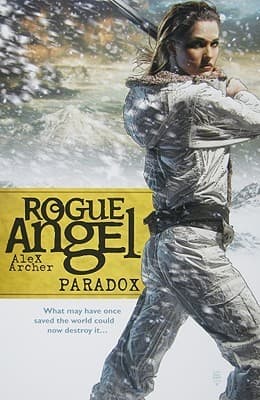
Alex Archer (2009)
Genre
Thriller / Fantasy / Mystery
Reading Time
320 min
Key Themes
See below
Sign in to track this book
An archaeologist's skeptical search for Noah's Ark on Mount Ararat turns into a deadly conspiracy among fundamentalists, where the legendary vessel holds not salvation, but a sinister secret that threatens humanity.
Archaeologist Annja Creed, known for her work with ancient artifacts and dangerous expeditions, is approached by Mr. Smith, who represents a covert U.S. government agency. He offers her a large sum to lead an expedition to Mount Ararat in Eastern Turkey, a politically unstable region. The mission is to investigate a massive, boat-like object detected by satellite, which some believe is Noah's Ark. Annja doubts the Ark's authenticity but is curious about the scientific mystery and the resources offered. She accepts, knowing the assignment carries risks beyond typical archaeological digs.
Annja travels to Turkey and meets her expedition team. To her dismay, many in the group are heavily armed fundamentalist Christians, led by Reverend Elias Thorne. Thorne believes the object is Noah's Ark and sees its discovery as a divine sign. Also present are Dr. Lena Petrova, a brilliant but distant geologist, and a small group of U.S. military personnel, including Captain Ben Carter, who appears to have his own agenda. Annja immediately senses tension and conflicting motives within the group, making her wary of the journey.
The expedition begins its difficult climb up Mount Ararat. The journey is dangerous, not only from the treacherous mountain terrain and harsh weather but also from the ongoing civil unrest. They encounter clashes between Turkish government forces and Kurdish separatists, forcing Annja to use her survival skills and diplomacy to navigate checkpoints and avoid direct conflict. The fundamentalists' aggressive behavior often increases tensions with locals, and Annja constantly mediates disputes and protects vulnerable team members from both outside threats and internal friction.
After days of climbing, the team reaches the object's location near the summit. They find a colossal, boat-shaped structure, partly encased in ice and rock, much larger than any known vessel. Its sheer size and age surprise Annja, challenging her scientific skepticism. Dr. Petrova's initial geological scans confirm the object is not a natural formation but an ancient, man-made structure of immense proportions. Reverend Thorne's followers celebrate, convinced they have found the Ark, while Annja considers the implications of such a discovery.
Using specialized equipment, the team breaches the structure's icy exterior. Inside, they find not the crude, wooden interior of a primitive ark, but a complex, technologically advanced vessel. The walls are made of an unknown, metallic material, and intricate carvings and symbols cover the surfaces. The air is surprisingly preserved, and strange, glowing mechanisms suggest a power source. This discovery shatters the fundamentalists' expectations and puzzles Annja and Dr. Petrova, who realize they are dealing with something far beyond biblical archaeology. The true nature of the 'Ark' begins to become clear.
As the team explores the mysterious interior, the true motives of some members begin to show. Captain Carter and his military group reveal they are under orders to secure the technology within the 'Ark' for the U.S. government, no matter the cost. Reverend Thorne, angered by the non-biblical nature of the discovery, becomes erratic and fanatical, believing the vessel to be a tool of the devil. He urges his followers to destroy the 'Ark' rather than let its secrets fall into what he sees as unholy hands, creating a dangerous split within the group.
While examining the complex internal mechanisms, Dr. Petrova, driven by scientific curiosity, tries to activate one of the glowing devices. Despite Annja's warnings, Petrova succeeds, and the 'Ark' begins to hum with an ominous energy. Strange lights flicker, and the structure's internal systems activate, revealing a control panel and a large, central chamber. The activation triggers dangerous events, trapping some team members and causing the structure to react unpredictably, raising fears of catastrophic failure.
Through Dr. Petrova's analysis and the strange events, Annja realizes the 'Ark's' true nature. It is not Noah's Ark but an ancient, technologically advanced vessel capable of manipulating time and space. The symbols and mechanisms suggest it is a device designed to displace objects or beings across different time periods, perhaps for an unknown civilization's survival. The activation has destabilized the mountain and created temporal distortions, threatening to engulf everyone in an unpredictable temporal shift. The 'Ark' is a paradox, a vessel out of time, capable of both salvation and destruction.
With the mountain crumbling and temporal anomalies appearing, Annja must fight on multiple fronts. Reverend Thorne and his remaining followers, convinced the 'Ark' is demonic, try to sabotage the vessel and prevent anyone from leaving, leading to violent clashes with Captain Carter's soldiers, who are still trying to secure the technology. Annja, focused on saving innocent lives, works with Dr. Petrova to stabilize the 'Ark' long enough to create an escape route. She uses her combat skills and knowledge of ancient mechanisms to navigate the collapsing structure, facing both human enemies and the dangerous effects of the activated time device.
In a final struggle, Annja disables the 'Ark's' most dangerous functions while fighting off the remaining fanatics and soldiers. Dr. Petrova makes a sacrifice, staying behind to contain the 'Ark's' temporal energies, allowing Annja and a few survivors to escape the collapsing mountain. The 'Ark' is ultimately consumed by the mountain's collapse; its true fate, whether destroyed or merely displaced, remains unclear. Annja returns from Mount Ararat, changed by the encounter, knowing she has witnessed a discovery that will challenge humanity's understanding of history and technology, a secret she must now carry.
The Protagonist
Annja begins as a skeptic, forced into a mission she doubts, but her encounter with the 'Ark' expands her understanding of reality and solidifies her role as a protector of truth and innocent lives.
The Antagonist
Thorne starts as a hopeful religious leader, but his rigid beliefs lead him to fanatical destruction when faced with a truth that shatters his understanding.
The Supporting
Petrova evolves from a detached scientist to a self-sacrificing ally, finding a deeper purpose in her pursuit of truth.
The Antagonist/Supporting
Carter remains steadfast in his mission, representing the unyielding pursuit of power, and ultimately fails to secure the desired technology.
The Mentioned/Supporting
Smith remains a consistent, shadowy force, representing the unseen hand of government power and its pursuit of technological advantage.
The Supporting
Their collective arc shows a descent from hopeful pilgrims to violent fanatics under Thorne's influence.
The Mentioned
They serve as an external threat, representing the turbulent geopolitical environment.
This theme is central to the narrative, particularly through the clash between Reverend Thorne's fundamentalist beliefs and Annja's scientific skepticism, alongside Dr. Petrova's pure scientific pursuit. The 'Ark' itself becomes the ultimate test, as its true nature as an advanced, time-displacing vessel shatters Thorne's biblical expectations, leading him to destructive fanaticism. Annja, while initially skeptical, is open to new truths, embodying the scientific spirit of discovery and adaptation in the face of the unknown. The story explores how different worldviews react when confronted with an undeniable, yet incomprehensible, reality.
““Some truths are too grand for human understanding, Annja. Others are too dangerous for human hands.””
The 'Ark' is an incredibly powerful device, capable of manipulating time and space. The narrative explores the dangers that arise when such power is pursued without ethical consideration. Captain Carter and the U.S. government seek to weaponize or control the technology for national interest, while Reverend Thorne wishes to destroy it to preserve his worldview. Both approaches highlight the destructive potential of human ambition and fear when confronted with immense power. Annja's role is often to prevent this power from being misused or falling into the wrong hands, underscoring the responsibility that comes with discovery.
““This isn't just an artifact, Annja. It's a bomb waiting to go off, and everyone wants to light the fuse.””
Annja Creed's character embodies the theme of survival and adaptation. She constantly navigates treacherous environments, from the hostile political landscape of Turkey to the collapsing, time-warped interior of the 'Ark.' Her ability to think on her feet, utilize her diverse skills, and adapt to rapidly changing and dangerous circumstances is key to her and others' survival. The theme extends to the scientific understanding of the 'Ark' itself, requiring the team to adapt their preconceptions and beliefs to comprehend its true nature, or face destruction, as Thorne does.
““The mountain doesn't care what you believe. It only cares if you can survive.””
The discovery of the 'Ark' fundamentally challenges human understanding of history and reality. If a time-displacing vessel existed in antiquity, it means that established historical narratives, including religious texts, might be incomplete or misinterpreted. The 'Ark' itself is a paradox, an object that shouldn't exist in its discovered context, forcing characters to confront the possibility of alternate histories or advanced ancient civilizations. This theme invites readers to question what they know about the past and the limits of human knowledge, suggesting that the universe holds far more mysteries than previously imagined.
““What if everything we thought we knew about history... was wrong?””
The mysterious object that drives the plot and motivates the characters.
The 'Ark' on Mount Ararat serves as the primary MacGuffin. Initially presented as potentially Noah's Ark, its true nature as a time-displacing, technologically advanced vessel is gradually revealed. It is the central object of desire and conflict, motivating Reverend Thorne's religious zeal, Captain Carter's government mission, and Annja and Dr. Petrova's scientific curiosity. Its enigmatic properties and the differing desires to control, destroy, or understand it propel the entire narrative, even though its ultimate purpose beyond being a plot driver remains partially ambiguous.
Characters whose true motives or allegiances are hidden, creating suspense.
This device is prominently used through Captain Ben Carter and, to a lesser extent, Reverend Elias Thorne. Carter initially appears as a straightforward security detail but is later revealed to be an agent with a covert mission to secure the 'Ark's' technology. Thorne's initial religious fervor devolves into dangerous fanaticism, making him an unpredictable and hostile force within the team. These hidden agendas and shifting loyalties create internal conflict, suspense, and unexpected betrayals, forcing Annja to constantly reassess who she can trust and adding layers of danger beyond the external threats.
A looming deadline or impending disaster that creates urgency.
The 'ticking clock' manifests in several ways throughout the narrative. Firstly, the ongoing civil unrest and impending war in Eastern Turkey create a constant external pressure, threatening to cut off the expedition or engulf them in conflict. More critically, once Dr. Petrova activates the 'Ark,' the vessel itself becomes a ticking clock, destabilizing the mountain, causing temporal anomalies, and threatening to self-destruct or displace everyone into an unknown timeline. This escalating danger forces Annja and the remaining survivors to act quickly and decisively, amplifying the tension and stakes of their escape.
Hints that suggest the true, non-biblical nature of the 'Ark'.
The story employs subtle foreshadowing to hint that the 'Ark' is not what it seems. Early descriptions of the satellite anomaly might mention its unusual size or composition, subtly differing from expected biblical accounts. Annja's initial scientific skepticism, despite her accepting the mission, also foreshadows that the discovery will align more with her scientific background than religious prophecy. The very title 'Paradox' itself serves as a meta-foreshadowing, indicating that the 'Ark' will present a contradiction to established beliefs, setting up the reveal of its advanced, time-displacing nature.
“The past is a stubborn ghost, always lurking, always ready to reach out and grab you when you least expect it.”
— Reflecting on the lingering impact of past events on the present.
“Sometimes, the only way to move forward is to acknowledge that some doors are meant to stay closed. Even if you're holding the key.”
— Considering the difficulty of letting go of unresolved issues.
“Truth isn't a single, shining beacon. It's a mosaic, and every piece you find only makes the picture more complex.”
— Grappling with the elusive and multifaceted nature of truth in a mystery.
“The greatest paradox is that the things we fear the most are often the things that define us.”
— A philosophical observation about confronting personal demons.
“There's a fine line between a coincidence and a pattern. And in our world, that line is often blurred beyond recognition.”
— Investigating a series of seemingly unrelated events.
“Some secrets are like viruses. They lie dormant, waiting for the right moment to erupt and infect everything around them.”
— Discussing the destructive potential of long-held secrets.
“You can run from your past, but you can't outrun the shadows it casts.”
— A character attempting to escape their history, only to find it catching up.
“The world isn't always what it seems. Sometimes, the most ordinary façade hides the most extraordinary horrors.”
— Uncovering a hidden, sinister reality beneath a mundane surface.
“Hope is a dangerous thing in a place like this. It gives you something to lose.”
— A character facing overwhelming odds and the risk of despair.
“Every choice carves a new path, but sometimes, all paths lead to the same inevitable destination.”
— Contemplating free will versus destiny in a complex situation.
“Silence can be louder than any scream when it hides a truth too terrible to speak.”
— Interpreting the meaning behind unspoken secrets and fear.
“The greatest battles are often fought not with swords or guns, but within the confines of one's own mind.”
— A character struggling with internal conflict and psychological challenges.
“Sometimes, the only way to find what you're looking for is to stop looking and let it find you.”
— A moment of serendipity or a shift in approach during an investigation.
“Belief is a powerful weapon, but it can also be the most dangerous blindfold.”
— Examining the double-edged nature of conviction and faith.
Ready to see how well you understood this book? Take our interactive quiz with 10 questions.

Alex Archer is a fiction author celebrated for his gripping narratives. His notable works include 'Day of Atonement,' 'Paradox,' and 'Footprints,' which showcase his skill in crafting suspenseful and thought-provoking stories. Archer's writing is characterized by its intricate plots and compelling character development.







