“All that you touch, you change. All that you change, changes you. The only lasting truth is change.”
— A core tenet of Earthseed, the religion founded by protagonist Lauren Oya Olamina.


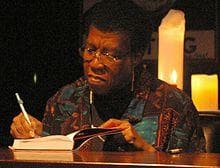
Octavia E. Butler (1998)
Genre
Fantasy / Spirituality / Science Fiction
Reading Time
900 min
Key Themes
See below
Sign in to track this book
In a shattered 2030s California, a prophetess leading humanity to the stars must first survive enslavement, reclaim her stolen daughter, and battle a tyrannical regime to forge a new world from the ashes.
The novel opens in 2032 with Lauren Olamina, now known as Olamina, establishing the Earthseed community called Acorn in the northern California wilderness. She is married to Bankole and they have a baby daughter, Larkin. The community, made of diverse individuals drawn by Lauren's philosophy, Earthseed, focuses on self-sufficiency, education, and colonizing space. They build defenses, cultivate food, and develop their own educational system based on Earthseed's ideas. Life at Acorn is challenging but purposeful, as they create a sustainable and safe haven in a world ravaged by climate change, economic collapse, and social unrest, always wary of outside dangers.
As Acorn thrives, the political situation outside worsens. A fundamentalist Christian movement, led by the charismatic and ruthless President Andrew Steele Jarret, gains power, promising a return to traditional values and American greatness. Jarret's followers, 'Christian America' or 'Crusaders,' are increasingly violent and intolerant of other belief systems. Their rhetoric demonizes 'heathens' and 'apostates,' making communities like Acorn targets. Lauren and her people understand the threat this movement poses, reinforcing their defenses and preparing for attacks, knowing their peaceful existence is fragile.
In 2035, Christian America 'Crusaders' attack Acorn. They breach the defenses, kill many, and enslave the survivors. Lauren is captured, witnessing the destruction of everything she built. In the chaos, her daughter, Larkin, is taken from her, a trauma that will affect Lauren for decades. The remaining Acorn members are branded with crosses, forced into labor camps, and subjected to brutal indoctrination, their Earthseed beliefs suppressed. Lauren is branded and made to work under harsh conditions, but her spirit of resistance remains.
Lauren is held in a 're-education' camp, forced into servitude alongside other captured Acorn members and 'heathens.' She is separated from Bankole and her other companions. Despite constant surveillance and harsh treatment, Lauren secretly teaches Earthseed principles to those around her, offering hope and purpose. She uses her observational skills to understand the camp's operations and identify potential allies. Her determination to find Larkin and rebuild Earthseed fuels her resilience, even as she witnesses the brutality and dehumanization from the Christian America regime. She waits for an escape opportunity.
After brutal enslavement, Lauren escapes the camp. She evades her captors and begins a perilous journey through the ravaged landscape, searching for survivors and her daughter. She encounters some former Acorn community members who also escaped or were released, including her brother, Marcus. These reunions are bittersweet, marked by shared trauma. They begin to form a new, smaller Earthseed group, dedicated to survival and the re-establishment of their faith, while continuing to search for Larkin and other lost members.
Lauren, now calling herself Olamina again, dedicates her life to two goals: finding Larkin and spreading Earthseed. She travels extensively, using aliases to gather information about her daughter's whereabouts, often leaving a trail of Earthseed converts. Her brother, Marcus, helps her establish new communities and spread the word. They face constant dangers from Christian America remnants, bandits, and general instability. Despite the pain of Larkin's absence, Lauren's faith in Earthseed strengthens, becoming a beacon for others seeking meaning and hope.
The narrative shifts to journal entries from Larkin, renamed Asha Vere by her adoptive Christian America family. She grows up believing she is the biological daughter of her adoptive parents, raised in the strict, fundamentalist environment of Christian America. She is taught that Earthseed is a dangerous cult and her biological mother, Lauren, is an evil apostate. Asha struggles with her identity and faith, often feeling a subtle disconnect from the rigid doctrines. Her entries show her internal conflicts, her artistic inclinations, and her eventual journey towards questioning the narratives she has been given.
Over decades, Earthseed, under Lauren's leadership and her growing number of disciples, expands significantly. It becomes a widespread movement, with communities across the continent, offering an alternative to crumbling society and the oppressive Christian America regime. Lauren's teachings, emphasizing change, adaptation, and humanity's destiny among the stars, appeal to many disillusioned individuals. Earthseed gains political and economic influence, becoming a force in the rebuilding world. Lauren, now an elder, continues to preach and organize, always hoping to find Larkin.
As an adult, Asha Vere, now an artist, uncovers discrepancies in her past. She meets individuals who knew her as Larkin and gradually pieces together the truth about her origins and her biological mother, Lauren Olamina. This revelation is unsettling, forcing her to confront the lies she was raised with and the propaganda against Earthseed. She begins to secretly read Earthseed texts and understand her mother's philosophy. This discovery leads her to question her upbringing and the values of Christian America, starting a personal crisis and a shift in her worldview.
Decades after Acorn's fall, Earthseed is a powerful, organized religion and a major economic and political force. They have accumulated the resources and technology to launch their first interstellar mission, a generational starship. This is the culmination of Lauren's lifelong vision and the central idea of Earthseed: that 'God is Change' and humanity's destiny is among the stars. Preparations for the launch are immense, involving countless Earthseed members. Lauren, now an old woman, oversees the final stages, knowing her life's work is about to bear its ultimate fruit.
Just before the starship launch, Lauren and Asha Vere finally meet. It is a complex and emotionally charged reunion, with decades of separation, misunderstanding, and pain between them. Asha, having come to terms with her past and her mother's philosophy, acknowledges Lauren and her legacy. Lauren, though aged, still embodies the strength and vision that founded Earthseed. The novel ends with the successful launch of the starship, carrying the first generation of Earthseed travelers to the stars. Lauren dies shortly after, her life's mission fulfilled, leaving a legacy that continues through her followers and, finally, through a reconciled relationship with her daughter, Asha.
The Protagonist
Lauren evolves from a community leader to a global religious and political figure, ultimately fulfilling her lifelong dream of interstellar colonization while grappling with the personal tragedy of her lost daughter.
The Supporting/Protagonist (through journal entries)
Asha transforms from an indoctrinated child of Christian America to an independent artist who embraces her true heritage and reconciles with her biological mother's legacy.
The Supporting
Bankole remains a steadfast supporter of Lauren and Earthseed, facing the destruction of his family and community with resilience, though his ultimate fate is not fully detailed.
The Supporting
Marcus transforms from a younger brother into a dedicated and influential minister and leader within the Earthseed movement, carrying on Lauren's legacy.
The Antagonist
Jarret rises to significant political power, orchestrating widespread oppression, only to see his regime eventually wane, though his influence leaves lasting scars.
The Supporting
Dominique remains a loyal and supportive member of the Earthseed community, contributing to its growth alongside her husband, Marcus.
The Supporting
Travis endures the destruction of Acorn and continues to support Lauren, demonstrating loyalty and resilience in the face of adversity.
The Supporting
Justin transforms from a traumatized former slave into a dedicated and influential leader within the Earthseed movement.
The Supporting
Zahra survives the destruction of Acorn and becomes a steadfast and influential member of the expanding Earthseed community.
This theme is central, especially through Larkin/Asha Vere's storyline. Raised under a false identity and indoctrinated into Christian America, Asha's journey to uncover her true parentage and understand Earthseed is an exploration of identity. Lauren also grapples with her identity as a mother separated from her child, and how that shapes her leadership. The novel suggests that true identity is not just inherited but actively discovered and embraced, often through questioning established narratives and challenging one's upbringing.
““I was born Asha Vere. I am Larkin Olamina. I am a daughter of Earthseed. I am a child of God, and God is Change.””
The novel explores the function and power of faith, contrasting Earthseed with Christian America. Earthseed, founded on the principle that 'God is Change' and humanity's destiny is among the stars, is an adaptive, forward-looking religion focused on survival and evolution. Christian America represents a rigid, fundamentalist faith that uses fear and oppression to control. The book examines how faith can be a source of hope, resilience, and community, or a tool for violence, manipulation, and stagnation, showing the societal impact of different belief systems.
““The only lasting truth is Change. God is Change.””
In a world ravaged by climate change, economic collapse, and social unrest, survival is a constant struggle. Lauren's Earthseed philosophy is about adaptation and preparing for change, both societal and environmental. The destruction of Acorn and the enslavement of its members force them to adapt to unimaginable circumstances, physically and psychologically. Earthseed's long-term success comes from its ability to evolve, learn, and persist despite overwhelming odds, demonstrating humanity's capacity for resilience and ingenuity in the face of existential threats.
““All that you touch, you change. All that you change, changes you. The only lasting truth is Change.””
The bond between parent and child, and the impact of its loss, is a central emotional part of the novel. Lauren's lifelong quest to find Larkin, and her grief over her abduction, drives much of her personal motivation. Asha's journey to understand her biological mother and the truth of her past shows the complex nature of familial love and the lasting scars of separation. This theme explores the sacrifices parents make, the enduring nature of their love, and the psychological toll of forced separation and deception.
““I have a daughter. I had a husband. I had a home. Now I have a memory, a hope, and a mission.””
The rise of President Jarret's Christian America is a warning about authoritarianism and religious extremism. The regime's use of violence, indoctrination, and suppression of dissent illustrates how easily a society can fall to demagoguery when faced with chaos and fear. The forced 're-education' camps, the branding of 'heathens,' and the systematic dehumanization of non-believers depict the destructive consequences of intolerance and the erosion of fundamental freedoms in the name of a singular, oppressive ideology.
““They want to save us from ourselves, from our sins, from our freedom.””
The story is primarily told through Lauren Olamina's journal entries, interspersed with her daughter's.
The novel is framed as Lauren Olamina's memoir, written in first-person journal entries, offering intimate access to her thoughts, struggles, and the development of Earthseed. This personal perspective allows the reader to experience the harsh realities of the world through her eyes and understand the philosophical underpinnings of her faith. Periodically, the narrative shifts to journal entries from her daughter, Larkin/Asha Vere, providing a crucial contrasting viewpoint and gradually revealing the truth from a different perspective, creating dramatic irony and tension as the reader knows more than Asha.
The narrative follows Lauren's timeline while periodically incorporating her daughter's retrospective journal entries.
While Lauren's narrative progresses chronologically from the founding of Acorn to the launch of the starship, Asha Vere's journal entries are inserted throughout, often reflecting on events that occurred earlier in her life. This creates a dual timeline effect, allowing the reader to follow Lauren's struggles in the present while simultaneously gaining insight into Asha's upbringing and eventual discovery of her past. This device builds suspense, reveals character motivations from different angles, and highlights the long-term consequences of the initial traumatic event of Larkin's abduction.
Lauren's inherited condition of feeling others' pain and pleasure.
Lauren's hyperempathy syndrome, inherited from her mother, is a significant character trait and plot device. It compels her to physically experience the pain and pleasure of others, making her acutely sensitive to suffering and injustice. This condition is both a burden and a source of her profound compassion, driving her to create a better world. It also makes her particularly vulnerable to violence, yet simultaneously strengthens her resolve to alleviate suffering. It is a constant reminder of the interconnectedness of humanity and a catalyst for her philosophical development.
Poetic tenets of Lauren's religion that guide the narrative and characters.
The Earthseed verses are poetic aphorisms and philosophical statements that form the core of Lauren's religion. They are frequently quoted throughout the novel, serving as chapter epigraphs and guiding principles for the characters. These verses encapsulate the themes of change, adaptation, destiny, and the human imperative to colonize space. They function as a powerful literary device, providing insight into Lauren's worldview, reinforcing the central tenets of Earthseed, and offering a moral and philosophical framework against which the characters' actions and the unfolding events are measured.
“All that you touch, you change. All that you change, changes you. The only lasting truth is change.”
— A core tenet of Earthseed, the religion founded by protagonist Lauren Oya Olamina.
“God is change. Shape God.”
— The central, repeated mantra of Earthseed, emphasizing human agency in a chaotic world.
“We are Earthseed. The life that perceives itself changing.”
— Lauren defining the purpose and identity of her religious community.
“The only thing that makes life possible is permanent, intolerable uncertainty; not knowing what comes next.”
— Reflection on the instability of the dystopian United States and human resilience.
“Choose your leaders with wisdom and forethought. To be led by a coward is to be controlled by all that the coward fears.”
— A warning about political leadership in the context of a fascist regime rising in America.
“We are all Godseed, but no more or less so than any other aspect of the universe.”
— Part of Earthseed's teachings on human connection to the divine and nature.
“Belief initiates and guides action—or it does nothing.”
— Lauren emphasizing that faith must be active to have meaning in Earthseed.
“In order to rise from its own ashes, a phoenix first must burn.”
— Metaphor for the necessity of destruction and suffering to enable renewal.
“The child in each of us knows paradise. Paradise is home. Home as it was or home as it should have been.”
— Reflection on loss and nostalgia in a broken world, from Lauren's perspective.
“We are born not with purpose, but with potential.”
— Earthseed teaching on human capability and the absence of inherent destiny.
“There is no end to what a living world will demand of you.”
— Observation on the relentless challenges of survival in a collapsing society.
“Kindness eases change.”
— A simple, practical advice from Earthseed on navigating difficult transitions.
“The universe is God's self-portrait.”
— Poetic Earthseed concept describing the divine as embodied in all existence.
“When vision fails, direction is lost. When direction is lost, purpose may be forgotten.”
— Warning about the dangers of losing sight of goals in times of crisis.
Ready to see how well you understood this book? Take our interactive quiz with 10 questions.
Biography coming soon.







