“What do you want a picture of, little girl? Something you can remember when you're an old woman?”
— Addie meets Moze for the first time, mistaking him for a photographer.

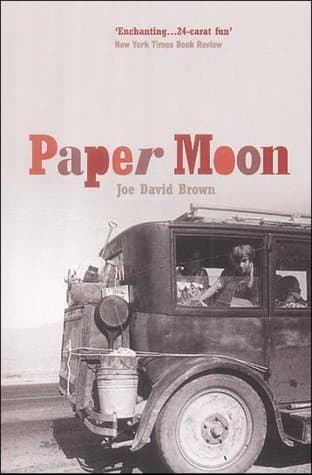
Joe David Brown (2003)
Genre
Historical Fiction / Young Adult
Reading Time
6-8 hours
Key Themes
See below
Sign in to track this book
In the desolate Dust Bowl, an 11-year-old orphan and a charming con man, who may or may not be her father, embark on a hilarious and heartwarming journey through the Deep South, leaving a trail of mischief and self-discovery.
The story opens in Depression-era Mississippi with the funeral of Addie Bundren's mother. Eleven-year-old Addie, now an orphan, is approached by Moses Pray, a Bible salesman and con artist, who claims to have known her mother. Town gossips imply that Moses might be Addie's biological father. Moses, a drifter, feels a reluctant sense of responsibility for Addie and is pressured by the local undertaker to take her to her Aunt Billie in St. Louis. Despite his initial reluctance and clear discomfort with children, Moses agrees, seeing a potential for profit along the way. Addie, sharp-witted and pragmatic, quickly understands their connection and the journey ahead.
Moses, with Addie in tow, begins his usual con: selling personalized Bibles to recently bereaved widows, pretending he knew their deceased husbands. Their first target is a wealthy widow named Mrs. Higgins. Moses attempts his usual act, but Mrs. Higgins is shrewder than he anticipates and quickly sees through his lies, threatening to call the sheriff. Addie, observing from a distance, interjects with a fabricated story about Moses being a war hero and her father, needing money for her mother's urgent medical care. Her quick thinking and innocent demeanor disarm Mrs. Higgins, who, touched by Addie's plea, gives them a substantial sum of money. This incident marks the beginning of their unlikely partnership.
Moses and Addie continue their journey, crossing the border into Alabama. Their dynamic begins to solidify, with Moses teaching Addie the finer points of his con game. They travel in Moses's dilapidated car, sleeping in cheap motels or by the roadside. Addie is an astute observer and a quick learner, often anticipating Moses's next move or correcting his mistakes. They share meager meals, often purchased with their ill-gotten gains. Despite the rough circumstances and Moses's gruff exterior, a nascent bond begins to form between them, built on mutual need and a shared understanding of survival in a harsh world. Addie, though still wary, starts to see Moses as more than just a con artist.
In a small town, Moses, always looking for a quick buck, gets involved with a local whiskey runner. He agrees to transport a load of illegal alcohol across state lines for a fee. Addie, ever vigilant, senses the danger but Moses dismisses her concerns. They are pursued by a rival gang of bootleggers, leading to a high-speed chase through dusty backroads. The car is shot at, and they narrowly escape a violent confrontation. Addie, though frightened, remains calm and even helps Moses navigate their escape. This incident further solidifies her trust in his ability to get them out of trouble, and his grudging respect for her resilience.
Their con game eventually attracts the attention of a persistent local sheriff in a small Mississippi town. The sheriff, suspicious of Moses's activities, attempts to question them. Moses, with Addie's quick thinking, manages to evade serious trouble. Addie, using her innocent appearance and a well-rehearsed story, distracts the sheriff while Moses disposes of incriminating evidence or slips away. This encounter highlights the constant threat of the law and the need for their combined wit and deception to remain free. It also shows Addie's growing confidence in her role as Moses's accomplice and protector.
While traveling, Moses picks up Trixie Delight, a seemingly glamorous but ultimately shallow woman, and her silent, long-suffering maid, Imogene. Trixie is a carnival dancer and prostitute, and Moses is immediately smitten. Addie, however, sees through Trixie's facade and resents her presence, feeling she disrupts their established routine and threatens her bond with Moses. Trixie's lavish spending habits quickly deplete their funds, and her demanding nature creates tension within the makeshift family. Addie's jealousy and protective instincts towards Moses become evident, even as she maintains a stoic exterior.
Frustrated by Trixie's presence and her negative influence on Moses, Addie decides to take matters into her own hands. She observes Trixie's flirtatious behavior with other men and devises a cunning plan. Addie orchestrates a situation where Trixie is caught in a compromising position with a wealthy local man, making it appear as though Trixie is stealing from him. Moses, witnessing the scene, is forced to confront Trixie. The resulting argument and exposure of Trixie's true character lead to her abrupt departure, much to Addie's quiet satisfaction. This event shows Addie's sharp intelligence and her determination to protect her interests, and Moses'.
After Trixie's departure, Moses and Addie attend a local carnival. Moses, always a gambler at heart, tries his luck at a rigged carnival game, convinced he can beat the system. Despite Addie's warnings, he loses a significant portion of their hard-earned money. This setback forces them to return to their primary con of selling Bibles to widows, starting almost from scratch. The incident highlights Moses's impulsive nature and the precariousness of their existence. Addie, though disappointed, remains pragmatic and quickly adapts to their renewed need for income, showing her resilience and commitment to their partnership.
As Moses and Addie continue their journey north, they gradually approach St. Louis, the destination where Addie is supposed to be delivered to her Aunt Billie. The impending separation creates an unspoken tension between them. Moses, despite his earlier desire to be rid of Addie, has grown accustomed to her presence and her invaluable assistance in his cons. Addie, for her part, has found a sense of belonging and purpose with Moses, a stark contrast to her previous life as an orphan. The journey has forged an unbreakable, if unconventional, bond, making the prospect of parting increasingly difficult for both of them.
Moses finally reaches St. Louis and, with a heavy heart, delivers Addie to the address of her Aunt Billie. The aunt is a stern, proper woman who clearly has little warmth for the unexpected arrival of her niece. Addie, after surveying her new, sterile environment and her uninviting relative, makes a decisive choice. She refuses to stay, realizing that her place is no longer with a distant relative but with the only person who has truly cared for her, in his own gruff way, and who has given her a sense of adventure and purpose. She runs back to Moses, who is already driving away.
As Moses drives away from Aunt Billie's house, a figure appears in his rearview mirror: Addie, running after the car, determined not to be left behind. Moses, initially surprised, stops the car. Addie, without a word, climbs back in, her face resolute. The unspoken agreement between them is clear: their journey together is not over. Moses, with a rare, subtle smile, acknowledges their continued partnership. They drive off into the horizon, ready for new adventures and new cons, their unconventional family unit now firmly established, signifying a future where they will navigate the world together, bound by their shared experiences and mutual affection.
The Protagonist
Addie transforms from a stoic, detached orphan into a confident and integral partner in Moses's schemes, ultimately choosing her unconventional family with him over a conventional one.
The Protagonist/Mentor
Moses evolves from a solitary drifter who sees Addie as a responsibility to a surrogate father figure who genuinely cares for and relies on her.
The Antagonist/Supporting
Trixie serves as a catalyst, highlighting Addie's cunning and Moses's susceptibility, ultimately being removed from the narrative, solidifying Addie's position.
The Supporting/Mentioned
Imogene's arc is minimal, serving primarily to underscore Trixie's character and the harsh realities of the Depression.
The Supporting
Aunt Billie serves as the final test of Addie's choice, her unwelcoming nature solidifying Addie's decision to stay with Moses.
The Mentioned
Mrs. Higgins's role is brief but pivotal, serving as the catalyst for Addie's direct involvement in Moses's schemes.
The Mentioned
The Sheriff serves as an external antagonist, driving the plot forward through chase sequences and near-misses.
The novel explores how family is not solely defined by blood, but by shared experiences, loyalty, and mutual support. Addie, an orphan, finds a deeper sense of belonging with the con man Moses Pray, who may or may not be her father, than she does with her biological aunt. Their unconventional partnership, built on shared cons and survival, evolves into a familial bond. Scenes where Addie chooses to run after Moses's car rather than stay with her cold aunt powerfully illustrate that home and family are found where one feels truly seen and valued, even amidst a life of crime.
“Blood don't make family, kid. Doing for each other does.”
Set during the Great Depression, the story portrays the harsh realities of economic hardship and the lengths people go to survive. Moses and Addie constantly rely on their wits, charm, and deception to make ends meet, whether through elaborate Bible cons or quick thinking to escape the law. Addie's rapid adaptation to the life of a con artist, her ability to think on her feet, and her pragmatic approach to difficult situations exemplify this theme. Their entire journey is a testament to human resilience and the ingenuity born out of necessity.
“You gotta be quicker than a cat and slicker than a snake if you wanna make it in this world.”
The novel explores the nuanced morality of con artistry, particularly when performed by desperate people during desperate times. Moses and Addie's cons, while illegal, are often directed at those who can afford it or are designed to evoke sympathy rather than outright theft. The story subtly questions whether their actions are truly 'wrong' given their circumstances and the lack of other options. Addie, despite her young age, quickly understands deception and uses it for their mutual survival, blurring the lines between right and wrong in a world that offers few 'right' choices.
“Sometimes a lie is just a way to get to the truth, or at least to what you need.”
Addie's journey is a rapid coming-of-age story. Having lost her mother, she is thrust into an adult world of cons, danger, and moral ambiguity. Her innocence is quickly shed as she learns the tricks of the trade, witnesses adult relationships (like Moses and Trixie), and makes difficult choices. However, her maturation is not a tragic loss, but rather a development into a strong, independent, and capable young woman. The experiences on the road, though unconventional, equip her with invaluable life skills and an understanding of human nature, shaping her into a resilient survivor.
“You learn quick when your belly's empty and the sheriff's on your tail.”
A journey across the Depression-era South that serves as the primary structural framework.
The entire novel is structured as a road trip, with Moses and Addie constantly moving from one town to the next. This device allows for episodic encounters with various characters and situations, showcasing different facets of Depression-era life and the challenges of their con artistry. The continuous movement prevents them from settling down, emphasizing their transient existence and reinforcing the theme of survival. The road trip also serves as a physical manifestation of their emotional journey, as their bond strengthens with each mile traveled.
Moses's primary con of selling Bibles to widows, which Addie enhances and expands upon.
Moses's signature con—pretending to be a friend of a deceased husband to sell a personalized Bible to the grieving widow—is a central plot device. It provides a recurring source of income and conflict, but also highlights their moral ambiguities. Addie's involvement elevates this device, as she learns to manipulate the con, adding emotional layers and often saving Moses from failure. This 'con within a con' dynamic showcases their evolving partnership and Addie's burgeoning talent for deception, making their illicit activities more successful and engaging.
The ambiguity surrounding Moses Pray's biological relationship to Addie.
The question of whether Moses is Addie's biological father is a subtle but potent plot device. It provides the initial impetus for their journey and adds a layer of emotional complexity to their relationship. The ambiguity allows their bond to develop organically, based on shared experience and mutual affection, rather than a predetermined familial tie. This device keeps the reader engaged in the emotional undercurrents of their interactions and reinforces the theme that family is forged, not just born, especially in challenging circumstances.
“What do you want a picture of, little girl? Something you can remember when you're an old woman?”
— Addie meets Moze for the first time, mistaking him for a photographer.
“You got to make a living, Addie. Everybody does. And sometimes it ain't pretty.”
— Moze explaining the necessity of his con artistry to Addie.
“Folks believe what they want to believe, especially when it saves 'em a little money or a little trouble.”
— Moze reflecting on human nature and the effectiveness of his cons.
“She was a small, skinny girl, but she had a will like a mule and a mind like a steel trap.”
— Narrator describing Addie's determined personality.
“Sometimes the truth ain't as important as what people think the truth is.”
— Moze imparting a lesson on perception versus reality to Addie.
“You got to look like you belong, even when you don't. That's half the trick.”
— Moze teaching Addie how to blend in and appear legitimate.
“Every once in a while, even a hard case like me gets a little soft around the edges.”
— Moze expressing a rare moment of vulnerability or sentimentality.
“We ain't family by blood, but we're family by circumstance, and that's just as strong, maybe stronger.”
— Addie reflecting on her bond with Moze despite their lack of biological relation.
“The road was a teacher, and it taught you things you'd never learn in a schoolhouse.”
— Description of the lessons learned through their itinerant lifestyle.
“A good story can make people forget their troubles, even if it's just for a little while.”
— Moze discussing the power of storytelling, often used in his cons.
“She learned to count money faster than she could count her blessings, and that was saying something.”
— Narrator highlighting Addie's quick adaptation to their life of cons.
“There's always someone who's got more than they need, and someone who needs more than they got.”
— Moze's cynical observation about wealth distribution and opportunity for cons.
“Home ain't always a place with four walls. Sometimes it's just the person beside you.”
— Addie's evolving understanding of home and belonging.
“The dust of the road got into your shoes, your clothes, and sometimes, it felt like it got into your soul.”
— A vivid description of the harsh realities of their transient existence.
Ready to see how well you understood this book? Take our interactive quiz with 10 questions.







