“The greatest wealth is health.”
— A common proverb repeated within various tales.

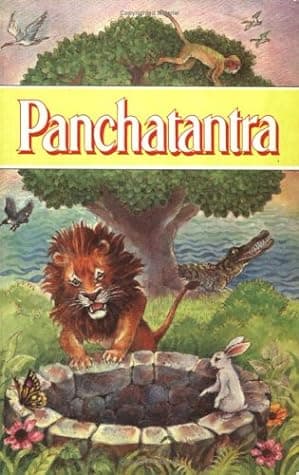
Genre
Fantasy / Children's / Philosophy
Reading Time
258 min
Key Themes
See below
Sign in to track this book
Through animal fables, the ancient Panchatantra shares lessons in human nature and wise conduct, guiding readers toward success.
King Sudarshan of Mahilaropya worries about his three uneducated princes. He asks the Brahmin Vishnusharma to teach them 'Nitishastra' (the science of wise conduct). Vishnusharma agrees and starts with 'The Loss of Friends'. This main story introduces Pingalaka, a powerful lion, and Sanjeevaka, an ox. Sanjeevaka, after being left by his owner, becomes Pingalaka's close friend. However, Karataka and Damanaka, two jackals who serve Pingalaka, become jealous of Sanjeevaka's influence. Damanaka, wanting more power, plans to separate the lion and the ox, believing it will restore his own position in the court.
Damanaka, using cleverness and flattery, tells Pingalaka that Sanjeevaka has bad intentions, claiming the ox plans to take the lion's throne. At the same time, he warns Sanjeevaka that Pingalaka is tired of their friendship and plans to kill him. Damanaka exaggerates small incidents and misinterprets actions, creating a web of lies that builds their distrust. He plays on Pingalaka's pride and Sanjeevaka's fear, making sure neither talks to the other to clear things up. This allows the misunderstanding to grow into full animosity. His actions show how malicious talk can destroy strong bonds.
Convinced by Damanaka's lies, both Pingalaka and Sanjeevaka become paranoid and hostile. The once close friends now see each other as dangerous enemies. The tension grows until it leads to a violent fight. Pingalaka, angry and feeling betrayed, attacks Sanjeevaka. Though Sanjeevaka is hesitant to fight his friend, he must defend himself. The battle is fierce, but Pingalaka overpowers and kills Sanjeevaka. Damanaka watches, pleased with his success, as the tragedy unfolds. This secures his return to influence in the lion's court, but at a great cost.
Vishnusharma continues his lessons with the second book, 'The Gaining of Friends'. This book features a crow named Laghupatanaka, a mouse named Hiranyaka, a turtle named Mantharaka, and a deer named Chitranga. They are all friends who live together. One day, Chitranga the deer is caught in a hunter's trap. Laghupatanaka the crow sees him and tells Hiranyaka the mouse, who is good at gnawing through ropes. Hiranyaka frees Chitranga. But as they celebrate, Mantharaka the turtle, who had slowly arrived, is captured by the same hunter. The friends then plan to free Mantharaka, showing the power of unity and cooperation.
To rescue Mantharaka, the friends work together. Laghupatanaka the crow suggests a clever trick. Chitranga the deer pretends to be dead, lying still near a pond, while Laghupatanaka sits on his head, pretending to peck him. Hiranyaka the mouse hides nearby. When the hunter, seeing the 'dead' deer, leaves the captured turtle to get the deer, Hiranyaka quickly gnaws through the turtle's ropes. As the hunter approaches the deer, Chitranga jumps up and runs away. The frustrated hunter returns to find the turtle gone as well. The four friends reunite, their bond stronger from their successful effort to overcome trouble and protect each other. This shows the value of true friendship and smart thinking.
The third book, 'Of Crows and Owls', tells of the constant conflict between these two species. The owls, led by their king Meghavarna, repeatedly attack the crows, led by their king Virata. The crows suffer many losses and must find shelter. Virata's chief minister, Sthirajeevi, plans a cunning and controversial way to defeat the owls. He suggests pretending to betray his own king and joining the owls' camp to gain their trust, then leading them to their destruction. Despite initial hesitation and moral concerns from some crow ministers about such a deceptive tactic, Virata agrees to Sthirajeevi's plan, driven by revenge and the survival of his kingdom.
Sthirajeevi, pretending to be an injured outcast crow, approaches the owls' king Meghavarna. He tells a convincing story of being betrayed and abandoned by his own king, Virata, and asks for refuge and an alliance with the owls. Meghavarna, despite warnings from his wise minister Raktaksha, is persuaded by Sthirajeevi's apparent sincerity and his promise of information about the crows. Sthirajeevi gets into the owls' secret mountain fortress. Once inside, he learns their weaknesses. At the right time, he signals his fellow crows, who then set fire to the owls' cave during the day when they cannot see in sunlight. The owls are trapped and die in the flames, leading to the crows' decisive, but deceitful, victory.
The fourth book, 'Loss of Gains', tells of a monkey named Rakta-mukha who lives on a rose-apple tree by a river. A crocodile named Karalamukha befriends the monkey, and they often share fruit. The crocodile regularly takes the fruits home to his wife. The crocodile's wife, jealous of the monkey's constant access to such sweet fruits, pretends to be sick and demands her husband bring her the monkey's heart, believing it to be the sweetest thing because of the monkey's fruit diet. Karalamukha, conflicted but loyal to his wife, reluctantly agrees to her cruel request, starting a plan to betray his friend.
Karalamukha invites Rakta-mukha for a feast at his home across the river, offering to carry him on his back. Halfway across, the crocodile reveals his true intention, explaining his wife's demand for the monkey's heart. Rakta-mukha, realizing the danger, quickly thinks of a plan. He pretends surprise and disappointment, telling Karalamukha that he keeps his heart safely stored in the rose-apple tree and if the crocodile had told him earlier, he would have brought it. He then convinces the foolish crocodile to return to the tree to get the 'heart'. Once back on the tree, Rakta-mukha jumps off, scolds the crocodile for his treachery, and escapes, saving his life through his quick thinking.
The fifth and final book, 'Ill-Considered Action', tells the tale of a Brahmin and his wife. The Brahmin's wife has a son and also raises a mongoose as a pet, treating it like her own child. One day, she leaves her infant son asleep in the house, trusting the mongoose to guard him, while she goes to get water. While she is away, a snake enters the house and approaches the baby. The loyal mongoose bravely fights and kills the snake, saving the infant's life. The mongoose, with blood on its mouth from the fight, rushes out to greet the Brahmin's wife when she returns, eager to show its heroic deed.
Seeing the mongoose with bloody jaws, the Brahmin's wife, without thinking, concludes that the mongoose killed her baby. Overcome with grief and anger, she immediately throws her water pot at the mongoose, killing it. Only when she enters the house does she find the dead snake near her unharmed baby, and the truth of the mongoose's heroism becomes clear to her. Overwhelmed by regret and despair, she realizes her terrible mistake, a result of her hasty action. This story is a warning against acting impulsively and judging situations without proper thought.
One of the stories within 'Ill-Considered Action' features a poor weaver who dreams of becoming a king and marrying a princess. In his dream, he orders his soldiers to clear the streets for his procession. In his sleep, he wildly moves his arms, accidentally hitting his wife who is sleeping next to him. She wakes up, startled and angry, and hits him back, leading to a domestic quarrel. This simple tale shows the dangers of unchecked ambition, living in fantasies, and acting without considering immediate reality and consequences.
The Protagonist/Narrator
He remains a consistent figure of wisdom, successfully transforming the ignorant princes into knowledgeable leaders through his narrative teachings.
The Antagonist
Starts as a disgruntled minister, successfully manipulates events to regain power, but at the cost of friendship and moral integrity.
The Supporting
Begins as a benevolent leader, becomes suspicious and violent due to manipulation, ultimately destroying a valuable friendship.
The Supporting
Starts as a loyal friend, becomes a victim of misunderstanding and manipulation, leading to his demise.
The Protagonist
Remains a steadfast and strategic friend, instrumental in the group's successful rescues.
The Protagonist
Consistently provides practical solutions and uses his unique skills for the benefit of his friends.
The Protagonist/Anti-hero
Starts as a loyal minister, devises and executes a morally questionable but effective plan to secure victory for his king.
The Protagonist
Begins as a trusting friend, but develops into a shrewd survivor through quick thinking when faced with treachery.
The Antagonist
Starts as a friend, becomes a betrayer due to his wife's influence, and ultimately loses his friend and gains nothing.
The Supporting
Acts impulsively to a perceived threat, resulting in deep regret and a harsh lesson about hasty judgment.
The Supporting
Performs a heroic act of protection, but is tragically killed due to a misunderstanding, serving as a cautionary example.
The main theme of the Panchatantra is 'Nitishastra' – the science of wise conduct, statecraft, and practical life wisdom. Vishnusharma states his goal is to teach this knowledge to the princes. Each story, whether about friendship, enmity, or quick thinking, illustrates a part of this wisdom. For instance, 'Loss of Friends' shows the dangers of being easily fooled and trusting bad advice, while 'The Gaining of Friends' shows the strength of unity and cooperation. The collection emphasizes that success and well-being come from thoughtful action, discernment, and ethical behavior, not brute force or impulsiveness. This directly addresses the king's challenge of his uneducated sons.
“For by no other means can the ignorant be made wise save by the teaching of tales.”
Many stories in the Panchatantra feature characters who use deceit and manipulation for personal gain, often with bad results. Damanaka the jackal in 'The Loss of Friends' is a clear example, destroying a strong friendship with lies and rumors. Sthirajeevi's cunning plan in 'Of Crows and Owls', while leading to victory for the crows, also shows the moral complexities and destructive nature of deep treachery. These stories warn against trusting those who cause conflict, flattering words, and the hidden danger of betrayal, in both personal relationships and state affairs.
“A shrewd man should never reveal his secret plans. If they are divulged, they are sure to fail.”
In contrast to deceit, the collection also supports genuine friendship and cooperation. 'The Gaining of Friends' is the clearest example, where the crow, mouse, turtle, and deer, despite their different abilities, work together to save each other from danger. Their strong loyalty and willingness to help show that mutual support, strategic planning, and collective action can overcome big challenges. This theme emphasizes that strong bonds, built on trust and shared purpose, are valuable in dealing with life's difficulties and ensuring survival and prosperity.
“No strength is equal to the strength of unity.”
Several fables highlight the bad results of acting without thinking, investigating, or having patience. The story of the Brahmin's wife and the mongoose in 'Ill-Considered Action' is a sad example, where her immediate, angry reaction to seeing blood leads her to kill her loyal pet, only to discover her grave error moments later. This theme repeatedly warns against jumping to conclusions, letting emotions control actions, and the importance of thinking before making big decisions. It shows that lasting harm can result from a lack of prudence and not considering all possible explanations.
“One should not undertake any action without due deliberation.”
Many characters in the Panchatantra succeed not through strength, but through their intelligence, resourcefulness, and ability to adapt. Rakta-mukha the monkey, when betrayed by the crocodile, quickly invents a believable lie to save his life. Similarly, the friends in 'The Gaining of Friends' plan to outsmart the hunter, using their individual strengths and combined intelligence. This theme celebrates quick thinking, the ability to solve problems creatively, and staying calm to handle dangerous situations. It suggests that cleverness and adaptability are often more powerful than physical strength.
“Intelligence is indeed the supreme power.”
Stories within stories, creating layers of wisdom.
The Panchatantra employs a classic framing device where Vishnusharma narrates the entire collection of fables to the princes. Within each of the five main books, there are further embedded stories, often told by one animal character to another to illustrate a point. This 'story within a story' structure allows for a rich tapestry of interconnected tales, each reinforcing a particular moral or lesson, making the educational process engaging and memorable for the audience. It also allows Vishnusharma to introduce complex ethical and political ideas in an accessible manner, gradually building layers of understanding for the princes.
Animals with human characteristics and societal structures.
A fundamental plot device in the Panchatantra is the portrayal of animals as characters who think, speak, and behave like humans. They form societies, have kings, ministers, and engage in complex political intrigues, friendships, and betrayals. This allows the author to explore human virtues and vices, ethical dilemmas, and principles of statecraft without directly moralizing. By using animals, Vishnusharma creates a relatable and less confrontational medium for conveying profound philosophical and moral lessons, making the stories universally appealing and timeless, especially for young learners.
Each story explicitly teaches a moral or ethical principle.
The Panchatantra is fundamentally didactic, meaning its primary purpose is to teach moral and practical lessons. Each fable is designed to illustrate a specific principle of 'Nitishastra', often concluding with an explicit moral or a proverb that summarizes the lesson. This direct approach ensures that the educational intent of the collection is clear. The stories are crafted not just for entertainment, but as tools for character building and imparting wisdom on how to navigate life's challenges, make sound decisions, and understand human nature, fulfilling Vishnusharma's mandate to educate the princes.
Short stories using animals to convey moral lessons.
The entire collection is a series of fables, short stories featuring anthropomorphic animals that embody human traits and dilemmas. Fables typically have a clear moral lesson, making them an effective tool for teaching. By using animals, Vishnusharma creates a distance that allows readers to reflect on human behavior without feeling directly judged. The simplicity of the narratives, combined with the vivid animal characters, makes the complex philosophical ideas accessible to a wide audience, including children, while still retaining depth for adults.
“The greatest wealth is health.”
— A common proverb repeated within various tales.
“United we stand, divided we fall.”
— Exemplified in the story of the pigeons and the fowler.
“Do not be afraid of enemies who attack you. Be afraid of the friends who flatter you.”
— A warning about false friends, often from a wise animal character.
“Slow and steady wins the race.”
— The moral of the story of the tortoise and the hare.
“A man's true wealth is the good he does to the world.”
— A philosophical reflection found in several narratives.
“Never trust a stranger, especially one who offers gifts.”
— A lesson learned through various encounters with cunning animals.
“The mind is everything. What you think you become.”
— A philosophical principle underpinning the tales of self-improvement.
“Better to live one day as a lion than 100 years as a sheep.”
— A call for courage and living a life of purpose.
“Even the wise make mistakes.”
— Acknowledged in tales where even intelligent characters face setbacks.
“Little by little, a little becomes a lot.”
— Encouraging persistence in small efforts.
“He who has no friends has no enemies.”
— A cynical observation on the nature of relationships.
“A wise enemy is better than a foolish friend.”
— Highlighting the dangers of incompetent allies.
“Knowledge is power, if you know how to use it.”
— Emphasized in stories where cleverness and application of knowledge lead to success.
“Never put off till tomorrow what you can do today.”
— A common maxim promoting diligence and timeliness.
Ready to see how well you understood this book? Take our interactive quiz with 10 questions.

Biography coming soon.







