“I do not care for people who are always serious. There is no joy in them.”
— Lieutenant Glahn reflecting on human nature and his own preferences.

Genre
Fantasy / Children's / Young Adult
Reading Time
240 min
Key Themes
See below
Sign in to track this book
An isolated hunter's passionate, doomed relationship with a merchant's daughter unfolds as a tragic story of misunderstanding and desire in the northern wilderness.
Lieutenant Thomas Glahn, a former soldier, arrives in Nordland and builds a simple hut in the secluded forest, with only his dog, Aesop. He enjoys the quiet and the wild beauty of nature, spending his days hunting, fishing, and watching animals. Glahn feels a deep connection to the wilderness, seeing it as his real home, far from the complications of human society. He has little contact with the local villagers, preferring a solitary life, though the community notices his presence.
Glahn's quiet life changes when he first meets Edvarda, the daughter of the wealthy local merchant, Mack. He is immediately drawn to her mysterious beauty and unpredictable nature. Their first meetings have an unspoken tension, a mix of fascination and awkwardness. Edvarda also seems drawn to Glahn's wild, unusual charm, which contrasts with the more refined men in her social circle. This meeting starts a complex and often unstable relationship that will define Glahn's time in Nordland, pulling him into a world he wanted to avoid.
As Glahn and Edvarda spend more time together, their attraction grows, but their relationship is troubled by misunderstandings and unspoken desires. Edvarda's changeable nature, her flirting with others, and her occasional cruelty confuse and hurt Glahn, despite his deep feelings for her. Glahn, in turn, struggles to express his emotions, often retreating into his solitary world or reacting with impulsive, destructive acts. Their interactions are a dance of desire and withdrawal, each testing the other's patience and affection, leading to alternating periods of closeness and distance.
Edvarda flirts with other men in the community, especially the Doctor and the Baron, a guest at the Mack estate. These interactions are often public and seem meant to provoke Glahn. His jealousy becomes a strong force, pushing him to irrational and sometimes violent acts. He watches Edvarda with her other suitors, his heart filled with longing and resentment. These rivals highlight Edvarda's elusive nature and Glahn's own insecurities, bringing their already fragile relationship to a breaking point and creating a strong sense of drama.
In a moment of drunken despair and a misguided attempt to impress Edvarda, Glahn accidentally kills his dog, Aesop, by throwing him off a cliff. This act is a major turning point, showing Glahn's self-destructive tendencies and the loss of his most loyal companion and connection to pure nature. Aesop's death leaves Glahn with great guilt and a deeper sense of isolation. It also further separates him from Edvarda, who sees his erratic behavior, and from the community, who view his actions with pity and disgust.
Driven by a desperate longing for Edvarda, Glahn tries to win her back by giving her a green shawl, a symbol of his affection. However, Edvarda, still hurt and perhaps seeking revenge for Aesop's death, publicly rejects his gesture by placing the shawl on a servant girl, humiliating Glahn. This public insult deeply wounds Glahn's pride and further widens the gap between them. It shows the pointlessness of his attempts to bridge their emotional divide and reveals Edvarda's cruel side, pushing Glahn deeper into despair.
Feeling completely rejected and humiliated, Glahn seeks a small revenge against Edvarda by cutting off a lock of her hair while she sleeps, an act that is both gentle and disturbing. He then decides to leave Nordland, unable to reconcile his love for Edvarda with their constant torment. He says goodbye to the nature he loves, a place that has become tied to his painful experiences. His departure shows that his love for Edvarda is impossible and that he cannot truly fit into human society, choosing instead to return to a life of wandering.
Before Glahn leaves, Edvarda sends him a small, mysterious package with two green bird eyes and a cryptic note. This final gesture is unclear, leaving Glahn to guess its meaning—perhaps a sign of her continued affection, or a final taunt. The gift only deepens his torment and confusion, solidifying the idea that their love was always meant to be unfulfilled and painful. It is a poignant and unsettling farewell, ensuring that Edvarda will remain a haunting presence in Glahn's memory.
Glahn travels to India, trying to escape the memories of Nordland and Edvarda. He returns to his life as a hunter, finding some comfort in the wilderness and the thrill of the chase. He befriends a local man and tries to live a simple, solitary life again. However, Edvarda's ghost and the pain of his past love continue to haunt him. He writes letters, though it is unclear to whom, reflecting on his past and his inability to find true peace, suggesting his emotional wounds are too deep to heal.
While in India, Glahn becomes increasingly troubled by a recurring hallucination: a green spot that appears before his eyes. This phantom image directly links to Edvarda, recalling the green shawl incident and the green bird eyes she sent him. The green spot symbolizes his inability to escape his past and his obsession with Edvarda. It slowly drives him to madness, his mind consumed by unfulfilled love and the psychological scars from their turbulent relationship. His mental state quickly worsens.
Driven to despair by the relentless green spot and Edvarda's memory, Glahn arranges his own death. He provokes a native hunter, making himself an easy target, effectively committing suicide by proxy. His final act is a desperate attempt to find peace and escape the torment of his unrequited love and its psychological scars. His death in a foreign land, far from the Nordland wilderness he once cherished, brings a tragic end to his story, highlighting the destructive power of obsessive love and the inability to deal with one's inner turmoil.
The Protagonist
Glahn begins as a seeker of solitude, is drawn into a consuming and destructive love, and ultimately succumbs to madness and self-destruction.
The Antagonist/Love Interest
Edvarda remains largely static, a catalyst for Glahn's development rather than undergoing significant change herself, maintaining her enigmatic and manipulative nature.
The Supporting
Aesop's arc is tragic; he is a symbol of loyalty and innocence whose death marks the beginning of Glahn's deeper descent.
The Supporting
Mack remains a consistent figure of authority and social standing, providing a stable backdrop against Glahn's emotional chaos.
The Supporting
The Doctor remains a minor character, serving mainly to highlight Glahn's jealousy.
The Mentioned
The Baron is a static background character whose primary function is to stir conflict.
The novel shows how Glahn's intense, unfulfilled love for Edvarda slowly destroys him, leading to madness and self-destruction. His inability to understand or be understood by Edvarda, combined with her changing behavior, drives him to extreme emotional states, ending in his tragic death. Scenes like the green shawl incident, where Glahn is publicly humiliated, and his later hallucinations of the 'green spot' in India, directly connect his mental decline to his obsessive love for Edvarda.
“What does it help that I love the earth, when it does not love me?”
Glahn represents the wild, untamed spirit of nature, finding comfort and identity in the forest. His attempts to join human society, especially through his relationship with Edvarda and the Mack family, are full of tension and misunderstanding. The novel explores the conflict between the raw, instinctive life of the wilderness and the complexities, expectations, and often cruel parts of human civilization. Glahn's eventual retreat from society and his inability to reconcile these two worlds highlight his tragic isolation.
“I was a hunter, I belonged to the forest, and I understood its language.”
Glahn is fundamentally a lonely figure, choosing a solitary life in the wilderness. Even when he tries to connect with others, especially Edvarda, his deep inability to express his true feelings and his impulsive actions lead to further isolation. Aesop's death, his most loyal companion, is a sad symbol of his growing isolation. His eventual departure from Nordland and his final, solitary death in India emphasize his deep and inescapable separation from human connection and his own inner peace.
“I was alone, as I had always been, and as I would always be.”
The story is largely told through Glahn's subjective and often unreliable viewpoint. His interpretations of Edvarda's actions and motives are colored by his own desires, insecurities, and romanticized ideas, causing constant misunderstandings. Edvarda's mysterious nature adds to this theme, as her true feelings and intentions remain largely hidden. The novel suggests that objective truth in human relationships is often impossible, with characters constantly misinterpreting each other's gestures and words, resulting in a cycle of pain and confusion.
“She was a riddle, a changing, living riddle, and I loved riddles.”
Glahn's subjective perspective shapes the entire story.
The story is told entirely from Thomas Glahn's first-person perspective, making him an unreliable narrator. His emotional state, his romanticized view of nature, and his obsessive love for Edvarda heavily color his interpretations of events and other characters' motives. This device creates ambiguity around Edvarda's true intentions and actions, forcing the reader to question Glahn's perceptions and recognize his descent into madness. It emphasizes the subjective nature of truth and the power of individual perspective in shaping reality.
The natural world reflects Glahn's inner state and emotional journey.
Nature in 'Pan' is more than just a setting; it's a living, breathing entity that mirrors Glahn's emotional landscape. The changing seasons, the wild animals, and the rugged Nordland landscape often reflect Glahn's moods, his passions, and his despair. The forest provides him solace but also witnesses his internal turmoil. His dog, Aesop, is a powerful symbol of his pure connection to this natural world, and Aesop's death marks a severing of that innocent bond and a deepening of Glahn's internal decay.
Recurring green imagery symbolizes Edvarda's haunting presence.
The recurring motif of 'green' imagery — the green shawl, the two green bird eyes, and Glahn's later hallucination of a 'green spot' — serves as a powerful symbol of Edvarda's persistent and haunting presence in Glahn's mind. Each instance of 'green' is directly tied to a significant, often painful, interaction with Edvarda. This motif underscores Glahn's obsession, his inability to escape the memory of his unfulfilled love, and his eventual descent into madness, where her image literally sears itself into his vision.
Early events and statements hint at Glahn's tragic fate.
The narrative employs subtle foreshadowing to hint at Glahn's eventual tragic end. His impulsive nature, his self-destructive tendencies (like his accidental killing of Aesop), and his profound despair are laid out early on, suggesting that his story will not have a happy resolution. His initial longing for solitude, contrasted with his deep dive into a destructive relationship, sets the stage for his ultimate alienation and demise, creating a sense of impending doom throughout the story.
“I do not care for people who are always serious. There is no joy in them.”
— Lieutenant Glahn reflecting on human nature and his own preferences.
“It is in the forest that I am truly at home. The trees are my brothers, the animals my friends.”
— Glahn expressing his deep connection to nature.
“Love, how strange it is. It comes like a thief in the night, and leaves you plundered.”
— Glahn's contemplation on the unpredictable and often painful nature of love.
“Sometimes I think the whole world is a dream, and we are only figures in it.”
— A philosophical musing by Glahn about reality and existence.
“The sun is a wonderful thing, but it can also be cruel.”
— Glahn observing the dual nature of beauty and harshness in the natural world.
“There is a kind of madness in me, a longing for something I cannot name.”
— Glahn describing his internal unrest and yearning.
“One day I shall go away and never come back. That is my secret.”
— Glahn hinting at his eventual departure and fate.
“Better to be alone in the wilderness than among people who do not understand you.”
— Glahn's preference for solitude over unsatisfying human connection.
“The forest breathes. Can you not feel it?”
— Glahn's sensory perception of the living forest.
“My dog, Esop, is my only true friend. He understands without words.”
— Glahn expressing his deep bond with his dog.
“There is a great sorrow in the world, and it sits heavy on my heart.”
— Glahn's pervasive sense of melancholy.
“She was like the forest itself, beautiful and wild, but also dangerous.”
— Glahn's description of Iselin, linking her to the untamed aspects of nature.
“The greatest joy is to feel oneself a part of nature, to be one with the trees and the wind.”
— Glahn articulating his ultimate source of happiness and fulfillment.
“I often think it would be better if I had never been born.”
— A moment of profound despair and existential weariness from Glahn.
Ready to see how well you understood this book? Take our interactive quiz with 10 questions.
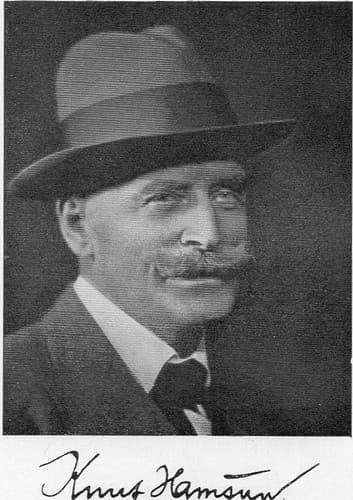
Knut Hamsun was a Norwegian writer who was awarded the Nobel Prize in Literature in 1920. Hamsun's work spans more than 70 years and shows variation with regard to consciousness, subject, perspective and environment. He published more than 20 novels, a collection of poetry, some short stories and plays, a travelogue, works of non-fiction and some essays.







