“The house had a single rule: utter obedience.”
— Describing the authoritarian atmosphere of the al-Jawad household.

Genre
Historical Fiction
Reading Time
900 min
Key Themes
See below
Sign in to track this book
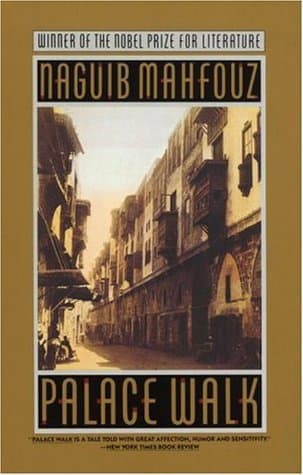
Amidst the British occupation of early 20th-century Cairo, the iron-fisted patriarch Al-Sayyid Ahmad navigates his family through tradition, rebellion, and the city's hidden nightlife, all while his wife and children yearn for freedom beyond their palace walls.
The novel opens by introducing Ahmed Abd al-Jawad's conservative and patriarchal household in Cairo. His wife, Amina, and their five children (Yasin, Fahmy, Kamal, Khadija, and Aisha) live under his absolute authority, never questioning his commands. Amina is pious and submissive, rarely leaving the house, and the children lead restricted lives, especially the girls. Ahmed, however, leads a double life. While at home he demands strict adherence to Islamic tradition and respect, outside he seeks pleasure, frequenting musical gatherings, drinking, and pursuing women with his friends. The family knows his power and their dependence on his financial support and social standing, which makes them fearful of his unpredictable temper.
The children's individual struggles against their father's strict rule begin to show. Yasin, the eldest from Ahmed's first marriage, mirrors his father's behavior, secretly drinking and visiting prostitutes. Fahmy, the second son, is more studious and politically aware, drawn to nationalist movements against British occupation, a path his father would not approve of. Kamal, the youngest, is still a boy, but intelligent and observant, deeply attached to his mother and showing an interest in philosophy and women. The two daughters, Khadija and Aisha, are largely confined. Their lives revolve around household duties and the prospect of arranged marriages, though they have distinct personalities: Khadija sharp-tongued and practical, Aisha beautiful and more romantic.
Amina, having lived a confined life, wants to visit the mosque of Imam Husayn. One morning, without her husband's explicit permission, she quietly leaves the house. While crossing the street, she trips and breaks her collarbone. When Ahmed Abd al-Jawad discovers her unauthorized excursion and injury, he is furious. In a fit of rage, he banishes her from their marital bed and forbids her from speaking to him. This isolates her within her own home. This incident shows the power imbalance in their marriage and the severe repercussions for even small transgressions against Ahmed's absolute authority, leaving Amina heartbroken and shamed.
Ahmed, wanting to control Yasin's behavior, arranges his marriage to Zaynab, the daughter of a friend. Initially, Yasin tries to settle down, but his behavior soon resurfaces. He begins to flirt with the family's maid, and eventually, Zaynab catches him with her. The scandal is immense, leading to a swift and humiliating divorce. This event shames the family and further solidifies Ahmed's disappointment in his eldest son, showing that even marriage cannot curb Yasin's inclinations towards pleasure-seeking and disregard for social propriety.
Ahmed arranges marriages for his two daughters. Khadija, known for her sharp tongue and plain appearance, marries Ibrahim Shawkat, a somewhat coarse but wealthy merchant. Their marriage has frequent quarrels, but also an affection. Aisha, beautiful and graceful, marries Khalil Shawkat, Ibrahim's brother. Aisha's marriage is initially happier, as Khalil is charming and they share a more romantic connection. These marriages give the sisters some independence from their father's immediate control, allowing them to establish their own households, though they remain tied to the larger family unit and its expectations. Khadija soon becomes pregnant, bringing new life and challenges to the family.
Kamal, now a young man, is a brilliant student, excelling in his studies and developing an interest in literature and philosophy. He falls deeply in love with Aida, a beautiful and sophisticated girl from a wealthier, more modern family. His love for her becomes an obsession, filling his thoughts and informing his poetry. However, Aida is largely unaware of his feelings, treating him as a friend. This unrequited love becomes a source of anguish and intellectual development for Kamal, as he grapples with the complexities of emotion, beauty, and the ideal versus reality, often confiding in his friend Husayn Shaddad.
Fahmy, passionate about Egyptian nationalism, dedicates himself to the cause of independence from British occupation. He attends secret meetings, participates in demonstrations, and discusses politics with his friends. This often clashes with Kamal's philosophical and detached perspective. His political activities challenge his father's cautious and apolitical stance, creating an unspoken tension within the household. Fahmy sees the struggle for national liberation as a moral need, driven by a strong sense of justice and patriotism, willing to risk his own safety for Egypt's future.
The political tensions in Egypt lead to the outbreak of the 1919 Revolution, a widespread uprising against British rule. Demonstrations, strikes, and clashes with British forces become common in Cairo. Fahmy, unable to stand by, throws himself into the movement. He participates in student protests and marches, his idealism and fervor pushing him to the forefront of the nationalist cause. The family watches with a mixture of pride, fear, and apprehension as Fahmy becomes exposed to the dangers of political activism, a contrast to their father's insulated world.
During a violent demonstration, Fahmy is shot and killed by British soldiers. His death shatters the Abd al-Jawad household. The family is in deep mourning, grappling with the sudden loss of their idealistic son. Amina is inconsolable, and even Ahmed Abd al-Jawad, though initially stoic, is affected. His authority momentarily falters in the face of such a personal catastrophe. Fahmy's death reminds them of the harsh realities of political struggle and the personal cost of the nationalist movement, leaving a permanent scar on the family.
After Fahmy's death, the Abd al-Jawad family struggles to find a new balance. The revolution eventually subsides, but its impact, and Fahmy's sacrifice, leaves a mark. Ahmed Abd al-Jawad, though resuming his routine, is subtly changed, perhaps a little more subdued. Amina remains pious, finding solace in her faith. Kamal, affected by his brother's death, continues his intellectual pursuits, now with a deeper sense of life's fragility and the weight of existence. The novel concludes with the family attempting to navigate their altered reality, carrying the burden of their loss and the quiet understanding that their world has shifted irrevocably.
The Patriarch/Protagonist
He maintains his authoritative facade throughout, but Fahmy's death subtly cracks his stoicism, revealing a deeper vulnerability beneath the rigid exterior.
The Matriarch/Supporting
She remains consistently pious and submissive, but her brief banishment and Fahmy's death cause her profound suffering, testing her faith and resilience.
The Son/Supporting
He attempts to conform to expectations through marriage but ultimately succumbs to his desires, leading to personal and familial disgrace.
The Son/Supporting
He moves from quiet study to active political engagement, culminating in his heroic sacrifice for the nationalist cause.
The Son/Protagonist
He transforms from a playful child into a thoughtful, often melancholic young man, deeply affected by his first love and his brother's death, beginning a journey of intellectual and emotional discovery.
The Daughter/Supporting
She transitions from a confined maiden to a married woman, establishing her own household and facing the challenges of married life and motherhood.
The Daughter/Supporting
She experiences the joy of a relatively happy arranged marriage, finding a degree of contentment in her new role.
The Supporting
He remains consistent in his character, a practical and somewhat boisterous husband to Khadija.
The Supporting
He enters a happy marriage with Aisha, maintaining a relatively stable and pleasant demeanor.
The Mentioned
She remains an idealized figure, largely unchanged, serving as the catalyst for Kamal's emotional growth rather than having her own arc.
The novel shows patriarchy, with Ahmed Abd al-Jawad's absolute rule over his family. His word is law, and any transgression, like Amina's unapproved mosque visit, results in severe punishment. This theme explores the power dynamics within the household, where women and children are subservient, their lives and choices dictated by the male head. It also critiques the hypocrisy in such a system, as the patriarch's public morality contrasts sharply with his private life, highlighting the double standards imposed on men versus women.
““Her husband was her paradise and her hell, her master and her tormentor, her life and her death.””
A central theme is hypocrisy, particularly in Ahmed Abd al-Jawad. He demands strict adherence to religious and moral codes from his family, especially his wife and daughters, while secretly indulging in drinking, music, and extramarital affairs. This double standard is also reflected in Yasin, who inherits his father's vices but lacks his discretion, leading to scandal. The theme highlights the societal pressures of maintaining appearances and the hidden lives people lead behind closed doors, exposing the moral complexities of the era.
““He was a man who lived two lives: one of strict piety and authority at home, and another of unrestrained pleasure outside.””
The Abd al-Jawad family is a microcosm of Egypt dealing with the tension between traditions and modernity. Amina embodies tradition, confined to her home and piety, while Fahmy represents modernity through his nationalist politics and desire for a new Egypt. Kamal's intellectual curiosity and unrequited love for Aida, a more modern woman, also reflect this clash. The novel explores how individual lives are shaped by these conflicting forces, from social customs and gender roles to political aspirations and intellectual freedom, particularly against the backdrop of British occupation.
““The world outside the house was a great, terrifying mystery that only men dared to venture into.””
This theme explores love and desire, often intertwined with suffering. Kamal's unrequited love for Aida is a central example, causing him emotional pain but also intellectual growth. Yasin's uncontrolled desires lead to his marital downfall. Ahmed Abd al-Jawad's desires are physical, detached from emotional intimacy. Amina's suffering, caused by her husband's harshness and the loss of Fahmy, shows the emotional toll of constricted lives. The novel portrays love as a complex, often painful, human experience, shaped by societal constraints and personal choices.
““Love, like a fever, had consumed him, leaving him both weak and intensely alive.””
The backdrop of British occupation and the Egyptian nationalist movement is a theme, primarily shown by Fahmy. His commitment to political activism and his sacrifice highlight the desire for independence and the dangers involved. The family's differing reactions to the political unrest (Ahmed's caution, Fahmy's passion, Kamal's intellectual observation) reflect the diverse responses within Egyptian society. This theme connects the personal struggles of the family to the larger historical forces shaping their nation, showing how political events directly impact individual lives and family dynamics.
““Egypt was a woman, and her sons were bound to protect her honor.””
A symbol of patriarchal control, tradition, and the family's internal world.
The physical house in Palace Walk serves as more than just a setting; it is a powerful symbol. It represents the fortress of tradition and patriarchal authority, where Amina and the girls are largely confined, and Ahmed's rules are absolute. The interior of the house is a space of strict order and hidden emotions, contrasting sharply with the chaotic and liberal world Ahmed inhabits outside. Its walls contain the family's secrets, joys, and sorrows, making it a central metaphor for their constrained lives and the societal structures they live within. The house itself feels like a character, observing and containing the family's story.
A narrative technique revealing the hypocrisy and complexity of the patriarchal system.
Ahmed Abd al-Jawad's starkly contrasting public and private lives serve as a significant plot device to highlight the theme of hypocrisy. His strict, pious persona at home and his debauched, pleasure-seeking life outside create dramatic irony and expose the moral compromises inherent in the patriarchal society. This duality not only defines his character but also impacts his children, particularly Yasin who emulates his vices, and Fahmy who rebels against such contradictions. It allows Mahfouz to explore the societal pressures of maintaining appearances versus individual desires, driving much of the internal and external conflict.
A narrative lens providing philosophical insights and emotional depth.
Kamal, as the youngest and most intellectual son, functions as a key narrative lens. His extensive inner monologues, philosophical musings, and keen observations provide deep insight into the family dynamics, the social environment, and the broader themes of the novel. His reflections on love, beauty, existence, and the contradictions he observes around him elevate the narrative beyond mere plot summary, offering a more profound exploration of the human condition. He often articulates the unspoken tensions and complexities that other characters may only feel, making him a crucial emotional and intellectual guide for the reader.
A historical backdrop serving as a catalyst for political awakening and tragedy.
The historical event of the 1919 Egyptian Revolution is not merely a backdrop but a crucial plot device. It acts as a catalyst, propelling Fahmy into active political engagement and ultimately leading to his tragic death. This external historical force directly impacts the private lives of the Abd al-Jawad family, shattering their insular world and forcing them to confront the larger political realities of their nation. It introduces a sense of urgency, danger, and national identity into the narrative, contrasting the family's domestic concerns with the monumental struggle for national liberation.
“The house had a single rule: utter obedience.”
— Describing the authoritarian atmosphere of the al-Jawad household.
“He was a man who believed that a woman's beauty was a trust from God, to be guarded jealously.”
— Reflecting on Ahmad Abd al-Jawad's views on women and modesty.
“The world outside was a vast ocean, and he was but a drop of water in it.”
— Amin's thoughts on his place in society and the broader world.
“Revolution is not just about changing rulers; it's about changing souls.”
— Discussed during political unrest in Cairo, reflecting on deeper societal transformation.
“A home without secrets is like a garden without flowers.”
— Yasmin's musing on the hidden lives within families.
“He drank to forget the man he was by day.”
— Describing Ahmad's nighttime escapades, contrasting his public and private selves.
“In the silence of submission, there is a roar of rebellion.”
— Observing the inner resistance of the women in the household.
“The streets of Cairo are a book, and every corner tells a story.”
— A reflection on the city's vibrant life and history during a walk.
“Love is a bird that cannot be caged, even by the strongest walls.”
— In reference to forbidden romances and desires within the family.
“To be a man is to bear the weight of expectation without complaint.”
— Ahmad's internal thoughts on societal pressures and masculinity.
“The past is a shadow that follows us into every room.”
— Mentioned during a family discussion about traditions and memories.
“In her eyes, he saw the whole world he had tried to shut out.”
— Describing a moment of connection that challenges Ahmad's rigid views.
“A nation sleeps, but its dreams are of awakening.”
— Set against the backdrop of Egypt's struggle for independence.
“The greatest tyranny is the one we impose on ourselves.”
— A philosophical insight into personal and societal constraints.
Ready to see how well you understood this book? Take our interactive quiz with 10 questions.

Naguib Mahfouz Abdelaziz Ibrahim Ahmed Al-Basha was an Egyptian writer who won the 1988 Nobel Prize in Literature. Mahfouz is regarded as one of the first contemporary writers in Arabic literature, along with Taha Hussein, to explore themes of existentialism. He is the only Egyptian to win the Nobel Prize in Literature. He published 35 novels, over 350 short stories, 26 screenplays, hundreds of op-ed columns for Egyptian newspapers, and seven plays over a 70-year career, from the 1930s until 2004. All of his novels take place in Egypt, and always mentions the lane, which equals the world. His most famous works include The Cairo Trilogy and Children of Gebelawi. Many of Mahfouz's works have been made into Egyptian and foreign films; no Arab writer exceeds Mahfouz in number of works that have been adapted for cinema and television. While Mahfouz's literature is classified as realist literature, existential themes appear in it.







