“I want to be a bird.”
— Punpun's childhood wish to escape his reality.

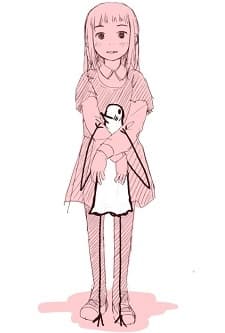
Inio Asano (2007)
Genre
Young Adult / Romance
Reading Time
985 min
Key Themes
See below
Sign in to track this book
This story, told through the surreal, bird-like eyes of Punpun, is a raw look at the messy, often heartbreaking reality of growing up, where first loves turn into obsession and the search for meaning meets disillusionment.
Punpun Punyama is a young boy living with his parents. His father is abusive, and his mother is often absent or sad. One night, his father attacks his mother, leading to his arrest and her hospitalization. Punpun's uncle, Yuichi, moves in to care for him. Punpun, who sees himself as a small, bird-like creature, struggles to understand these events, often seeking advice from an imagined 'God'. During this time, a new girl named Aiko Tanaka transfers to his class. Punpun immediately likes her, and they form a bond, sharing childhood dreams of going to Kagoshima.
Punpun's feelings for Aiko grow, and they promise to go to Kagoshima together. However, Aiko's life is also unstable; she lives with her neglectful mother, who is part of a cult. One day, Aiko suddenly moves away without saying goodbye, leaving Punpun heartbroken. This event, along with his family problems—his mother eventually leaves and his uncle struggles with his own mental health and relationships—makes Punpun feel more isolated. He deals with feelings of being left behind and the difficulty of keeping connections, retreating into his own mind and the advice of 'God'.
Years pass, and Punpun starts middle school, still living with his uncle Yuichi. He becomes friends with two classmates, Seki and Shimizu. Seki is a cynical but loyal friend. Shimizu is a quiet boy who believes in aliens and is later shown to be involved with a cult, the same one Aiko's mother was in. This brings a strange element to their lives. Punpun also develops a crush on another classmate, Sachi Nanjou, an artist, but their relationship remains platonic. Punpun's internal struggles continue, showing up as increasingly strange visions of 'God'.
In high school, Punpun's social awkwardness continues. He briefly dates a girl named Fumi, but their relationship is shallow and ends. He still deals with his uncle's behavior, including Yuichi's on-again, off-again relationship with his girlfriend, Midori. Punpun also sees his friends' struggles, especially Seki, who faces family problems and financial hardship. These experiences, combined with his own inability to form deep connections, add to Punpun's growing doubt about love and the adult world. He begins to feel lost, with no clear direction.
Punpun attends university, but his social anxieties keep him from truly connecting with his peers. He largely isolates himself, dealing with depression and a lack of motivation. During this time, he meets a woman named Aiko Tanaka, who he thinks is his childhood crush. He tries to reconnect, but it turns out to be a different Aiko, leading to more disappointment. He eventually drops out of university, feeling lost. He takes odd jobs, drifting, and his internal 'God' figure becomes more sinister, reflecting Punpun's declining mental state.
After dropping out of university, Punpun works a series of low-paying jobs. He eventually reconnects with Sachi Nanjou, who is now an aspiring manga artist and a single mother. Sachi, with her practical nature, offers Punpun a place to stay and a chance to work as her assistant. This time could be a turning point for Punpun, as Sachi's directness challenges his passive and self-pitying ways. She encourages him to face his problems and provides some stability and purpose, even if he struggles to fully accept it.
Punpun's life changes drastically when Aiko Tanaka, his childhood love, reappears. She is now an adult, working in a hostess club, and very troubled. She seeks out Punpun, saying her life has been ruined by her abusive, cult-leader mother. Punpun, still focused on his childhood promise to her, is drawn back into her life. Their reunion is full of tension and unresolved trauma. Aiko eventually reveals she has killed her mother in a fit of rage and asks Punpun for help to escape. Driven by a twisted sense of loyalty and a desperate desire to keep his childhood promise, Punpun helps her cover up the crime and escape.
Punpun and Aiko run away, traveling across Japan to avoid the police. During their desperate journey, their relationship becomes intensely dependent and unhealthy. They share intimate moments, but also extreme emotional distress and abuse. Aiko's mental state is fragile, and Punpun, consumed by guilt and his long-held obsession, struggles to cope. Their flight is marked by poverty, fear, and growing hopelessness. Punpun's internal bird-like form becomes increasingly distorted, reflecting his moral decline and psychological pain.
Their journey eventually leads them to a secluded area, where Aiko's mental state completely breaks down. Overwhelmed by guilt, fear, and her past trauma, Aiko dies by suicide, leaving Punpun devastated and alone. This event shatters Punpun's already fragile mind. He tries to take his own life but fails. He is eventually found and hospitalized, suffering from severe psychological trauma. The police investigate Aiko's mother's death, and Punpun is cleared of direct involvement but is left with deep guilt and loss.
After his hospitalization, Punpun begins a slow recovery. Sachi supports him, remaining a steady presence in his life, offering him a home and a chance to heal. Punpun, however, is deeply scarred by the events with Aiko. He decides to let go of his 'Punpun' identity, which represents his past traumas, and live as an anonymous person, blending into society. He takes on a new, ordinary appearance, losing his bird-like form, and tries to live a normal life, working and trying to move past his traumatic experiences, though the memories continue to bother him.
Years later, Punpun lives a seemingly normal, unremarkable life. He is still close to Sachi and her daughter, and he has a stable job. He occasionally runs into his old friends, Seki and Shimizu, who have also grown up. However, despite looking normal, Punpun remains emotionally distant and scarred. The story suggests that while he has survived, he has lost a part of himself, unable to fully experience joy or deep connection. The series ends with Punpun observing his friends, realizing he is different and forever marked by his past, living a life of quiet acceptance.
The Protagonist
Punpun's arc is one of gradual disillusionment and psychological deterioration, culminating in a forced, anonymous recovery where he loses his unique identity.
The Love Interest/Catalyst
Aiko's arc is a tragic spiral from a hopeful child to a deeply scarred, desperate, and ultimately self-destructive adult.
The Supporting
Yuichi's arc involves a slow and painful journey towards self-acceptance and a degree of peace, often through confronting his past mistakes.
The Supporting
Sachi's arc shows her growing from an ambitious artist to a responsible single mother who finds stability and compassion despite life's challenges.
The Supporting
Seki's arc shows him maturing from a cynical teenager to a responsible adult, finding stability despite his difficult upbringing.
The Supporting
Shimizu's arc involves his entanglement with a cult and his eventual disengagement, leading to a more grounded, albeit still somewhat eccentric, adulthood.
The Supporting/Antagonist
Her arc is one of continuing struggle with mental health and domestic issues, leading to her eventual separation from Punpun's life.
The Mentioned/Minor Antagonist
His arc is brief and impactful, serving as the initial catalyst for Punpun's traumatic childhood.
The Plot Device/Internal Monologue
God's arc mirrors Punpun's, transforming from a benign guide to a grotesque and tormenting manifestation of his inner demons.
This is the main theme of the manga, showing Punpun's journey from a naive child to a disillusioned adult. His bird-like form symbolizes his innocence, which slowly changes as he faces the difficult parts of life: family trauma, broken promises (Aiko leaving), complicated relationships, and the world's inherent cruelty. Each major event, from his parents' separation to Aiko's tragic end, removes some of his childish idealism, leaving him with a deep sense of disappointment about love, happiness, and life's meaning. This is clear in his changing 'God' figure, which becomes more cynical.
““Even if you don't believe in God... there are some things you just can't do alone. Even if you don't believe in God, there are times you need to pray.””
The manga explores how childhood trauma affects a person's mental health. Punpun's early experiences with domestic abuse, being left alone, and his unstable family life lead to severe anxiety, depression, and social isolation. His internal struggles are shown through his bird-like form and the 'God' figure, which visually represent his psychological state. Characters like Yuichi and Aiko also deal with their own traumas, showing a cycle of pain and how hard it is to break free. The story directly shows self-harm, suicidal thoughts, and the deep psychological damage from unresolved emotional wounds.
““I wish I could erase my memories. I wish I could forget everything and start over.””
Oyasumi Punpun shows a complex and often bleak view of love and human connection. Punpun's crush on Aiko starts pure but becomes a toxic obsession based on childhood fantasy rather than real understanding. His other relationships, like with Sachi, are more realistic but still difficult because he cannot truly open up. The manga explores different kinds of love—family, romantic, platonic—often showing them as sources of pain, disappointment, and manipulation rather than comfort. It questions if true, unconditional love is possible or just an ideal that always leads to heartbreak.
““No matter how much you love someone, you can't save them. You can't even save yourself.””
Punpun's struggle with who he is is central to the story, especially through his changing visual appearance. His bird-like form symbolizes his separation from human identity, his feeling of being different, and his inability to truly connect. As he gets older and faces more trauma, his form changes, reflecting his inner corruption and self-hatred. The series ends with him letting go of the 'Punpun' identity, trying to become an anonymous, 'normal' person. This search for a stable identity is painful, suggesting that real self-acceptance might mean facing, not escaping, one's past and nature, a challenge Punpun struggles with.
““I wanted to be someone else. Anyone else but me.””
The manga hints at problems in modern Japanese society, especially the pressure to conform, the rise of cults, and the widespread feeling of being alone. Punpun, Seki, and Shimizu all represent people who struggle to fit into societal norms, often feeling like outsiders. Aiko's mother's cult shows how vulnerable people are when they look for belonging and meaning in a disconnected world. The ordinary, often bleak city scenes and the characters' struggles with unemployment and aimlessness reflect a generation dealing with a lack of purpose and a feeling of being lost in a vast, uncaring society, which adds to their isolation.
““Everyone wants to be special. But if everyone's special, then no one is.””
Visual representation of Punpun's psychological state and loss of innocence.
Punpun's visual depiction as a simple, bird-like doodle (and later other abstract, often grotesque forms) is a central plot device. This abstract representation allows readers to project their own interpretations onto him, while simultaneously symbolizing his detachment from humanity, his innocence, and his deteriorating mental state. As he experiences trauma and grows older, his form becomes more distorted, reflecting his inner turmoil, self-loathing, and the loss of his childhood purity. This device uniquely illustrates his psychological journey without explicit dialogue, making his internal world palpable.
An imagined deity that externalizes Punpun's thoughts, fears, and moral compass.
The recurring appearance of 'God' as a floating, afro-haired head is a unique narrative device. 'God' functions as Punpun's internal monologue, conscience, and often, his tormentor. Initially offering simplistic advice, 'God' evolves to reflect Punpun's increasing cynicism, despair, and moral corruption. This device provides direct insight into Punpun's fragmented psyche, his anxieties, and his struggle to make sense of the world. 'God's' pronouncements often serve as dark humor or brutal truths, highlighting Punpun's inability to cope with reality and his reliance on an imagined, increasingly malevolent, guide.
Jumps in time to reveal past traumas or foreshadow future events.
While largely chronological, the manga employs occasional flashbacks and subtle flashforwards. Flashbacks are crucial for revealing the full extent of characters' past traumas, such as Aiko's abusive childhood or Yuichi's failed marriage, providing context for their present behavior. The narrative also includes subtle hints or glimpses of future events, creating a sense of foreboding or inevitability. This non-linear approach enriches the character development and deepens the thematic exploration of memory, consequence, and the inescapable nature of one's past.
A childhood dream representing escape, hope, and an idealized future.
Kagoshima, a distant city Punpun and Aiko dream of visiting as children, serves as a powerful symbol. Initially, it represents an idealized escape from their troubled lives, a place where they can be happy and free. It embodies their childhood innocence, hope, and the promise of a better future. However, as their lives become more complicated and tragic, Kagoshima transforms into a symbol of lost innocence, broken promises, and the impossibility of truly escaping one's past. Their eventual journey, albeit forced and tragic, is a dark inversion of their childhood dream.
A background element highlighting social alienation and the search for belonging.
The cult, led by Aiko's mother and later involving Shimizu, serves as a symbolic backdrop. It represents the darker aspects of society: the vulnerability of lonely or disillusioned individuals, the allure of false hope, and the destructive power of manipulation. The cult's presence underscores the themes of social alienation and the search for meaning, even if it leads to harmful ends. It also connects directly to Aiko's traumatic past, providing context for her psychological damage and the cycle of abuse she endures.
“I want to be a bird.”
— Punpun's childhood wish to escape his reality.
“I'm not a bird. I'm a human being.”
— Punpun's realization as he grows older.
“I love you. I love you so much it hurts.”
— Punpun expressing his feelings for Aiko.
“The world is a scary place.”
— Punpun reflecting on his experiences.
“I'm sorry for being born.”
— Punpun's deep-seated guilt and self-loathing.
“We're all just trying to survive.”
— A character's observation on human struggle.
“Happiness is something you have to fight for.”
— A reflection on the effort required for joy.
“I don't know what love is anymore.”
— Punpun's confusion about relationships.
“The past is a heavy burden.”
— Punpun dealing with his traumatic memories.
“Sometimes, I feel like I'm disappearing.”
— Punpun's sense of losing himself.
“Life is just a series of goodbyes.”
— A melancholic view on existence.
“I want to be remembered.”
— Punpun's desire for significance.
“Love is a beautiful lie.”
— A cynical take on romantic relationships.
“I'm tired of pretending to be okay.”
— Punpun's exhaustion from masking his pain.
“Maybe we're all just broken.”
— A reflection on human imperfection.
Ready to see how well you understood this book? Take our interactive quiz with 10 questions.
Biography coming soon.