“The trees stood still as giant statues.”
— The narrator describes the quiet winter forest at night.

Sign in to track this book
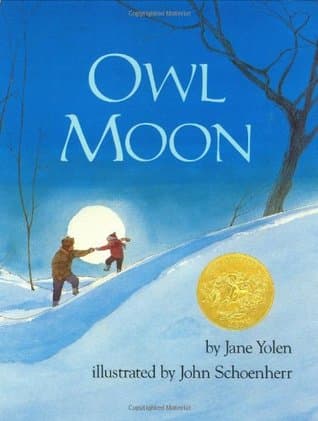
A silent, hopeful winter's night transforms a simple father-daughter owling trip into a quest for a glimpse of the mysterious, elusive bird.
On a very cold, clear winter night, a young girl, who tells the story, gets ready to go owling with her father. She has waited a long time for this moment, wanting a night with 'no moon and no wind'—the best conditions for owling. Her father reminds her to be brave and quiet, saying silence is important for a good trip. They dress warmly in wool hats and scarves, ready for the cold. The girl feels excited and a little scared, knowing owling needs patience and respect for the night's stillness. Her father's presence makes her feel safe as they step out into the silent fields.
The father and daughter leave their warm house and walk into the snowy fields, their breath making 'white clouds' in the cold air. The snow crunches under their feet, a sound that feels 'too loud' in the deep quiet. They pass dark, silent trees and an old barn, its windows like 'black eyes.' The girl notices how different the familiar place looks at night, changed by shadows and the lack of daily sounds. Her father leads the way, a tall, silent figure in the dark. They walk a long time, their senses sharp, listening closely for any sign of an owl. The girl remembers her father's past owling trips, which sometimes ended without seeing an owl, showing that patience is key.
After walking a good distance, they stop at the edge of a field, surrounded by tall pine trees. The father raises his gloved hands to his mouth and makes his first owl call: 'Whoo-whoo-whoo, Whoo-whoo-whoo.' The sound echoes through the silent woods, then fades, leaving an even deeper quiet. The girl holds her breath, waiting, hoping for a reply. The silence feels huge. She watches her father, seeing how patient he is. He waits a long time, looking into the dark, before finally lowering his hands. No immediate reply is part of the owling ritual, a test of their patience.
They continue walking through the woods, passing 'bare branches' of oak and maple trees, and 'dark shadows' of pine. The girl sees an old stone wall, its stones 'covered with snow,' reminding her of a 'giant's tooth.' Her father stops again, choosing a new spot near a 'great white pine.' The night is completely still, broken only by the soft crunch of their boots on the snow. The girl feels more connected to nature, noticing details she might miss during the day. She thinks about owling, where success is not guaranteed, but the experience itself is good.
At the new spot, her father calls out again, a long, clear 'Whoo-whoo-whoo, Whoo-whoo-whoo.' This time, after a moment of silence, a faint but clear reply comes from deep in the woods: 'Whoo-whoo-whoo.' The girl feels a rush of excitement and a 'shiver of delight.' Her father also feels the thrill, his face showing a small change. The sound is from a Great Horned Owl, a powerful and hard-to-find bird. This reply means they might succeed, changing their hopeful trip into a definite encounter. The silence that follows now holds anticipation, a promise of something magical about to happen.
Her father quickly turns on his flashlight, shining its beam up. The light catches the owl, which comes down 'like a shadow' and lands on a branch right above them. The girl sees the owl clearly: its 'great horned head,' its 'yellow eyes,' and its 'feathery wings.' The owl looks down at them, its gaze steady. It is a moment of connection between human and nature, a silent talk between species. The girl describes the owl as 'big and soft, like a winter moon,' showing its grand yet gentle presence. The cold, the long walk, and the waiting all lead to this silent meeting.
The owl stays on the branch for a long time, watching the father and daughter. The girl and her father stand perfectly still, barely breathing, enjoying every second of this rare interaction. No words are spoken, as they are not needed. The father eventually turns off the flashlight, putting them back in darkness, but not before the image of the owl is clear in the girl's memory. The owl then silently lifts off the branch and disappears back into the night, its flight 'like a ghost.' This shared experience strengthens the bond between the girl and her father, creating a lasting memory of wonder and quiet joy.
As they walk home through the snow, the cold no longer bothers the girl. She feels happy and warm, not from the temperature, but from the 'warmth inside' her. She no longer feels she needs to be brave or quiet; the owling trip has filled her with peace. The father smiles, a quiet sign of their success and the special bond they share. The silence of the walk home is different from the silence on the way out; it is now a silence filled with the memory of the owl and the shared joy of their adventure. The girl knows this memory will stay with her, a cherished moment of connection with nature and her father.
Back in her warm bed, the girl closes her eyes and can still see the owl, its 'great yellow eyes' looking down at her. She thinks about owling, where success is not guaranteed, but the journey itself is full of quiet waiting and wonder. She understands that when you go owling, you don't need words; you just need 'hope and silence and patience.' The memory of the owl, and of being out in the cold, dark woods with her father, is precious. It is a memory of patience, respect for nature, and the unspoken love between a parent and child, showing the lasting impact of their shared adventure.
The Protagonist
She begins with anticipation and a little trepidation, and ends with a deep sense of contentment, wonder, and a cherished memory of connection.
The Supporting
He remains a consistent figure of patience and wisdom, successfully guiding his daughter to a memorable encounter.
The Mentioned
The owl remains a wild, independent creature, briefly interacting with the humans before returning to its natural habitat.
The owling trip is about patience. The girl waits 'for a long time' for the right night, and both she and her father walk and wait in silence for the owl to respond. The story often mentions the quiet and the waiting, showing that success in nature needs perseverance. Seeing the owl is a reward made better by the effort and patience, making the meeting feel special and earned. This theme is central to owling, where things don't happen instantly.
“When you go owling you don't need words. You don't need anything but hope. And silence. And patience.”
The book shows a deep, respectful link between people and nature. The father and daughter are in the winter night, watching the snow, trees, and the deep quiet. Seeing the owl is a moment of pure, wordless connection with wildlife. The story shows how nature changes at night, becoming mysterious and wonderful. This theme asks readers to enjoy the beauty and quiet majesty of nature, and to find real connections with it.
“The trees stood still as statues. And the world was silent as a dream.”
At its heart, 'Owl Moon' is a story about the special relationship between a father and his daughter. The owling trip is a shared adventure that makes their bond stronger. The father is a patient guide and protector, teaching his daughter about nature and life lessons like patience and respect. The girl trusts and admires her father. The quiet, shared experience of the cold night and seeing the owl creates a lasting, close memory that both cherish, showing the power of shared moments over spoken words.
“And my father put his arm around me for a minute, but he never said a word.”
Silence is not just no noise; it is an active part of the story, needed for owling. The father tells the girl to be 'brave and quiet,' and the story often points out the deep stillness of the night. This silence lets them observe more closely, helping them hear the owl's call and eventually spot it. It also helps them think and notice small details in nature. The story suggests that real understanding and connection often come not from talking, but from quiet listening and careful watching.
“When you go owling you don't need words. Not an unnecessary sound.”
Vivid descriptions appealing to sight, sound, and touch to immerse the reader.
Yolen uses rich sensory imagery to bring the winter night to life. Descriptions like 'white clouds' of breath, the 'crunch' of snow, trees 'standing still as statues,' and the owl's 'great yellow eyes' engage the reader's senses. The emphasis on sound, particularly the 'Whoo-whoo-whoo' calls and the profound silence, is crucial. The feeling of 'cold' and the 'shiver of delight' also contribute. This device creates a strong atmosphere and allows the reader to experience the owling trip alongside the narrator, enhancing the feeling of being present in the moment.
The recurring phrase 'When you go owling...' reinforces the core themes and rituals.
The repeated phrase 'When you go owling...' acts as a refrain, setting expectations and reinforcing the rules and ethos of the activity. It appears at key moments, emphasizing the need for silence, hope, and patience. This repetition gives the story a rhythmic, almost meditative quality, akin to a quiet ritual. It also serves to distill the essence of the owling experience into simple, memorable truths, making the narrative feel both personal and universal, much like a shared wisdom passed down.
Giving human qualities to inanimate objects or animals to enhance atmosphere.
Personification is used subtly to deepen the atmosphere and emotional resonance. For example, 'The trees stood still as statues' gives the trees a watchful, almost sentient quality. The old barn's windows are described as 'black eyes,' creating a slightly eerie but observant presence. While the owl is not explicitly personified, its 'looking down at us' and 'great yellow eyes' suggest a profound intelligence and awareness, making its encounter with the humans feel more significant and communicative, despite the lack of words.
The owl symbolizes mystery, wisdom, and the elusive beauty of nature.
The Great Horned Owl is more than just a bird; it symbolizes the wild, mysterious aspects of nature that are often hidden from human view. Its elusiveness requires patience and respect, and its appearance is a moment of profound wisdom and connection. It represents the quiet rewards that come from seeking out and appreciating the natural world. For the little girl, the owl becomes a symbol of her bravery, her patience, and the special bond she shares with her father, a cherished memory of a magical encounter.
“The trees stood still as giant statues.”
— The narrator describes the quiet winter forest at night.
“Somewhere behind us a train whistle blew, long and low, like a sad, sad song.”
— The girl and her father hear a distant train while owling.
“When you go owling you don't need words or warm or anything but hope.”
— The narrator explains the simple requirements for owling.
“The moon made his face into a silver mask.”
— Describing the father's face illuminated by moonlight.
“If you go owling you have to be quiet and make your own heat.”
— Instructions for the owling adventure.
“The shadows were the blackest things I had ever seen.”
— The girl observes the deep darkness of the winter night.
“Then the owl pumped its great wings and lifted off the branch like a shadow without sound.”
— The moment the owl finally appears and flies away.
“Pa made a long, slow sound, like a sad, happy song.”
— The father calls to the owl with a special hoot.
“I could feel the cold, as if someone's icy hand was palm-down on my back.”
— The girl describes the intense cold of the winter night.
“Our feet crunched over the crisp snow and little gray footprints followed us.”
— Describing their walk through the snowy woods.
“The owl's call came closer, from high up in the trees.”
— The anticipation builds as the owl responds.
“For one minute, three minutes, maybe even a hundred minutes, we stared at one another.”
— The magical moment when the girl and owl lock eyes.
“I knew then I could talk, I could even laugh out loud. But I was a shadow as we walked home.”
— After the owl flies away, the girl reflects on the experience.
Ready to see how well you understood this book? Take our interactive quiz with 10 questions.
Biography coming soon.

Dan Gemeinhart
4.5

Kate O'Hearn
4.4

Jeanne Birdsall
4.4

Jen Wang
4.4

Wendelin Van Draanen
4.3

John Marsden
4.3

Chris Van Allsburg
4.3

Jennifer A. Nielsen
4.2