“When the wise man sees a chance for profit, he thinks of righteousness; when the fool sees a chance for profit, he forgets righteousness.”
— A general moral principle discussed in the narrative about ethical conduct.

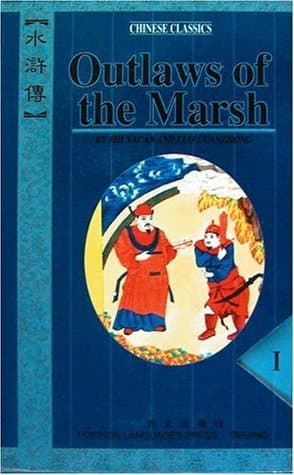
Shi Naian, Shi Nai'an (1999)
Genre
Fantasy / Historical Fiction
Reading Time
100+ hours (given 2149 pages)
Key Themes
See below
Sign in to track this book
In a corrupt Song Dynasty, over a hundred outlaws, forced by tyranny, unite in a mountain stronghold to defy the government with an epic saga of intrigue, warfare, and adventure.
The story begins with Grand Marshal Hong Xin, sent by Emperor Renzong to Dragon Tiger Mountain to invite Abbot Tianshi for a ritual to stop a plague. Hong ignores warnings and opens the Hall of Suppressed Demons, a sealed temple said to hold evil spirits. When he forces open the door, a gust of wind and a crash reveal a stone tablet inscribed with 'Opened by Hong'. When turned over, it shows the names of 108 Star Spirits. These spirits, previously imprisoned, fly out as streaks of light, scattering across the land. This event hints at the gathering of the 108 heroes who will become the Outlaws of the Marsh, setting up the many events to come as these celestial beings are reborn.
Gao Qiu, a street ruffian, gains favor with Prince Duan, who later becomes Emperor Huizong, through his skill at Cuju (ancient football). He quickly becomes Grand Marshal and is known for being vengeful. One of his first acts of power abuse targets Wang Jin, the chief martial arts instructor of the Imperial Guards. Gao Qiu dislikes Wang Jin's father, who had once shamed him. Fearing for his life and his mother's safety, Wang Jin leaves his post and flees the capital, disguised as a common traveler with his mother. This incident shows the corrupt officials who force many good men to become outlaws.
Lu Da, an army officer, meets Jin Cuilian and her father, who are being taken advantage of by the local butcher, Zheng Tu. Angry at Zheng Tu's cruelty, Lu Da helps them. He shames Zheng Tu by making him prepare meat in strange ways, then beats him to death. Realizing what he has done, Lu Da flees and eventually hides at Wutai Mountain, becoming a monk named Lu Zhishen. His violent nature, however, conflicts with monastic rules, leading him to more adventures, including getting drunk and breaking the monastery's statues, which forces him to flee again.
Lin Chong, the respected Leopard Head and chief instructor of the Imperial Guards, is a loyal man. His life changes when Gao Qiu's adopted son, Gao Yanei, tries to rape Lin Chong's wife. Gao Qiu, to protect his son, sets up Lin Chong, first tricking him into carrying a forbidden sword into a restricted area, which leads to his exile to Cangzhou. During his exile, Gao Qiu sends assassins to kill him. Lin Chong survives, and when he learns his wife killed herself to escape Gao Yanei, he becomes enraged. He then kills his escorts and joins the Liangshan band.
Chao Gai, a rich squire from Dongxi Village, learns about a convoy carrying ten carts of valuable birthday gifts, full of gold and jewels, meant for the corrupt Grand Tutor Cai Jing. These gifts were taken from the people of Daming Prefecture. With six other men, including Wu Yong, Gongsun Sheng, and the Ruan brothers, Chao Gai plans and carries out the robbery at the Yellow Mud Ridge, using drugged wine to disable the guards. This daring act against corrupt officials makes Chao Gai and his friends known as powerful outlaws and draws the attention of the authorities, forcing them to hide at Liangshan Marsh.
Song Jiang, the 'Timely Rain', a kind county clerk, does not want to become an outlaw at first. He accidentally kills his mistress, Yan Poxi, after she blackmails him about a letter from Chao Gai. He is exiled and later sentenced to death in Jiangzhou, where Li Kui and the Liangshan heroes save him in a daring raid. Later, after killing a corrupt official and his family in self-defense, Song Jiang is truly forced to become an outlaw. His journey shows his compassion, his strong sense of justice, and his loyalty to his friends, making him a natural leader and attracting many to his cause.
As the Song Dynasty's corruption worsens, more and more people, from skilled warriors and strategists to fishermen and farmers, are persecuted by unfair officials. Many, like Lin Chong, Lu Zhishen, Wu Song, and Li Kui, are forced into outlawry due to direct conflict with the corrupt system. Others, like Hua Rong and Qin Ming, are tricked or made to join. They are drawn to Liangshan Marsh, a natural fortress, by its reputation as a safe place for the oppressed and by the growing leadership of Chao Gai and later Song Jiang. The 108 Star Spirits, released at the start of the story, are gradually reborn as these heroes, coming together to form a strong force.
Chao Gai, the first leader of the Liangshan band, leads an expedition against the Zeng Family Fortress, a powerful local clan. During the battle, Shi Wengong shoots him with a poisoned arrow. Mortally wounded, Chao Gai says that whoever avenges his death will become the next leader of Liangshan. After his death, Song Jiang, already respected among the outlaws, slowly takes over leadership. His strategic mind, compassion, and ability to unite different personalities make him the natural successor, fulfilling the prophecy and setting the stage for the band's future and their wish for amnesty.
The Song imperial court, worried by Liangshan's growing power, repeatedly sends large armies to defeat the outlaws. However, because of the outlaws' good tactics, detailed knowledge of the marsh, and the skill of their many warriors, the government campaigns always fail. Notable wins include defeating Grand Marshal Gao Qiu's forces and General Huyan Zhuo's armored cavalry. Each win adds to Liangshan's supplies and brings captured officers into their ranks (often through persuasion). It also strengthens their reputation as an unbeatable force, attracting more unhappy people to them and showing their power.
After many successful campaigns and the recruitment of all 108 heroes, a large assembly happens at Juyi Hall (Hall of Gathering Righteousness) on Liangshan. During a night of celebration, a heavenly stone tablet falls from the sky, showing the names and celestial ranks of all 108 heroes – 36 Heavenly Spirits and 72 Earthly Fiends – confirming their destiny as reborn stars. Song Jiang is officially recognized as the supreme leader, and a clear hierarchy is set up, with military, administrative, and logistical roles given to each hero. This event marks the height of Liangshan's power and unity, and they formally promise to 'carry out Heaven's will' and protect common people.
Despite their power, Song Jiang's goal is not to overthrow the Song Dynasty but to be granted amnesty and serve the emperor. He believes in the imperial court, despite its corrupt officials. After several attempts, an amnesty is granted through the efforts of Emperor Huizong and some supportive officials. The Liangshan heroes are then asked to suppress other rebel groups, especially Fang La's rebellion. This decision creates mixed feelings among the heroes, as some prefer to remain free, but Song Jiang's authority wins, leading them into battles that will greatly reduce their numbers and test their loyalty.
The campaign against the powerful rebel leader Fang La is brutal and costly for the Liangshan heroes. They face strong resistance, difficult land, and clever strategies from Fang La's forces. One by one, many of the most liked and skilled heroes die in battle, get sick, or are captured and killed. The losses are huge, including figures like Wu Song, Lu Zhishen, and Li Kui, who are badly hurt or die. By the time Fang La is defeated and captured, only a few of the original 108 heroes remain, leaving a sense of tragedy and showing the high cost of their loyalty and service to the Song court.
After the win over Fang La, the few surviving Liangshan heroes return to an ungrateful and still corrupt imperial court. Song Jiang and Lu Junyi get high but unstable positions. However, the treacherous Grand Marshals Gao Qiu and Cai Jing, still holding grudges, plan to poison Song Jiang with wine. Learning of his coming death, Song Jiang also poisons Li Kui, fearing his loyal but impulsive brother would rebel and damage the Liangshan name. The remaining heroes either die of illness, retire to monastic life, or are exiled and eventually die. The story ends sadly, showing how useless their sacrifices were against deep-seated corruption.
The Protagonist
From a respected local official forced into outlawry, he rises to lead the Liangshan band with a vision of serving the emperor, only to be betrayed and die tragically.
The Major Supporting
From a loyal imperial officer to a persecuted exile, he transforms into a fierce outlaw driven by injustice, becoming a pillar of Liangshan's military strength.
The Major Supporting
A righteous but violent army officer, he seeks redemption as a monk but cannot escape his nature, ultimately becoming a powerful and devoted outlaw.
The Major Supporting
From a wanderer, he becomes a legendary tiger-slayer and a relentless avenger, ultimately dedicating his formidable skills to the Liangshan cause.
The Major Supporting
A wild and impulsive executioner, he becomes Song Jiang's most devoted and fierce follower, remaining loyal to the very end.
The Antagonist
From a petty ruffian to a powerful, corrupt Grand Marshal, he uses his position to persecute the righteous, ultimately contributing to the Liangshan rebellion.
The Supporting
From a village scholar, he becomes the indispensable strategic mastermind of Liangshan, guiding their numerous victories.
The Supporting
From a righteous squire who defies corrupt officials, he becomes the first leader of Liangshan, laying the foundation for its growth before his untimely death.
The Supporting
A reclusive Taoist master, he periodically joins Liangshan to contribute his magical prowess, ultimately returning to his spiritual path.
The Supporting
A loyal magistrate who sacrifices his position for Song Jiang, he becomes one of Liangshan's most skilled and trusted generals.
The Mentioned
Her brief appearance as Song Jiang's mistress and blackmailer culminates in her murder, serving as a catalyst for his transformation.
The main theme is the clear difference between justice and injustice in the Song Dynasty. The Liangshan heroes almost all become outlaws because of the deep injustices done by corrupt officials like Gao Qiu and Cai Jing. They want to 'carry out Heaven's will' (替天行道), which for them means punishing the wicked and protecting the innocent, filling the gap left by a failing imperial system. This theme is shown through Lin Chong's tragic persecution, Lu Zhishen's anger against Zheng Tu, and Song Jiang's initial unwillingness to become an outlaw until the system's corruption forced him.
“Better to gather in the marshes and pledge to strike down the corrupt officials, carrying out Heaven's will, than to suffer under their tyranny.”
Loyalty, especially brotherhood (义气 - 'yiqi'), is a foundation of the Liangshan band. The heroes form strong bonds of loyalty to each other, often making oaths of brotherhood. This loyalty is seen in their willingness to risk their lives for one another, as when the Liangshan forces raid Jiangzhou to save Song Jiang from execution, or when heroes like Hua Rong defy imperial orders for their friends. However, this loyalty is also tested, especially by Song Jiang's strong loyalty to the emperor, which conflicts with the desires of some who want independence. This eventually leads to tragic outcomes for the band.
“We are sworn brothers, bound by righteousness. If one of us is in trouble, all must come to his aid, even if it means defying the heavens.”
The novel criticizes the corruption of the Song Dynasty's officials. Characters like Gao Qiu and Cai Jing show how people can gain great power through flattery and bribery, then abuse that power for personal gain and to persecute the innocent. This systemic corruption creates the conditions that force good people into outlawry. The outlaws' fight is not against the emperor himself, but against the 'treacherous ministers' who surround him, suggesting the emperor is misled rather than evil. This corruption ultimately leads to the demise of the Liangshan heroes, even after they serve the state.
“The good are persecuted, the wicked prosper. How can the people live when the officials are like wolves and tigers?”
The idea of fate plays a big part, especially through the story of the 108 Star Spirits. Marshal Hong's initial release of these spirits foreshadows the gathering of the heroes at Liangshan, suggesting their destinies are set. The falling of the stone tablet at Juyi Hall, which reveals the celestial ranks of each hero, strengthens this theme. It shows that their assembly and roles are not just chance but part of a larger cosmic plan. This idea of predestination often provides a way to understand the characters' actions and the inevitable unfolding of events, including their tragic end.
“The 108 Star Spirits, 36 Heavenly Spirits and 72 Earthly Fiends, descended to the mortal world to aid the righteous and punish the wicked.”
Many characters, at first driven by personal revenge or forced into outlawry, seek redemption through their actions at Liangshan. Song Jiang's desire for amnesty and his willingness to give up the band's independence to serve the emperor is a clear example of seeking redemption for their past 'crimes.' The ultimate sacrifice comes during the campaign against Fang La, where most of the heroes die, paying a high price for their loyalty and their attempt to rejoin the imperial system. Their deaths, though tragic, are presented as a sacrifice for a greater, though ultimately unfulfilled, ideal of justice and loyalty to a perceived righteous cause.
“Though we die, we die for righteousness, for the people, and for the true emperor.”
A supernatural origin story for the heroes, linking them to celestial destiny.
This device serves as the overarching mythological framework for the entire narrative. The accidental release of 108 Star Spirits at the beginning of the novel foreshadows the gathering of the 108 heroes at Liangshan. Each hero is a reincarnation of one of these celestial beings, lending a sense of destiny and epic scale to their struggles. This device justifies their extraordinary abilities, their fated meeting, and their collective purpose, reinforcing the theme of fate and suggesting that their actions are part of a larger cosmic plan, beyond mere human will. It elevates them from common bandits to divinely appointed agents of justice.
Individual tales woven into a larger, continuous plot.
The novel employs an episodic narrative structure, where the stories of individual heroes are introduced and developed, often as self-contained adventures, before they converge and integrate into the main plot of the Liangshan band. Each hero's journey to outlawry typically involves a catalyst of injustice, a dramatic escape, and eventual recruitment. This structure allows for a rich tapestry of characters and diverse settings, while the overarching plot of the Liangshan gathering and their struggle against the Song Dynasty provides continuity. This mirrors the traditional Chinese storytelling method, where individual 'chapters' or 'performances' would focus on one hero's tale.
A symbolic hub representing the outlaws' unity and purpose.
The Juyi Hall is both a physical place and a powerful symbol. It is the central command and meeting place for the Liangshan heroes, located at the heart of their mountain fortress. Symbolically, it represents their collective commitment to 'righteousness' (义 - 'yi') and their unity as sworn brothers. When the 108 heroes are formally assembled and their celestial ranks are revealed on the stone tablet within this hall, it signifies the peak of their power and the divine sanction of their cause. It is the place where their collective identity is forged and their purpose articulated, serving as a constant reminder of their shared values and goals.
A divine artifact that legitimizes the heroes' roles and hierarchy.
This miraculous stone tablet, which falls from the sky during the grand assembly at Juyi Hall, is a crucial plot device. It is inscribed with the names and celestial ranks of all 108 Liangshan heroes, divided into 36 Heavenly Spirits and 72 Earthly Fiends. This divine revelation serves to legitimize Song Jiang's leadership and the hierarchical structure of the band, convincing any doubters that their gathering and their roles are ordained by Heaven. It reinforces the theme of fate and destiny, providing a supernatural justification for their existence and their mission to 'carry out Heaven's will,' thereby solidifying their unity and purpose.
Song Jiang's persistent goal, driving the latter half of the narrative.
Song Jiang's unwavering desire to gain amnesty from the emperor and serve the Song Dynasty is a primary plot driver, particularly in the latter half of the novel. This quest for legitimacy creates internal conflict within Liangshan, as some heroes prefer their outlaw independence. It shapes their interactions with imperial forces, leading to both battles and diplomatic overtures. The eventual, albeit flawed, amnesty and the subsequent campaigns against other rebels like Fang La are direct consequences of this quest. It highlights Song Jiang's complex character and his belief in the imperial system, ultimately leading to the tragic dissolution of the band and the decimation of its members.
“When the wise man sees a chance for profit, he thinks of righteousness; when the fool sees a chance for profit, he forgets righteousness.”
— A general moral principle discussed in the narrative about ethical conduct.
“I am Song Jiang, the Timely Rain. I help those in need and relieve those in distress.”
— Song Jiang introduces himself, emphasizing his role as a benefactor to the oppressed.
“A man should die for a friend who understands him; a woman should make herself beautiful for the man who appreciates her.”
— A saying reflecting the deep bonds of loyalty and appreciation among characters.
“The strong prey on the weak; that is the way of the world.”
— A cynical observation about societal injustice and corruption.
“If you want to catch the bandits, first capture their leader.”
— Strategic advice given in military or conflict situations.
“Wine and meat pass through the bowels, but loyalty and righteousness are stored in the heart.”
— A proverb highlighting the enduring value of moral virtues over material pleasures.
“In times of peace, prepare for war; in times of war, prepare for peace.”
— A maxim about foresight and preparedness in governance or personal life.
“The hero does not boast of his past deeds.”
— A reminder of humility among the skilled and brave characters.
“When the government is corrupt, the people rebel.”
— A statement on the cause of the outlaws' uprising against the Song Dynasty.
“Better to be a broken piece of jade than a whole tile.”
— A metaphor for valuing integrity and honor over safety and conformity.
“The wind follows the tiger, the clouds follow the dragon.”
— A poetic line describing the natural order and the aura of great leaders.
“Do not use a cannon to kill a mosquito.”
— Advice against overreacting or using excessive force in minor situations.
“In the face of injustice, even a scholar must take up arms.”
— Reflecting the theme of righteous rebellion among educated characters.
“A true man does not fear death, but fears dying without purpose.”
— A sentiment about the importance of meaningful action and legacy.
Ready to see how well you understood this book? Take our interactive quiz with 10 questions.

Shi Nai'an was a Chinese writer from the Yuan and early Ming periods. Shuihu zhuan, one of the Four Great Classical Novels of Chinese literature, is traditionally attributed to him. There are few reliable sources for his biography, much less his literary activity.

Biography coming soon.







