“The microscopic world, once so benign, had become a battleground, and humanity was losing.”
— Reflecting on the nature of the epidemic.

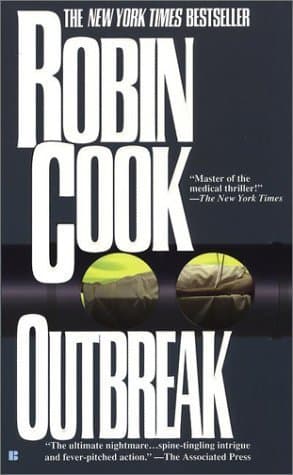
Robin Cook (1987)
Genre
Thriller / Mystery / Science Fiction
Reading Time
7-8 hours (based on ~250 words per page)
Key Themes
See below
Sign in to track this book
A deadly plague sweeps the nation, and Dr. Marissa Blumenthal must expose a sinister conspiracy within the medical community before a 'cure' becomes the deadliest weapon.
The story begins with puzzling deaths in Los Angeles. Dr. Alice Austin, a young physician, is confused by patients with severe flu-like symptoms that quickly turn into hemorrhagic fever and death. The Centers for Disease Control (CDC) in Atlanta alerts Dr. Marissa Blumenthal, an epidemiologist, who first investigates a similar outbreak in New York City. The rapid onset and high death rate are alarming, and the lack of a clear pathogen or transmission route makes the situation worse. The initial cases are spread out geographically, adding to the mystery and making containment hard.
Dr. Marissa Blumenthal, a dedicated epidemiologist, arrives in New York City to investigate the first reported outbreak. She examines patient records and conducts interviews but finds no clear link between victims or a common infection source. Frustrated, she goes to Los Angeles, where cases are quickly increasing. Working with local health officials, Marissa struggles to identify the cause, which seems highly contagious and deadly. Her early findings suggest a virus, but its traits are unlike anything she has seen, leading her to suspect something more sinister.
As deaths rise in Los Angeles and new cases appear in other cities, the CDC, led by Dr. Chester Golden, declares a full emergency. Dr. Marissa Blumenthal is central to the investigation, working to understand the disease. Public panic starts as news of the mysterious plague spreads. Hospitals are overwhelmed, and fear of contagion causes social disruption. Marissa notes unusual patterns in patient demographics and locations, which do not fit a natural epidemic. This leads her to suspect a deliberate act rather than a naturally occurring virus.
During her investigation, Dr. Marissa Blumenthal notices a disturbing pattern: many early victims in both New York and Los Angeles were patients of specific Health Maintenance Organizations (HMOs). This link seems too strong to be a coincidence. She investigates the records of these HMOs, especially those in a large national chain. This discovery shifts her focus from a purely epidemiological search for a natural pathogen to a more forensic investigation, raising questions about corporate practices and the potential for a deliberate, targeted spread of the illness. Some meet her suspicions with skepticism, but she continues.
Dr. Marissa Blumenthal's investigation leads her to reconnect with Dr. David Wilson, a former colleague and past romantic interest, who now works for a private research firm. David is also investigating the outbreaks, hired by some of the affected HMOs. Initially, their collaboration is tense due to their past, but their shared dedication to solving the crisis quickly overcomes personal history. David's access to different data and his observations support Marissa's findings, strengthening the idea that the outbreaks are not random natural events. Their combined efforts speed up understanding of the disease's unusual spread.
Through lab work and data analysis, Dr. Marissa Blumenthal and Dr. David Wilson identify the cause: a virulent, genetically engineered virus. This confirms Marissa's earlier suspicions that the outbreaks are not natural. The virus is highly contagious and lethal, mimicking flu symptoms at first to hide its true nature. They realize this is not a random act of nature but deliberate bioterrorism, or a targeted attack with specific motives. This discovery turns the medical mystery into a criminal investigation.
The puzzle pieces come together for Dr. Marissa Blumenthal and Dr. David Wilson. They discover the engineered virus is deliberately released into specific HMOs, targeting patients considered expensive or unprofitable due to chronic conditions or age. The goal is to reduce healthcare costs and increase HMO profits by eliminating high-risk patients. The mastermind is a powerful figure within the national HMO network, who sees human lives as statistics. The realization of this monstrous conspiracy shakes Marissa, turning her scientific investigation into a moral fight.
Dr. David Wilson, using his connections and corporate data, uncovers the mastermind: Dr. Eugene Landau, a brilliant but ruthless executive at the head of the national HMO conglomerate. Landau, driven by an extreme focus on cost-efficiency and profit, planned the creation and release of the virus. He saw it as a solution to rising healthcare costs, a twisted form of 'quality control' for patients. This reveal is a shocking betrayal of medical ethics and human decency, showing a dark side of a system meant to care for the sick.
As Dr. Marissa Blumenthal and Dr. David Wilson gather evidence against Dr. Landau and his accomplices, they become direct threats to the conspiracy. Marissa faces increasing danger, with subtle and then overt attempts to stop her investigation and silence her. Her lab samples are tampered with, her findings dismissed by higher-ups who may be involved or intimidated, and she receives direct threats. Her life is at risk as she gets closer to the truth, showing the extreme measures the conspirators will take to protect their deadly secret.
Despite threats and obstacles, Dr. Marissa Blumenthal and Dr. David Wilson gather enough evidence to expose Dr. Eugene Landau and his scheme. They present their findings to authorities, detailing the virus's genetic engineering, its deliberate release, and the profit motive behind the murders. The public revelation causes a massive scandal and outrage. Landau and his co-conspirators are arrested, ending the deadly outbreaks. The event warns about how corporate greed can corrupt even the most important institutions.
After the conspiracy's exposure, the immediate threat of the engineered virus is contained, and the public health crisis ends. Dr. Marissa Blumenthal and Dr. David Wilson are hailed as heroes, though they carry the emotional scars of their experience. The novel ends with a reflection on the fragility of ethical boundaries in medicine and the influence of corporate greed. The events prompt a re-evaluation of healthcare practices and oversight of powerful organizations, leaving a lasting impact on the characters and the fictional world, showing the constant need for vigilance to prevent such atrocities.
The Protagonist
Marissa transforms from a dedicated but somewhat naive epidemiologist into a hardened investigator who uncovers and fights against a deep-seated medical conspiracy.
The Supporting
David moves from a somewhat detached private researcher to a deeply committed partner in exposing a medical conspiracy, reigniting his bond with Marissa.
The Antagonist
Landau's arc is one of sustained villainy, culminating in his exposure and downfall as his monstrous scheme is revealed.
The Supporting
Golden grapples with the escalating crisis and the unsettling nature of Marissa's findings, moving from standard epidemiological response to reluctantly acknowledging a deeper conspiracy.
The Supporting
Alice's arc is brief but impactful, highlighting the initial medical community's struggle and confusion as the outbreaks begin.
The Supporting
Blanton's arc is focused on the scientific discovery, moving from identifying an unknown virus to confirming its artificial nature.
The Mentioned
Her role is to subtly represent the corporate bureaucracy and its initial resistance to external scrutiny.
This is the main theme, exploring the consequences when profit overrides medical ethics. Dr. Landau's plan to eliminate 'unprofitable' patients with a deadly virus directly opposes Dr. Marissa Blumenthal's dedication to saving lives and upholding the Hippocratic Oath. The novel criticizes how healthcare systems, especially corporate models like HMOs, can be corrupted by financial incentives, turning patients into commodities. The conflict between Marissa's ethics and Landau's ruthless calculations forms the core of the story.
““The Hippocratic Oath means nothing to men who only see numbers, not lives.””
The novel shows how unchecked power, whether corporate or scientific, can lead to abuse. Dr. Landau, a high-ranking executive in a large HMO network, has immense power over healthcare decisions and resources. His ability to plan a widespread, deadly biological attack comes from this position and a lack of oversight. Similarly, creating a genetically engineered virus shows the danger of scientific advancement without strong ethical limits. The plot warns about the importance of accountability and moral leadership in powerful institutions, especially those affecting public health.
““Power without conscience is the most dangerous disease of all.””
Initially presented as a natural epidemic, the story quickly moves into bioterrorism. The novel details an epidemiologist's investigative process, from identifying symptoms and tracking transmission to lab analysis. However, it reveals the deliberate, man-made nature of the outbreaks. This theme explores society's vulnerability to both natural pathogens and intentionally weaponized diseases. It raises questions about preparedness, detection, and the moral implications of using biological agents, showing the insidious nature of an attack disguised as a natural disaster.
““It wasn't just a disease; it was a weapon, aimed with terrifying precision.””
Marissa Blumenthal's journey shows an individual fighting a powerful, corrupt system. Despite skepticism from superiors, threats from conspirators, and the problem's scale, she pursues the truth. This theme emphasizes the courage and determination needed for one person to challenge established institutions and expose corruption. It suggests that even against overwhelming odds, individual integrity and perseverance can make a difference, leading to the downfall of a powerful and malevolent force.
““One person can make a difference, especially when armed with truth and unwavering resolve.””
Initial presentation of the outbreaks as a natural flu epidemic.
The novel initially misleads the reader by presenting the mysterious illness as a naturally occurring, highly virulent flu strain. This creates a sense of medical mystery and urgency, focusing the early investigation on typical epidemiological methods. This misdirection serves to heighten the eventual shock and horror when Dr. Marissa Blumenthal discovers that the disease is, in fact, a man-made, genetically engineered virus, deliberately released. It also allows the conspirators to operate undetected for a crucial period, as the medical community is looking for a natural explanation.
The rapidly spreading and deadly nature of the virus.
The accelerating spread and high mortality rate of the engineered virus create a constant sense of urgency throughout the narrative. Each new reported case and death adds pressure on Dr. Marissa Blumenthal and her team to identify the pathogen and its source before the epidemic overwhelms healthcare systems and causes widespread societal collapse. This 'ticking clock' device intensifies the suspense and drives the plot forward, making every discovery feel critical and every delay potentially fatal, pushing the characters to their limits to find a solution before it's too late.
Marissa's initial suspicions of a deliberate act are dismissed but proven true.
Initially, when Dr. Marissa Blumenthal suggests that the outbreaks might not be natural, her theories are met with skepticism and even dismissal by her superiors and colleagues. This common narrative trope allows the protagonist to appear isolated in their beliefs, making their eventual discovery of the truth more impactful. The device effectively builds tension by pitting Marissa's intuition against the scientific orthodoxy and bureaucratic inertia, only to dramatically validate her 'conspiracy theory' as the horrifying reality. This reinforces her sharp intellect and tenacity against formidable opposition.
The rekindling of Marissa and David's professional and personal bond.
The strained past romantic relationship between Dr. Marissa Blumenthal and Dr. David Wilson serves as a plot device to add a personal dimension to their professional collaboration. Their shared history creates an initial friction, but as they work together on the life-or-death investigation, their mutual respect and trust are rekindled. This not only provides emotional depth to the characters but also strengthens their partnership, making them a more formidable duo against the powerful antagonists. Their personal connection enhances their resolve and mutual support in the face of danger.
“The microscopic world, once so benign, had become a battleground, and humanity was losing.”
— Reflecting on the nature of the epidemic.
“Fear was a more potent pathogen than any virus. It could spread faster, infect deeper, and kill with a certainty that even the most virulent disease couldn't match.”
— Considering the public's reaction to the outbreak.
“In the realm of biological warfare, the line between accident and intention was often blurred, a terrifying gray area where the truth might never fully emerge.”
— Investigating the origins of the virus.
“Money, power, and the pursuit of scientific glory could corrupt even the most noble intentions, turning medicine into a weapon.”
— Realizing the motivations behind the crisis.
“The greatest threat to life wasn't always external; sometimes, it was the very systems designed to protect it that posed the most danger.”
— Questioning government and corporate involvement.
“Every patient was a puzzle, every symptom a clue. But in this game, the stakes were life and death, and the clock was always ticking.”
— Dr. Marissa Blumenthal's perspective on her work.
“The silence in the morgue was a heavy blanket, muffling everything but the stark reality of the epidemic's toll.”
— Examining victims of the disease.
“They were playing God, but without the wisdom or foresight to understand the consequences of their creations.”
— Criticizing the scientists behind the bioweapon.
“Hope was a fragile thing in the face of such overwhelming despair, but it was all they had left to cling to.”
— During a particularly bleak moment in the investigation.
“The human body, a marvel of complexity, could also be its own worst enemy when turned against itself by a microscopic invader.”
— Discussing the pathology of the virus.
“Bureaucracy, in its infinite wisdom, often became an unwitting accomplice to disaster, its slow gears grinding against the urgency of a crisis.”
— Frustration with official channels during the outbreak.
“The truth, once revealed, was a bitter pill, but far less toxic than the lies that had fueled the catastrophe.”
— After the conspiracy is uncovered.
“Sometimes, the most terrifying monsters weren't lurking in shadows, but sat behind desks, making decisions that affected millions.”
— Considering the true villains of the story.
“The world was a petri dish, and humanity, for all its arrogance, was just another culture susceptible to infection.”
— A broader, philosophical reflection on humanity's vulnerability.
Ready to see how well you understood this book? Take our interactive quiz with 10 questions.
Biography coming soon.







