“Daddy says we're staying. No matter what. This is our home. We'll make it work.”
— Billie Jo's father's determination to stay on their farm despite the Dust Bowl.

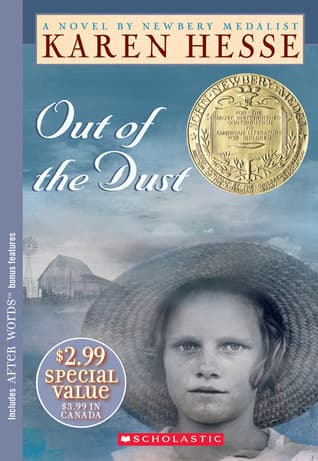
Karen Hesse (1997)
Genre
Children's / Historical Fiction / Young Adult
Reading Time
240 min
Key Themes
See below
Sign in to track this book
In 1930s Oklahoma, Billie Jo finds strength through piano, navigating loss and environmental ruin.
Fourteen-year-old Billie Jo Kelby lives with her parents, Bayard and Polly Kelby, on a farm in Joyce City, Oklahoma. It is 1934, and the Dust Bowl has ruined their land, making farming hard. Billie Jo finds comfort in playing the piano, a skill she learned from her mother. Her father, a quiet farmer, hopes for rain and a good wheat crop, always fighting the dust. Billie Jo describes the dust everywhere, covering food, furniture, and even their lungs. She feels growing tension between her parents, both weighed down by their difficult lives.
One hot April day, Billie Jo's mother leaves a pail of kerosene by the stove for cleaning. Her father mistakes it for water and throws it onto the fire. The kerosene immediately ignites, setting Ma on fire. Billie Jo tries to save her mother, grabbing the flaming pail and throwing it outside. In doing so, her own hands catch fire. Ma suffers severe burns, especially on her chest and face. Billie Jo's hands are deeply scarred, making it agonizing to play the piano, her greatest joy. The accident casts a dark shadow over the Kelby home.
Ma's burns are too severe. She goes into labor early, giving birth to a baby boy named Franklin. But both Ma and Franklin die soon after. This double tragedy shatters Billie Jo and her father. Ma's death leaves a huge empty space in their home. Billie Jo feels consumed by guilt, believing she is partly to blame for the accident and for not saving her mother. The dust storms continue without end, mirroring the emotional emptiness in the Kelby home. Billie Jo's hands are still healing, stopping her from playing the piano, which deepens her sadness.
In the months after the tragedy, Billie Jo and her father sink into a shared, silent grief. Their relationship, already tense, becomes even more distant, marked by unspoken blame and sorrow. Billie Jo's hands are a constant reminder of the accident and her lost ability to play piano. She tries to help her father on the farm, but the dust makes everything a struggle. She sees her father's quiet suffering and his failed attempts to grow crops. The community offers sympathy, but Billie Jo feels alone, unable to express her deep pain or connect with anyone, even her father.
The dust storms show no signs of stopping. They become more frequent and violent, bringing a new illness: dust pneumonia. People in Joyce City get sick, coughing up dust and struggling to breathe. Billie Jo worries about her father, who also has a cough. The land becomes more barren. Many families, unable to support themselves, pack up and leave Oklahoma, heading west for a better life. Billie Jo watches them go, feeling both longing and fear. She remains tied to her home by her father and the graves of her mother and brother.
Wanting comfort and a connection to her mother, Billie Jo tries to play the piano again. But the scars on her hands are still raw and sensitive, making every touch of the keys extremely painful. The music she once made easily now feels strange and impossible. Not being able to play her beloved instrument deepens her sense of loss and isolation. She feels as though a part of her died with her mother and Franklin. The piano, once a source of joy, now only brings her pain and reminds her of what she lost.
A drifter, a 'boxcar man,' appears in Joyce City, looking for food and shelter. Billie Jo's father, despite his own hardships, offers him a meal. The man tells stories of his travels, of seeing the world beyond the dusty plains. His presence and stories plant an idea in Billie Jo's mind: leaving, escaping the constant dust and painful memories of her home. She starts to imagine hopping on a train and riding away, a sharp contrast to her father's stubborn decision to stay on the land.
Over a year after Ma's death, overwhelmed by grief, dust, and the silence between her and her father, Billie Jo makes a quick decision. She packs a small bag and runs away, hopping on a freight train heading west. She travels for several days, meeting other transients and seeing life outside her familiar, desolate world. But the journey is hard and lonely. She realizes that despite the difficulties, her home, her father, and her mother's memories are where she belongs. The outside world is not the escape she imagined. She feels a strong pull back to Joyce City.
Billie Jo returns to Joyce City. Her father is relieved to see her but does not openly show his feelings. Their reunion is quiet, but they share an unspoken understanding. Billie Jo realizes that running away solved nothing; it only made her appreciate what she had. She is ready to stop running from her grief and instead, learn to live with it. She starts to see her father with new eyes, recognizing his quiet strength and his own lasting pain. This marks a turning point in their relationship, as they slowly begin to heal and find a way to talk.
Billie Jo slowly starts to heal, both emotionally and physically. She accepts that her hands will never be the same, but she finds a way to play the piano again, changing her technique. The music is different, but it is still hers. Her relationship with her father gradually improves; they start talking more openly, sharing memories of Ma. A new teacher, Miss Freeland, arrives in town, bringing a new outlook and hope. Billie Jo begins to look to the future with quiet strength, understanding that life, even in the dust, can have moments of beauty and connection.
Billie Jo notices her father spending more time with Louise, a quiet and kind store clerk. At first, Billie Jo feels a pang of loyalty to her mother, fearing a replacement. But she slowly accepts Louise's presence. Louise respects Ma's memory and does not try to take her place. Instead, she offers quiet company and support to Billie Jo's father. This new relationship in her father's life shows a gradual move toward healing and finding new happiness, even amid their ongoing grief and the harsh realities of the Dust Bowl.
By the end of the year, Billie Jo finds a fragile peace. She continues to play the piano, her music changing to reflect her experiences and endurance. She accepts Louise as a positive, gentle presence in her father's life and her own. The dust remains, a constant challenge, but Billie Jo no longer feels trapped by it. She has learned to live with loss, to find beauty in small moments, and to appreciate her own lasting spirit and her father's love. She looks forward with quiet hope, ready for whatever the future, dust or not, may bring.
The Protagonist
Billie Jo transforms from a hopeful, musically gifted girl into a grief-stricken, isolated adolescent, eventually finding resilience, acceptance of her changed body, and a renewed connection with her father and her music.
The Supporting/Deceased
Ma's arc is cut short by tragedy, but her memory and influence continue to guide Billie Jo's journey towards healing and acceptance.
The Supporting
Daddy's arc shows his struggle with profound grief and his eventual, quiet opening up to his daughter and finding new companionship.
The Mentioned
Franklin's arc is tragically short, serving as a catalyst for Billie Jo's deeper grief and sense of responsibility.
The Supporting
Louise's arc introduces the possibility of new relationships and healing for the grieving family.
The Supporting
Livie's arc is a minor one, representing the exodus of many families from the Dust Bowl.
The Supporting
Arley's arc is a steady source of encouragement for Billie Jo to return to her passion.
The Mentioned
The Wild Boy's arc is a brief appearance, highlighting the widespread suffering and transient nature of life during the Dust Bowl.
The most common theme is the deep loss and grief Billie Jo and her father feel. Ma and infant Franklin's deaths, along with Billie Jo's injured hands, plunge them into deep sorrow. The story shows different ways people cope with loss: Billie Jo's guilt and silent suffering, her father's quiet strength, and the distance that grows between them. The dust itself symbolizes this grief, always covering everything, making escape impossible. For example, Billie Jo often visits Ma's grave, and her inability to play the piano due to her burns directly links to her lost joy and connection to her mother.
“And the dust came.”
Despite the great hardships, the story also shows how humans can endure and how hope lasts. Billie Jo faces immense personal tragedy and environmental ruin, yet she finds the strength to move forward. Her healing journey, her eventual return to playing the piano (though with changed hands), and her acceptance of Louise into her father's life all show this endurance. Small acts of kindness from neighbors, occasional rain, and her father's strong commitment to the land, even when it yields nothing, also represent the continuing flicker of hope in a bleak world.
“I am my father's daughter. I am my mother's daughter. And the dust has made me stronger.”
The natural environment, specifically the Dust Bowl, is not just a setting but a strong, destructive force that shapes every part of the characters' lives. The constant dust storms cause crop failures, illness (dust pneumonia), and many families to leave. It controls their daily lives, their dreams, and their losses. The land is both a source of income and a cause of suffering, showing how vulnerable humans are to nature. The dust is a constant problem, affecting mood, health, and money. Its presence everywhere highlights the characters' fight to survive.
“Dust storms came, blowing prairie soil, dust from other farms, until on the worst days, the dust was so thick, it blocked out the sun.”
Family bonds, especially between Billie Jo and her father, are central to the story. After Ma's death, their relationship becomes tense, marked by a lack of talking and unspoken grief. They love each other, but their inability to express their pain creates distance. Billie Jo's journey involves learning to close this communication gap, eventually finding ways to connect with her father through shared understanding and quiet actions. Louise's arrival further explores how families adapt and redefine themselves after loss, showing that love and connection can take new forms.
“Daddy and I, we were like tumbleweeds, rolling through the dust, side by side, but never touching.”
Billie Jo's journey is one of deep self-discovery. She grapples with who she is after losing her mother, injuring her hands, and seeing her environment ruined. Her identity as a piano player is deeply tied to who she is, and losing the ability to play challenges her core self. Her brief attempt to run away is a search for a new identity, a new place. But she ultimately discovers that her true self is tied to her home, her past, and her ability to adapt. She learns to accept her changed hands and create a new musical identity, finding strength in her endurance.
“I am a girl who is nothing without her music. And now, I am a girl with nothing.”
The entire novel is written in free verse, enhancing emotional depth and immediacy.
The novel's use of free verse poetry allows for a powerful, immediate, and intimate portrayal of Billie Jo's inner world and the harsh realities of the Dust Bowl. The lack of strict rhyme or meter mirrors the unpredictable nature of the dust storms and the disarray of Billie Jo's life. The concise language and vivid imagery create a strong emotional impact, allowing the reader to experience Billie Jo's grief, hope, and observations directly. It also gives a lyrical quality to the narrative, reflecting Billie Jo's musicality even when she cannot play the piano, and makes the book accessible for its target audience.
The omnipresent dust symbolizes grief, despair, and the relentless challenges of life.
The dust in 'Out of the Dust' is a potent and multifaceted symbol. It represents the physical hardship and environmental devastation of the Dust Bowl, covering everything, making life and farming a constant struggle. More profoundly, it symbolizes Billie Jo's internal state: the suffocating grief, the despair, and the feeling of being buried under her losses. The dust gets into everything – lungs, food, and even the emotional spaces between characters – highlighting how deeply the hardships permeate their lives. As the dust slowly settles, it mirrors Billie Jo's gradual process of healing and coming to terms with her new reality.
The piano represents Billie Jo's joy, identity, and connection to her mother, while her hands symbolize her physical and emotional wounds.
The piano is central to Billie Jo's identity and her bond with her mother, symbolizing joy, expression, and a link to a more beautiful life outside the dust. When her hands are severely burned in the accident, her inability to play becomes a powerful symbol of her profound loss, her guilt, and her broken spirit. The scars on her hands are a constant physical reminder of the tragedy. Her eventual return to playing, despite the pain and the altered way she must play, symbolizes her resilience, her acceptance of her changed self, and her ability to find new forms of expression and hope after trauma.
The novel is structured like a series of diary entries, providing an intimate first-person perspective.
The entire novel is presented as a series of dated, first-person entries, giving it the feel of a personal journal or diary. This structure provides an intimate and immediate window into Billie Jo's thoughts, feelings, and observations. It allows the reader to experience her grief, her small moments of hope, and her daily struggles directly through her eyes. The chronological nature of the entries also marks the passage of time and the slow, arduous process of healing and change, making her journey feel deeply personal and authentic.
“Daddy says we're staying. No matter what. This is our home. We'll make it work.”
— Billie Jo's father's determination to stay on their farm despite the Dust Bowl.
“The dust came, a cloud of it, like a monster devouring everything.”
— Billie Jo describing the terrifying arrival of a dust storm.
“Nothing is ever going to be the same, not after the fire.”
— Billie Jo reflecting on the tragic accident that disfigured her hands and killed her mother and baby brother.
“I used to love the piano, but now it just sits there, a reminder of what I can't do.”
— Billie Jo's struggle with her injured hands preventing her from playing the piano.
“Ma always said I had music in my bones. Now it feels like the dust has taken that too.”
— Billie Jo's internal conflict about her passion for music after her injury.
“Sometimes I feel like I'm just waiting for the dust to bury me.”
— Billie Jo expressing her despair and hopelessness during the worst of the Dust Bowl.
“Even with the dust, the sky is still there, sometimes.”
— A small moment of hope and perspective amidst the overwhelming dust.
“You can't outrun the dust, Billie Jo. It's everywhere.”
— A character's grim realization about the inescapable nature of the Dust Bowl.
“I want to be able to play again. I want to feel the music in my hands, not just in my head.”
— Billie Jo's longing to recover her ability to play the piano.
“Daddy and me, we're two halves of a whole, broken.”
— Billie Jo reflecting on her shared grief and brokenness with her father after their losses.
“Sometimes you just have to keep going, even when you don't know why.”
— A quiet reflection on the necessity of perseverance in difficult times.
“The wind howls, and the dust swirls, and I try to find a place inside myself where it can't reach.”
— Billie Jo's internal struggle to find peace amidst the external chaos of the dust storms.
“I'm learning to live with what's left, and to make it enough.”
— Billie Jo's journey towards acceptance and finding contentment despite her losses.
“The dust may cover everything, but it can't cover the music in my heart.”
— Billie Jo's enduring connection to music, even when she cannot physically play.
Ready to see how well you understood this book? Take our interactive quiz with 10 questions.

Biography coming soon.

Dan Gemeinhart
4.5

Kate O'Hearn
4.4

Jeanne Birdsall
4.4

Jen Wang
4.4

Wendelin Van Draanen
4.3

John Marsden
4.3

Chris Van Allsburg
4.3
Jennifer A. Nielsen
4.2