“We're all just trying to survive, aren't we?”
— Reflection by one of the factory women on their shared struggles.

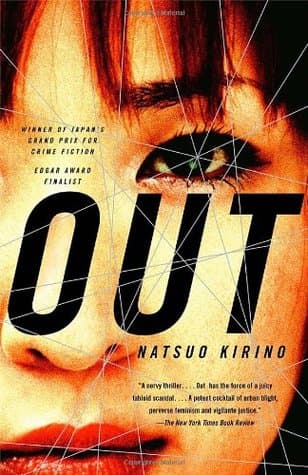
Natsuo Kirino (2007)
Genre
Thriller / Mystery
Reading Time
900 min
Key Themes
See below
Sign in to track this book
In the quiet Tokyo suburbs, a desperate night-shift worker strangles her deadbeat husband, plunging her and her lunch-making co-workers into a grim, blood-soaked pact with the yakuza to dispose of the body and escape their suffocating lives.
The story begins in a bento box factory in the Tokyo suburbs, where a group of women work the night shift. Yayoi Yamamoto, a young mother with a gambling-addicted and abusive husband, Kenji, snaps after he spends their savings and insults her. She strangles him to death with his own belt at home. Panicked, Yayoi calls her co-worker, Masako Katori, in the middle of the night. Masako, a detached and pragmatic woman, agrees to help. She recognizes a shared desperation in Yayoi's plea. They realize the seriousness of the situation and the need for a careful plan to dispose of the body and avoid suspicion.
Masako, needing more help, brings in two other co-workers: Kuniko, a vain and debt-ridden woman, and Yoshie, an older, stoic woman with a dark past. Under Masako's calm direction, the four women meet in Yayoi's apartment to dismember Kenji's body in the bathtub. The gruesome task is done carefully, with Masako leading the dissection. Yoshie offers practical advice, and Kuniko struggles with nausea and fear. They bag the body parts separately, planning to scatter them in various remote locations. This act binds them together in a pact of silence and complicity.
Despite their efforts, a golfer discovers Kenji's severed left hand in a remote wooded area. This leads to a police investigation led by Detective Azuma. The discovery immediately puts pressure on the women. Azuma, a shrewd investigator, quickly identifies the victim as Kenji Yamamoto, a known gambler with yakuza connections. The police start questioning people connected to Kenji, including Yayoi, who acts grieving and ignorant. The women become paranoid, knowing any mistake could expose them. The discovery also alerts the yakuza, who are interested in Kenji's gambling debts.
Mitsuyoshi Satake, the bento factory manager, becomes suspicious of the women's behavior after overhearing parts of their conversations. He eventually figures out the truth about Kenji's murder and begins to blackmail Yayoi, demanding money for his silence. This adds more stress and danger to the women's lives. Yayoi, desperate to protect herself and her children, begins to pay him, but his demands become more and more. Satake's involvement threatens to unravel their cover-up.
Overwhelmed by guilt, fear, and Satake's blackmail, Yayoi takes her children and flees to her parents' home in the countryside, leaving her co-conspirators to deal with the situation. Meanwhile, the yakuza, led by Jumonji, increase their search for Kenji, believing he has run off with a large amount of gambling debt money. They start pressuring people connected to Kenji, including the women from the bento factory. Jumonji's brutal methods and relentless pursuit create a sense of dread for Masako, Yoshie, and Kuniko, who now face the consequences alone.
When Satake's blackmail demands become too much, and he tries to sexually assault Kuniko, Masako decides to act. She lures Satake to a love hotel and strangles him to death, getting back the money he extorted from Yayoi. This second murder is more planned and cold-blooded than Yayoi's initial act, showing Masako's growing detachment and her willingness to commit extreme acts to protect herself and her colleagues. She carefully cleans up the scene, leaving no trace, solidifying her role as the group's pragmatic leader.
Yoshie's past as a survivor of an attack, where she killed her assailant, is revealed. This explains her stoicism and practical approach to the dismemberment. This shared history of violence creates a deeper bond between her and Masako. Kuniko, still burdened by debt and wanting a better life, makes reckless decisions. She tries to escape her financial problems by running away with a young man, only to be abandoned and left in a more desperate situation. Her erratic behavior and emotional instability pose a risk to the group's secrecy and safety.
Jumonji, frustrated by his inability to find Kenji or the missing money, starts focusing on the women from the bento factory. He suspects they know more than they are saying and uses intimidation and violence to get information. He targets Kuniko, who, because of her financial desperation and emotional vulnerability, becomes an easy target for his manipulation. Jumonji's brutal interrogation methods and the threat of yakuza violence put immense pressure on the remaining women, forcing them to consider even more drastic measures to survive.
With both the police and Jumonji closing in, Masako and Yoshie decide to flee Tokyo. They try to establish new identities and disappear, but their past actions, particularly the disposal of Satake's body, make it difficult. Jumonji, relentless in his pursuit of Kenji's money, corners them. A violent confrontation happens, during which Masako and Yoshie fight for their lives. The chase ends in a desolate, industrial area, where the women are pushed to their physical and psychological limits. This shows their desperation to escape the results of their actions and the oppressive society that contributed to their crimes.
In a final confrontation, Masako faces Jumonji. She manages to escape him, but with further violence and injury. The police, led by Azuma, are also close behind. The story ends with the women scattered, their lives changed by their shared crime. While some avoid immediate capture, the psychological scars and the constant threat of discovery remain. The ending leaves the reader thinking about justice, the bonds formed in desperation, and the oppressive forces that drove these ordinary women to commit acts of violence. Their ultimate fates are ambiguous but grim.
The Protagonist
Masako transforms from a seemingly ordinary, repressed woman into a cold, efficient killer, embracing a dangerous freedom through her actions.
The Protagonist
Yayoi moves from a victim of domestic abuse to a murderer, then to a fugitive haunted by her actions.
The Supporting
Yoshie's past trauma resurfaces, confirming her inner strength and resolve in the face of new violence.
The Supporting
Kuniko's recklessness and desperation lead her into deeper trouble, making her a liability to the group and herself.
The Antagonist
Satake transforms from a petty blackmailer into a victim, killed by Masako for his escalating threats.
The Antagonist
Jumonji remains a constant, escalating threat, relentlessly pursuing his objectives regardless of the cost.
The Supporting
Azuma's investigation slowly uncovers the truth, bringing him closer to the women, though their ultimate fates remain ambiguous.
The Mentioned
Kenji's death is the inciting incident, and his past actions continue to influence the plot long after he is gone.
The novel explores how ordinary women, trapped in oppressive societal roles and dead-end lives, find a sense of empowerment through acts of violence. For Masako, murder and cover-up free her from her monotonous existence, allowing her to take control. Yayoi's initial act is a desperate reclaiming of power from her abusive husband. The women's solidarity in crime creates a unique bond, suggesting that for them, breaking societal norms and committing violent acts is a 'way out' of their invisible lives.
“What does it mean to be a woman? To be a woman is to be nothing. To be nothing is to be free.”
Kirino portrays the widespread oppression faced by women in contemporary Japanese society, especially those in lower socioeconomic groups. The women are trapped in monotonous, poorly paid jobs, burdened by family responsibilities, and often subjected to male abuse or exploitation. Yayoi's husband's abuse, Kuniko's financial desperation, and Masako's quiet resignation to her unfulfilling life all show the limited options and societal pressures that push these women to their breaking point. The murder and cover-up become an act of rebellion against these systemic constraints.
“They were women who worked the night shift, women whose lives were a constant negotiation of compromise and quiet desperation.”
The novel looks at the psychological impact of guilt and the complex dynamics of complicity. While Yayoi is initially overwhelmed by guilt, Masako seems almost immune to it, driven by practicality. The shared act of dismemberment binds the women together. Their individual fears and moral compasses are tested. The constant threat of exposure and the need to commit further crimes to maintain their secret deepen their complicity, blurring the lines between victim and perpetrator and forcing them to confront the darker aspects of their own humanity.
“Once you cross that line, there's no going back. You just keep going.”
Money is a corrupting force and a primary motivator for many characters. Kenji's gambling debts and financial irresponsibility drive Yayoi to murder. Kuniko's desperate need for money makes her vulnerable to blackmail and reckless decisions. Satake's greed leads to his demise. The yakuza's involvement is solely driven by the pursuit of money. The novel shows how financial desperation can push individuals to extreme moral compromises and violence, highlighting the reality of economic hardship in a capitalist society.
“Money was a monster, always hungry, always demanding.”
The characters change significantly because of their criminal acts. Masako, in particular, sheds her former identity as a docile factory worker to become a more ruthless and self-possessed person. The shared secret forces the women to confront who they truly are and what they are capable of. This transformation is not necessarily positive, often leading to further violence and moral decay, but it means they break free from their previously constrained selves. They redefine their identities outside societal expectations.
“She felt as if she had shed her old skin, leaving behind the dull, submissive woman she used to be.”
Shifting viewpoints to reveal inner thoughts and motivations.
The narrative frequently shifts between the perspectives of the main characters—Masako, Yayoi, Yoshie, Kuniko, and even Detective Azuma and Jumonji. This allows the reader to delve into the individual psychologies, motivations, and fears of each character, providing a multifaceted view of the crime and its aftermath. It builds suspense by showing how different characters perceive the same events and highlights their varying degrees of guilt, desperation, and resolve.
A central, grotesque scene that binds the characters.
The detailed and graphic description of the dismemberment of Kenji's body serves as a pivotal plot device. It is the defining moment that irrevocably binds the four women together in a pact of complicity and silence. This grotesque act is not merely for shock value; it symbolizes their collective breaking of societal taboos and their descent into a world beyond conventional morality. It establishes the high stakes and the irreversible nature of their actions, shaping all subsequent events and character developments.
A mundane, oppressive setting that contrasts with the violence.
The bento box factory, with its monotonous night shifts and repetitive tasks, serves as a symbolic backdrop. It represents the oppressive, unfulfilling lives of the working-class women, highlighting the contrast between their mundane existence and the extreme violence they commit. The factory's sterility and anonymity mirror the women's hidden lives and provide a seemingly innocuous cover for their criminal activities, further emphasizing the 'out' theme of breaking free from such environments.
An organized criminal element escalating the stakes.
The introduction of the yakuza, particularly Jumonji, as an external and highly organized threat, significantly escalates the tension and danger for the women. Unlike the police, who operate within legal frameworks, the yakuza's brutal and extra-legal methods add a layer of visceral fear and desperation. This device forces the women to become even more resourceful and violent in their self-preservation, transforming their amateur crime into a high-stakes struggle for survival against a formidable underworld.
A recurring metaphorical and literal escape.
The concept of a 'way out' is a central motif. It refers to a literal escape from the scene of the crime, from the city, or from capture. More profoundly, it signifies an escape from the oppressive conditions of their lives—from poverty, abuse, monotony, and societal expectations. For each woman, the murder and its aftermath represent a desperate attempt to find an 'out,' even if it leads them into a darker, more dangerous existence. This motif underpins their motivations and the novel's overarching themes of liberation and desperation.
“We're all just trying to survive, aren't we?”
— Reflection by one of the factory women on their shared struggles.
“The night hides everything, but it also reveals the truth.”
— Narrator's observation during a tense nighttime scene.
“Sometimes the only way out is through.”
— Character's thought while dealing with a difficult situation.
“In the factory, we're all the same. Just bodies on the line.”
— Description of the women's monotonous work life.
“Fear can make you do things you never thought possible.”
— Reflection on the characters' escalating actions.
“A woman's life is a series of small betrayals.”
— Character's bitter observation about societal expectations.
“The body is just meat. It's the soul that's hard to dispose of.”
— Thought during the gruesome disposal of a corpse.
“We built this prison ourselves, with every small compromise.”
— Reflection on the characters' trapped lives.
“Money doesn't buy freedom; it just changes the cage.”
— Comment on the characters' motivations for crime.
“In the end, we're all alone with our decisions.”
— Final realization by a main character.
“The factory floor is where dreams go to die.”
— Description of the bleak work environment.
“Sometimes the monster is just a reflection in the mirror.”
— Character's self-reflection after committing violence.
“Trust is the first thing to go when you're desperate.”
— Observation about the crumbling relationships among the women.
“There's no such thing as a clean escape.”
— Narrator's comment on the consequences of their actions.
Ready to see how well you understood this book? Take our interactive quiz with 10 questions.







