“Monsters don't have to be hideous. They just have to be evil.”
— August reflecting on the nature of monsters and their appearance.

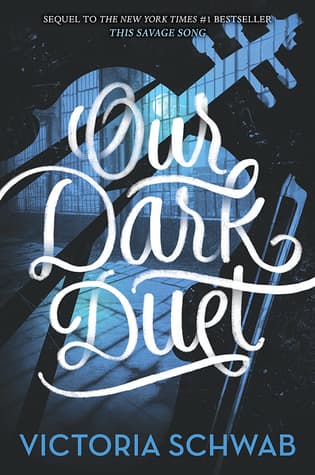
Victoria Schwab (2017)
Genre
Fantasy / Young Adult
Reading Time
10-12 hours
Key Themes
See below
Sign in to track this book
As their city descends into chaos, a monster-hunting heiress and a violin-playing shadow creature must face a growing war outside and the darkness within themselves to save their fractured world.
Six months after leaving Verity, Kate Harker lives in Prosperity, a city without monsters in the south. She uses a fake name, Kate Larissa, and hunts violent humans, trying to fill the emptiness left by real monsters. Despite the calm, Kate feels an unsettling quiet, a sense of something missing. She often thinks of August Flynn and her old life in Verity, struggling with her identity as a monster hunter without actual monsters. Her inner conflict is clear; she wants the excitement and purpose of the hunt but also the safety she has found, even if it feels empty.
In Verity, August Flynn leads the Flynns' monster-hunting forces, working with his sister Ilsa and the remaining Sunai. The city is in chaos, with the truce between the Flynns and Harkers broken, and humans fighting each other. A new kind of monster, a Malchai, has appeared. It feeds on chaos and fear and is more dangerous than anything they have seen. August, still dealing with his own monstrous nature and the burden of leadership, tries desperately to keep peace and protect the innocent, but the city is ready to explode. He misses Kate but believes she is safer away from the growing conflict.
Kate receives an unexpected, urgent message from her father, Leo Harker, through a coded newspaper ad. He says Verity is falling apart, attacked by a new, terrifying monster he cannot fight alone, and asks her to return. This message breaks Kate's fragile peace in Prosperity. Despite her decision to stay away, her father's plea, combined with her need to fight monsters, makes her consider going back. The message also suggests the true scale of the threat, confirming her uneasy feeling that the quiet in Prosperity was only temporary.
Kate decides to return to Verity. She makes a dangerous journey through territories where human groups clash and the monsters' influence is spreading beyond Verity's borders. During her travels, she thinks about her past, her complex relationship with her father, and her bond with August. She wonders if she is making the right choice, knowing that returning means facing the new monster, the unresolved issues with August, and the painful memories of Verity. The journey itself tests her resolve and skills, preparing her for the chaos ahead.
When she arrives in Verity, Kate finds the city more broken than she imagined. She eventually reunites with August, but their reunion is tense. While an undeniable connection exists, their time apart and the growing war have changed them both. August is tougher, burdened by his responsibilities, and Kate is more guarded. They quickly realize the new monster, a Malchai named Soro, is more cunning than a typical monster. It feeds not just on violence but on the emotional chaos and inner demons of its victims. Soro's power makes humans fight each other, speeding up the city's fall into anarchy.
Kate, August, and the Flynns' forces investigate Soro, discovering its terrifying ability to increase humans' darkest emotions: fear, anger, paranoia, and hatred, turning citizens against each other. Soro does not just consume souls; it corrupts them, creating a cycle of violence and despair that fuels its growth. They realize that to defeat Soro, they must not only fight the monster physically but also find a way to stop the chaos it thrives on. The monster's existence shows how fragile humanity is and how easily society can crumble when fear takes over.
Leo Harker, weak and desperate, tells Kate his plan to fight Soro. His methods are extreme and morally wrong, involving his own monster creations and using the city's fear. Kate is horrified by his willingness to sacrifice innocent people and make Verity even more unstable. This confrontation deepens the divide between father and daughter, as Kate realizes Leo's desperation has pushed him further into darkness, blurring the lines between monster and monster hunter. She understands she cannot rely on her father's methods and must find her own way to fight Soro, even if it means opposing him.
Despite their personal tensions, Kate and August form a difficult alliance. They realize the only way to fight Soro is to unite the remaining humans and bring back some order and hope. They work tirelessly; August uses his music to calm, and Kate uses her leadership and combat skills to protect. They try to convince the different groups, human and monster, that Soro is their common enemy. Their efforts are a desperate attempt to create a united front in a city tearing itself apart, showing that even in chaos, cooperation is possible.
As Soro grows stronger, consuming more souls and spreading its influence, August realizes that normal methods are failing. He discovers that because Soro feeds on chaos and fear, it can be stopped by overwhelming it with an opposite force: pure, focused order and calm. In a heartbreaking decision, August chooses to make the ultimate sacrifice. He confronts Soro, using his Sunai ability to absorb all the chaos, fear, and malice Soro has created and feeds on, turning it into a flood of calm and peace. This act destroys Soro but also consumes August, turning him into a glass statue.
After August's sacrifice, Soro is defeated, but Verity is broken. Kate is devastated by August's loss, struggling to accept her grief with the victory. She finds herself alone in a city that is slowly healing, but the cost has been huge. She deeply mourns August, recognizing his profound impact on her life and the world. Kate decides to stay in Verity, honoring August's memory by helping to rebuild the city and protect it from future threats. She embraces her role as a true monster hunter who fights for humanity, not just against monsters.
With Soro defeated and August gone, Kate works to rebuild Verity. She works with Ilsa and the remaining Flynns, trying to establish a new order in a city scarred by war. August's memory is always present, both a source of pain and inspiration. Kate finds a faint hope for the future, a chance that peace can grow even in the most broken places. She understands that the fight against monsters continues, but her purpose is clearer than ever: to protect the innocent and ensure that August's sacrifice was not in vain. The world is changed forever, and so is Kate, now a symbol of strength.
The Protagonist
Kate evolves from a hardened, cynical hunter seeking her father's approval to a self-reliant protector fighting for humanity and honoring August's sacrifice.
The Protagonist/Sacrificial Hero
August accepts his monstrous nature and ultimately chooses to make the ultimate sacrifice to save Verity, solidifying his role as a true hero.
The Antagonist/Supporting
Leo's desperation and morally bankrupt decisions lead to his ultimate demise, a consequence of his own monstrous creations.
The Supporting
Ilsa continues to lead and fight for Verity, mourning her brother but committed to his legacy.
The Antagonist
Soro grows in power by feeding on Verity's chaos until it is ultimately destroyed by August's sacrifice.
The Supporting
Callum continues to lead the Flynns, providing stability and guidance amidst the war.
The Mentioned
Sloan remains in Prosperity, unaware of the full extent of Verity's monster problems.
This theme explores the idea that humanity's greatest threats often come from within. Soro, the Malchai, feeds on fear, hatred, and chaos, increasing the destructive potential of human emotions. The breakdown of Verity, where humans turn on each other, shows this. Leo Harker's desperation and morally wrong actions also show how humans can become monstrous when seeking power or survival. Both Kate and August struggle with their own internal 'monsters' — Kate with her cynicism and inherited darkness, August with his monstrous nature and the burden of his powers. The real battle is not just against outside creatures but against the darkness in every heart.
“Which will be harder to conquer: the monsters they face, or the monsters within?”
The novel strongly features the theme of sacrifice, especially through August's final act. His decision to absorb Soro's chaos, knowing it will destroy him, is a deep act of selflessness and redemption. It changes him from a monster who consumes souls to a hero who sacrifices his own for the greater good. Kate's journey also involves personal sacrifices, leaving her peaceful life in Prosperity to return to Verity's chaos and confront her past. These sacrifices, though painful, lead to a form of redemption for the city and for the characters, showing that true heroism often comes at a great personal cost.
“He would not let Verity fall. Not if he could help it. Not if he could keep a single soul from falling into the monster's maw. He would be the calm.”
Both Kate and August struggle with their identities throughout the story. Kate, a human raised by a monster-making father, feels she does not fully belong in either world. She questions who she is without monsters to hunt and where her loyalties lie. August, a monster who wants to be human, constantly fights his nature and the fear it causes in others. Their shared struggle for a place in the world, caught between monstrosity and humanity, forms a core part of their bond. The novel suggests that identity is not only defined by birth or power, but by choices and actions, and that belonging can be found even in the most unlikely alliances.
“He was a monster who wanted to be human. She was a human who wanted to be a monster. And they were both wrong.”
The story clearly shows how easily peace and order can fall apart in the face of fear and chaos. Verity, already a city under stress, falls into complete anarchy with Soro's arrival, a monster that thrives on discord. The human groups turn on each other, showing how thin the layer of civilization is. Kate's initial peace in Prosperity feels empty precisely because it is a false calm, a temporary break from a world on the edge. The book argues that true peace requires constant watchfulness, cooperation, and a willingness to face destructive forces, both outside and within.
“Order was a fragile thing, easily broken, and once broken, hard to mend.”
A new breed of monster that feeds on chaos and internal human darkness.
The Malchai, specifically Soro, functions as the primary antagonist and a powerful plot device. Unlike the Sunai (August) who consume souls of violent acts or Corsai who feed on shadows, Soro feeds on the emotional chaos, fear, and hatred of humans. This unique ability means Soro doesn't just physically threaten Verity but internally corrodes it, turning its citizens against each other. This device raises the stakes, making the conflict not just about fighting a monster but about restoring humanity's moral fabric. Soro's existence also forces characters to confront the 'monsters within' themselves and society.
A magical ability to soothe, calm, and control his Sunai powers.
August's music serves as a crucial plot device, representing his connection to humanity and his means of controlling his monstrous nature. When he plays his violin, he can soothe fear, bring calm, and even suppress his urge to consume souls. This ability is initially a tool for self-control and comfort, but it becomes a weapon against Soro, as his music can counteract the chaos the Malchai creates. Ultimately, his music is instrumental in his final, self-sacrificial act, as he uses it to channel the overwhelming calm that destroys Soro, highlighting the power of art and peace against destruction.
A divided, monster-ridden city that reflects the internal struggles of its inhabitants.
Verity City is more than just a setting; it acts as a plot device reflecting the moral and emotional state of its inhabitants. Divided between the North (Harker territory, monstrous) and South (Flynn territory, striving for order), the city itself is a battleground. As Soro gains power, Verity descends into total anarchy, mirroring the internal chaos and fear that the monster feeds on. The city's decay and eventual, fragile rebuilding underscore the themes of the fragility of order and the cost of war. Its fate is intrinsically linked to the characters' struggles and choices.
The fundamental ideological and physical division that defines Verity's conflict.
The long-standing divide between the Harkers (monster-makers, chaos-driven) and the Flynns (Sunai, order-driven) is a foundational plot device. It establishes the central conflict of the series, creating the initial conditions for monsters and monster hunters, and shaping the identities and loyalties of Kate and August. This divide creates inherent tension and mistrust, making cooperation difficult even when facing a common enemy like Soro. The eventual necessity of Kate and August working together, despite this divide, highlights the theme of overcoming inherited conflict for a greater good, though the cost is immense.
“Monsters don't have to be hideous. They just have to be evil.”
— August reflecting on the nature of monsters and their appearance.
“Sometimes, the only way to stay sane is to go a little mad.”
— Kate contemplating the extreme measures she must take.
“What do you do when the world is burning, and you're the only one who can put out the fire?”
— Kate grappling with the weight of her responsibility.
“Every monster has a melody. Every song has a price.”
— August reflecting on his powers and their cost.
“Some roads are meant to be walked alone.”
— Kate's realization about her solitary journey.
“Fear is a weapon. You can let it paralyze you, or you can wield it.”
— Kate's internal monologue about confronting her fears.
“There are worse things than death. And I'm one of them.”
— August acknowledging his monstrous nature.
“The hardest part of being a hero is knowing when to stop.”
— A reflection on the sacrifices made in the name of good.
“We are all broken, in one way or another. It's how we put ourselves back together that matters.”
— A moment of introspection on healing and resilience.
“Sometimes, the only way to save someone is to let them go.”
— A painful truth learned by one of the characters.
“Hope is a dangerous thing. It can keep you alive, but it can also get you killed.”
— Kate's cynical view of hope in a bleak world.
“The city was a song, and he was its discordant note.”
— Describing August's place within Verity.
“You don't fight monsters because you hate what's in front of you. You fight them because you love what's behind you.”
— A powerful motivation for fighting evil.
“He was a monster, but he was *her* monster.”
— Kate's acceptance and connection to August.
Ready to see how well you understood this book? Take our interactive quiz with 10 questions.

Biography coming soon.







