“For the first time in his life Orlando felt his kinship with the Duke.”
— Orlando's initial encounter with the Duke, sparking a new self-awareness.

Virginia Woolf (2022)
Genre
Fantasy / Historical Fiction
Reading Time
240 min
Key Themes
See below
Sign in to track this book
Orlando, an aristocratic poet, lives for four centuries and changes gender, exploring identity, love, and literature.
Orlando begins as a sixteen-year-old boy in the Elizabethan era, a wealthy nobleman with a love for poetry and romance. He is first seen cutting at a Moor's head, a symbol of his family's military past, but he soon leaves such activities for thought and writing. Queen Elizabeth I favors him, giving him lands and titles, and making him her favorite. Orlando enjoys court life but also wants solitude and beauty. He falls deeply in love with a Russian princess named Sasha, who visits the English court. He experiences the joys and sorrows of first love, but Sasha betrays him by sailing away with a sea captain, leaving Orlando heartbroken and disappointed with love.
After Sasha leaves, Orlando goes back to his family home, Oakdean, a large estate that reflects his complex and old heritage. He devotes himself to writing poetry, filling notebooks with verses, but struggles with publishing and how his work is received. He hosts an intellectual salon, attracting writers of the Jacobean age, but feels increasingly alone due to his artistic nature. His search for ideal beauty often conflicts with the everyday parts of life, leading to times of sadness and thought. He continues to think about the meaning of love and identity, often feeling a gap between his inner self and his outward appearance.
King Charles II makes Orlando ambassador to Constantinople. He takes on this new role with his usual enthusiasm, enjoying the culture and wealth of the Ottoman Empire. There, he gets involved in diplomatic matters and finds personal satisfaction. However, during a time of unrest, Orlando falls into a deep, seven-day sleep. He wakes up to find himself a woman. This change happens without any physical or emotional trouble; it is simply a change in biological sex, while he keeps all his memories, personality, and intelligence. The story does not explain this event, presenting it as a natural, though unusual, occurrence.
As a woman, Orlando deals with the different social expectations and limits placed on women in the 18th century. Many suitors pursue her, including the Archduchess Harriet, who later turns out to be Archduke Harry. Orlando struggles with corsets, social roles, and the expectations of marriage and home life, which are very different from her previous freedom as a man. She escapes these pressures by running away with a group of gypsies in Turkey, finding a brief time of wild freedom and a deeper connection to nature. However, she eventually wants to return to England and her writing.
Orlando returns to England, now in the Georgian era, and faces legal battles over her property and titles because of her sex change and long absence. Her legal situation is complicated because she is legally still a man, despite being physically a woman. These legal disputes highlight the absurdity and strictness of social norms and gender roles. She observes the changing English society, from social rituals to new intellectual movements. She continues to write, but her work largely goes unrecognized, adding to her internal struggles with identity and artistic value.
In the Victorian era, Orlando, now a woman for several centuries, is drawn to the customs of the time. She meets and marries Marmaduke Bonthrop Shelmerdine, a sea captain who shares her love for adventure and unconventional spirit. Their marriage is a union of two independent people, marked by respect and a shared understanding of life's complexities. This period sees Orlando dealing with the expectations of Victorian womanhood, home life, and growing social changes. She continues to revise her long poem, 'The Oak Tree,' a work that has been with her through all her changes, showing her lasting artistic ambition.
As the novel nears the present day (1928), Orlando navigates the quickly changing world of the early 20th century. She experiences cars, electricity, and the decline of traditional aristocratic life. She reflects on the vast history she has seen, the evolution of human nature, and the continuous struggle between social expectations and individual freedom. Her identity, once fluid, begins to become firm as she embraces all her past selves. She has lived through centuries, changed sex, and experienced countless human emotions, all while keeping a core sense of self.
Through the centuries, Orlando has carefully worked on her epic poem, 'The Oak Tree,' a reflection of her lasting connection to her family home and her own varied existence. This poem is a metaphor for her life – rooted in history but always growing and changing. Finally, in 1928, the poem is published, bringing her some literary recognition, though perhaps not the deep understanding she has always sought. The publication marks the end of her artistic journey and her long search for self-expression, showing her persistent spirit and her unique view of life and literature.
The novel ends with Orlando in the present day (1928), reflecting on her extraordinary life, her changes, and the many experiences that have shaped her. She is a woman of great wisdom and a deep understanding of human nature, having lived for four centuries. Her thoughts are rich with memories, insights, and a strong sense of continuity despite the changes she has gone through. As the clock strikes midnight, her husband, Marmaduke Bonthrop Shelmerdine, returns, symbolizing the cyclical nature of time and love. Orlando looks out at her estate, feeling all her past selves come together in the present moment, a complete being.
The Protagonist
Orlando transforms from a naive Elizabethan boy to a wise, multi-century woman, embracing their fluid identity and culminating in the publication of their life's work, 'The Oak Tree'.
The Supporting
The Queen remains a fixed, powerful figure, serving as Orlando's initial patron and a symbol of the Elizabethan era's grandeur and strictures.
The Supporting
Sasha enters as a romantic ideal for Orlando and exits as the source of his first great heartbreak, a catalyst for his disillusionment.
The Supporting
The Archduchess/Archduke's arc is brief but impactful, revealing the performative nature of gender roles and the societal pressures Orlando faces as a woman.
The Supporting
Shelmerdine appears as Orlando's eventual husband, providing a sense of companionship and stability in her later centuries without restricting her independent spirit.
The Mentioned
The narrator's 'arc' is one of evolving literary commentary, adapting their voice and observations to each historical period Orlando inhabits.
The main theme is the fluidity of gender and identity. Orlando's change from a man to a woman, without explanation or distress, questions fixed ideas of sex and gender. The novel explores how social expectations and roles change greatly based on one's perceived gender. Orlando experiences firsthand the different limits and freedoms as a man in Elizabethan England versus a woman in the Georgian or Victorian eras. The story suggests that identity is not fixed but always changing, shaped by time, experience, and social context, going beyond biological sex. Orlando's inner self stays consistent, showing the artificiality of gender divisions. This is clear when Orlando, as a woman, sees the Archduchess Harriet become Archduke Harry, further blurring these lines.
“For here again, very largely, the biographer is at a loss to account for the extraordinary changes that took place in Orlando herself.”
Orlando's centuries-long life offers a way to look at time and history. The novel compresses long historical periods, showing the repeating patterns of fashion, literature, and social norms, while also pointing out big changes. Orlando experiences history not as a straight line but as a continuous present, where past selves and memories always inform the current moment. This theme questions traditional historical narratives, suggesting that 'history' is often a subjective and incomplete account. The changing landscape of Oakdean, Orlando's family home, reflects the passing of time and the evolution of English society, acting as a constant background to Orlando's enduring presence.
“A biography, however, is a work that is not to be lightly undertaken; and we can but pray that we may be granted the patience, the insight, and the courage which are required.”
Art and literature are central to Orlando's life and the novel's main message. Orlando is a poet at heart, driven by a strong passion for writing. The novel makes fun of literary conventions, the difficulties of publishing, and the changing nature of critical reception across different eras. Orlando's long poem, 'The Oak Tree,' acts as a symbolic anchor, growing and gaining meaning throughout their centuries of life. This theme explores the lasting power of creative expression, the artist's struggle for recognition, and how literature reflects and shapes its times. The novel itself comments on biography and literary form, playfully subverting its own genre.
“As for the oak tree, it was part of her; she had been born with it; it was her life.”
The novel explores different forms of love and relationships across eras. From the passionate, yet betraying, first love with Sasha, to the more unconventional and understanding marriage with Marmaduke Bonthrop Shelmerdine, Orlando experiences the range of human connection. The limits placed on love by social expectations, especially for women, appear often. The novel suggests that true love goes beyond gender and social norms, focusing instead on a deep, spiritual connection between people. Orlando's ongoing search for companionship, combined with their strong independent spirit, highlights the complexities of finding genuine connection in a world defined by superficialities.
“It was love, she thought, that was to blame. For love has a thousand guises.”
Orlando's unexplained transformation from man to woman.
The central plot device is Orlando's spontaneous and unexplained change of sex during his ambassadorship in Constantinople. This fantastical event is presented without scientific or magical justification, simply as a fact. It serves as the primary mechanism for exploring gender fluidity, societal expectations, and the continuity of identity beyond biological sex. By changing sex, Orlando experiences firsthand the vastly different social, legal, and emotional landscapes for men and women across centuries, allowing the novel to satirize and critique gender roles. This device is crucial for the novel's feminist undertones and its experimental approach to biography and identity.
Orlando's ability to live for centuries.
Orlando's extended lifespan, allowing him/her to live from the Elizabethan era to the early 20th century, is a key plot device. This grants the narrative a vast historical scope, enabling the exploration of social, cultural, and literary changes over four centuries through a single, continuous consciousness. It allows the author to comment on the cyclical nature of history, the evolution of human behavior, and the enduring aspects of the human spirit. The long lifespan also emphasizes the theme of identity, as Orlando's core self persists despite centuries of external change and gender transformation, highlighting the subjective experience of time.
Orlando's long-running poetic masterpiece.
'The Oak Tree' is Orlando's epic poem, a work they labor on throughout all their centuries and transformations. This poem functions as a symbolic plot device, representing Orlando's enduring artistic ambition, their connection to their ancestral home, and the continuity of their inner life. The poem itself evolves and is revised across different historical periods, mirroring Orlando's own development and the changing literary tastes. Its eventual publication in 1928 signifies the culmination of Orlando's artistic journey and provides a tangible achievement that ties together the disparate threads of their long and varied existence. It is a metaphor for the self – rooted yet constantly growing.
A playful, philosophical, and intrusive narrative voice.
The narrator is a highly distinctive and self-aware voice that directly addresses the reader, comments on the act of writing a biography, and often offers philosophical digressions. This narrative style is a crucial plot device, as it allows the author to break conventional biographical structure, inject humor and irony, and directly engage with themes of truth, history, and the subjective nature of storytelling. The narrator's intrusions and musings serve to both guide the reader through Orlando's extraordinary life and to playfully subvert the expectations of a traditional biography, making the narrative itself a character in its own right and a vehicle for Woolf's commentary.
“For the first time in his life Orlando felt his kinship with the Duke.”
— Orlando's initial encounter with the Duke, sparking a new self-awareness.
“He—for there could be no doubt of his sex, though the fashion of the time did something to disguise it—was in the act of poising himself to bring the head of a Moor, which he had severed from its body, and was now holding by the hair, to the ground.”
— The opening scene, establishing Orlando's noble, masculine, and somewhat violent nature.
“Life, it has been agreed by all thinking men, is a luminous halo, a semi-transparent envelope surrounding us from the beginning of consciousness to the end.”
— A philosophical interlude on the nature of life and perception.
“He had a great variety of selves to call upon, far more than most people, and it was a relief to him to think that he was not, as his present employer would have it, a single, indivisible being, but many.”
— Orlando's reflection on his multifaceted identity while serving as an ambassador.
“Change had taken place in the very fabric of his being.”
— Describing Orlando's physical transformation from a man to a woman.
“The great advantage of being a woman is that one can pass through a crowd without exciting very much attention.”
— Orlando's initial observations and feelings after becoming a woman.
“She had to choose, and choose at once, between the life of a man and the life of a woman, with all their different values.”
— Orlando contemplating the implications of her gender change.
“For it is love, the poet has said, that makes the world go round.”
— A common adage invoked, perhaps with a touch of irony, in the narrative.
“She was not a woman. She was not a man. She was an angel.”
— Orlando's ethereal and ambiguous state during a period of introspection.
“The past is beautiful because one never realises an emotion at the time. It expands later, and thus we don't have to suffer.”
— Orlando's musings on memory and the experience of time.
“As long as she thinks of a man, nobody objects to a woman thinking.”
— A sardonic observation on societal expectations for women's intellectual pursuits.
“And there, in the very centre of the room, stood a girl, whose head was bare, whose feet were bare, and whose clothes were of the scantiest.”
— The introduction of Sasha, a significant love interest for Orlando.
“The age of the earth in which we live is 1928.”
— A direct breaking of the fourth wall, grounding the fantastical narrative in a specific present.
“It was impossible to say whether Orlando was a man or a woman.”
— A recurring theme emphasizing the ambiguity of Orlando's identity throughout the centuries.
“For she had a great variety of selves to call upon, far more than most people can boast.”
— A reiteration of Orlando's multifaceted nature, emphasizing her unique capacity for self-reinvention.
Ready to see how well you understood this book? Take our interactive quiz with 10 questions.
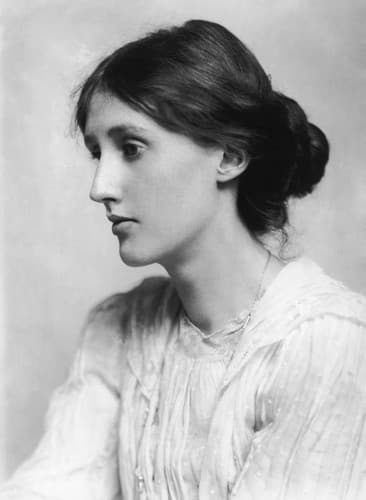
Adeline Virginia Woolf was an English writer. She is considered one of the most important modernist 20th-century authors and a pioneer in the use of stream of consciousness as a narrative device.







