“It's not the end of the world. It's just the end of the game.”
— Johnny reflects on the difference between virtual reality and actual reality.

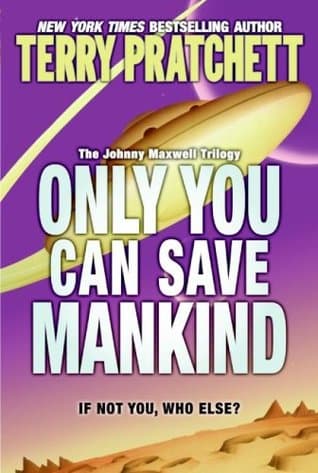
Terry Pratchett (1992)
Genre
Fantasy / Children's / Science Fiction / Young Adult
Reading Time
210 min
Key Themes
See below
Sign in to track this book
A teenage gamer finds his virtual war against an alien race turn terrifyingly real when the 'enemy' surrenders and begs for his help, blurring the lines between pixels and genuine peril.
Johnny Maxwell, a twelve-year-old boy, plays his computer game, 'Only You Can Save Mankind.' He is Commander Johnny Maxwell of the Earth Defense Corps, battling the alien ScreeWee. Just as he is about to get a high score by destroying the last of their fleet, a message pops up on his screen: 'WE WISH TO TALK. WE SURRENDER.' Confused, Johnny thinks it is a bug or a prank by his friends, Wobbler and Bigmac. He tries to delete the message and continue the game, but the aliens, led by their Queen, keep asking for peace and safe passage. Johnny finds himself in a situation where the game's rules are breaking down, and the fictional aliens seem to be talking directly to him, begging for their lives and the survival of their species.
The ScreeWee Queen, talking through text on Johnny's screen, says their entire race faces extinction in their own reality, and the game is their only escape route. They believe that if Johnny, as the 'Destroyer,' allows them to surrender and pass through his game, they can find a new existence elsewhere. Johnny is skeptical at first, trying to see their messages as part of a complex, unprogrammed game feature. However, the Queen's sincere and desperate pleas, along with the fact that the game's usual violence is no longer an option, start to affect him. He realizes that by simply 'playing' the game as intended, he would be committing genocide, a concept that suddenly feels real and disturbing, even on a computer screen.
Troubled by the ScreeWee's situation, Johnny tries to explain it to his friends, Wobbler and Bigmac. He describes how the aliens have surrendered and are asking for his help. Wobbler, a tech expert, immediately dismisses it as a hack or a virus, unable to understand the idea of game characters being sentient. Bigmac, more interested in food, finds the whole concept boring. Their skepticism leaves Johnny feeling alone. He realizes he is alone in facing this bizarre moral dilemma, as his friends cannot grasp what he perceives to be happening within his computer game, making his secret responsibility more apparent.
Feeling more alone, Johnny tells Kirsty, a girl from his class known for her imaginative nature. To his surprise, Kirsty believes him and offers advice and support. She suggests that the aliens might be escaping from a war in their own dimension and that the computer game is a portal. Kirsty's belief validates Johnny's experience and gives him courage to keep talking with the ScreeWee. She also introduces the idea of 'real' and 'unreal' worlds, suggesting that the game world might be as real to the ScreeWee as their own. Together, they start to plan to help the aliens escape, forming an alliance.
With Kirsty's help, Johnny starts to talk with the ScreeWee Queen. Their goal is to guide the entire ScreeWee fleet, including the mothership and smaller vessels, out of the game's combat zone and into a 'safe' area. This means Johnny carefully moving his on-screen ship to guide them, while Kirsty gives moral support and helps interpret the messages from the Queen. They face challenges, such as other players in the game who are still trying to 'destroy' the ScreeWee, forcing Johnny to shield them. The process is slow and tense, as the fate of an entire alien species rests on Johnny's gaming skills and their combined ideas.
As Johnny is focused on saving the ScreeWee, news of the real-world Gulf War starts to dominate television and conversations. The reports of bombings, military action, and refugees create a parallel to the aliens' desperate escape from their own conflict. Johnny's father, a soldier, is deployed to the region, adding personal anxiety to Johnny's life. The lines between the 'game' war and the 'real' war begin to blur for Johnny, making the ScreeWee's situation feel more urgent. The war news serves as a grim background, showing the consequences of conflict and the universal desire for safety and peace.
Just as Johnny and Kirsty are making progress, a new, aggressive player, 'the Destroyer,' enters the game. This player is focused on destroying the ScreeWee, seeing them as targets for points. The Destroyer's attacks put the escaping ScreeWee fleet in danger, forcing Johnny to protect them. This new threat shows the moral conflict: Johnny is trying to save lives, while the Destroyer is playing the game as intended, without any thought for the 'sentience' of the aliens. Johnny and Kirsty realize they must outmaneuver or disable the Destroyer to ensure the ScreeWee's safe passage, adding a desperate race against time to their mission.
After intense effort and a final push to evade the Destroyer, Johnny guides the last of the ScreeWee fleet through the 'exit' point in the game. The Queen sends a message of gratitude, promising to remember his kindness. As the aliens disappear from his screen, Johnny feels relief, exhaustion, and a strange sense of loss. He has saved an entire species, an act far beyond a computer game. The game itself now feels empty, its original purpose changed. He knows he can never play 'Only You Can Save Mankind' in the same way again, as his perspective on conflict and responsibility has been changed by this experience.
In the days following the ScreeWee's escape, Johnny struggles to connect his virtual experience with his everyday life. The real-world Gulf War continues, and the news of his father's safe return brings relief but also a deeper understanding of the realities of conflict. He tries to explain his feelings to his friends, but they remain unaware, still seeing the game as just a game. Kirsty, however, understands. She believes the ScreeWee have found their 'paradise' and that Johnny's actions mattered. Johnny's perspective on life, war, and reality has shifted, leaving him with a deeper sense of empathy and a unique secret that binds him to Kirsty.
The book ends with Johnny and Kirsty sharing an understanding. They both believe in the reality of the ScreeWee's escape, even if no one else does. Johnny thinks about the nature of reality, games, and the choices people make in times of conflict. The experience has matured him, making him more thoughtful and empathetic. The 'Only You Can Save Mankind' game, once a simple diversion, is a symbol of his compassion and the blurred lines between fiction and reality when stakes are high. Their shared secret creates a bond between them, marking them as the only two who truly understand the event they participated in.
The Protagonist
Johnny evolves from a boy focused on game scores to a compassionate individual who questions the nature of reality and takes responsibility for fictional lives.
The Supporting
Kirsty remains consistently supportive and open-minded, solidifying her belief in the blurred lines between reality and fiction.
The Supporting
Wobbler remains largely unchanged, representing the grounded, skeptical perspective that cannot fully grasp Johnny's unique experience.
The Supporting
Bigmac's character remains consistent, serving as a foil to Johnny's evolving perspective.
The Supporting
The Queen's arc is one of desperate survival, culminating in her people's successful escape and gratitude.
The Antagonist
The Destroyer remains a static force of antagonism, embodying the game's original violent purpose.
The Supporting
His arc is one of absence and return, providing a real-world parallel to the themes of conflict and safety.
The Supporting
Her arc centers around her concern for her husband and her role as a comforting parent.
The book explores how Johnny's identity changes from being a gamer to a compassionate savior. His empathy for the ScreeWee, initially just pixels on a screen, becomes a sense of responsibility for their lives. This theme is clear when Johnny chooses to help the aliens despite the game's objective, questioning the morality of 'winning' by destroying a sentient race. His ability to empathize with a non-human, virtual species shows the power of compassion to cross perceived boundaries of reality.
“It's just a game, Johnny. You're supposed to kill them.”
'Only You Can Save Mankind' constantly blurs the line between the real and the virtual. Johnny deals with whether the ScreeWee are 'real' or just code, and the book suggests that their reality is defined by their experience and Johnny's perception. The parallel with the Gulf War further questions what 'real' conflict and suffering are. Kirsty's belief reinforces the idea that reality is subjective, and that something can be real if it has an impact and evokes genuine emotion, regardless of its origin.
“It's real enough for them, isn't it?”
The novel uses both the fictional war in the game and the real-world Gulf War to explore the consequences of conflict. Johnny's initial destruction of aliens in the game is contrasted with the ScreeWee's desperate flight for survival, and with the anxiety surrounding his father's deployment. The theme shows the universal desire for peace and safety, and the moral implications of violence, whether virtual or real. It makes Johnny and the reader consider the victims of war, regardless of their species or dimension.
“The war was always just somewhere else. A long way away. Until now.”
A central theme is Johnny's moral responsibility when faced with the ScreeWee's surrender. He has to choose between playing the game as intended (destruction) or acting on his conscience (salvation). This choice is important because it is set within a context usually without real consequences. The book argues that even in a fictional setting, moral choices have weight and can shape one's character. Johnny's decision to save the aliens, despite his friends' disbelief, shows his personal growth and ethical compass.
“He was the Destroyer. He was supposed to kill them. But he couldn't.”
The different reactions of Johnny's friends to his problem show the complexities of friendship and understanding. Wobbler and Bigmac's skepticism makes Johnny feel alone, while Kirsty's belief and support create a deeper connection. This theme explores how shared experiences, especially unusual ones, can either strengthen bonds or show the limits of understanding between individuals. It shows the importance of having someone who validates one's unique experiences.
“No one else would ever believe him. Except Kirsty.”
The game 'Only You Can Save Mankind' serves as a literal and metaphorical gateway to another reality.
The computer game is not just a backdrop but a central plot device. It acts as a portal through which the ScreeWee aliens, facing extinction in their own dimension, attempt to escape. This blurs the lines between fiction and reality, giving the virtual characters a tangible existence within Johnny's perception. The game's mechanics, designed for destruction, become the very means of salvation, forcing Johnny to subvert its intended purpose. It's a powerful symbol of how technology can connect different worlds and challenge our understanding of reality.
The simultaneous unfolding of the fictional game war and the real-world Gulf War.
The book employs parallel narratives by interweaving Johnny's virtual war with the ScreeWee and the real-world Gulf War, where his father is deployed. This device serves to amplify the themes of conflict, survival, and empathy. The news reports and discussions about the Gulf War provide a grim, tangible context that makes the ScreeWee's plight feel more urgent and real to Johnny. It highlights the universal nature of war's impact and forces the reader to consider the ethical implications of violence in both fictional and non-fictional settings.
Text-based communications from the alien leader that drive the plot and Johnny's moral dilemma.
The messages from the ScreeWee Queen, appearing as text on Johnny's screen, are a crucial plot device. These messages are the primary means of communication between the aliens and Johnny, conveying their desperation, their plea for surrender, and their gratitude. They transform the aliens from anonymous targets into sentient beings with a voice and a story. These messages are what initially challenge Johnny's assumptions about the game and compel him to take action, driving the entire narrative forward and deepening his moral quandary.
An anonymous in-game antagonist representing the traditional, violent approach to gaming.
The character of 'the Destroyer' is a plot device that embodies the conventional, aggressive way of playing 'Only You Can Save Mankind.' This player's relentless pursuit and destruction of the ScreeWee highlights the moral choice Johnny has made. The Destroyer acts as an external antagonist, creating urgency and obstacles for Johnny and Kirsty's mission. This contrast emphasizes Johnny's unique empathetic response and the book's central message about choosing compassion over thoughtless destruction within a gaming context.
The constant questioning of what constitutes a 'game' versus 'reality' and its implications.
This overarching plot device or meta-narrative constantly challenges the reader and characters to define what is real. The story begins with a clear distinction between a game and reality, but this boundary progressively blurs. Johnny's friends insist it's 'just a game,' while Kirsty and the ScreeWee Queen argue for a more fluid understanding of reality. This device forces contemplation on the impact of virtual worlds and whether emotional and moral consequences can exist within them, ultimately suggesting that reality is shaped by perception and action.
“It's not the end of the world. It's just the end of the game.”
— Johnny reflects on the difference between virtual reality and actual reality.
“The trouble with having an open mind, of course, is that people will insist on coming along and trying to put things in it.”
— Johnny's thoughts on dealing with new and confusing situations.
“Only you can save mankind. But first, you have to save yourself.”
— The central theme of the book, emphasizing personal responsibility.
“In space, no one can hear you scream. But in a computer game, they can hear you all the time.”
— Johnny's observation about the immersive nature of video games.
“The universe is made of stories, not of atoms.”
— A philosophical moment highlighting the power of narrative.
“Sometimes the only way to win is to refuse to play.”
— Johnny learns a non-violent approach to conflict.
“Real life doesn't have an 'off' switch.”
— Johnny contrasts the escapism of games with reality.
“You can't save the world if you don't understand it.”
— Emphasizes the importance of empathy and knowledge.
“The enemy is not always who you think it is.”
— Johnny realizes the aliens in the game might not be villains.
“In the game, you get extra lives. In real life, you only get one.”
— A reminder of the stakes in reality versus virtual worlds.
“Fear is a reaction. Courage is a decision.”
— Johnny finds bravery in facing the unknown.
“Sometimes saving the world means changing your mind.”
— Highlights the importance of flexibility and growth.
“The screen is a window, but it's also a wall.”
— Reflects on how technology both connects and isolates.
“You don't have to be a hero to do the right thing.”
— Johnny learns that ordinary actions can have impact.
Ready to see how well you understood this book? Take our interactive quiz with 10 questions.

Sir Terence David John Pratchett was an English humorist, satirist, and author of fantasy novels, especially comical works. He is best known for his Discworld series of 41 novels.







