“We are only ever yours. That is what we are told from the moment we are born.”
— A core mantra of the girls' existence, highlighting their lack of agency.

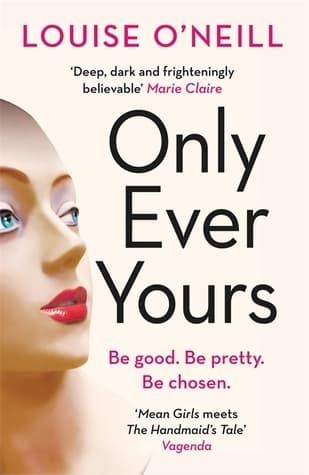
Louise O'Neill (2014)
Genre
Fantasy / Science Fiction / Young Adult
Reading Time
400 min
Key Themes
See below
Sign in to track this book
In a future where women are bred for male companionship, Freida must choose between her friendship with Isabel, who defies the system, and her own fight for survival in a brutal selection process.
Freida and Isabel are best friends at the Academy, where girls are raised to become 'eves'—women destined for specific roles in a patriarchal society. Their main goal is to become Companions, the most respected role, allowing them to marry and have sons. Girls are constantly rated on their beauty, obedience, and skills, with their worth determined by a score. Freida is ambitious and wants to secure her future, often pushing Isabel to conform. Isabel, though usually compliant, has a rebellious side. As the final year begins, pressure grows, and their ranking becomes crucial for their future.
Under the intense pressure of the final year, Isabel starts to subtly defy the Academy's rules. She begins to eat more, gaining weight, which is a major offense in a society that values extreme thinness. This physical change is seen as defiance and a lack of self-control, causing her ranking to drop. Freida feels torn between her loyalty to Isabel and her own need to keep her high status. She tries to help Isabel, but Isabel's defiance grows, signaling a deeper rejection of the system. Other girls, including the manipulative Lena, notice Isabel's decline, further isolating her.
The 'boys' arrive at the Academy, marking the final stage of the selection process. These young men from the outside world choose their future wives from among the eves. The Academy becomes even more competitive and tense as the girls compete for attention and approval. Each interaction is a performance, a chance to prove their worth. Freida, with her high ranking, is confident but aware of the high stakes. Isabel, now much lower in rank due to her weight gain, is increasingly marginalized and looked down upon by her peers and the visiting boys. The selection process is brutal, showing how the girls are objectified.
As the selection continues, Freida faces a hard choice. Her own future as a Companion is at risk, and Isabel's presence, with her low status and rebellious attitude, threatens to bring Freida down. Under immense fear, Freida makes a calculated decision to betray Isabel. She helps isolate Isabel further and contributes to her downfall, aligning herself with the system. This betrayal is a turning point, cementing Freida's commitment to her own survival within the oppressive regime, but at a great personal cost. The bond between the two friends is broken.
Isabel's mental and emotional state quickly worsens after Freida's betrayal and ongoing humiliation. During a public event for the boys to observe the girls, Isabel has a complete breakdown, openly defying the rules. This public rebellion is unacceptable, and the Academy quickly removes her. Isabel is taken away, her fate unknown but clearly bad. Freida watches, feeling a mix of guilt, fear, and a twisted relief that the threat to her own future is gone. Isabel's disappearance warns other girls about the consequences of not conforming.
Despite the emotional distress, Freida secures her place as a Companion. She is chosen by a 'boy' named Finn, and they marry in a formal ceremony. Freida moves into her new life, leaving the Academy. She is now expected to fulfill her duties as a wife, mainly to have sons, and maintain her beauty and subservience. While she achieved the coveted status, her new life is not the ideal future she imagined. The rules of the outside world are different but just as confining as the Academy. She constantly carries the weight of her actions toward Isabel.
Life as a Companion for Freida is characterized by a stifling routine and constant pressure. She is expected to be beautiful, compliant, and focused on conceiving a son. Her days are filled with set activities, and she has little control or real connection with Finn. The other Companions she meets are equally trapped, their lives revolving around their husbands and the fear of losing their status if they fail to produce male offspring or stay youthful. Freida realizes that the 'freedom' of being a Companion is just another form of gilded cage, and the expectations are relentless.
Lena, a former classmate and rival from the Academy, reappears in Freida's life, but as a Concubine—a lower-status woman who serves men but is not married. Lena's presence unsettles Freida, as Lena was always cunning. Lena subtly challenges Freida, hinting at secrets and the true nature of their society. Her presence reminds Freida of the different paths eves can take and the precariousness of Freida's own position. Lena's interactions force Freida to confront uncomfortable truths about her past and the system she lives in, planting seeds of doubt.
Driven by guilt and growing unease, Freida investigates Isabel's disappearance. She seeks information, piecing together memories and clues. Through conversations and forbidden research, Freida uncovers the truth: Isabel was not just sent away, but subjected to a cruel procedure that took her identity, turning her into an 'eve-in-waiting'—a blank slate ready for re-conditioning. This revelation shatters Freida's understanding of her world and the insidious nature of the Academy's control. She realizes the true brutality of their society and her own part in it.
With knowledge of Isabel's fate, Freida confronts the system she has always been part of. She realizes that the 'choices' offered to eves are just different forms of servitude, and their entire existence is engineered for male pleasure and control. The freedom she thought she gained as a Companion is an illusion. She understands that the Academy's purpose was not just to train, but to break and re-mold women, ensuring their compliance. This realization is a painful awakening, making her question everything she believed about her world and herself.
With her eyes opened to the truth, Freida finds subtle ways to resist the system. While open rebellion is impossible and dangerous, she starts to reclaim small parts of her agency. This might involve small acts of non-compliance, finding solace in forbidden thoughts, or connecting with others who also have doubts. The book ends with Freida, still trapped, making a conscious decision to defy the internal programming she received. It is not a grand escape, but a quiet, internal revolution, a commitment to remember the truth and perhaps, in her own small way, plant seeds of future change, even if only in her mind.
The Protagonist
Freida transforms from a compliant, ambitious product of the Academy into a woman who understands and subtly resists the oppressive system, albeit at a great personal cost.
The Supporting
Isabel starts as a hopeful eve, rebels against the system through her body, and is ultimately destroyed by it, becoming a symbol of its cruelty.
The Supporting
Lena remains a shrewd survivor within the system, adapting to her role and subtly prodding Freida's conscience.
The Supporting
Finn remains a static character, representing the unchanging male privilege within the society.
The Antagonist
The Headmistress remains a figure of unwavering authority, a symbol of the system's unyielding power.
The Supporting
The Teachers are static characters, representing the unchanging fate of those who fail to excel.
The Mentioned/Collective Antagonist
The 'boys' collectively represent the unchanging, privileged male power in the society.
The Supporting
The Matron remains largely static, but her subtle expressions of weariness hint at the personal cost of her role.
The novel shows how women are systematically objectified and dehumanized from birth. Girls, called 'eves,' are bred and trained only for their looks and ability to reproduce, their worth reduced to a 'rating.' Their bodies are not their own, constantly scrutinized and controlled. Isabel's weight gain is a major failure and an act of rebellion, showing how a woman's body is seen as public property, to be perfectly maintained for men. Even as Companions, women are valued only for beauty and bearing sons, losing their names and individual identities.
“We were only ever yours. And you were never ours.”
The society in 'Only Ever Yours' offers its female inhabitants an illusion of choice. Girls aim to become 'Companions,' believing it offers freedom and prestige. However, Freida's experience as a Companion reveals this is just another, more gilded cage. All female roles—Companion, Concubine, Teacher—are forms of servitude, designed to serve male needs. The 'choices' are set, and deviation leads to severe punishment, as seen with Isabel. Girls are groomed to want their own subjugation, believing they succeed when they are just fulfilling a pre-assigned function.
“We were raised to be perfect, but perfect for what?”
A key part of the novel is how the oppressive system creates internalized misogyny and intense competition among women. Girls are pitted against each other from a young age, competing for higher ratings and the boys' attention. This competition prevents real solidarity and encourages betrayal, as shown by Freida's actions toward Isabel. The women become enforcers of their own oppression, policing each other's bodies and behaviors, believing their survival depends on outshining and sometimes sacrificing their peers. This dynamic keeps women divided and unable to challenge the patriarchal structure together.
“We were supposed to love each other, but we were taught to hate ourselves, and each other, more.”
The novel explores the deep impact of a society that denies women individual identity and bases their self-worth entirely on external validation. The eves lose their birth names when they enter the Academy, are given new ones, and their entire sense of self is tied to their 'rating' and their ability to fit an ideal of beauty and obedience. Isabel's rebellion, shown through her changing body, is an attempt to reclaim her identity, but it leads to her destruction. Freida's journey involves realizing her entire identity was constructed for her, prompting her to search for her true self beneath the layers of societal conditioning.
“Who was I, if not what they wanted me to be?”
A numerical score dictating each eve's worth and future.
The rating system is a central plot device, serving as the primary mechanism of control and competition within the Academy. It assigns a numerical score to each eve based on her beauty, obedience, and skills, directly determining her future role in society (Companion, Concubine, Teacher). This system fosters intense rivalry among the girls and internalizes the societal values of physical perfection and compliance. Isabel's declining rating due to her weight gain is a pivotal moment, showcasing the system's unforgiving nature and the devastating consequences of non-conformity. It's a constant, visible reminder of their objectification.
Specific terms that highlight gender roles and dehumanization.
The consistent use of 'eves' for women and 'boys' for men (even when they are adults) is a powerful plot device. 'Eves' immediately strips the women of individual identity, reducing them to a generic, almost biblical, archetype of subservience and origin. 'Boys' for the men, on the other hand, subtly emphasizes their perpetual power, innocence, and lack of accountability, maintaining a paternalistic dynamic. This terminology reinforces the fundamental power imbalance and dehumanization inherent in the society, constantly reminding the reader of the women's subordinate status and the men's unchallenged dominance.
A horrifying fate for non-conforming women.
The 'eve-in-waiting' procedure, ultimately revealed as Isabel's fate, is a crucial and horrifying plot device. It represents the ultimate form of control and punishment in this society. This procedure erases a woman's memories, personality, and identity, effectively turning her into a blank slate to be re-conditioned and re-purposed. It underscores the absolute power the system holds over women, proving that even defiance cannot lead to true freedom, only a terrifying erasure. This revelation is the turning point for Freida, shattering her illusions and fueling her internal resistance, making the stakes of their world chillingly clear.
The school serves as a contained representation of the larger society.
The Academy functions as a microcosm of the entire society, mirroring its patriarchal values, rigid hierarchy, and oppressive control. The rules, expectations, and competition within the school directly reflect the outside world's demands on women. The girls' training, their constant scrutiny, and the ultimate selection process are all scaled-down versions of their future lives. This device allows the author to explore the societal themes in a contained, intense environment, making the transition to the 'outside' world for Freida feel both familiar and yet more profoundly limiting, emphasizing the pervasiveness of the oppression.
“We are only ever yours. That is what we are told from the moment we are born.”
— A core mantra of the girls' existence, highlighting their lack of agency.
“Beauty is a weapon, and it is the only weapon we are allowed to wield.”
— The girls understand their primary value and power lies in their physical appearance.
“The greatest sin is to be unchosen.”
— Emphasizes the ultimate failure in their society: not being selected by a male.
“We are not supposed to think, only to be beautiful.”
— A stark summary of the expectations placed upon the girls, suppressing intellect.
“The mirror is our best friend and our worst enemy.”
— Reflects the constant self-scrutiny and anxiety over their appearance.
“Love is not a feeling, it is a transaction.”
— Reveals the transactional nature of relationships and affection in their world.
“Every girl knows that her worth is measured in her waistline.”
— Highlights the extreme focus on physical measurements and their direct link to value.
“To be fat is to be forgotten.”
— Underlines the severe consequences and social ostracization for not maintaining an ideal physique.
“The world outside is a dangerous place. Here, you are safe. Here, you are ours.”
— A deceptive promise of security that masks their true imprisonment.
“We are perfect. We are flawless. We are empty.”
— A poignant realization of the emotional cost of their manufactured perfection.
“The greatest rebellion is to choose yourself.”
— A powerful statement about finding self-worth and agency in a system designed to deny it.
“They don't want us to be happy. They want us to be compliant.”
— Exposes the true agenda behind the system: control over individual well-being.
“Sometimes, the only way to win is not to play.”
— A profound insight into rejecting the rules of a rigged game.
“Our bodies are not our own. They are property.”
— A harsh truth about the complete lack of bodily autonomy for the girls.
“Hope is a dangerous thing in a place like this, but it is also the only thing that keeps you alive.”
— Reflects the dual nature of hope in oppressive environments.
Ready to see how well you understood this book? Take our interactive quiz with 10 questions.







