“There are no fairy tales here, children. Not anymore.”
— Agatha's early realization about the School for Good and Evil's new reality.

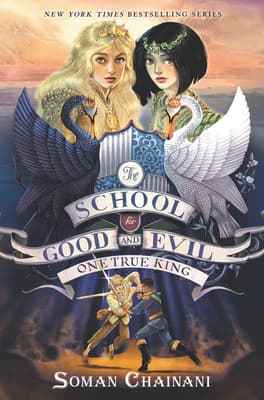
Soman Chainani (2020)
Genre
Fantasy / Children's / Young Adult / Romance
Reading Time
800 min
Key Themes
See below
Sign in to track this book
In the finale, Sophie and Agatha must choose between good and evil, love and power, to decide who will rule Camelot and the Endless Woods.
King Tedros of Camelot, after uniting the Endless Woods, proposes to Agatha in a grand ceremony. Their upcoming marriage promises a new time of peace and the end of the Age of Evil. But their happiness is short-lived when Sophie, now Queen of the Northern Woods and seemingly evil, interrupts the celebration. She reveals she is pregnant with Rafal's child, a truth that shocks Agatha and makes Tedros question everything. Sophie's manipulation and Rafal's lingering power restart old fights and throw the Woods into chaos, threatening to undo the peace Tedros worked to create.
Sophie is put on trial in Camelot for her past wrongs and her part in Rafal's rule. Agatha, still upset by Sophie's news and her own mixed feelings, is chosen as the prosecutor by Tedros. The trial becomes a public show, forcing both girls to face their shared past and their complicated friendship. Sophie, in her defense, tries to say she was a victim of circumstance and Rafal's power, but her past actions, especially her alliance with the School Master, are held against her. The trial shows the deep divisions and unsolved issues in the Endless Woods.
During the chaos, two new threats appear: Rhian and Japeth, King Arthur's long-lost sons, who believe they should be the kings of Camelot. They challenge Tedros's claim to the throne, using their royal background to gain support among unhappy groups in the Woods. Their arrival makes the political situation more complex, as many in the Woods question Tedros's right to rule, especially with Sophie's past and her link to Rafal. Rhian, charming and magnetic, quickly gains followers, while Japeth, more moody, shows a darker goal. Their presence further destabilizes the kingdom and pushes Tedros to prove his worth as king.
To counter Rhian and Japeth's claims and secure his rule, Tedros is told to get Excalibur, King Arthur's legendary sword, which only the true king can use. He starts a dangerous journey, with his loyal knights, including Hort and Nicola. The journey tests his resolve, leadership, and belief in himself. Along the way, he faces magical creatures, dangerous lands, and inner doubts about his ability to live up to his father's name. This quest is not just for a sword, but for self-discovery and proof of his own goodness and strength as a leader.
After her trial, Sophie, desperate and weak, asks Agatha for help, stressing their strong bond. Despite her anger and hurt, Agatha is torn between her duty to Camelot and her deep loyalty to Sophie. She considers if Sophie might truly be trying to change, or if this is another one of her tricks. This inner struggle highlights the main idea of their friendship — its lasting nature despite constant betrayals and the unclear lines between good and evil that define their relationship. Agatha's choice will have big effects on both their futures.
As the conflict grows, Japeth's truly evil nature starts to show. It is revealed that he has been tricking Rhian and is linked to a strong, old evil that wants to plunge the Endless Woods into endless darkness. His goal goes beyond just ruling Camelot; he wants to undo the balance of good and evil entirely. This discovery creates a new, more frightening enemy, shifting the focus from a sibling fight to a battle against a universal threat. The stakes are much higher, as the very existence of the fairy tale world is now in danger, requiring everyone to unite against this growing darkness.
Japeth successfully uses the old, powerful magic of the School Master, the series' original villain. He uses this dark energy to corrupt the Woods, turning its people against each other and powering his own twisted plans. The familiar dark forest magic, once thought gone, returns with terrible force, appearing as a widespread evil that warps lands and minds. This return forces Sophie, Agatha, and Tedros to face the lasting effects of Rafal and the School Master, realizing that the fight for good is never truly over and that their past struggles are directly connected to the current threat.
In a key moment, Sophie, driven by her love for her unborn child and a strong desire to make amends, makes a selfless sacrifice to stop Japeth's plans. She uses her unique link to both good and evil magic, channeling a powerful force to counter Japeth's dark magic. This heroic act shows the end of her character's journey, proving her ability for true goodness and her willingness to put others before herself, even at great personal cost. Her sacrifice not only saves the Woods but also changes how she is remembered, proving that she can be a force for good despite her past.
With Sophie's sacrifice, Agatha fully accepts her love for Tedros, realizing their bond is the real foundation for the Woods' future. Tedros, however, faces a hard choice: to rule as a traditional king and keep old ways, or to take a new path that includes the lessons learned from Sophie's complex journey and the unclear lines of good and evil. His decision will shape the future of Camelot and the Endless Woods, showing a move away from the strict black-and-white morality of old fairy tales towards a more complex understanding of leadership and justice.
Tedros, with Agatha, chooses a path that accepts the complexities of the Endless Woods, moving past strict definitions of good and evil. He creates a new form of leadership, one that values understanding, empathy, and the grey areas of morality. Camelot becomes a place where even those who made mistakes can find redemption, and where the balance of the Woods is kept through wisdom rather than strict obedience to old laws. This new era marks the growth of all characters and the maturing of the fairy tale world itself, promising a future built on hope and a more open idea of 'happily ever after'.
The Protagonist
Agatha evolves from a reluctant princess to a wise and compassionate queen, embracing her role and her love for Tedros while also accepting the nuanced nature of good and evil.
The Protagonist
Sophie undergoes a profound transformation, moving from a self-absorbed villain to a self-sacrificing hero, ultimately finding redemption through love and motherhood.
The Protagonist
Tedros grows from a proud prince into a wise and compassionate king, capable of leading a unified Woods and embracing a more nuanced understanding of good.
The Supporting
Hort matures from a lovelorn follower to a loyal knight, finding his own strength and proving his true goodness.
The Supporting
Nicola remains a steadfast and loyal knight, embodying consistency and unwavering support for good.
The Antagonist
Rhian's arc moves from a seemingly legitimate challenger to a manipulated pawn, ultimately facing the consequences of his ambition.
The Antagonist
Japeth is revealed as the ultimate villain, a force of pure evil seeking to destroy the balance of the Woods.
The Mentioned
Though deceased, Rafal's influence continues to shape events, particularly through Sophie and his child.
This theme explores the idea that good and evil are not simple opposites, but rather complex forces within people and the world. Sophie's whole journey, from villain to hero, shows this, as she constantly deals with her ability for both. Agatha, too, struggles with her 'good' identity when her loyalty to Sophie is tested. Japeth's appearance, as he tries to destroy the balance, forces all characters to face the grey areas and the need to understand, rather than just judge, different kinds of magic and morality. The book ultimately argues for a world where good is not defined by purity, but by conscious choices and the ability to make amends, as seen in Sophie's final sacrifice.
““Good isn't a power. It’s a choice.””
The idea of redemption is key, especially for Sophie. Throughout the series, she makes bad choices, but this last book offers her a way to truly make up for them. Her pregnancy with Rafal's child, at first seen as a sign of her past evil, becomes a reason for her selfless actions. Her sacrifice to save the Woods and her child shows her complete change. The story suggests that even those who have fallen furthest can find their way back to goodness through true selflessness and love. This theme also applies to how the Woods must learn to forgive and accept those who made mistakes, making way for a more inclusive future for Camelot.
““Perhaps 'happily ever after' isn't about being perfect. It's about being true.””
Tedros's journey is a deep look at what it means to be a true king. He first struggles with his famous father, King Arthur, and the traditional expectations of royalty. The challenges from Rhian and Japeth force him to look beyond family line and brute strength. He learns that true leadership needs not just courage, but wisdom, empathy, and the ability to adapt to a changing world. His final decision to create a Camelot that accepts the complexities of the Woods, rather than forcing strict rules, shows his growth into a king who makes his own legacy, one built on understanding and a new idea of justice, instead of just repeating the past.
““A true king doesn't just inherit a crown. He earns it with every choice.””
At its core, the series, and especially this last book, is about the lasting power of Sophie and Agatha's bond, and the romantic love between Agatha and Tedros. Despite betrayals, rivalries, and dangerous conflicts, Sophie and Agatha's friendship continues, proving to be as strong as any magic. Their complex relationship is pushed to its limits, but in the end, their love for each other, however imperfect, helps them grow. Similarly, Tedros and Agatha's love for each other is shown as a stable, uniting force that helps them overcome problems and lead the Woods into a new era. These relationships are the emotional anchors of the story.
““Some loves are meant to break you. Others are meant to make you.””
The characters, especially Sophie and Agatha, constantly fight against set roles and the expectations placed on them by the School for Good and Evil, and by fairy tale ideas themselves. Sophie, at first meant for evil, fights to make her own path and proves that fate is not fixed. Agatha, the 'good' princess, accepts her own complexities. The whole story questions the idea of a fixed 'Ever After' and instead supports the idea that people can create their own futures, even if it means changing the rules of their world. This theme ends with the creation of a new Camelot that is not tied to old prophecies or strict categories.
““Your story isn't written in the stars, but in the choices you make.””
A legendary artifact used to prove rightful kingship.
Excalibur serves as a traditional symbol of legitimate rule and a plot device to challenge and validate Tedros's claim to the throne. Its retrieval becomes a quest for Tedros, forcing him to confront his own worthiness and leadership abilities. The success or failure in wielding it would either solidify his position or empower his rivals, Rhian and Japeth. It grounds the fantastical elements in Arthurian legend and provides a tangible goal for the protagonist, while also representing the weight of history and expectation upon him.
A personal and narrative catalyst for Sophie's redemption.
Sophie's pregnancy with Rafal's child is a crucial plot device. It initially serves as a source of conflict and betrayal, further complicating her relationship with Agatha and Tedros. However, it ultimately becomes the driving force behind Sophie's profound transformation and selfless sacrifice. The child represents her last connection to Rafal and her first step towards unconditional love, pushing her to choose good over evil. It adds a layer of vulnerability and humanity to her character, making her redemption more impactful and believable, and elevates the stakes of the final conflict.
A returning dark force that threatens to unbalance the Woods.
The re-emergence of the School Master's dark magic, channeled by Japeth, acts as a major plot device to raise the stakes and provide a formidable, overarching antagonist. It connects the current conflict to the series' foundational lore and the initial battle between good and evil. This familiar threat forces the protagonists to confront the lingering consequences of past events and underscores the cyclical nature of conflict in the Woods. It also serves to unite the characters against a common, existential enemy, moving beyond their personal squabbles.
A classic literary trope used to challenge the protagonist's legitimacy.
Rhian and Japeth, presented as King Arthur's long-lost sons, embody a classic literary trope of usurpers or challengers to the throne. This device creates external conflict for Tedros, forcing him to defend his claim not just through strength, but through wisdom and true leadership. It serves to explore themes of lineage versus merit. More importantly, it allows for the revelation of Japeth as the true, darker antagonist, initially masking his evil intent behind the guise of a legitimate challenger, thus adding layers of deception and suspense to the plot.
“There are no fairy tales here, children. Not anymore.”
— Agatha's early realization about the School for Good and Evil's new reality.
“Love isn't a story. It's a choice.”
— Tedros reflecting on his feelings for Agatha.
“A king doesn't just rule his people. He rules himself.”
— Tedros learning a hard lesson about leadership.
“To save a world, sometimes you have to break it first.”
— A difficult decision faced by the protagonists.
“Even villains have their own fairy tales, if you look closely enough.”
— Exploring the motivations behind antagonists.
“The greatest magic isn't in spells, but in the hearts that wield them.”
— A deeper understanding of true power.
“Sometimes, the only way to find your true self is to get lost.”
— Sophie's journey of self-discovery.
“A crown doesn't make a king. The king makes the crown.”
— Reinforcing the idea that leadership comes from within.
“Hope is a dangerous thing, but despair is far worse.”
— Characters facing overwhelming odds.
“The past isn't a prison, unless you let it be.”
— Agatha grappling with past events and choices.
“True friendship isn't about always agreeing, but about always being there.”
— The evolving dynamic between Agatha and Sophie.
“Every ending is just a new beginning, waiting to be written.”
— Reflecting on the conclusion of their saga.
“You can't save everyone, but you can save someone.”
— A hard truth about the limits of heroism.
“The greatest power is the power to choose your own story.”
— The ultimate message of agency and destiny.
Ready to see how well you understood this book? Take our interactive quiz with 10 questions.

Biography coming soon.







