“The kind of place where you get directions like ‘go past the diner, turn left at the old gas station, and if you hit the creek, you’ve gone too far.’”
— Describing a small, out-of-the-way town.

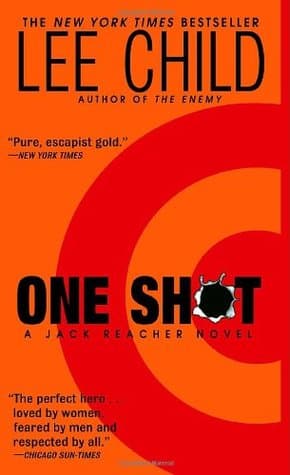
Lee Child (2005)
Genre
Thriller / Mystery
Reading Time
9-10 hours
Key Themes
See below
Sign in to track this book
When a simple sniper case turns into a complex plot, ex-military investigator Jack Reacher must find the truth, even if it means facing a dangerous enemy.
A sniper shoots five people in a Midwestern city. Police, led by Detective Emerson, quickly arrest James Barr, a former U.S. Army sniper with a questionable past. The evidence against Barr seems clear: his rifle is found, his fingerprints are at the scene, and his car is identified. During questioning, Barr is badly beaten and falls into a coma. Before losing consciousness, he writes 'Get Reacher for me,' asking for Jack Reacher, a former military police investigator.
Jack Reacher, living off the grid, hears about Barr's request through news. He comes to the city, at first believing Barr is guilty because he knows about Barr's past in the military, specifically an incident in Kuwait where Barr admitted killing four people. Reacher plans to ensure Barr gets a fair trial and punishment, not to free him. But he meets Helen Rodin, Barr's defense lawyer and the daughter of District Attorney Alex Rodin. Helen convinces Reacher to investigate for Barr's sister, who believes Barr is innocent.
Reacher, with Helen's help, starts looking at the evidence. He immediately sees problems that challenge the prosecution's 'slam-dunk' case. He questions how Barr, a skilled sniper, could have missed a sixth shot, and why he would leave such obvious evidence. They find that the parking garage video is incomplete, a witness's statement seems forced, and the victims appear unrelated to Barr or each other. Reacher feels something is wrong with the official story, pushing him to investigate further.
Reacher focuses on the 'missed' sixth shot. He concludes that a real sniper would not miss at such close range. The shot was meant to hit a water barrel, making a splash to hide the shooter from one angle, but also to frame Barr. He thinks only one of the five victims was the real target, and the others were killed to make the shooting seem random. Reacher suspects the real target was James Caldwell, an ordinary businessman.
Reacher talks to Martin Cash, who owns a gun shop where Barr supposedly bought the rifle. Cash first confirms Barr's purchase. But under Reacher's intense questioning, Cash subtly reveals that Barr bought a different, older rifle than the one found at the crime scene. This is important because it proves the police's rifle was not Barr's, further weakening the prosecution's case and suggesting a wider plot.
As Reacher and Helen continue their investigation, they find that the seemingly random victims were connected. James Caldwell, the real target, was involved in a money laundering plan with a ruthless criminal known as Zec, from Eastern Europe. Zec, a former Soviet sniper, runs a large network of illegal activities. Reacher realizes Zec planned the shooting, not Barr, to kill Caldwell and use Barr as a scapegoat because of his military record.
As Helen Rodin investigates with Reacher, she becomes a threat to Zec's operation. Zec's men start threatening her and her family, including her father, D.A. Alex Rodin. This increased danger makes Reacher her protector, moving her to a safe place and constantly watching her. The threats show how serious their investigation is and how dangerous their enemies are, strengthening Helen's resolve to find the truth, despite the personal cost.
James Barr finally wakes from his coma. Under Reacher's questioning, with Helen present, Barr tells the truth about the day of the shooting. He admits he went to the parking garage to kill those who wronged him in Kuwait, but he lost his nerve and left without shooting. He also says he knew Zec's men were following him and that he was being set up. This confession clears Barr of the sniper killings but confirms he was indeed targeted for framing.
Reacher, having found Zec's location and the scope of his operation, tracks him to his isolated, heavily guarded compound. He enters the compound alone, using his military training to stop Zec's bodyguards. The confrontation ends in a brutal, hand-to-hand fight between Reacher and Zec, who is also a skilled fighter. Reacher defeats Zec, killing him and ending his criminal business.
With Zec dead, the full conspiracy is revealed, and James Barr is cleared. The corrupt police and prosecutors who helped frame Barr are exposed. Helen Rodin, seeing Reacher's unique justice, becomes stronger in her legal career. Reacher, true to his wandering nature, quietly leaves, letting the city handle the aftermath. Helen thinks about Reacher's impact on her life and the case, changed by the experience.
The Protagonist
Reacher starts as a skeptic, convinced of Barr's guilt, but through his investigation, he uncovers a vast conspiracy, reaffirming his role as a lone dispenser of justice.
The Supporting
Helen begins as a somewhat sheltered lawyer, but through her partnership with Reacher, she gains invaluable experience, courage, and a deeper understanding of justice, challenging her own beliefs and family ties.
The Supporting
Barr starts as the prime suspect, incapacitated and presumed guilty. He is eventually exonerated as the true circumstances of his involvement and the frame-up are revealed, bringing him a measure of peace regarding his past actions.
The Antagonist
Zec maintains his ruthless and cunning nature throughout, serving as the hidden architect of the crime, until he is ultimately confronted and eliminated by Reacher.
The Supporting
Alex Rodin begins as an obstacle to Helen's investigation, blinded by ambition and the appearance of a clear-cut case. He is eventually forced to confront the corruption within his own system and the truth uncovered by Reacher and Helen.
The Supporting
Emerson initially appears as a diligent officer but is later revealed to be a corrupt enforcer for Zec, ultimately exposed and facing consequences for his complicity.
The Supporting
Cash starts as a minor witness confirming the official story, but his honest interaction with Reacher proves pivotal in exposing the frame-up.
The Mentioned
Caldwell's death serves as the catalyst for the plot, and his identity as the true target is the key to unraveling the conspiracy.
The novel explores the difference between legal justice and what Reacher sees as true justice. The legal system, shown by Helen and her father, can make mistakes, be manipulated, and be influenced by politics. Reacher, however, acts outside the law, driven by strong morals to fix wrongs. His methods are often violent and outside legal bounds, but they lead to the truth and stop the real villains. This shows that true justice sometimes means bypassing the system. This is clear when Reacher stops Zec after the legal system failed to identify him.
“''I'm not a hero. I'm a drifter. But I know right from wrong, and I'll do what it takes to make it right.''”
A main theme is how easily truth can be hidden by lies. The entire case against James Barr is a carefully built lie, meant to be a 'slam-dunk' that no one would question. Reacher's ability to observe, deduce, and challenge assumptions helps him uncover the layers of deceit. From the 'missed' sixth shot to the swapped rifle, the story shows how appearances can be used to hide darker realities. This theme is clear in how Zec uses Barr's past to create a believable, but false, story.
“''The truth is out there, but you have to want to find it. And sometimes, it's hidden under a mountain of lies.''”
Both James Barr and Jack Reacher are affected by their past military service and the violence they have seen or caused. Barr's past actions in Kuwait are used to frame him, making him an easy scapegoat. Reacher, though not directly involved in the current crime, carries his own experiences and knowledge of Barr's history. The novel suggests that the past, especially a violent one, cannot truly be escaped and often affects the present, shaping people and their reasons for acting. This is why Reacher initially believes Barr is guilty.
“''Some things you do, you can never outrun. They stick to you like a shadow.''”
Reacher's life as an outsider is important to his effectiveness. Because he has no ties, no political goals, and no personal interest in the city or its systems, he can see the case clearly in a way those inside the system cannot. He is not swayed by public opinion, political pressure, or career goals. This allows him to question every assumption and follow the evidence, even if it goes against the official story. Helen Rodin, initially an insider, benefits from adopting Reacher's outsider view.
“''When you have nothing to lose, you have everything to gain. And everything to see.''”
An apparently open-and-shut case designed to mislead and prevent further investigation.
The 'slam-dunk' case against James Barr is a primary plot device. It is meticulously constructed by the antagonists to appear irrefutable, with overwhelming evidence pointing to Barr's guilt. This serves to immediately establish a false reality, allowing the true perpetrators to operate in the shadows. Reacher's role is to systematically dismantle this seemingly perfect case, forcing him to question every piece of evidence and thereby revealing the deeper conspiracy at play. It creates a strong initial obstacle and highlights Reacher's investigative prowess.
A seemingly insignificant detail that proves to be a crucial clue for Reacher.
The 'missed' sixth shot, which hit a water barrel, is a critical plot device. For Reacher, a former military marksman, the idea that a skilled sniper like Barr would miss at close range is illogical. This single detail is the first major crack in the 'slam-dunk' case. It prompts Reacher to question the entire narrative and deduce that the shot was not missed but deliberately aimed to create a specific visual effect (a splash) and to serve as a signature for the frame-up, indicating the true shooter's intent and skill.
Barr's specific request for Reacher, drawing the protagonist into the mystery.
James Barr's scrawled request, 'Get Reacher for me,' is the inciting incident and a powerful plot device. It directly pulls Reacher, a man living off the grid, into the narrative. This request is baffling to others but significant to Reacher due to their shared military past and Reacher's unique understanding of Barr. It establishes Reacher's reputation and sets up his internal conflict (initial belief in Barr's guilt) before he even begins his investigation, providing a personal stake in the outcome.
A seemingly trusted figure within the system who is secretly working for the antagonist.
Detective Emerson serves as the corrupt insider plot device. His position within law enforcement allows him to manipulate evidence, control information, and steer the investigation away from the true culprits. This device highlights the insidious nature of the antagonist's reach and the difficulty of fighting corruption from within the system. Emerson's betrayal makes the challenge for Reacher and Helen even greater, forcing them to rely only on each other and Reacher's unconventional methods to uncover the truth.
“The kind of place where you get directions like ‘go past the diner, turn left at the old gas station, and if you hit the creek, you’ve gone too far.’”
— Describing a small, out-of-the-way town.
“There are no second chances. Not for the first shot.”
— Reflecting on the precision and finality required for a sniper's shot.
“I’m not a hero. I’m a drifter. But sometimes, even a drifter needs to stop drifting.”
— Reacher's internal monologue about his transient lifestyle and the call to action.
“Details matter. Especially when people are trying to hide them.”
— Reacher emphasizing the importance of scrutinizing small details in an investigation.
“The truth is a stubborn thing. It doesn't care what you want it to be.”
— A general observation about the nature of truth in the face of deception.
“Sometimes good intentions aren't enough. Sometimes you need to be good at what you do.”
— Reacher's pragmatic view on effectiveness over mere good will.
“He didn’t look like much, but neither did a loaded gun.”
— A description of a character, implying hidden danger.
“Wrong place, wrong time. Or maybe the right place, right time, if you were looking for trouble.”
— Reacher assessing a situation he finds himself in.
“A man who thinks he knows everything learns nothing.”
— A philosophical point about arrogance hindering understanding.
“Justice isn’t always about what’s legal. Sometimes it’s about what’s right.”
— Reacher's personal code regarding dispensing justice.
“You can never assume anything. Assumptions get people killed.”
— A warning about the dangers of making assumptions in dangerous situations.
“The first rule of a cover-up is that there are no rules.”
— Reflecting on the desperate and unethical nature of those trying to hide the truth.
“Silence can be a weapon, too. Sometimes the most effective one.”
— Reacher observing how withholding information or remaining quiet can be powerful.
“He moved like a man who knew he could handle anything, because he usually could.”
— Describing Reacher's calm confidence and capability.
Ready to see how well you understood this book? Take our interactive quiz with 10 questions.

Biography coming soon.







