“It’s a peculiar thing, but the more you try to make a BookWorld character behave in an unpredictable way, the more predictable they become.”
— Thursday Next reflecting on the nature of characters within the BookWorld.

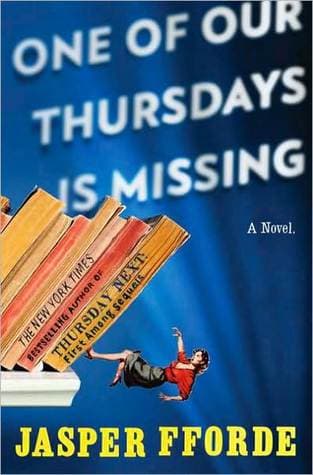
Jasper Fforde (2011)
Genre
Fantasy / Mystery / Science Fiction
Reading Time
9-12 hours
Key Themes
See below
Sign in to track this book
When the real Thursday Next retires, her fictional counterpart must navigate a looming genre war and a treacherous journey up the Metaphoric River to save the BookWorld from a fiendish plot.
The story opens in the BookWorld, a literary dimension where characters live out their lives within their books. The 'real' Thursday Next, a Jurisfiction agent, has retired to the Realworld, leaving a void. Her fictional counterpart, Written Thursday Next, a character from the 'Thursday Next' series, resides in a quiet cottage in the Outskirts, a region for unused or forgotten narratives. However, the BookWorld is on the brink of a devastating Genre War, with the Generic, a powerful and aggressive genre, threatening to consume all others. The Council of Genres, desperate for a figurehead to unite the warring factions, decides to enlist Written Thursday to impersonate the Real Thursday, believing her fame and authority can bring order. Despite her initial reluctance, Written Thursday, along with her dodo, Pickwick, accepts the mission.
Written Thursday is brought before the Council of Genres, a governing body comprising representatives from various literary categories like Westerns, Romances, and Thrillers. They reveal that the Real Thursday Next has gone missing from her retirement in the Realworld, and her absence makes the BookWorld unstable. The Council, specifically Lady Cavendish of the Thrillers and the Duke of the Romances, asks Written Thursday to impersonate the Real Thursday and discreetly investigate her disappearance. They believe that if the Real Thursday is in peril, it could have catastrophic implications for the entire BookWorld, as she is important in maintaining its balance. Written Thursday, despite her fictional nature, feels a growing sense of responsibility to her world and its inhabitants.
To fulfill her diplomatic duties, Written Thursday, accompanied by her dodo, Pickwick, and the Jurisfiction operative, Sprockett, embarks on a journey up the Metaphoric River aboard the ship 'The Suspense'. Their mission is to visit various genre enclaves and attempt to broker peace among the hostile factions. Along the way, they encounter the Literalists, a group obsessed with textual accuracy, and navigate literary landscapes. The journey is fraught with danger, reflecting the volatile state of the BookWorld, and Written Thursday must constantly adapt to the rules and narrative quirks of each genre she encounters. Sprockett, with his knowledge of BookWorld mechanics, is an invaluable, if sometimes cryptic, guide.
Their first major stop is the Westerns, a genre characterized by its dusty landscapes, saloon brawls, and clear-cut good-versus-evil narratives. Written Thursday is tasked with mediating a dispute, but her true objective is to investigate a lead regarding the Real Thursday's disappearance. She learns that a Jurisfiction agent, Agent Sprocket (an earlier, more naive version of her companion), had been investigating something significant before vanishing. Written Thursday's presence stirs up anxieties among the Western characters, who are wary of outside interference. She begins to piece together clues, realizing that the Real Thursday's disappearance might be connected to a larger, more sinister plot that extends beyond simple genre conflict. The Westerns provide a stark contrast to her own relatively ordered world, challenging her understanding of narrative integrity.
As Written Thursday investigates, she encounters the Literalists, a group who believe in the absolute truth of a text and seek to eliminate any deviations or 'errors'. They are suspicious of Jurisfiction and the concept of 'written' characters. Here she uncovers the existence of the 'Shifters', characters who can alter their own narratives and jump between books, a violation of BookWorld law. This discovery is unsettling, as it suggests an instability in the fabric of their existence. The Literalists' rigid ideology clashes sharply with the fluid, interpretative nature of the BookWorld, highlighting a growing split that threatens to unravel everything.
Written Thursday eventually learns that the aggressive Generic genre is not merely seeking expansion but is a front for a plot: the 'Great Rewrite'. This plan, orchestrated by an unknown mastermind, aims to eliminate all existing genres and narratives, replacing them with a single, bland, and easily consumable 'Generic' story. This would erase the individuality and complexity of the entire BookWorld. The Shifters are revealed to be tools in this scheme, their abilities exploited to facilitate the narrative restructuring. Written Thursday realizes that the Real Thursday's disappearance is directly linked to her attempts to stop this event, making her impersonation even more critical to the BookWorld's survival.
With the help of Sprockett and other loyal Jurisfiction agents, Written Thursday finally unmasks the mastermind behind the Great Rewrite: Professor Viktor Analogy, a brilliant but megalomaniacal literary theorist. Analogy believes that the BookWorld has become too chaotic and fragmented, and that a single, unified narrative will bring order and efficiency. He views the Real Thursday Next as an obstacle to his vision and has imprisoned her, intending to absorb her unique narrative abilities into his Generic framework. Written Thursday confronts Analogy in a showdown, where she must use her wits, her understanding of narrative, and her growing sense of self to counter his ideology and prevent the complete annihilation of the BookWorld's diversity.
In a daring rescue mission, Written Thursday manages to free the Real Thursday Next from Professor Analogy's clutches. The reunion between the two Thursdays is important, as the Real Thursday, weakened but resolute, explains the full extent of Analogy's plan and the danger it poses. She also reveals more about Written Thursday's own nature, acknowledging her as a legitimate, albeit fictional, entity within the BookWorld. This revelation solidifies Written Thursday's identity and her right to exist, empowering her to take a more active role in the unfolding crisis. Together, they form a team, combining their unique strengths to combat Analogy's narrative manipulation.
The climax of the story sees both Thursdays, along with their allies, engaging in a desperate battle against Professor Analogy and his Generic forces. The conflict is not just physical but also narrative, as Analogy attempts to impose his bland, universal narrative upon the BookWorld, threatening to overwrite all existing stories. The Thursdays must defend the integrity of individual genres, fighting to preserve the unique voices and structures that make the BookWorld so rich. Written Thursday, having fully embraced her role, plays a part in mobilizing the different genres to resist the Generic's assimilation, proving that even a fictional character can be a powerful champion for literary diversity.
With Professor Analogy defeated and the Great Rewrite averted, the BookWorld slowly begins to recover from the brink of genre war. The Real Thursday, having fulfilled her immediate purpose, once again retreats, leaving Written Thursday to find her own path. Written Thursday, no longer merely an impersonator, has forged her own identity and earned the respect of the Council of Genres. She decides to continue her work within Jurisfiction, taking on a more permanent role in protecting the BookWorld's narrative integrity. The experience has transformed her from a character living within a pre-defined story to an active agent shaping her own future, solidifying her existence as an independent entity within the literary world.
The Protagonist
Written Thursday evolves from an insecure, secondary character to a confident, independent agent who embraces her unique identity and takes a proactive role in saving the BookWorld.
The Supporting
Her arc is largely off-screen, but her return validates Written Thursday's journey and reaffirms her own commitment to the BookWorld.
The Supporting
Pickwick remains a steadfast companion, his loyalty unwavering, and he occasionally offers insights that help Written Thursday.
The Supporting
Sprockett's arc involves revealing his past and growing to trust Written Thursday's capabilities as a legitimate agent.
The Antagonist
Analogy's arc is one of escalating ambition and eventual defeat, as his rigid ideology clashes with the inherent diversity of the BookWorld.
The Supporting
Lady Cavendish primarily serves as a consistent, authoritative figure, representing the Thriller genre's perspective.
The Supporting
The Duke's arc is less about personal change and more about representing his genre's perspective within the Council.
The Mentioned
The Literalists serve as an antagonistic force, their ideology clashing with the protagonists' goals.
The core of Written Thursday's journey is her struggle with and eventual acceptance of her own identity. As a fictional character, she initially feels like an imitation, constantly comparing herself to the 'Real' Thursday Next. Her quest forces her to define herself not by her origins but by her actions and choices. This theme is highlighted when she realizes she can make decisions independent of her pre-written narrative, culminating in her choosing to remain a Jurisfiction agent rather than simply returning to her book. Her meeting with the Real Thursday further validates her existence, proving that her experiences have forged a unique self.
““I wasn’t the original, I was a copy, a shadow, a character within a book. But as I journeyed further, I began to realise that even a copy can have its own story to tell.””
Fforde blurs the lines between fiction and reality, exploring how stories shape existence and how existence shapes stories. The BookWorld itself is a manifestation of this, where characters live within their narratives. The threat of the 'Great Rewrite' and the 'Generic' genre directly challenges the integrity of individual stories, suggesting that a loss of narrative diversity is a loss of reality itself. The existence of 'Shifters' who can alter their own narratives also raises questions about free will versus authorial intent, forcing both characters and readers to consider the implications of narrative manipulation.
““The BookWorld was not merely a collection of stories, but a living, breathing entity, its very fabric woven from the threads of narrative and imagination.””
The impending Genre War and Professor Analogy's 'Great Rewrite' are an allegory for the dangers of homogenization and the suppression of unique voices. The Generic genre aims to erase the distinctiveness of Westerns, Romances, Thrillers, and all other genres, reducing them to a bland, universal narrative. Written Thursday's mission, therefore, is a fight to preserve the richness of stories, celebrating the quirks, conventions, and contributions of each genre. The victory against Analogy is a triumph for literary diversity, emphasizing that the strength and beauty of the BookWorld lie in its varied and individual narratives.
““To lose a genre was to lose a voice, a way of seeing the world, a unique perspective that could never be truly replaced.””
The novel consistently highlights the power held by authors and the narratives they create. Characters are aware of their 'authors' and the 'BookWorld's' structure. Jurisfiction's role is to maintain the integrity of these stories. Professor Analogy's attempt to 'rewrite' the BookWorld is the ultimate abuse of this power, seeking to become the sole author of a new, uniform reality. Written Thursday, as a character who gains agency, represents the idea that even within a pre-written story, there is room for characters to influence their own destinies and contribute to the ongoing narrative, blurring the line between creation and self-creation.
““Every story, no matter how small or seemingly insignificant, held a piece of the BookWorld’s soul.””
A narrative device where the story self-consciously refers to itself as a fictional construct.
Metafiction is central to 'One of Our Thursdays Is Missing'. The entire premise revolves around a 'Written Thursday Next' – a character within a book – interacting with the 'Real Thursday Next' and the mechanics of the 'BookWorld'. Characters are aware of their authors, their genre conventions, and the narrative rules that govern their existence. This device allows Fforde to comment on storytelling itself, explore themes of identity and authorship, and create a uniquely self-referential and humorous literary landscape, constantly reminding the reader of the constructed nature of the narrative.
The use of characters and events to represent abstract ideas or principles.
The novel functions as an elaborate allegory for literary criticism, genre conflicts, and the publishing industry. The Genre War represents the real-world clashes between different literary categories and the struggle for dominance. Professor Analogy's 'Great Rewrite' and the 'Generic' genre can be seen as an allegory for the dangers of homogenization in art, the pursuit of mass appeal over artistic integrity, and the loss of unique voices in literature. Written Thursday's fight to preserve narrative diversity becomes an allegorical battle for the soul of storytelling itself.
The creation of a detailed and consistent fictional world.
Fforde's 'BookWorld' is an incredibly intricate and imaginative example of world-building. It's a literal dimension where characters live within their books, and literary concepts manifest physically (e.g., the Metaphoric River, the Outskirts for forgotten narratives, the Council of Genres). The rules of this world are consistently applied, yet playfully bent, allowing for logical absurdity. This detailed setting not only provides a rich backdrop for the adventure but also serves as a character in itself, influencing the plot and the characters' understanding of their own existence and purpose.
A seemingly unsolvable problem is suddenly and abruptly resolved by an unexpected and unlikely occurrence.
While not a pure 'deus ex machina', Fforde often playfully introduces elements that *could* function as such, only to subvert them. The 'Real Thursday Next' is initially presented as the ultimate solution, the hero who *should* fix everything. However, her disappearance forces Written Thursday to step up, and when the Real Thursday does return, she is not a magic bullet but rather a collaborator. This subversion highlights Written Thursday's growth and agency, demonstrating that the solution comes from within the developing protagonist rather than an external, sudden intervention.
“It’s a peculiar thing, but the more you try to make a BookWorld character behave in an unpredictable way, the more predictable they become.”
— Thursday Next reflecting on the nature of characters within the BookWorld.
“The BookWorld has its own laws, and while they might seem arbitrary to an Outsider, they make perfect sense to those of us who live here.”
— Thursday Next explaining the unique rules of her reality.
“Being a fictional character is a lot like being a politician: you spend your life saying things you don't mean, and doing things you don't want to.”
— A character lamenting their predetermined existence.
“There are some things in life that you can't prepare for, no matter how many manuals you read or how many simulations you run. The unexpected is one of them.”
— Thursday facing an unforeseen challenge.
“Every book is a world, and every world has its own unique flavor. Some are sweet, some are sour, and some are just plain odd.”
— A description of the diverse nature of books in the BookWorld.
“The past is a foreign country; they do things differently there. And sometimes, they even have different Thursdays.”
— A playful twist on a famous quote, highlighting parallel realities.
“To truly understand a character, you must not only read their words but also the silences between them.”
— A literary insight into character analysis.
“The greatest weapon against chaos is order, and the greatest weapon against meaninglessness is story.”
— Thursday considering the fundamental importance of narrative.
“Sometimes, the hardest thing to do is to simply exist, especially when you know you're not supposed to.”
— A character grappling with their existential status.
“A good plot twist isn't just a surprise; it's an inevitability that you never saw coming.”
— A discussion on the craft of mystery writing.
“The BookWorld is a vast ocean, and we are but tiny ships, sailing on currents we can barely comprehend.”
— A philosophical reflection on the scale of the BookWorld.
“Never underestimate the power of a well-placed comma, or the destructive force of a misplaced one.”
— A humorous take on the importance of grammar in the BookWorld.
“Truth is a malleable thing in the BookWorld. What's true in one genre might be heresy in another.”
— Thursday discussing the subjective nature of reality within different books.
“There's a fine line between inspiration and plagiarism, and in the BookWorld, it's often a toll road.”
— A witty observation about literary creation and originality.
Ready to see how well you understood this book? Take our interactive quiz with 10 questions.
Biography coming soon.







