“He didn't kill her for revenge. He didn't kill her for money. He killed her because he enjoyed it.”
— Mulling over the killer's motive early in the investigation.

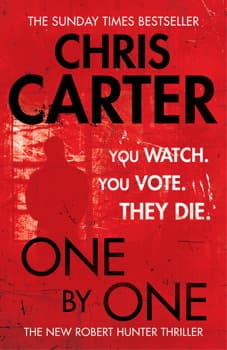
Genre
Thriller / Mystery
Reading Time
512 min
Key Themes
See below
Sign in to track this book
Detective Robert Hunter must take part in a live-streamed murder reality show where the public votes on how victims die. He races to unmask the killer, who is always one step ahead.
Detective Robert Hunter, an LAPD homicide detective, receives an anonymous call with a private web address. Logging in, Hunter sees a live broadcast of a victim being tortured. The caller, 'The Director,' forces Hunter to choose between 'fire' or 'water' for the victim's death. Despite Hunter's attempts to stall and alert his partner, Carlos Garcia, The Director uses the chosen method, and the victim is murdered live. This event starts a cat-and-mouse game between Hunter and the killer.
Before Hunter and Garcia make much progress on the first case, Hunter gets another call and web address. This time, The Director has made the murder a 'reality show' where the public votes on the victim's torture and death. A new victim, a young man, is shown, and the live stream gains viewers who do not know the grim reality. Hunter is again forced to watch the horror as public votes decide the victim's suffering. The LAPD and FBI try to trace the broadcast, but The Director's technical skill makes him untraceable.
As more victims are broadcast and murdered, Hunter and Garcia work to identify them and find connections. At first, the victims seem random, from different backgrounds with no clear links. But Hunter starts to notice patterns in the killer's methods and the victims' pasts. They find that all victims, despite varied public lives, held dark secrets or had done morally questionable acts that were never brought to justice. This changes the investigation from random killings to a planned series of executions.
Hunter and Garcia, with forensic psychologist Dr. Stacy Miller, look deeper into the victims' lives. They find that each victim had committed a serious crime—from financial fraud causing suicides to child abuse—but had avoided prosecution due to legal loopholes, had cases dismissed, or were never suspected. The Director, it becomes clear, sees himself as a vigilante, delivering a distorted form of justice. This motive adds a disturbing layer to the case, as the killer is not just a psychopath, but someone with a clear, though warped, agenda.
Throughout the investigation, The Director shows great technical skill. He uses encrypted networks, constantly changes IP addresses, and employs advanced routing, making it impossible for LAPD and FBI cyber units to find his location. Each time they get close, he vanishes, leaving no digital trace. This technical superiority frustrates Hunter and Garcia, meaning they cannot simply trace the killer. They realize they must outthink him, focusing on psychological aspects and physical evidence, not just the digital trail.
As the murders continue, Hunter feels The Director's actions are personal, aimed at him. The anonymous calls, direct challenges, and how the killer seems to anticipate Hunter's moves suggest a deeper connection than just a random detective on the case. Hunter reviews his past cases, looking for anyone who might hold a grudge or have a reason to plan such a revenge plot against him. This personal element adds great pressure to Hunter, forcing him to face his professional history.
Hunter refuses to be a passive observer, carefully re-watching every broadcast for subtle clues the killer might have left or embedded. He notices recurring symbols, camera angles, and background music, which he believes are not random. These elements, though small, start to form a narrative that helps Hunter build a psychological profile of The Director. He thinks the killer is leaving a 'signature' or a message in the broadcasts, meant for Hunter to decode.
Based on his analysis of the killer's pattern, motive, and profile, Hunter predicts where The Director might strike next. He realizes the killer seeks revenge, an audience, and a final confrontation. Hunter, with Garcia and the FBI, plans to lure The Director into the open. They use media and carefully placed information to make the killer believe his ultimate target is within reach, hoping to draw him to a specific location where they can finally catch him.
Hunter's trap works, and The Director reveals himself, leading to a tense and brutal confrontation. The killer is someone with a personal connection to a past case Hunter handled, a case where justice, in the killer's eyes, was not served. The showdown happens in a remote, prepared location, mirroring the killer's setups for his broadcasts. Hunter, pushed to his limits, uses his intelligence and skills to outmaneuver The Director, ending the live murder reality show.
The Director is captured, stopping the online murders. The public is shocked by the revelations, and the ethics of the 'reality show' are debated. Hunter and Garcia, though successful, are deeply affected by the trauma they witnessed and the choices they made. The case leaves a mark on Hunter, forcing him to grapple with justice, vengeance, and the dark parts of human morality. The ending provides closure but acknowledges the lasting psychological impact of the ordeal.
The Protagonist
Hunter is forced to confront his own past and the limits of his psychological resilience, emerging more resolute but deeply scarred.
The Supporting
Garcia grows in his understanding of the darker aspects of human nature and strengthens his bond with Hunter through shared trauma.
The Antagonist
The Director maintains his persona of a detached, vengeful showman until his identity and personal motivations are finally exposed.
The Supporting
Dr. Miller's understanding of extreme criminal psychology deepens as she grapples with the unique nature of The Director's crimes.
The Supporting
Captain Miller navigates the political pressures of the case while maintaining faith in his lead detectives.
The Supporting
Agent Chen experiences the limitations of technology against a highly skilled and determined digital adversary.
The Mentioned
Each victim's past is exposed posthumously, serving as justification for The Director's actions.
This theme is central to the novel, exploring the blurred lines between seeking justice and enacting personal vengeance. The Director believes he is delivering justice to those who escaped the legal system, but his methods are vengeful and barbaric. Hunter struggles with this, understanding the frustration with legal loopholes but opposing the killer's vigilante actions. The public's participation in the 'vote' shows how easily people can be swayed by the appeal of swift, brutal retribution, as votes consistently favor extreme torture.
“What is justice when the law fails to deliver it? And who decides what is truly just?”
The novel looks at how technology, especially the internet and social media, can be used for horrific purposes. The 'live murder reality show' shows how easily anonymity can be kept online and how a depraved act can become a spectacle for mass viewing. It highlights the voyeuristic nature of some online communities and the dangerous power of collective anonymity, where individuals feel brave enough to vote for torture and death without direct consequence. Law enforcement's inability to trace The Director highlights the challenges of advanced digital obfuscation.
“The internet is a vast ocean, Detective. And in its depths, anything is possible, and no one can hear you scream.”
Hunter and Garcia are repeatedly forced into morally difficult positions, witnessing horrors and making impossible choices under pressure. Hunter's psychological strength is tested as he is forced to be a direct participant in the killer's games. The theme explores the lasting impact of trauma on individuals, and how even those dedicated to upholding the law can be scarred by the darkness they encounter. The victims' pasts also force Hunter to confront the reality that sometimes 'justice' is elusive, and the system is imperfect, adding to his internal conflict.
“To catch a monster, sometimes you have to look into the abyss. But what if the abyss looks back?”
The novel explores the many sides of evil, presenting it not just as random acts of violence but as calculated, ideologically driven terror. The Director's actions are carefully planned, stemming from a warped sense of morality rather than pure psychosis. This raises questions about what makes up evil—is it the act itself, the intention behind it, or the societal conditions that allow it to grow? The public's participation in the voting mechanism further explores how ordinary people can contribute to evil when hidden by anonymity and distance.
“Evil isn't always a deranged maniac in a dark alley. Sometimes, it's a calm voice, a clear purpose, and an audience.”
The central mechanism for the killer's crimes and public engagement.
The live broadcast is the primary plot device, serving as the medium through which The Director commits his murders and engages with Hunter and the public. It creates immediate urgency and high stakes, as victims are tortured and killed in real-time. This device also allows for the 'reality show' element, involving public voting, which introduces a chilling social commentary on voyeurism and collective responsibility. The technical challenges of tracing the broadcast drive a significant portion of the police investigation.
Hunter is compelled to make choices that directly impact the victims.
This device forces Detective Hunter into a moral quandary, making him an unwilling participant in the killer's gruesome games. By compelling him to choose between 'fire or water,' or to simply watch, The Director aims to psychologically torture Hunter and implicate him in the crimes. This personalizes the conflict for Hunter, making it more than just another case and adding immense emotional and psychological pressure, driving his relentless pursuit of the killer.
The past misdeeds of the victims provide the killer's twisted justification.
The revelation that each victim had committed a serious, unpunished crime serves as the core motivation for The Director. This plot device adds a layer of moral ambiguity to the killer's actions, making him a 'vigilante' rather than a random murderer. It challenges the reader's perception of justice and allows for exploration of the legal system's failures, while simultaneously condemning the killer's barbaric methods. It also provides the key for Hunter to profile and ultimately track down The Director.
The ongoing psychological and tactical battle between Hunter and The Director.
This classic thriller device drives the narrative forward, creating constant tension and suspense. The Director constantly taunts Hunter, setting traps and revealing clues, while Hunter uses his intellect to anticipate the killer's moves and decipher his motives. It's a battle of wits that extends beyond physical pursuit, encompassing psychological manipulation and strategic planning. This dynamic elevates the conflict from a simple police procedural to a deeply personal and intellectual confrontation.
“He didn't kill her for revenge. He didn't kill her for money. He killed her because he enjoyed it.”
— Mulling over the killer's motive early in the investigation.
“The human mind is a terrifying place when it breaks.”
— Hunter reflecting on the psychological state of the killer.
“Every victim tells a story, if you know how to listen.”
— Hunter explaining his investigative approach.
“There are monsters in this world, and sometimes, they wear human faces.”
— A general observation about the nature of evil encountered in his work.
“The past always catches up, one way or another.”
— Discussing the long-term consequences of actions.
“Fear is a powerful weapon, and some people wield it with terrifying precision.”
— Analyzing the killer's method of control over victims.
“Sometimes, the most obvious answer is the one we refuse to see.”
— Frustration during a difficult point in the case.
“He wasn't just taking lives; he was taking pieces of the soul of the city.”
— Describing the wider impact of the serial killings.
“The silence of the dead is often louder than the screams of the living.”
— Hunter examining a crime scene, interpreting the silent clues.
“Justice isn't always about what's right; sometimes it's about what's left.”
— A cynical view on the limitations of the justice system.
“Every choice has a ripple effect, especially the ones made in darkness.”
— Reflecting on the chain of events leading to the murders.
“He lived in the shadows, but his darkness touched everything it encountered.”
— Describing the pervasive influence of the killer.
“You can't outrun your demons, not when they're inside you.”
— A character struggling with personal guilt or past trauma.
“The puzzle pieces were there, scattered, waiting for someone to put them together.”
— Hunter's perspective on the investigative process.
Ready to see how well you understood this book? Take our interactive quiz with 10 questions.







