
BookBrief
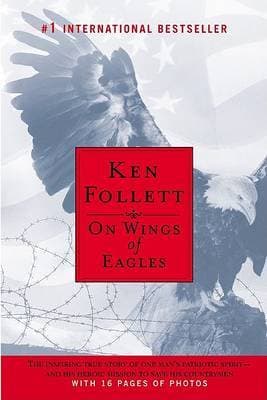
On Wings of Eagles cover
Archivist's Choice

On Wings of Eagles

Ken Follett (1983)

Genre

Thriller / Biography / History / Mystery

Reading Time

12 Minutes

Key Themes

See below

Track Your Reading

Sign in to track this book

In a terrifying hostage crisis, an unconventional billionaire risks everything, defying governments and borders to rescue his stranded countrymen.

Core Idea

Ken Follett's "On Wings of Eagles" recounts the incredible true story of Ross Perot's daring mission to rescue two of his employees from an Iranian prison in the tumultuous wake of the Iranian Revolution. It's a testament to extraordinary leadership, private enterprise's capacity for international action, and the unwavering loyalty between an employer and his staff, demonstrating how a determined individual can achieve what governments deem impossible.
Difficulty
Medium

Core idea

The central argument and framework that powers the entire book.

Ken Follett's "On Wings of Eagles" recounts the incredible true story of Ross Perot's daring mission to rescue two of his employees from an Iranian prison in the tumultuous wake of the Iranian Revolution. It's a testament to extraordinary leadership, private enterprise's capacity for international action, and the unwavering loyalty between an employer and his staff, demonstrating how a determined individual can achieve what governments deem impossible.

At a glance

Difficulty

Medium

Key Takeaways

1

The Power of Private Diplomacy

When traditional government channels fail, determined individuals can forge their own paths.

Quote

When governments are paralyzed by bureaucracy or political considerations, the private sector can often act with a speed and decisiveness that is truly remarkable.

Follett's 'On Wings of Eagles' shows how official diplomatic channels often fail during crises, especially with non-state groups or unstable political situations. The book's best point is how Ross Perot, a private citizen, bypassed government delays to rescue his employees held in Iran. This was more than a logistical challenge; it was an example of private diplomacy, using personal money, contacts, and an understanding of people to do what governments could not. Perot's ability to act quickly and commit resources highlights a gap in ...

Supporting evidence

Ross Perot's decision to fund and organize a private rescue operation for EDS employees held in Tehran, after official U.S. government efforts proved ineffective in the immediate aftermath of the Iranian Revolution.

Apply this

Individuals or corporations facing international crises should consider parallel, private initiatives when state support is slow or absent, understanding the inherent risks and legal complexities. This involves building robust international networks and contingency plans.


2

Unconventional Leadership in Crisis

True leadership emerges not from titles, but from courage, resourcefulness, and an unwavering commitment to one's people.

Quote

Perot was not a general, nor a diplomat, but in that moment, he became both, driven by a simple, profound loyalty to his men.

Ross Perot's leadership during the hostage crisis was unexpected. He was not a military leader or a diplomat, but he showed key traits for crisis management: quick action, a focus on his employees' safety, and an ability to inspire loyalty. He was willing to take big personal and financial risks, and he understood the local politics in Iran. This commitment went beyond words; he funded and oversaw the entire operation, showing a rare level of corporate responsibility. Follett shows Perot as a man driven by a strong moral duty, proving...

Supporting evidence

Perot's direct involvement in orchestrating the rescue, including recruiting Colonel Bull Simon and personally bankrolling the entire operation, motivated by his stated commitment to 'take care of our people'.

Apply this

Leaders should cultivate a deep sense of personal responsibility for their teams and be prepared to act decisively and unconventionally when standard protocols fail. This requires fostering a culture of loyalty and trust within an organization.

3

The 'Bull' Simon Factor

The right person with the right skills can turn an impossible mission into a feasible one.

Quote

Simon was a man who understood the impossible was often just an unexamined problem, a challenge waiting for a solution no one else dared to consider.

The decision to recruit Colonel Bull Simon was important to the rescue story. Simon, a retired Green Beret, brought military skill, practicality, boldness, and leadership to the mission. His ability to quickly assess the chaos in Iran, recruit and train EDS employees, and plan an improbable escape shows the value of specialized skills in unusual operations. Simon's leadership was different from Perot's; he was the operational mind who turned Perot's idea into action. This highlights that even with strong top leadership, complex tasks ...

Supporting evidence

Colonel Bull Simon's role in training the EDS 'commando' team, planning the prison break from Gasr Prison, and leading the overland escape through Turkey.

Apply this

When facing complex challenges, identify and empower individuals with specialized, unconventional skills and a proven track record of problem-solving. Trust their judgment and provide them with the necessary resources.

4

The Human Cost of Revolution

Political upheaval can trap innocent individuals in a maelstrom of unpredictable danger.

Quote

They were caught in a storm not of their making, pawns in a revolution that cared little for their individual fates.

Follett clearly shows the frightening reality for EDS employees trapped in Iran during the early days of the Iranian Revolution. Their arrest, imprisonment, and constant threats of violence or execution highlight the unpredictable nature of revolutionary fervor. This part of the book is important for understanding the urgency and extreme risk of the rescue. It shows how ordinary people can become victims in big political changes, losing legal protections and subject to changing power. The story conveys the fear, uncertainty, and stres...

Supporting evidence

The arbitrary arrest and imprisonment of Paul Chiapparone and Bill Gay, along with other EDS employees, on fabricated charges during the chaos of the Iranian Revolution.

Apply this

Companies operating in politically unstable regions must prioritize robust security protocols, evacuation plans, and continuous geopolitical risk assessment, recognizing that employees can quickly become targets or pawns.

5

The Power of Morale and Esprit de Corps

Even in dire circumstances, a shared purpose and strong camaraderie can be a powerful force for survival.

Quote

It was more than a company; it was a family, and families don't leave their own behind.

A repeated idea in 'On Wings of Eagles' is the strong loyalty and unity within EDS, created by Ross Perot. This was not just a company slogan; it was a deep belief that ran through the rescue mission. The EDS volunteers who joined Bull Simon's team, ordinary men without military experience, wanted to save their colleagues. Their willingness to risk their lives, enduring hard conditions and real danger, speaks to the power of morale and a shared goal. This team spirit helped them overcome fear, maintain discipline, and complete a compl...

Supporting evidence

The dedication of the EDS volunteer team, ordinary employees who trained as a commando unit under Bull Simon and risked their lives to rescue their colleagues.

Apply this

Organizations should invest in fostering a strong, supportive culture where employees feel valued and part of a 'family.' This builds resilience and loyalty that can be invaluable during crises.

6

The Unpredictability of Revolutionary Justice

In the absence of established law, 'justice' becomes a tool of political expediency and mob rule.

Quote

The law was whatever the revolutionary guards declared it to be on any given day, a terrifying and arbitrary power.

Follett thoroughly describes the confusing legal system, or lack thereof, that the EDS hostages faced in revolutionary Iran. Accusations were groundless, trials were a joke, and sentences were random, often swayed by political changes and the whims of local officials or crowds. The book shows how quickly legal protections can disappear during intense political upheaval, leaving people vulnerable to unfair treatment. While it focuses only on the American hostages' view, it powerfully conveys the terror of facing a system where fair pro...

Supporting evidence

The sham trials and fabricated charges against Paul Chiapparone and Bill Gay, culminating in their conviction for espionage and exorbitant bail demands, despite no evidence.

Apply this

When operating in high-risk zones, understand that legal frameworks can dissolve rapidly. Relying on international law or local jurisprudence may be futile; proactive self-protection and escape planning become paramount.

7

The Role of Media in Crisis

Media attention can be a double-edged sword, offering both pressure and peril.

Quote

Every headline was a siren, drawing attention, yet also raising the stakes and complicating every move.

Though not a main point, the book touches on the complex role of media during the hostage crisis. Initial media silence was important for the rescue's secrecy, allowing Perot and Simon to work. But as the situation grew and details leaked, media attention became unavoidable. This put international pressure on Iran, which could help, but also increased danger for the hostages and made rescue harder by making the team more visible. Follett suggests that managing information and media stories is a critical, delicate part of crisis manage...

Supporting evidence

The initial efforts by Perot to keep the rescue mission secret, contrasting with the later inevitable media coverage that both highlighted the plight of the hostages and increased the risks for their rescuers.

Apply this

In crisis situations, develop a clear communication strategy that balances the need for operational security with the potential benefits or drawbacks of public awareness. Be prepared for both silence and intense scrutiny.

8

The Psychological Warfare of Captivity

Beyond physical confinement, hostages endure a profound assault on their mental and emotional well-being.

Quote

The prison was not just walls and bars; it was a place where hope was systematically dismantled, piece by agonizing piece.

Follett effectively shows the psychological pain suffered by Paul Chiapparone and Bill Gay during their imprisonment in Gasr Prison. The constant uncertainty, the random nature of their detention, threats of execution, and isolation all led to helplessness and despair. This element is vital for understanding the true stakes of the rescue; it was not just about physical freedom but about saving people from complete psychological breakdown. The book illustrates how captors use fear and uncertainty to break prisoners, making rescue not j...

Supporting evidence

The detailed accounts of Paul Chiapparone and Bill Gay's experiences in Gasr Prison, including their interrogations, the mock trials, and the constant fear of execution, leading to significant psychological stress.

Apply this

Support systems for individuals in captivity must address psychological well-being as much as physical safety. Post-rescue, extensive psychological care is essential for recovery from the trauma of captivity.

9

The Logistics of an Impossible Escape

Meticulous planning and audacious execution are required to navigate chaos and achieve the improbable.

Quote

Every mile, every checkpoint, every decision was a gamble, a thread in a tapestry of desperate hope.

The escape itself is an example of logistical planning under extreme pressure. Follett details the challenges: navigating Tehran's revolutionary chaos, the spontaneous prison break, the dangerous overland journey through mountains, and crossing borders with armed guards. The book's strength here is making the seemingly impossible feel real, showing how Bull Simon and his team used local knowledge, improvisation, and determination. This was not a clean military operation; it was a rough, messy, and dangerous effort, subject to constant...

Supporting evidence

The detailed description of the escape from Gasr Prison during the revolutionary riots, the covert movement of the rescue team and hostages through Iran, and their perilous crossing into Turkey.

Apply this

For complex, high-stakes operations, develop multi-layered contingency plans, train for adaptability, and empower on-the-ground teams to make rapid, informed decisions in fluid environments.

10

The Moral Imperative of 'Leaving No One Behind'

Beyond business, there exists a profound human duty to protect those under one's care.

Quote

Perot's actions transcended corporate responsibility; they spoke to a deeper human truth: that we do not abandon our own.

Ultimately, 'On Wings of Eagles' shows the importance of 'leaving no one behind.' Ross Perot's commitment to his employees, even at great personal and financial cost, raises the story beyond a corporate biography to one about basic human values. His belief that his company was a family, and that family members protect each other, guided every decision. This belief contrasts with government inaction and bureaucracy. The book suggests that while governments are bound by political calculations, individuals and private groups can, and som...

Supporting evidence

Perot's repeated statements and actions, from the moment of the hostage-taking to the successful extraction, consistently prioritizing the safe return of his employees above all other considerations, including financial cost or political risk.

Apply this

Leaders and organizations should embed a strong 'duty of care' into their core values, ensuring that the safety and well-being of their people are paramount, especially in high-risk environments. This fosters trust and long-term loyalty.

Critical analysis

Notable Quotes

Quiz

Test Your Knowledge

Ready to see how well you understood this book? Take our interactive quiz with 10 questions.

10
Questions
~5
Minutes
?
Best Score

Key Questions (FAQ)

"On Wings of Eagles" is a true story detailing the 1979 Middle East hostage crisis and the efforts of Ross Perot to rescue American hostages. It's a thrilling account of a real-life rescue mission.

About the author

Ken Follett

Kenneth Martin Follett, is a British author of thrillers and historical novels who has sold more than 160 million copies of his works.





