“It wasn't fair. It wasn't fair that he had to be afraid.”
— Joel reflects on his fear of the river.

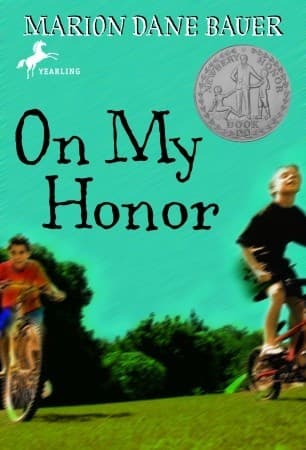
Marion Dane Bauer (1979)
Genre
Children's / Young Adult
Reading Time
90 min
Key Themes
See below
Sign in to track this book
A reckless dare to swim a dangerous river shatters Joel's world when his best friend, Tony, vanishes beneath the currents, leaving Joel to grapple with a terrible truth and the weight of their parents' grief.
Twelve-year-old Joel and his best friend, Tony, are spending a hot summer day at Joel's house, bored and restless. Joel's mother asks them to take Joel's younger sister, Marcy, to the park, but Joel avoids the chore. Instead, the boys decide to go for a bike ride, seeking adventure. As they cycle through town, Joel, feeling competitive, dares Tony to a race up a steep hill, a challenge Tony accepts. This sets a precedent for their competitive, dare-driven dynamic that will soon have tragic consequences.
After racing up the steep hill, Joel and Tony arrive at a high bluff overlooking the Vermillion River, a place forbidden to them due to its strong currents and hidden dangers. The river is known for its undertow, and a boy had drowned there years ago. Despite the known risks and their parents' strict warnings, Joel, wanting to impress Tony and perhaps himself, dares Tony to go swimming in the river. Tony, initially hesitant and reminding Joel of the rules, is goaded by Joel's taunts about being scared. The dare escalates into a test of courage and friendship.
Tony agrees to the swim after Joel's taunts. The boys strip down to their underwear and plunge into the cold, murky water of the Vermillion River. Joel, a stronger swimmer, takes the lead, setting a course for a distant sandbar. Tony struggles to keep up, his less powerful strokes evident as he falls behind. Joel, focused on winning the race, doesn't look back, confident that Tony is right behind him. The current is stronger than they anticipated, pulling at them, but Joel pushes on, determined to reach the sandbar first.
Joel reaches the sandbar, pulling himself out of the water, exhilarated by the swim and the win. He turns to look for Tony, expecting to see him emerge from the river any second. He scans the water, then the riverbanks, but Tony is nowhere in sight. A cold dread begins to creep over Joel as the silence of the river becomes deafening. He calls out Tony's name, his voice echoing back to him unanswered. Panic sets in as the realization dawns: Tony is gone. The playful dare has turned into a horrifying reality, and Joel is alone.
Overwhelmed by fear and disbelief, Joel plunges back into the water, frantically searching for Tony. He dives repeatedly, feeling along the riverbed, calling his friend's name, but finds nothing. The current seems to mock his efforts, and the river feels vast and indifferent. As the reality of Tony's absence sinks in, Joel's mind races, trying to conjure an explanation, a scenario where Tony is safe. He then starts to make up a lie, a story to tell their parents, to escape the crushing weight of his responsibility. He imagines Tony having gone home, or playing a trick on him.
Joel, after an agonizing and fruitless search, dresses and retrieves their bikes. He rides home, the familiar path now feeling alien and heavy. Upon arriving, he finds Tony's parents, the Zabrinskys, at his house, having come to pick up Tony. Joel is confronted with their questions, and the lie he made up earlier spills out: he tells them Tony went home a different way. He watches Mrs. Zabrinsky's growing concern and Mr. Zabrinsky's quiet worry. The lie feels flimsy and horrifying, and Joel struggles to keep his composure, knowing the truth is a terrible secret he can't yet reveal.
As evening falls, the search for Tony intensifies. The Zabrinskys and Joel's parents grow increasingly worried, and soon the police are involved. Joel is questioned again, and he repeats his lie, feeling trapped by it. He watches the adults organize search parties, their faces etched with fear. Every question, every phone call, every siren, intensifies Joel's guilt. He sees the pain in Mrs. Zabrinsky's eyes and the despair in his own mother's face. The secret bothers him, making it impossible to eat or sleep, as he grapples with the knowledge that his dare led to this tragedy.
The night is long and agonizing for Joel. He lies in bed, haunted by images of Tony and the river, unable to escape his guilt. He hears the hushed conversations of the adults downstairs, the phone calls, the growing sense of dread. The burden of the lie becomes unbearable. Unable to contain it any longer, Joel goes downstairs and finds his father. In a moment of vulnerability and desperation, he breaks down and confesses everything: the dare, the swim in the forbidden river, and Tony's disappearance. His father listens, his face a mixture of shock and sadness.
After Joel's confession, his father, though clearly devastated, takes him to the Zabrinskys' house. The journey is quiet and heavy with unspoken grief. Joel's father gently explains to the Zabrinskys that Joel has something important to tell them. Joel, trembling and tearful, recounts the events of the afternoon, admitting to daring Tony to swim in the Vermillion River and that Tony never emerged. The Zabrinskys are heartbroken, their worst fears confirmed. Mrs. Zabrinsky collapses in grief, and Mr. Zabrinsky is stoic, his pain clear. Joel is overwhelmed by their sorrow and his role in causing it.
The next day, Tony's body is recovered from the Vermillion River. The news brings a grim finality to the tragedy. Joel attends the funeral, numb with grief and guilt, watching the Zabrinskys mourn their son. In the weeks and months that follow, Joel struggles to come to terms with what happened. He is plagued by nightmares and haunted by memories of Tony. He understands the irreversible nature of his actions and the loss he caused. His parents are supportive but also deeply affected. Joel learns a devastating lesson about responsibility, the power of a dare, and the fragility of life, forever changed by the events of that summer day.
The Protagonist
Joel transforms from an impulsive, competitive boy into one who must confront the devastating consequences of his actions, learning a painful lesson about responsibility and guilt.
The Supporting
Tony's character arc is cut short by his tragic death, serving as a stark consequence of reckless behavior and a catalyst for Joel's transformation.
The Supporting
He remains a consistent figure of support and moral guidance for Joel, helping him face the consequences of his actions.
The Supporting
Her character arc primarily involves experiencing the grief and shock of the event alongside her son, while maintaining her supportive role.
The Supporting
Her arc is one of profound grief and loss, representing the ultimate cost of the tragedy.
The Supporting
His arc is one of silent and profound grief, reflecting the enduring pain of loss.
The Mentioned
Marcy's character has no arc, serving only as an initial plot point.
The central theme revolves around Joel's guilt and his struggle to take responsibility for Tony's death. His initial denial and fabricated story show his desperate attempt to escape accountability. The weight of his lie and the sorrow of Tony's parents ultimately force him to confess, initiating his painful journey of accepting the consequences of his reckless dare. The book explores how guilt can consume an individual and the difficult, but necessary, path toward honesty and self-forgiveness.
“He had killed his best friend. He had killed his best friend.”
The story examines how an innocent dare can escalate into a tragic event. Joel's constant need to prove himself and his goading of Tony into swimming in the forbidden Vermillion River are central. The dare is not just a challenge but a test of friendship and courage, which Tony, despite his initial reluctance, feels compelled to accept. The book is a cautionary tale about the devastating consequences of peer pressure and the desire to impress or win.
“He had dared Tony, hadn't he? He had dared him, and Tony had gone.”
The book explores the impact of loss and grief, not only on Joel but also on Tony's parents and Joel's own family. The Zabrinskys' devastation upon hearing the truth and their mourning are depicted with raw emotion, emphasizing the irreversible nature of death. Joel's personal grief is intertwined with his guilt, making his processing of Tony's loss complex and agonizing. The story illustrates how a community grapples with sudden tragedy and how individuals must learn to live with a great absence.
“Mrs. Zabrinsky began to cry, great, tearing sobs that shook her whole body.”
Joel's experience is a brutal transition from the carefree innocence of childhood to the realities of adult responsibility and the finality of death. Before Tony's disappearance, Joel is impulsive and disregards rules. The tragedy shatters this innocence, forcing him to confront the grave consequences of his actions and the fragility of life. This painful awakening signifies a loss of naivete and a forced maturation, as he grapples with a truth more profound than any childhood game.
“He was a killer. And he was only twelve years old.”
Hints of danger and tragedy are woven throughout the early parts of the story.
The novel uses foreshadowing to build tension and hint at the tragic outcome. The initial discussion of boredom and Joel's competitive nature sets the stage for a dare. More explicitly, the Vermillion River is described as 'forbidden' and known for its 'strong currents' and a past drowning incident. These details immediately establish the danger and create a sense of unease, making the eventual tragedy feel both inevitable and heartbreaking. The warnings from parents and the historical context of the river serve to underscore the recklessness of the boys' actions.
Joel's thoughts and feelings are extensively narrated, revealing his guilt and fear.
A significant portion of the narrative is dedicated to Joel's internal monologue, allowing readers deep insight into his psychological state. After Tony's disappearance, Joel's thoughts are a torrent of panic, denial, and frantic attempts to rationalize or fabricate a story. This device effectively conveys the crushing weight of his guilt, his fear of exposure, and his struggle to reconcile with the terrible truth. It makes his eventual confession more impactful, as the reader has intimately experienced his internal torment.
A symbolic setting representing danger, forbidden boundaries, and the irreversible nature of consequences.
The Vermillion River functions as a powerful symbol in the story. It represents forbidden territory, danger, and the boundary between safety and peril. Its 'strong currents' and 'hidden dangers' are not just physical threats but also symbolic of the dangerous impulses and unchecked dares of childhood. The river ultimately becomes a symbol of irreversible loss and the finality of death, as it claims Tony's life and forever alters Joel's. It is the locus of both the initial thrill and the ultimate tragedy.
The central inciting incident and a recurring motif representing peer pressure and recklessness.
The dare itself is a pivotal plot device. It is introduced early when Joel dares Tony to race up the hill, establishing their competitive dynamic. The ultimate dare—to swim in the forbidden Vermillion River—is the inciting incident that directly leads to the tragedy. The dare represents the pressures of childhood friendship, the desire to prove oneself, and the lack of mature judgment regarding consequences. It serves as a constant reminder of Joel's direct role in Tony's death and the tragic outcome of impulsive challenges.
“It wasn't fair. It wasn't fair that he had to be afraid.”
— Joel reflects on his fear of the river.
“I'm not going to drown. I'm not going to drown. I'm not going to drown.”
— Joel repeats this mantra to himself after Tony's death.
“He knew, even before he felt the cold, even before he saw the dark water, that Tony was gone.”
— Joel's immediate realization after Tony disappears.
“He just wanted to pretend that none of it had happened, that Tony was still alive, that they were still going to the bluffs, that they were still going to have fun.”
— Joel's desire to escape reality after the accident.
“He had lied. He had lied to his parents. He had lied to himself. And now Tony was dead.”
— Joel connects his lie about going to the bluffs with Tony's death.
“The secret was a heavy, wet stone in his stomach.”
— Joel feels the burden of keeping Tony's death a secret.
“He was afraid of the river. He was afraid of his father. He was afraid of the truth.”
— Joel's multiple fears after the tragedy.
“It was as if his own heart had stopped beating, too.”
— Joel's physical reaction to Tony's death.
“He had promised. On his honor.”
— Joel remembers the promise he made to Tony about not telling.
“The silence in the house was a different kind of silence now.”
— Joel notices the change in the atmosphere at home after the accident.
“He didn't want to tell. He couldn't tell. He had to tell.”
— Joel's internal conflict about confessing what happened.
“He wished he could just go back to yesterday, to the beginning of the day, before they had left for the bluffs.”
— Joel's desperate wish to undo the events of the day.
“The water had taken Tony, but it hadn't taken the lie.”
— Joel's realization that the lie persists even after the tragedy.
“He knew, with a terrible certainty, that some things could never be un-done.”
— Joel's understanding of the permanence of his actions.
Ready to see how well you understood this book? Take our interactive quiz with 10 questions.

Dan Gemeinhart
4.5
Kate O'Hearn
4.4

Jeanne Birdsall
4.4

Jen Wang
4.4
Wendelin Van Draanen
4.3

John Marsden
4.3

Chris Van Allsburg
4.3
Jennifer A. Nielsen
4.2