“Being a woman is worse than being a Negro. They can free the Negro. They can't free the woman.”
— Lucy Marsden reflecting on the difficulties women faced in her time, particularly in comparison to racial equality.

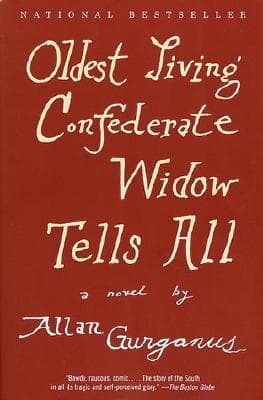
Allan Gurganus (1990)
Genre
Historical Fiction
Reading Time
1500 min
Key Themes
See below
Sign in to track this book
A spirited ninety-nine-year-old widow of a Confederate colonel recounts a century of Southern history, from the Civil War's echoes to her feisty battles in a modern nursing home, all through her own sharp-witted and unforgettable lens.
Lucy Marsden, a sharp-witted ninety-nine-year-old, introduces herself from her room at the Confederate Widows' Home. Despite her age and living in an institution, she has an extraordinary memory and a lively, often irreverent, voice. She immediately states her position as the 'oldest living Confederate widow,' having married a Civil War veteran. Her first observations touch on the home's routine, the staff's quirks like the mohawk-coiffed candy-striper, and her own wish to tell her story on her terms, often correcting historical accounts she feels are wrong. She sets the stage for a long memoir that will cover over a century of American history, seen through her personal experiences.
Lucy tells of her childhood in Falls, North Carolina, a time of relative innocence mixed with the Civil War's lingering shadows, which shaped her community. At fifteen, she catches the eye of Colonel William Marsden, a fifty-year-old Confederate veteran who fought at Gettysburg and Appomattox. Despite the age difference and the Colonel's reputation as a man haunted by war, he courts Lucy with a mix of formality and real affection. Lucy, interested by his stories and the status his past gives him, eventually accepts his proposal, a decision that will link her life to the Confederacy's legacy. Her family, though hesitant at first, supports the union, seeing it as a respectable match.
Lucy's marriage to Colonel William Marsden is not typical. She quickly learns what it is like to live with a man deeply scarred by the Civil War, both physically and mentally. The Colonel's nights are often filled with nightmares and flashbacks to battles like Gettysburg, and he often relives the horrors of combat, sometimes even acting them out in his sleep. Lucy, though young, becomes his steady companion and caretaker, learning to understand his wartime language and calm his troubled spirit. She gains a close understanding of the war not from books, but from the experience of a man who fought in it, absorbing his stories and the deep impact the conflict had on his generation and the South.
Through Colonel Marsden's fragmented memories and Lucy's patient work to piece together his stories, the reader is taken into the heart of the Civil War. One particularly moving story involves a young drummer boy named Billy, whom the Colonel describes with affection and horror. Billy, barely more than a child, is killed during a brutal fight, a memory that still haunts the Colonel decades later. Lucy recounts how the Colonel would often speak of the senseless loss of young lives and the bond formed in battle, painting a clear and often gruesome picture of the war that goes beyond romanticized ideas of Southern heroism. These stories are central to Lucy's understanding of her husband and the historical period.
Lucy and Colonel Marsden settle into farm life, trying to rebuild in the post-Reconstruction South. Lucy, despite her youth, takes on the responsibilities of a farm wife and mother, having several children. She describes the daily struggles of rural life, the effort needed to make ends meet, and the widespread societal attitudes still shaped by the Confederacy's defeat. The Colonel, while a loving husband and father, remains burdened by his war experiences, which often show in his parenting and interactions. Lucy raises her children with practicality and her own growing wisdom, often comparing her more modern views with her husband's and the community's traditional, war-hardened perspectives.
As years pass, Colonel William Marsden's health declines, worsened by his war wounds and age. Lucy becomes his main caregiver, tending to his needs and comforting him through his increasing frailty and more frequent bouts of wartime delirium. She describes the bittersweet experience of watching her husband fade, thinking about their unusual marriage and the deep bond they formed despite their age difference and his traumatic past. His death, when it comes, is a great loss for Lucy, marking the end of a chapter in her life and leaving her a widow, linked to the Confederacy through her husband's legacy.
After the Colonel's death, Lucy, still relatively young, begins a new phase of life as a widow. She describes the challenges and freedoms that come with her new independence. While mourning her husband, she also begins to assert her own identity more fully, stepping out from under the shadow of the 'Confederate veteran's wife.' She continues to manage the farm and raise her children, showing great resilience and resourcefulness. This period is important for Lucy's personal growth, as she develops a stronger sense of self and begins to form her own opinions about history, society, and the South's legacy, often subtly questioning the common stories.
Lucy's life extends through the entire 20th century, letting her see firsthand the changes that reshape the South and the world. She recounts her experiences during both World War I and World War II, noting the differences between these global conflicts and her husband's Civil War. She sees her children and grandchildren go off to fight, thinking about war's cyclical nature and the lasting human cost. Lucy also observes society's gradual modernization, new technologies, and shifting social dynamics, often comparing them to her youth's more rigid traditions and the Confederacy's era, giving a unique historical view.
In her old age, Lucy moves into the Confederate Widows' Home, a place for the last surviving wives of Confederate veterans. She describes the institution's dynamics, its mix of historical respect and the daily realities of elder care. She interacts with the staff, including the quirky candy-striper, and other residents, often finding humor and absurdity in her surroundings. Despite physical limitations that come with age, Lucy's mind stays sharp, and she uses her time in the home to think about her past, process her memories, and continue her storytelling, often to the amusement or confusion of those around her. The home is a final stage for her grand story.
Throughout her story, Lucy consistently questions common historical accounts and the romanticized versions of the Civil War often found in the South. She insists on telling the 'truth' as she experienced it, acknowledging the brutality, suffering, and complex reasons of individuals on both sides. She often debunks myths and shows the hypocrisy she observed, especially regarding race relations and slavery's lasting impact. Her thoughts emphasize memory's subjective nature and how personal experience shapes one's understanding of history, arguing that 'official' narratives often miss the human element and the past's messy realities. Her voice becomes a strong counter-narrative.
Lucy's story is deeply connected to the American South's identity. She offers poignant observations on how the Confederacy's defeat and its mythology continued to shape the region's culture, politics, and social fabric for generations. She discusses the lasting pride, bitterness, and the complex relationship Southerners have with their history. While she lived through segregation and saw its gradual dismantling, she gives a nuanced view of the deep-seated traditions and prejudices that define the South. Her insights show how the past, especially the Civil War, remains a living presence, influencing everything from family dynamics to community values.
As Lucy's story nears its end, she thinks about the act of storytelling itself. She understands her voice's power and her unique position as a living link to a past era. She repeats her commitment to telling her story honestly, even if it goes against popular belief or makes listeners uncomfortable. Her final thoughts touch on the human spirit's resilience, love and loss's lasting nature, and the importance of remembering history, not as a clean story, but as a complex mix of individual lives and experiences. She leaves the reader with a deep sense of history's weight and the lively, strong spirit of a woman who lived through it all.
The Protagonist
Lucy evolves from an impressionable young girl into a resilient, independent woman who finds her own voice and challenges conventional historical narratives.
The Supporting/Mentioned
His arc is largely in the past, a man defined by his wartime experiences, slowly declining and passing the torch of memory to Lucy.
The Mentioned
His brief, tragic life serves as a static, powerful symbol of war's devastation.
The Supporting
Willis remains largely static, a symbol of modernity and a catalyst for Lucy's storytelling.
The Supporting
Their individual arcs are not detailed, but collectively they represent the ongoing generational shifts and the continuation of life beyond the Civil War era.
The Mentioned
They remain static, part of the setting that prompts Lucy's reflections.
The novel explores the subjective and often contradictory nature of history and personal memory. Lucy, as the 'oldest living Confederate widow,' offers a different story to official histories and romanticized myths of the Civil War. She constantly corrects, embellishes, and reinterprets events based on her experience and her husband's fragmented memories. The war's brutal reality, suffering, and complex reasons are highlighted, challenging the 'Lost Cause' narrative. Lucy's insistence on telling her 'truth' shows how history is not fixed facts, but a dynamic, often debated, story shaped by individual views and time. Her memory, though vast, is also selective and personal.
“History is not what happened. History is what gets told.”
The lasting impact of the American Civil War on individuals, families, and the entire Southern region is a main theme. Through Colonel Marsden's post-traumatic stress and Lucy's thoughts, the novel shows how the war's psychological, social, and cultural scars lasted for generations. The Colonel's nightmares and the community's lingering pride and bitterness show how the conflict continued to shape Southern identity long after its official end. Lucy's life, spanning over a century, lets her observe the evolving legacy, from the immediate aftermath to the modern era, showing how the past remains a living presence, informing everything from racial dynamics to regional character.
“He fought the war every night. I slept through a hundred thousand battles.”
Lucy Marsden shows remarkable resilience and an ability to adapt. From marrying a much older, war-scarred veteran at a young age to navigating widowhood, raising children, and seeing the societal changes of the 20th century, Lucy constantly adjusts to new situations. She survives personal losses, economic hardships, and the indignities of old age in a nursing home, all while keeping her sharp wit and independent spirit. Her ability to find humor, meaning, and purpose in every stage of her life, even in hard times, shows the human spirit's lasting strength. She adapts not by forgetting, but by adding her experiences into a rich, evolving story.
“I was a veteran of the veteran. And that's a whole different kind of war.”
The entire novel shows the power of storytelling to preserve history, understand the past, and assert individual identity. Lucy's constant narration is not just a recounting of events; it's an act of creation, shaping her own legacy and challenging common narratives. Her voice is her most powerful tool, letting her control her story and share her unique view with a world that might otherwise forget her or misremember her husband's war. The novel itself shows how personal narratives, even from the edge of major historical events, can offer deep insights and a deeper, more human understanding of the past.
“A life unrecorded is a life unlived. Or, if lived, then forgotten.”
The theme of youth and age is central to Lucy's story, both in her marriage to Colonel Marsden and in her own journey through a century of life. Her marriage at fifteen to a fifty-year-old man immediately highlights the difference between youthful innocence and the burdens of age and experience. As Lucy herself ages, she thinks about the changes in her body and mind, comparing her youthful energy with the realities of being ninety-nine. The novel explores how perspectives shift with age, how memory can both fade and sharpen, and how the young and old interact, often with mutual misunderstanding, as seen in her talks with the candy-striper. It is a look at life's full cycle.
“When you're fifteen, you think fifty is ancient. When you're ninety-nine, fifty looks like a baby.”
The entire novel is presented as Lucy Marsden's continuous, unfiltered monologue.
The novel is entirely told through Lucy Marsden's first-person, stream-of-consciousness monologue. This device immerses the reader directly into Lucy's mind, allowing for her unique voice, sharp wit, and rambling narrative style to dominate. It provides an intimate and subjective perspective on history, filtering all events through her personal lens. The lack of an external narrator reinforces her agency and her determination to tell her story on her own terms, often jumping between past and present, giving the narrative a rich, conversational, and authentic feel. It's a direct transmission of her memory and personality.
Lucy's modern sensibilities and language often punctuate her historical recollections.
While not strictly anachronistic in terms of factual errors, Lucy's narrative voice often possesses a remarkably modern sensibility and idiom, even when recounting events from the 19th century. This stylistic choice allows her to comment on past events with the benefit of hindsight and a contemporary understanding, bridging the gap between historical periods. It highlights her timeless wisdom and allows the author to infuse the historical narrative with a fresh, often irreverent, perspective, making the distant past feel immediate and relevant to a modern audience. It underscores her role as a bridge between eras.
The physical setting that grounds Lucy's present-day narration.
The Confederate Widows' Home serves as the primary present-day setting for Lucy's narration. It acts as a frame device, grounding her sprawling historical recollections in a tangible, if somewhat surreal, reality. The home itself is a symbol—a place where the past is literally institutionalized and preserved, yet also subject to the indignities of old age and the intrusions of the modern world. It provides a static point from which Lucy can launch into her memories, and its daily routines and quirky inhabitants offer humorous and poignant contrasts to the epic scope of her past.
Lucy's storytelling frequently jumps between different periods of her life.
Lucy's monologue is characterized by its fluid, non-linear progression. She frequently jumps back and forth in time, from her present-day experiences in the nursing home to her childhood, her marriage, and various moments throughout the 20th century. This device mirrors the natural flow of memory and conversation, reflecting how an elderly person might recall their life. It allows for thematic connections to be drawn across different eras and prevents the narrative from becoming a dry chronological account, instead creating a rich tapestry of interwoven experiences and reflections.
“Being a woman is worse than being a Negro. They can free the Negro. They can't free the woman.”
— Lucy Marsden reflecting on the difficulties women faced in her time, particularly in comparison to racial equality.
“Life is a story. You're born. You live. You die. But the story's the thing.”
— Lucy Marsden musing on the nature of existence and the importance of narrative.
“War don't make sense, not to the ones who fight it. It's the ones who send you there that make sense of it, for their own reasons.”
— Lucy Marsden's perspective on the futility and political motivations behind the Civil War.
“Memory is a funny thing. Sometimes it's like a clear glass, and you can see right through it. Other times it's like a muddy pond, and you can't see nothing.”
— Lucy Marsden describing the unreliable and selective nature of her long-term memory.
“A good lie, well told, can be better than the truth, if the truth ain't pretty.”
— Lucy Marsden commenting on the power and utility of storytelling, even if it involves embellishment.
“You can't outrun your past, not really. It's always there, breathing down your neck, even if you don't feel it.”
— Lucy Marsden reflecting on the lasting impact of historical events and personal experiences.
“Love ain't always pretty. Sometimes it's messy, and it hurts, and you still can't live without it.”
— Lucy Marsden's pragmatic view on the complexities and enduring nature of love.
“People always want to know about the war. They don't want to know about the living after the war, which is harder.”
— Lucy Marsden expressing frustration with people's focus on battle over the long-term societal and personal aftermath.
“The past is never dead. It's not even past.”
— A common literary allusion, but Gurganus uses it through Lucy Marsden to emphasize the continuing influence of the Civil War and its legacy.
“You got to make your own happiness in this world, 'cause nobody else is gonna hand it to you.”
— Lucy Marsden's philosophy on self-reliance and the pursuit of contentment.
“A man without a story is like a house without a roof. It just ain't right.”
— Lucy Marsden highlighting the fundamental human need for narrative and identity.
“Every person's got a secret garden inside 'em, full of things they don't show nobody.”
— Lucy Marsden acknowledging the private inner world and hidden aspects of every individual.
“It don't matter how long you live, it's what you do with the time you got.”
— Lucy Marsden's reflection on the quality of life over mere longevity.
“The world keeps turning, no matter what you do. You just got to keep up with it, or get left behind.”
— Lucy Marsden's acceptance of change and the relentless march of time.
Ready to see how well you understood this book? Take our interactive quiz with 10 questions.







