“Yes, I remember it all, just the way it was. The way it always will be. The way it has to be.”
— The narrator reflecting on the past and the enduring nature of the events.

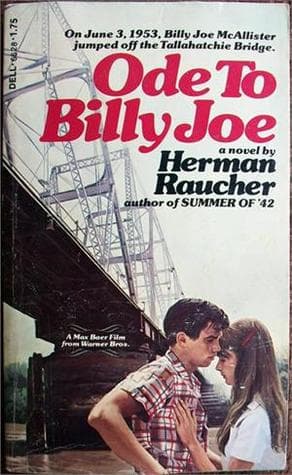
Herman Raucher (1976)
Genre
Young Adult / Romance
Reading Time
256 min
Key Themes
See below
Sign in to track this book
In the sweltering Mississippi summer of 1953, a ballad tells the tender, tragic secret behind Billy Joe McAllister's leap from the Tallahatchie Bridge and the love he shared.
The story begins with Bobbie Lee Hartley, now an adult, remembering the summer of 1953 in Chickasaw County, Mississippi, when she was fifteen. She recalls the heat, the simple farm life, and the coming of a new boy, Billy Joe McAllister. The Tallahatchie Bridge, a local landmark, already felt special to teenagers as a place for dares and secret meetings. Bobbie Lee lives with her strict but kind parents and her younger brother, James. The story sets up the rural, conservative world and Bobbie Lee's innocent but curious nature as she nears adulthood. The first scenes show ordinary life before the sad events unfold.
Billy Joe McAllister arrives, a handsome and somewhat mysterious new person. Bobbie Lee is immediately drawn to him, and he to her. Their first interactions are shy, often involving shared looks and short talks at local gatherings or school. Billy Joe is a skilled carpenter doing odd jobs, and Bobbie Lee watches him with growing interest. Their connection is clear, with an innocent intensity. They start spending more time together, often in secret, as their mutual interest grows. These early moments show the awkward beauty of first love, set against the Mississippi summer, hinting at a romance that feels both destined and delicate.
As summer goes on, Bobbie Lee and Billy Joe's relationship grows deeper. They often meet in secret, by the Tallahatchie River or on the bridge itself, away from the small town's eyes. These meetings are full of quiet talks, shared hopes, and a gentle discovery of their feelings. Billy Joe, despite being quiet, shows a sensitive side, while Bobbie Lee finds herself opening up to him as she hasn't with anyone else. Their time together involves increasing physical closeness, though their interactions remain mostly innocent. They share a special, unspoken bond that makes their relationship different from typical teenage romances.
The local carnival comes to town, offering a rare chance for public fun and for Bobbie Lee and Billy Joe to be seen together, though with the usual social rules. At the carnival, a confusing moment happens when Billy Joe seems distant. Bobbie Lee sees him talking with others, including a local girl named Becky Thompson, and feels a pang of jealousy. This event creates a small crack in their otherwise perfect romance, making Bobbie Lee wonder about Billy Joe's true feelings or what might be bothering him. It is a brief but important moment that hints at future problems.
One evening, walking home, Billy Joe and Bobbie Lee share their first kiss. This moment is shown as very tender and important, marking a new level of closeness in their relationship. The kiss is not just physical but deeply emotional, strengthening their bond and confirming their mutual affection. For Bobbie Lee, it is a life-changing experience, cementing her love for Billy Joe. This scene is key to showing how deep their connection is and the innocent yet intense nature of their young love. It highlights the purity of their feelings, making the coming tragedy even more sad.
Later, Billy Joe, carrying a hidden secret, finally tells Bobbie Lee. He reveals he had a brief, confusing sexual encounter with another boy. This confession is a moment of deep vulnerability for Billy Joe and a shocking discovery for Bobbie Lee, who struggles to understand it. He expresses deep shame and confusion about his identity and desires, fearing social rejection and personal ruin in their conservative community. Bobbie Lee, despite her initial shock, tries to understand and support him, but the revelation creates a deep emotional gap between them. It is clear this secret weighs heavily on Billy Joe.
After Billy Joe's confession, Bobbie Lee is left in turmoil. She loves Billy Joe deeply, but his revelation challenges her understanding of love, relationships, and society's rules. She struggles to process what he told her, feeling confused, sad, and a desperate wish to help him. The secret creates a barrier between them, as Billy Joe withdraws further into himself, burdened by shame. Bobbie Lee tries to reach out, but the weight of his secret seems too much. The story emphasizes her youth and her inability to fully grasp the problems of Billy Joe's inner struggle, showing her helplessness in his pain.
In what would be their last meeting, Bobbie Lee and Billy Joe are on the Tallahatchie Bridge. The air is heavy with unspoken sadness and unresolved tension. Billy Joe is clearly upset, his inner conflict consuming him. He and Bobbie Lee share a quiet, desperate moment, full of unsaid feelings and the sense of a final goodbye. Billy Joe gives Bobbie Lee a small, important gift — a rag doll. This act symbolizes their innocent love and his attempt to leave her with something to remember him by. The scene is filled with a sad beauty, as Bobbie Lee feels his despair but cannot stop what is coming.
The day arrives: June 3rd. Billy Joe McAllister jumps off the Tallahatchie Bridge. The news quickly spreads through the small community, shocking Chickasaw County. The townspeople are puzzled and guess endlessly about why he killed himself. The event becomes a constant topic of talk, with rumors and theories, none of which truly understand Billy Joe's deep inner struggles. Bobbie Lee is heartbroken by the news, her grief made worse by the secret she shares with him. She listens to the whispers, knowing a truth no one else does, but unable to share it, bearing her sorrow in silence.
After Billy Joe's death, Bobbie Lee holds onto the rag doll he gave her, a clear reminder of their love and his last gesture. The doll becomes a symbol of their innocent, lost romance and the secret they shared. She often visits the Tallahatchie Bridge, where he died, and throws flowers into the muddy river below. This ritual is her private way of grieving and honoring Billy Joe, a solitary act of remembrance away from the town's curious eyes and endless guessing. The flowers are a silent tribute, a symbol of her lasting love and the unspoken truth beneath the tragedy.
The story moves forward several years. Bobbie Lee Hartley is now older, having lived a life shaped by that summer's events. She has married and moved on, but the memory of Billy Joe McAllister and the secrets of the Tallahatchie Bridge still affect her deeply. She often returns to her hometown, and the bridge remains a strong symbol of her past. She has reached a place of quiet acceptance, understanding that some mysteries remain unsolved and some grief never fully goes away. Her thoughts show maturity and a lingering tenderness for the boy she loved, highlighting the lasting impact of first love and tragic loss.
The story ends with Bobbie Lee's adult view, thinking about how Billy Joe's jump became a local legend, remembered in the ballad. While the song and town gossip focus on the mystery of what was thrown off the bridge, Bobbie Lee carries the deeper, more personal truth of Billy Joe's inner struggles and their shared secret. She understands that the world will never know the real reasons for his death, and she accepts her role as the silent keeper of that truth. Her life has moved forward, but the memory of Billy Joe and the summer of '53 remain a part of who she is, a reminder of lost innocence and a love that was not easily explained.
The Protagonist
Bobbie Lee transforms from an innocent, hopeful girl into a woman marked by profound loss, carrying the weight of an unspoken truth, achieving a quiet acceptance of her past.
The Love Interest / Tragic Figure
Billy Joe's arc is one of escalating internal conflict, from quiet charm to deep despair, culminating in his suicide as he succumbs to societal and personal pressures.
The Supporting
His arc remains largely static, representing the unchanging values of the community, but he is deeply affected by the community's grief over Billy Joe's death.
The Supporting
Her arc is one of quiet support and observation, maintaining her role as the family's emotional center, enduring the community's shared grief.
The Supporting
Remains a static character, representing childhood innocence and the continuing flow of life, largely unaffected by the central tragedy beyond its immediate impact on his family.
The Mentioned
Static, serving as a minor plot device.
The novel clearly shows how hidden secrets, especially about identity and sexuality, can cause great personal suffering and tragedy. Billy Joe's struggle with his homosexual desires, seen as shameful in the conservative 1950s South, leads to his despair and suicide. The weight of this secret, known only to Bobbie Lee, isolates him. Bobbie Lee, in turn, keeps the secret silently, experiencing her own grief and loneliness. This theme highlights how society's judgment and internalized shame can destroy a person, as seen in Billy Joe's inability to accept his true self.
“And it was Bobbie Lee who knew the truth, the secret that had driven him to the edge, a truth the town would never know, forever whispering about a lost love or a lost object.”
The story is about Bobbie Lee Hartley growing up. Her strong first love with Billy Joe and his death force her to face life, death, and human sexuality much earlier than most. She loses her childhood innocence not just through love, but through the heartbreak of grief and the burden of a deep secret. The summer of 1953 marks her change from girlhood to a more mature, serious understanding of the world, forever shaping her views and feelings. Her journey reflects the painful but ultimately changing process of growing up.
“That summer, the world changed for me. It wasn't just Billy Joe who jumped off that bridge; a piece of my innocence went with him.”
The novel quietly criticizes the strict social rules of the rural American South in the 1950s. The small town's conservative values and lack of acceptance for anything outside the 'norm' create a place where people like Billy Joe cannot openly express themselves without fear of being rejected. The town's endless talk about Billy Joe's suicide, focusing on surface reasons, shows its inability or unwillingness to face deeper, more uncomfortable truths about people and identity. This theme shows how social pressures can crush a person's spirit and lead to great personal tragedy.
“They talked and they talked, weaving their own stories, never touching the real thread that ran through Billy Joe's heart.”
The story is told through Bobbie Lee's adult memories, highlighting the lasting power of memory and grief. Her love for Billy Joe, though tragically short, remains a defining experience of her life. She carries his memory, and their shared secret, for years, finding comfort in private acts like throwing flowers off the bridge. This theme explores how love, even lost love, continues to shape a person's identity and outlook. It suggests that some loves and losses are so deep they become a permanent part of who we are.
“Some things you never forget, no matter how many years pass, no matter how much the river keeps flowing.”
A central symbol of connection, secrets, and tragic loss.
The Tallahatchie Bridge serves as the most prominent plot device and symbol in the story. Initially, it's a place of innocent dares and secret meetings for young lovers, representing freedom and youthful adventure. As the story progresses, it transforms into the site of Billy Joe's suicide, becoming a somber monument to his despair and the town's enduring mystery. For Bobbie Lee, it is a constant reminder of her lost love and the secret she carries, a place for private mourning and reflection. The bridge literally connects two sides of the river, mirroring the deep emotional connection between Bobbie Lee and Billy Joe, and then tragically separates life from death.
A tangible symbol of innocent love and a final, heartbreaking gesture.
The rag doll that Billy Joe gives to Bobbie Lee just before his death is a powerful symbolic plot device. It represents the innocent, tender nature of their love before it was tainted by his secret and subsequent tragedy. It is a child's toy, signifying purity and vulnerability. For Bobbie Lee, the doll becomes a cherished memento, a tangible link to Billy Joe and a physical embodiment of their shared, lost intimacy. It is his last gift, a silent plea for remembrance and a poignant reminder of the life he was leaving behind, making its meaning deeply personal and heartbreaking for her.
The story is framed by the adult Bobbie Lee's reflections, providing a retrospective and poignant perspective.
The entire novel is framed by the adult Bobbie Lee Hartley looking back on the events of 1953. This retrospective narrative structure serves as a crucial plot device, allowing for a deeper emotional resonance and a more mature understanding of the tragedy. The adult Bobbie Lee provides context, emotional depth, and a sense of enduring grief and acceptance that would be impossible from a purely youthful perspective. It allows the reader to understand the lasting impact of Billy Joe's death and her secret on her life, highlighting how memory shapes identity. This framing also mirrors the structure of the original song, where the narrator reflects on the past.
Billy Joe's hidden homosexuality, a driving force of the tragedy.
Billy Joe's secret, his homosexual encounter and the subsequent shame he feels, is the central, unseen plot device that propels the tragedy. While not explicitly detailed, the revelation of this secret to Bobbie Lee is the turning point in their relationship and the direct cause of Billy Joe's despair. It functions as an internal antagonist, a societal taboo internalized by Billy Joe, leading to his isolation and ultimate suicide. The secret's weight and Bobbie Lee's silent knowledge of it create dramatic irony throughout the story, as the town speculates about other reasons for his jump, oblivious to the true, heartbreaking motive.
“Yes, I remember it all, just the way it was. The way it always will be. The way it has to be.”
— The narrator reflecting on the past and the enduring nature of the events.
“Most of all, I remember the day Billy Joe McAllister jumped off the Tallahatchie Bridge.”
— The opening line, setting the central event of the story.
“And Mama said, 'It's a shame about Billy Joe, seems like a nice boy.'”
— The family's initial, somewhat detached reaction to the news of Billy Joe's death.
“I never knew why he did it. Nobody ever did. But I had my own ideas.”
— Bobbie Lee contemplating the mystery of Billy Joe's suicide.
“We were just kids, really. Playing at being grown-up.”
— Bobbie Lee recalling her youthful innocence and budding romance with Billy Joe.
“There was a secret, you see. A secret only he and I shared.”
— Bobbie Lee hinting at the hidden reason behind Billy Joe's actions.
“The bridge was more than just a bridge. It was a place for secrets.”
— Describing the symbolic significance of the Tallahatchie Bridge.
“Love can be a powerful thing, especially when you're young and don't know any better.”
— Bobbie Lee reflecting on the intensity and naivete of first love.
“Some things, once seen, can never be unseen.”
— A quote hinting at a traumatic event or discovery.
“And the silence. That's what I remember most about that day. The awful, heavy silence.”
— The narrator recalling the atmosphere after the news of Billy Joe's death.
“You can never really know what's going on inside someone else's head.”
— A reflection on the unknowable nature of human minds and motivations.
“The wind whispers his name sometimes, when I'm alone by the river.”
— Bobbie Lee's lingering connection to Billy Joe and the setting.
“It was a summer that changed everything. A summer I'll never forget.”
— A concluding thought on the profound impact of that specific summer.
Ready to see how well you understood this book? Take our interactive quiz with 10 questions.