“The past is like a stone in a shoe. It's always there, causing a little pain with every step.”
— Naomi reflects on the persistent impact of past injustices.

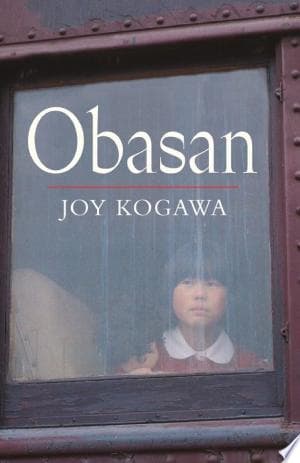
Joy Kogawa (2016)
Genre
Historical Fiction
Reading Time
9-10 hours
Key Themes
See below
Sign in to track this book
Through a young girl's eyes, Obasan directly shows the quiet pain and strength of Japanese Canadians moved and confined during World War II, a story long kept hidden.
The novel starts with Naomi Nakane, a quiet, unmarried schoolteacher, receiving a package from her Aunt Emily. The package holds Emily's diaries and journals, which contain fragmented memories and historical papers about the Japanese Canadian experience during World War II. Naomi, who has suppressed much of her past, does not want to look at these painful memories. Her Aunt Obasan, a silent woman living in Granton, also sends her a box of old photos. These items make Naomi face her family's unspoken history, especially her mother's disappearance and the injustices Japanese Canadians suffered during the war, which Obasan has always met with silence.
Naomi begins to remember her early childhood in Vancouver, a time filled with warmth and the comforting presence of her parents, her older brother Stephen, and her extended family. She recalls happy days by the sea, the smells of her mother's kitchen, and their beautiful garden. However, these good memories soon become mixed with the growing fear and suspicion directed at Japanese Canadians after the attack on Pearl Harbor. The family's sense of safety is broken as racist feelings grow, leading to more hostile treatment from their white neighbors and the government. Naomi, though young, senses the change in atmosphere and her parents' worries, marking the end of her innocent childhood.
Following Canadian government orders, all Japanese Canadians are called 'enemy aliens' and forced to register. Their fishing boats are taken, businesses closed, and properties seized. Naomi's family, like thousands of others, has little time to pack one suitcase per person. They are put on trains, leaving their homes, belongings, and the life they knew in Vancouver. Naomi clearly remembers the confusion, fear, and deep sense of loss during this time. The forced move is a brutal turning point, breaking up the community and moving them from their established lives, with no clear destination or future.
Naomi, Stephen, her father, and Obasan are sent to Tashme, one of the remote camps in the British Columbia interior. Living conditions are basic and crowded, with families squeezed into small shacks without basic amenities. Food is scarce, and the climate is harsh. Naomi describes the constant dust, the cold, and the general feeling of hopelessness. Despite the difficulties, the community tries to keep some sense of normal life, with children attending makeshift schools. Naomi's father, a gentle man, tries to provide comfort and stability, but his health gets worse under the stress and physical labor. The camp becomes a symbol of their lost freedom and dignity.
During their time in Tashme, Naomi's mother is still absent, having gone to Japan to care for her sick mother before the war. Naomi hopes her mother will return, but as time passes, the silence from Japan becomes more troubling. At the same time, Naomi's father becomes very ill with tuberculosis, a common sickness in the camps due to poor conditions. He is eventually sent to a hospital, further separating the family. Naomi remembers her father's quiet strength and his attempts to protect them from the worst of their reality, even as he himself gives in to the harshness of their situation. His eventual death leaves a deep emptiness.
As the war ends, the Canadian government gives Japanese Canadians a 'choice': either move east of the Rocky Mountains to work as laborers, or be sent back to war-torn Japan. Naomi, Stephen, and Obasan choose to stay in Canada and are moved to a sugar beet farm near Granton, Alberta. The move is another painful displacement, forcing them into hard manual labor under unfair conditions. Naomi describes the difficult work in the beet fields, the isolation, and the continued racism they face from the local community. This period strengthens her feeling of being an outsider, constantly reminded that she is not wanted.
Aunt Emily, a passionate Nisei, dedicates her life to working for justice and payment for Japanese Canadians. Her letters and diaries, which Naomi reads, are full of historical facts, political arguments, and calls for action. She believes words and public protest can fix historical wrongs. In contrast, Obasan believes in quiet endurance, thinking that suffering should be handled with dignity and that too much talk can be dangerous. Obasan's 'wordlessness' is a form of resistance itself, a refusal to speak her pain, but also a way to protect herself that has shaped Naomi's own quiet nature.
Through Aunt Emily's persistent questions and a letter from her Uncle Isamu in Japan, Naomi finally learns the terrible truth about her mother. Her mother, who was in Japan to care for her own mother, was caught in the atomic bombing of Nagasaki. She survived the first blast but suffered from severe radiation sickness, dying a slow and painful death. The letter describes her mother's disfigurement and the terrible suffering she endured. This news is a deep shock for Naomi, explaining the long silence and the family's deep grief. It adds another layer of tragedy to the family's already immense suffering.
The painful truths about her mother's death and all the injustices her family faced force Naomi to confront her own suppressed memories and feelings. The 'wordlessness' that has marked her life, a legacy from her Obasan and the trauma itself, begins to break. By reading Aunt Emily's papers and listening to the unspoken stories, Naomi starts to bring her past into her present. She realizes that silence, while once a form of protection, also stopped healing. This process is not easy, but it starts her journey toward peace with her personal and shared history.
Naomi thinks about the different ways her family handled trauma: Aunt Emily's open activism and Obasan's deep silence. She comes to understand that both are valid, though different, reactions to terrible suffering. Emily's voice seeks justice and historical truth, while Obasan's silence holds the weight of unspeakable pain and a quiet strength. Naomi, having parts of both, begins to find her own voice, not necessarily through public protest, but through remembering and telling stories. The novel ends with Naomi acknowledging the lasting impact of her past and finding a way forward, one that includes both spoken and unspoken truths.
The Protagonist
Naomi begins as a character defined by her silence and suppressed memories but gradually, through confronting her family's history, begins to find her own voice and a path toward healing.
The Supporting
Obasan remains largely unchanged in her quiet demeanor, serving as a constant, silent presence that grounds Naomi's journey of remembrance.
The Supporting
Aunt Emily's conviction and activism remain steadfast, serving as the driving force behind the narrative's exploration of historical truth.
The Supporting
Stephen's arc remains somewhat ambiguous, as he largely avoids direct confrontation with the past, choosing to sublimate his pain through his art.
The Mentioned/Central Mystery
Her story is revealed retrospectively, providing the ultimate, tragic resolution to Naomi's search for truth.
The Supporting
His arc is tragic, as he gradually succumbs to the harsh conditions and injustice of the internment, symbolizing the community's suffering.
The Supporting
He serves as the reluctant bearer of the final, most painful truth, enabling Naomi's eventual understanding and healing.
The Supporting
His character provides a brief, positive interlude in Naomi's otherwise traumatic experience, symbolizing an unexpected source of human connection.
The novel looks at how people and groups deal with terrible trauma, especially through silence and voice. Obasan represents a generation's 'wordlessness,' a way to cope that comes from deep suffering and cultural values that favor quiet endurance. Naomi at first takes on this silence, pushing down her memories. In contrast, Aunt Emily supports the power of words, historical records, and protest to face injustice and demand recognition. The story suggests that while silence can protect, it can also stop healing, and that real peace requires finding a voice to speak the pain, even if that voice is quiet and internal. For example, Obasan's refusal to speak of the past contrasts with Emily's detailed journals.
“''The past is a flood. The past is a river. The past is a wound. The past is a memory that will not be erased. The past is a story that has to be told.''”
The forced movement and confinement of Japanese Canadians during WWII takes away Naomi's and her community's innocence and stable identity. Naomi's happy childhood in Vancouver is suddenly broken by the government's racist policies. Taking property, moving to camps, and forced labor on sugar beet farms systematically break down their sense of belonging and self-worth. They are called 'enemy aliens' even though they are Canadian citizens, leading to a deep identity crisis. Naomi's journey is about dealing with this broken identity, trying to figure out who she is after such dehumanization. Losing her mother further breaks her sense of self and family.
“''We are Canadian citizens. We are Japanese Canadians. We are Canadian Japanese. We are nothing.''”
The novel is deeply concerned with memory—personal, shared, and historical—and its link to truth. Naomi's story is a mix of fragmented memories, dreams, and historical documents, showing how hard it is to recall and make peace with a traumatic past. Aunt Emily's careful collection of historical facts and official documents is an attempt to record an objective history, while Obasan's silence represents a different kind of historical truth, one felt rather than spoken. The novel argues that both individual memory and official history are needed to understand the past and achieve justice, and that the 'untold story' of the Japanese Canadian confinement must be revealed. The book's climax is the discovery of her mother's fate, a memory suppressed for decades.
“''There are so many stories that have been kept in the heart, in the bones, in the earth.''”
At its core, *Obasan* is a strong criticism of the systemic racism and injustice Japanese Canadians faced during World War II. The novel carefully details the growing prejudice, discriminatory laws, forced evacuation, property seizure, confinement, and later dispersal that took away an entire community's rights and dignity. It shows the hypocrisy of a nation that claimed to uphold freedom while persecuting its own citizens based only on their ethnicity. The experiences of Naomi and her family in the camps and on the beet farms clearly show the terrible human cost of such state-approved discrimination. This theme is clear from the first taking of fishing boats to the forced relocation to sugar beet farms.
“''It is not a story of the past. It is a story of the present. It is a story of what happens when you let fear and prejudice take over.''”
Writing and storytelling are presented as important ways to heal and claim identity. Naomi, at first unwilling to face her past, slowly finds comfort and understanding by putting together fragmented stories from her own memories, Aunt Emily's journals, and Obasan's unspoken history. The novel itself, as historical fiction, is an act of storytelling that brings to light a hidden chapter of Canadian history. It shows how literature can bear witness to injustice, give a voice to the voiceless, and add to shared memory, building empathy and stopping similar terrible events from being forgotten or repeated. Naomi's journey ends with her own internal story coming to terms with the past.
“''The stories are there. They are in the air. They are in the earth. They are in the blood.''”
The story is told through non-linear, fragmented memories, dreams, and historical documents.
The novel's narrative structure mirrors the fractured nature of trauma and memory. Naomi's story is not told chronologically but through a collage of present-day reflections, childhood memories, dreams, letters, and excerpts from Aunt Emily's journals. This fragmentation reflects Naomi's suppressed past and the difficulty of confronting painful truths. It also allows the reader to experience the disorienting and incomplete nature of historical understanding when official records are sparse or biased, and personal memories are deeply buried. This device forces the reader to actively participate in piecing together the story, much like Naomi herself.
The contrasting representations of 'wordlessness' and articulate expression.
Silence and voice are central symbolic devices. Obasan's 'wordlessness' symbolizes the quiet endurance of suffering, a generation's trauma that is too profound for words, and a protective mechanism against further pain. Naomi initially embodies this silence. In contrast, Aunt Emily's prolific writing and activism symbolize the power of articulation, historical truth, and the fight for justice. The tension between these two forms of expression drives Naomi's journey, as she learns to navigate the space between them and ultimately find her own voice, one that respects both the spoken and unspoken truths of her history.
A recurring image representing suppressed pain, endurance, and the weight of the past.
The image of the stone appears throughout the novel, often associated with Obasan and Naomi's suppressed grief. It symbolizes the weight of unspoken suffering, the unyielding nature of the past, and the silent endurance of the Japanese Canadian community. The stone is heavy, unmoving, and carries a deep, cold memory, much like the trauma Naomi carries within her. It also suggests a resilience, a capacity to withstand immense pressure. For Naomi, the 'stone' of her past eventually begins to crack, allowing for the release of buried emotions and memories, leading to a form of healing.
Documents that serve as catalysts for memory and sources of historical information.
Aunt Emily's letters and journals are crucial plot devices. They act as direct historical records, providing factual accounts, political context, and emotional appeals that contrast with Naomi's fragmented personal memories. These documents are the primary catalyst for Naomi's journey into her past, forcing her to confront the official history and the collective experience of Japanese Canadians. They provide the 'voice' that counters the 'silence' and allow the narrative to shift between personal recollection and broader historical context, eventually leading to the revelation of her mother's fate.
“The past is like a stone in a shoe. It's always there, causing a little pain with every step.”
— Naomi reflects on the persistent impact of past injustices.
“We are the silences. We are the ones who do not speak. We are the ones who do not complain.”
— Naomi describes the Japanese Canadian community's tendency towards quiet endurance.
“A word is a stone. It can be thrown, it can be built with, it can be a stepping stone or a stumbling block.”
— Naomi ponders the power and duality of language.
“There are some memories that are like a stone in the heart. Heavy and unmoving.”
— Naomi contemplates the burden of particularly painful memories.
“It is not a story to be told, but a story to be remembered.”
— A reflection on the nature of traumatic historical events.
“The system was not designed for justice. It was designed for control.”
— Reflecting on the government's actions during the internment.
“We are all the children of our memories.”
— Naomi acknowledges how deeply individuals are shaped by their past.
“The silence of the Japanese Canadians was not a sign of weakness, but a sign of strength.”
— Explaining the community's stoicism in the face of adversity.
“To be silent is to be complicit. To speak is to risk.”
— Highlighting the dilemma faced by those who witnessed injustice.
“The past is a foreign country; they do things differently there.”
— A general observation on the disconnect between past and present perspectives.
“Memory is a political act.”
— Understanding how the act of remembering and telling stories shapes public understanding and justice.
“The world is a harsh place, but it is also a beautiful one.”
— A broader philosophical reflection on life's dualities.
“Sometimes the greatest strength is in enduring, not in fighting.”
— Reflecting on the quiet resilience of the Japanese Canadian community during difficult times.
“The stories we tell ourselves determine the future we build.”
— Emphasizing the importance of narrative in shaping collective destiny.
Ready to see how well you understood this book? Take our interactive quiz with 10 questions.







