“I am a stick.”
— Pattern trying to explain his nature to Shallan.

Brandon Sanderson (2017)
Genre
Fantasy
Reading Time
20-25 hours
Key Themes
See below
Sign in to track this book
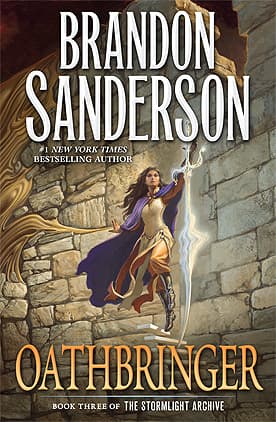
As an apocalyptic storm awakens enslaved parshmen to their justified rage, Dalinar Kholin must unite a fractured world against a vengeful foe by confronting his own bloody past, even as ancient secrets and rediscovered powers emerge from the depths of Urithiru.
Following the Battle of Narak, where Szeth-son-son-Vallano assassinated Gavilar Kholin and the Everstorm was summoned by the Parshendi, Roshar is plunged into a new era of conflict. The Everstorm, a sentient highstorm, sweeps across the continent, transforming the previously docile parshmen into Voidbringers, specifically the Fused, ancient Parshendi spirits inhabiting parshmen bodies. Dalinar Kholin, now united with the remnants of his army and the newly formed Knights Radiant, retreats to Urithiru, the legendary tower city of the Radiants, which has been discovered and partially restored. This move begins humanity's desperate struggle for survival against the awakened Fused and their new god, Odium.
Upon arriving in Urithiru, Dalinar begins to experience powerful visions, guided by the Stormfather, which show him events from Roshar's ancient past, specifically the history of the Knights Radiant, the Heralds, and the true nature of the Desolations. These visions reveal that the Parshendi, or Listeners, were not the original Voidbringers but were manipulated, and that humanity itself had a hand in the cyclical nature of the conflicts. As he grapples with these revelations, Dalinar also struggles to unite the disparate nations of Roshar, who are reluctant to trust him due to Alethkar's history of conquest and his own violent past as the Blackthorn. He uses his growing Bondsmith abilities to connect with others and establish a coalition.
Kaladin Stormblessed, accompanied by Bridge Four and Syl, undertakes a dangerous journey to his hometown of Hearthstone, which lies in Alethkar, now overrun by the Fused and their newly awakened parshmen armies. His goal is to rescue his family, particularly his parents, who are trapped there. During this mission, Kaladin sees firsthand the transformation of the parshmen into Fused and discovers that many of the newly awakened parshmen, now called Singers, bear deep-seated resentment and anger towards humans for their millennia of enslavement. This forces Kaladin to confront the moral complexities of the conflict and question whether humanity is entirely in the right, deepening his understanding of justice and empathy.
Shallan Davar, along with her Lightweavers, explores the vast and mysterious tower city of Urithiru. Her investigations lead her to discover ancient libraries, hidden passages, and disturbing evidence of a forgotten past. While uncovering the city's secrets, Shallan battles her own deteriorating mental state, struggling with multiple personas—Veil, Radiant, and her true self—each representing different aspects of her trauma and responsibilities. She uses her Lightweaving to infiltrate enemy strongholds and gather intelligence, but the constant strain of maintaining her disguises and confronting her past threatens to shatter her identity completely, making her quest for truth both external and internal.
Adolin Kholin, having confessed to the murder of Torol Sadeas, faces a formal trial in Urithiru, where his actions are debated by the various monarchs and leaders. Despite his guilt, the trial shows the moral ambiguities of justice in wartime and the deep-seated corruption within Alethi society. At the same time, the Fused launch a large assault on Thaylen City, a port controlled by Queen Fen, which is a supply hub for humanity. Dalinar, with the nascent coalition, must defend Thaylenah against the overwhelming forces of the Fused, led by Amaram, who has embraced Odium and become a powerful enemy.
Through his visions and the efforts of the Nightwatcher, Dalinar is forced to relive and confront the most horrifying moments of his past as the Blackthorn. He remembers the burning of Rathalas and the massacre at the Rift, where he ordered the slaughter of innocent people, including the family of his wife, Eila, in a fit of grief-fueled rage after her death. These memories, previously suppressed, resurface with brutal clarity, revealing the full extent of his cruelty and the true cause of Eila's death—an accident he blamed on the people of Rathalas. This painful confrontation is essential for his growth and his ability to unite Roshar.
The Battle of Thaylen City is a critical turning point. As the Fused overwhelm the defenses, Dalinar is directly confronted by Odium, who attempts to break him by forcing him to accept responsibility for his past actions and surrender to his will. In a moment of defiance and self-acceptance, Dalinar declares, "I will take responsibility for what I have done. If I must fall, I will rise each time a better man." This act, combined with his ability to unite the Cognitive, Spiritual, and Physical Realms, allows him to speak the Third Oath of the Bondsmiths: "I will unite instead of divide. I will bring men together. I will take responsibility for what I have done." He then unleashes a surge of pure Investiture, pushing back the Fused and preventing Odium's complete victory.
Throughout the events in Urithiru and Thaylen City, Szeth-son-son-Vallano, now bonded to a Highspren and becoming a Skybreaker, struggles with his past as the Assassin in White and his guilt over his actions. Nale, the Herald of Justice, trains him and attempts to guide him, though Nale's interpretation of justice is often skewed. Szeth eventually confronts his past, accepts responsibility for the lives he took, and truly dedicates himself to the ideals of the Skybreakers. He vows to seek true justice, even if it means opposing Nale, signifying a personal redemption and a deeper understanding of his new role.
During the battle in Thaylen City, Amaram, empowered by Odium, fights fiercely against the Knights Radiant. Kaladin Stormblessed, still grappling with his own internal conflicts, faces Amaram in a brutal duel. Kaladin, with the help of Teft and other Radiants, ultimately defeats Amaram, ending his service to Odium. While a significant victory for humanity, the battle concludes with the Fused still a powerful and organized force, retreating but not defeated. The war is far from over, and the ending sets the stage for future conflicts, with Odium still present and the Singers now fully mobilized.
After the Battle of Thaylen City, humanity has achieved a vital, if costly, victory. Dalinar, now fully accepting his past and having spoken the Third Oath, has become a powerful figure capable of uniting the realms. The coalition of nations, though fragile, has been established. The Fused, however, have not been vanquished, and the Everstorm continues to rage, ensuring the continued transformation of parshmen into Voidbringers. The book concludes with cautious optimism, but also a stark realization that the war against Odium is only just beginning, and Dalinar's role as a Bondsmith and unifier will be important in the battles to come.
The Protagonist
From a tormented warlord suppressing his past, Dalinar transforms into a self-aware leader who accepts his mistakes and uses his Bondsmith powers to unite humanity.
The Protagonist
Kaladin moves from a purely human-centric view of protection to a more nuanced understanding of justice, encompassing the suffering of the Singers, while still battling his internal demons.
The Protagonist
Shallan grapples with her fractured identity, attempting to reconcile her past traumas and integrate her personas into a cohesive self, while also becoming a more effective Radiant.
The Supporting
Adolin faces the legal and moral consequences of his actions, demonstrating his commitment to justice and his unwavering support for his loved ones.
The Supporting
Jasnah fully embraces her role as an Elsecaller and a leader, using her intellect and power to guide humanity through the new Desolation.
The Supporting
Szeth moves from being a guilt-ridden assassin seeking death to a Skybreaker dedicated to a purer form of justice, independent of Nale's influence.
The Supporting
Navani continues to grow as a scholar and inventor, becoming indispensable to the Radiants' efforts through her technological expertise and unwavering support for Dalinar.
The Antagonist
Odium solidifies his control over the Fused and attempts to claim Dalinar, but is ultimately defied, setting up a larger confrontation.
The Mentioned
Gavilar's past actions and hidden motives are gradually revealed, showing his significant, posthumous influence on the current conflict.
The Mentioned
Sadeas's death serves as a catalyst for Adolin's trial and highlights the moral complexities of justice in Alethi society.
The Antagonist
Amaram fully descends into villainy, becoming a powerful general for the Fused, and is ultimately defeated by Kaladin.
The Supporting
Raboniel emerges as a strategic and innovative Fused leader, demonstrating a unique approach to the war that challenges the established cycle of Desolations.
This theme is explored through Shallan's struggle with her multiple personas (Shallan, Veil, Radiant) and her traumatic past. She uses these identities as coping mechanisms to avoid confronting painful memories and responsibilities. Her journey is about integrating these fragmented parts of herself and accepting all of who she is, flaws and all. Similarly, Dalinar's arc of remembering and taking responsibility for his past as the Blackthorn is an exploration of self-acceptance, demonstrating that true strength comes from confronting and owning one's history, rather than suppressing it.
“I will take responsibility for what I have done. If I must fall, I will rise each time a better man.”
Oathbringer explores the complexities of justice, particularly in the context of a millennia-long war. Kaladin's journey to Hearthstone forces him to confront the moral ambiguity of humanity's enslavement of the parshmen, realizing their anger and desire for vengeance are justified. Adolin's trial for Sadeas's murder raises questions about personal versus systemic justice. The actions of the Heralds, particularly Nale, and Szeth's quest for true justice further complicate the idea of right and wrong, showing that even those dedicated to law can be misguided, and that true justice often requires empathy and understanding of all perspectives.
“Sometimes, a man must be willing to lose his life to save his soul.”
The central driving force of the narrative is Dalinar's mission to unite the warring nations of Roshar against the common threat of the Fused and Odium. The book shows the divisions caused by ancient grudges, political rivalries, and cultural differences, particularly between the Alethi and other kingdoms. Dalinar, as a Bondsmith, embodies this theme, literally bringing the three realms together and striving to bridge the gaps between people. The struggle for unity is not just external, but also internal, as characters like Shallan must unite their fragmented selves.
“I will unite instead of divide. I will bring men together. I will take responsibility for what I have done.”
Trauma and the way characters cope with or suppress painful memories are central to Oathbringer. Dalinar's journey focuses on the forced remembrance of his actions at the Rift, which he had suppressed for years, leading to emotional pain but ultimately to healing. Shallan's multiple personalities are a direct result of her childhood traumas, serving as protective layers against unbearable memories. The entire premise of the Desolations and the Heralds' suffering also speaks to the long-term, cyclical trauma inflicted upon Roshar, showing how past wounds continue to shape the present.
“The most important step a man can take? It's not the first one, is it? It's the next one. Always the next step.”
The book explores the influence of divine beings—the Shards Honor and Odium, and the Stormfather—on Roshar. Dalinar's faith in the Stormfather and his visions guides his actions, but also forces him to confront the fallibility of even divine guidance. Odium's direct manipulation of the Fused and his attempts to corrupt Dalinar show the dangerous power of malevolent deities. The theme questions blind faith, emphasizing the importance of personal moral choice even when faced with divine commands, and reveals the complex and often destructive history of the gods on Roshar.
“I am not worthy, but it is my turn. I will not fail.”
A magical means of revealing Roshar's ancient history and Dalinar's past.
Dalinar's visions, granted by the Stormfather, serve as a primary plot device for revealing the deep history of Roshar, the true nature of the Desolations, and the origins of the Knights Radiant. These visions are not just historical flashbacks; they are also a psychological tool, forcing Dalinar to confront his own suppressed memories and the atrocities he committed as the Blackthorn. They provide exposition in an immersive way, allowing the reader to experience the past alongside Dalinar, and are crucial for his character development and his understanding of the war he must now lead.
A psychological coping mechanism that provides narrative flexibility and character depth.
Shallan's fractured identity, manifested as distinct personas like Veil and Radiant, is a significant plot device. It allows her to navigate different social situations, undertake dangerous espionage missions, and cope with her severe trauma. Narratively, it provides diverse perspectives on events and allows for internal conflict and growth. Each persona has unique skills and attitudes, enabling Shallan to perform tasks that her 'true' self might be incapable of, while simultaneously highlighting the psychological toll of her past and her struggle for wholeness. This device pushes her character arc and creates intricate social interactions.
A sentient, reverse highstorm that awakens the parshmen and serves as a constant threat.
The Everstorm is a revolutionary meteorological phenomenon and a potent plot device introduced at the end of Words of Radiance and central to Oathbringer. Unlike the benevolent Highstorms, the Everstorm is sentient and travels in the opposite direction. Its primary function is to transform the docile parshmen into Fused and other forms of Singers, thereby revitalizing the Voidbringer army. It acts as a constant, omnipresent threat, reshaping the political and military landscape of Roshar and forcing humanity into a desperate struggle for survival against a rapidly growing enemy. It symbolizes the true return of the Desolations.
The ancient, mysterious tower city of the Knights Radiant, serving as a base and source of secrets.
Urithiru is the legendary and massive tower city of the Knights Radiant, rediscovered and now serving as humanity's primary stronghold and capital against the Fused. As a plot device, it provides a central setting for much of the political maneuvering, strategic planning, and character development. Its ancient, partially powered systems and hidden chambers offer numerous secrets for Shallan to uncover, providing exposition on the Radiants' history and technology. The city itself is a symbol of hope and a mystery to be solved, simultaneously offering refuge and posing new challenges for its inhabitants.
A supernatural urge for violence, revealing Odium's insidious influence.
The Thrill, or Dalinar's 'blackouts,' is a subtle but pervasive plot device. It's a supernatural urge for violence and battlelust that affects many Alethi, particularly Dalinar in his youth. In Oathbringer, it is explicitly revealed to be a direct manifestation of Odium's influence, allowing the Shard to subtly corrupt and control individuals by amplifying their baser instincts. This device explains much of the Alethi's warlike culture and Dalinar's past brutality, and its presence highlights the insidious nature of Odium's power, showing how he can manipulate without direct confrontation, shaping entire societies to his will.
“I am a stick.”
— Pattern trying to explain his nature to Shallan.
“The most important step a man can take. It's not the first one, is it? It's the next one. Always the next step, Dalinar.”
— Wit's advice to Dalinar Kholin during a difficult time.
“A man’s heart is a wretched, wretched thing, Dalinar. It is not so much a thing to be trusted, but a thing to be guarded.”
— Wit giving Dalinar advice on self-control and human nature.
“Journey before Destination.”
— The First Ideal of the Knights Radiant, often repeated.
“The past is in the past. You can't change it. You can only change the future.”
— Dalinar Kholin reflecting on his past actions and future responsibilities.
“Sometimes, a man must simply choose to be better.”
— Dalinar Kholin's internal resolve to overcome his past.
“What is the most important step? The next one.”
— Wit's repeated mantra to Dalinar, emphasizing continuity and progress.
“Sometimes the prize isn’t worth the cost. The cost is not always in coin, but in spirit, in heart, in soul.”
— Jasnah Kholin offering a pragmatic perspective on ambition.
“You cannot have my pain!”
— Dalinar Kholin's defiant declaration to Odium during the climax.
“The only way to truly fail is to stop trying.”
— A common sentiment among the Knights Radiant, emphasizing persistence.
“We are not defined by our past, but by our choices.”
— A recurring theme in the book, particularly for characters like Dalinar.
“Honor is dead, but I'll see what I can do.”
— Kaladin Stormblessed's grim determination in the face of overwhelming odds.
“A lie is an insult to truth.”
— Pattern's simple, yet profound, statement on the nature of lies.
“The purpose of a storyteller is not to tell you how to think, but to give you questions to think upon.”
— Wit reflecting on the role of stories and parables.
“Sometimes a man needs to be told that he's not alone, that his pain is real, and that he's not weak for feeling it.”
— Kaladin recognizing the importance of empathy and support for others.
Ready to see how well you understood this book? Take our interactive quiz with 10 questions.

Brandon Sanderson is a prolific American author of epic fantasy and science fiction. He is best known for his expansive Cosmere universe, featuring series like Mistborn and The Stormlight Archive, as well as his completion of Robert Jordan's Wheel of Time series. Sanderson's intricate magic systems and compelling world-building have earned him a dedicated global fanbase and critical acclaim.







