“Ah, my dear little Clara, what a wonderful Christmas Eve this is!”
— Clara's initial joy on Christmas Eve, before the mysterious events unfold.

Genre
Fantasy / Children's
Reading Time
90 min
Key Themes
See below
Sign in to track this book
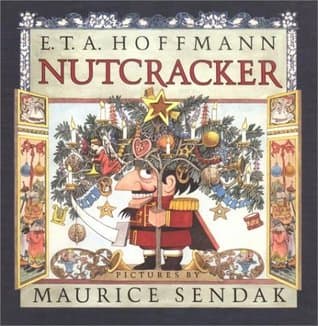
A young girl's Christmas Eve comes alive with a magical nutcracker, leading her into a fantastical war between toys and mice, all brought to vivid life through Maurice Sendak's enchanting illustrations.
On Christmas Eve, the Stahlbaum children, seven-year-old Marie and her older brother Fritz, eagerly await their presents. Their godfather, Drosselmeier, a skilled clockmaker and inventor, arrives with an elaborate toy castle and tiny, dancing figures. However, the castle proves too delicate for the children to play with. Later, among their other gifts, Marie discovers a small, ugly nutcracker doll. Fritz, with his usual energy, quickly breaks several of its teeth trying to crack hard nuts. Marie, feeling sympathy for the injured toy, carefully tends to it, wrapping it in a ribbon and placing it in her doll's bed, promising to protect it.
After everyone else has gone to bed, Marie, disturbed by a scratching noise, returns to the drawing-room to check on her Nutcracker. As the grandfather clock strikes midnight, the room transforms. The toys in the display cabinet come to life, and an army of mice, led by the seven-headed Mouse King, emerges from under the floorboards. The Nutcracker, now animated and leading the toy soldiers, battles the mice. Marie, initially terrified, is injured by a piece of flying glass and faints after throwing her slipper at the Mouse King, turning the tide of the battle.
Marie wakes up in her bed, her arm bandaged. Her parents dismiss her story of the battle as a dream, but Godfather Drosselmeier believes her. To explain the Nutcracker's situation and the Mouse King's anger, Drosselmeier begins to tell Marie the 'Tale of the Hard Nut'. This story describes how Princess Pirlipat, once beautiful, was cursed by the Mouse Queen, Frau Mauserinks, and turned ugly because of the Queen's anger over her family being trapped and killed by the King's traps. The only cure for Pirlipat's ugliness is the magical Krakatuk nut, which a young man who has never shaved must crack.
Drosselmeier continues the tale of Princess Pirlipat. Many young men tried to crack the Krakatuk nut to restore Pirlipat's beauty, but all failed. Finally, Drosselmeier's nephew, a handsome young man, successfully cracks the nut. However, at the moment of triumph, the Mouse Queen, Frau Mauserinks, appears and causes the nephew to trip, causing him to step on the Queen and kill her, but he is also cursed and turned into an ugly Nutcracker. This transformation leaves him unable to speak or move freely, only able to crack nuts. The tale ends with the Nutcracker's exile, awaiting a pure-hearted girl to love him and break the spell.
The Mouse King begins to terrorize Marie, appearing in her dreams and demanding sweets and gingerbread figures. He threatens to harm the Nutcracker if Marie doesn't comply. Marie, out of love and fear for her toy, secretly gives him her candies and even some of Fritz's toy soldiers. She feels a growing frustration with the Mouse King's demands and the secrecy she must maintain from her family. The Nutcracker, through subtle movements and gestures, communicates his distress and inability to defeat the Mouse King without a special weapon.
One night, the Nutcracker finally speaks to Marie, explaining that he needs a sword to defeat the Mouse King once and for all. Marie, understanding the situation, decides to make a sacrifice. She goes to Fritz's room and, after much thought, takes one of his Hussar toy soldiers' swords. She brings it to the Nutcracker, who accepts it with gratitude. This act of selflessness and courage from Marie shows her devotion and belief in the Nutcracker, solidifying her role in breaking his curse.
With the new sword, the Nutcracker confronts the Mouse King once more. This time, the battle is swift and decisive. The Nutcracker, now empowered, fights fiercely and manages to slay the seven-headed Mouse King. He presents the Mouse King's seven crowns to Marie as a token of his victory and gratitude. Marie is overjoyed, finally free from the Mouse King's tyranny and proud of the Nutcracker's triumph. The fear and secrecy that had filled her nights are lifted, replaced by hope and wonder.
After his victory, the Nutcracker invites Marie to visit his kingdom. He leads her through a magical landscape, first through a wardrobe that turns into a fir tree forest, where they encounter sugar plums and marzipan figures. They then travel through the Candied Meadow, the Orange Grove, and the Lake of Roses, each more wondrous than the last. Marie is captivated by the beauty and sweetness of these lands, a stark contrast to her ordinary world. The journey is a reward for her kindness and bravery, immersing her in the fantasy of the Nutcracker's world.
The Nutcracker and Marie finally arrive at Confiturembourg, the capital of the Land of Sweets. Here, Marie sees magnificent architecture made of gingerbread and marzipan. They are greeted by a procession of figures: shepherdesses made of spun sugar, children of cinnamon, and pages of almonds. The Nutcracker is hailed as a hero, and Marie is welcomed as his guest. She observes the joyous celebration and the details of this fantastical city, feeling at home in this magical realm, far removed from her family's skepticism.
In Confiturembourg, the Nutcracker finally reveals his true identity to Marie. He explains that he is, in fact, the nephew of Godfather Drosselmeier, the young man from the 'Tale of the Hard Nut' who was cursed by the Mouse Queen and turned into the Nutcracker. He thanks Marie for her love, kindness, and bravery, which broke the spell. Marie is astonished but overjoyed to realize that her beloved toy is a real, handsome young man, fulfilling the prophecy of the tale Drosselmeier told her.
Marie wakes up back in her own bed, her magical adventure seemingly a dream. She tries to tell her mother and father about her journey to the Land of Sweets and the Nutcracker's transformation, but they, again, dismiss her stories as fantasies or ramblings. Even Fritz, though interested, remains unconvinced. Marie feels disappointed that her family cannot share in her wonderful experience, but she holds onto the memories and the belief in the reality of what she witnessed, knowing it was more than just a dream.
One day, Godfather Drosselmeier arrives at the Stahlbaum house with his nephew, a handsome young man whom Marie instantly recognizes as the transformed Nutcracker. The nephew, now free from his curse, confirms all of Marie's stories, validating her experiences to her family. He expresses his gratitude and love for Marie, kneeling before her and proposing marriage. He promises her a life of joy and wonder in his kingdom, where she will be queen. Marie, overjoyed, accepts his proposal, and they depart for his magical realm.
Marie marries Drosselmeier's nephew, the Nutcracker Prince, and becomes the Queen of Confiturembourg. She lives a life filled with beauty, wonder, and happiness in the Land of Sweets. The story concludes with Marie ruling alongside her prince, cherished for her kindness, bravery, and pure heart that broke the enchantment. Her journey from a child with a broken toy to a queen in a magical land shows the power of imagination, love, and belief in the extraordinary, proving that true magic exists for those who are open to it.
The Protagonist
Marie transforms from a child who simply loves her toys into a brave and selfless individual whose belief and love break a powerful enchantment, leading her to become a queen in a magical land.
The Protagonist/Love Interest
From a cursed, inanimate object, he is restored to his true, princely form through Marie's love and bravery, regaining his kingdom and finding his queen.
The Supporting
He remains a consistent, mysterious, and benevolent force, orchestrating events to help his nephew and Marie.
The Supporting
Fritz remains largely unchanged, serving as a foil to Marie's imaginative nature.
The Antagonist
The Mouse King is introduced as a menacing threat and is ultimately defeated by the Nutcracker, enabling the resolution of the curse.
The Mentioned
Her story is a historical event that sets the stage for the main plot, her arc is completed within the flashback.
The story emphasizes how Marie's imagination and belief in magic are central to the events. While adults, like her parents, dismiss her experiences as dreams or fantasies, Marie's conviction allows her to see and interact with the magical world. Her belief in the Nutcracker's sentience and her love for him are the forces that break his curse, showing that seeing beyond the ordinary can unlock extraordinary realities. This theme is clear when she alone sees the battle of the toys and when her family disbelieves her tales of Confiturembourg.
“"Only you, dear, kind Marie, who believed in me and loved me when I was still an ugly Nutcracker, could have done it!"”
A central tension in the story is the contrast between Marie's innocent, open-hearted acceptance of magic and the rational, often dismissive attitude of the adult world. Her parents constantly try to explain away her experiences, calling them fever dreams or overactive imagination. This conflict shows how adulthood often loses the capacity for wonder and belief in the unseen. Marie's journey and ultimate triumph validate the child's perspective, suggesting that the truth of magic resides in those who are pure of heart and willing to believe, untouched by the cynicism of maturity.
“"Oh, Mother, if you had only seen how the mice ran and how the glass flew!" Marie cried. But her mother just shook her head and smiled.”
Transformation is a key element, most notably seen in the Nutcracker himself. He transforms from a handsome young man into an 'ugly' wooden doll and then back again, not by a magic spell alone, but by Marie's love and selflessness. This physical change mirrors a deeper redemption, as the Nutcracker is freed from his curse. Marie also changes, evolving from a gentle child into a brave and decisive figure who makes sacrifices for the one she loves. The story suggests that inner kindness and love can reverse outward appearances and overcome curses, leading to a state of grace and happiness.
“"You have saved me, dear Marie, and now I am free!"”
The story constantly blurs the lines between what is real and what is a dream, particularly from Marie's perspective. Her adventures with the Nutcracker often begin at night, only for her to wake up in her bed, with her family dismissing them as dreams. This ambiguity challenges the reader to question what 'reality' is and suggests that dreams can hold a deeper truth or access to another realm. The fantastical elements are so vivid that they feel more real to Marie than her waking life, culminating in the Nutcracker's physical return, which validates her 'dreams' as true experiences.
“"You are still a child, Marie, and you have dreamed all this," said her mother, stroking her hair.”
An ordinary object imbued with extraordinary power.
The Nutcracker, initially presented as a simple Christmas gift, acts as the primary magical gift. It is not just a toy but a cursed prince, a vessel for a magical being. Its true nature is hidden beneath a mundane exterior, serving as a gateway to the fantastical world. This device highlights the potential for magic within the everyday and the idea that true value is not always immediately apparent. It also serves as the catalyst for Marie's entire adventure, drawing her into the conflict between the toy world and the mice.
A story told within the main narrative to provide crucial backstory.
Drosselmeier's 'Tale of the Hard Nut' is a frame story that explains the origin of the Nutcracker's curse and the animosity of the Mouse King's family. This device not only provides essential exposition but also deepens the mythological background of the story, giving a rich history to the conflict. It allows the narrative to reveal information in an engaging way, validating Marie's experiences and connecting her present reality to a long-standing magical history, making the fantastical elements more credible within the story's logic.
Giving human characteristics or behavior to inanimate objects or animals.
Anthropomorphism is central to the magic of the Nutcracker. Toys come to life, engage in battles, and express emotions, most notably the Nutcracker himself. The mice also display human-like intelligence, organization, and malice, particularly the Mouse King. This device allows for the fantastical elements to interact directly with Marie's world, creating a vibrant and engaging magical realm. It blurs the line between play and reality, suggesting that children's toys and creatures can have an inner life and significance beyond their physical form.
A preordained fate or magical affliction that drives the plot.
The Nutcracker's transformation into a wooden doll is the result of a curse placed upon Drosselmeier's nephew by the Mouse Queen. This curse comes with a specific condition for its reversal: it requires the love and bravery of a pure-hearted girl. This prophecy drives the entire plot, providing the Nutcracker with his motivation and Marie with her destiny. It creates a sense of urgency and purpose for Marie's actions, as her kindness and sacrifices are directly linked to breaking the enchantment and restoring the prince to his true form.
“Ah, my dear little Clara, what a wonderful Christmas Eve this is!”
— Clara's initial joy on Christmas Eve, before the mysterious events unfold.
“The most beautiful things in the world, Clara, are not seen or touched, but are felt in the heart.”
— Drosselmeyer's philosophical musings to Clara, hinting at deeper realities.
“For a nutcracker to be truly great, he must be able to crack the hardest nuts.”
— Drosselmeyer explaining the purpose and challenge of the Nutcracker.
“The Mouse King, with his seven crowned heads, advanced with a hideous squeak.”
— The terrifying appearance of the Mouse King during the battle.
“Courage, dear Nutcracker! I will help you!”
— Clara's brave declaration as she intervenes in the battle.
“Suddenly, a tiny little man, no bigger than my thumb, stood before her.”
— Clara's first encounter with the transformed Nutcracker Prince.
“Welcome, dear Clara, to the Kingdom of Toys!”
— The Nutcracker Prince introducing Clara to his magical realm.
“Here, everything is made of sugar and spice, and all things nice.”
— A description of the enchanting Land of Sweets.
“The most delicious marzipan castles and gingerbread houses rose majestically.”
— Description of the architecture in the Land of Sweets.
“But the true magic, Clara, lies not in what you see, but in what you believe.”
— Another profound statement from Drosselmeyer or the Nutcracker Prince about the nature of magic.
“And so, Clara danced through the night, a princess in her own dreams.”
— Clara's joyful experience in the magical kingdom.
“For in the land of make-believe, anything is possible.”
— A general theme of the story, highlighting the power of fantasy.
“The Nutcracker, once a mere toy, became her dearest friend and companion.”
— The developing bond between Clara and the Nutcracker.
“And Clara, no longer a child, but a queen in her own right, reigned over a kingdom of joy.”
— Clara's growth and transformation through her adventures.
Ready to see how well you understood this book? Take our interactive quiz with 10 questions.

E.T.A. Hoffmann was a German Romantic author, composer, and jurist. He is celebrated for his fantastical and often macabre tales, including "The Nutcracker and the King of Mice" and "The Sandman." His work profoundly influenced later writers in the fantasy and horror genres, solidifying his legacy as a master of the uncanny.







