“The wind was a living thing, always trying to snatch your hat or whisper secrets in your ear.”
— Early in the story, describing the harsh prairie environment.

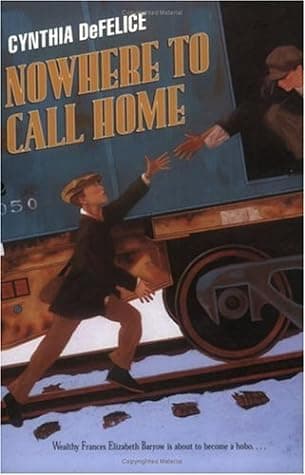
Cynthia C. DeFelice (1999)
Genre
Historical Fiction / Young Adult
Reading Time
208 min
Key Themes
See below
Sign in to track this book
During the Great Depression, a grieving girl sheds her identity to ride the rails as 'Frankie Blue,' only to discover the harsh realities of hobo life when her companion falls ill.
The story begins with thirteen-year-old Frances Ward experiencing the devastating loss of her father, Mr. Ward, who takes his own life due to the financial pressure of the Great Depression. His suicide leaves Frances and her mother, Mrs. Ward, in dire straits. Mrs. Ward arranges for Frances to live with her Aunt Louise in Chicago, hoping for a better life for her daughter. However, Frances, feeling grief, anger, and a desperate need for independence, makes a life-altering decision. Instead of using her train ticket to Chicago, she cashes it in for money. She then cuts her hair, trades her dress for a boy's trousers and cap, and renames herself 'Frankie Blue,' determined to ride the rails and escape her past.
Frankie Blue's first attempts at hobo life are hard. She struggles to board a moving train, nearly injuring herself, and finds herself alone and hungry. Her romantic ideas of freedom quickly clash with the harsh realities of survival. While trying to hop a freight train in a rail yard, she meets a gruff but helpful older hobo named 'Stewpot.' Stewpot, seeing her inexperience and vulnerability, reluctantly takes her under his wing. He teaches her the basic skills for rail-riding: how to properly jump on and off a moving train, how to find food, and the unspoken rules of the hobo community.
Under Stewpot's guidance, Frankie starts to adapt to her new life. They travel together, riding boxcars and learning to navigate the dangerous world of the rails. Stewpot teaches her about 'hobo signs,' secret symbols left by other travelers to indicate safe houses, dangerous towns, or food sources. They face hunger, cold, and the constant threat of 'bulls' (railroad police) who patrol the yards. Despite the hardships, Frankie finds a sense of camaraderie with Stewpot. He becomes a mentor, sharing his knowledge and experience, and a fragile bond of trust begins to form between the young girl and the seasoned hobo.
Frankie and Stewpot continue their journey, encountering a mix of kindness and cruelty on the road. They learn to be wary of strangers and to rely on their wits. They narrowly escape capture by railroad police several times, forcing them to run and hide. They also meet other hobos, some friendly and willing to share, others suspicious or even predatory. Frankie's disguise as a boy, 'Frankie Blue,' is key to her safety, as being a young girl alone on the rails would be far more dangerous. Stewpot's protective presence is also vital, shielding her from many of the harsher realities they face.
The harsh conditions of hobo life begin to affect Stewpot. He falls gravely ill with a persistent cough and fever, his health rapidly worsening. Frankie, who has grown to depend on him, now faces the daunting task of caring for her ailing companion. They are stranded in a small town, unable to move on. Frankie realizes the stark reality of their situation: without Stewpot's strength and experience, her own survival is precarious. She has to find food, shelter, and medicine for him, a responsibility far beyond what she initially imagined.
With Stewpot's condition worsening, Frankie must make a difficult decision. She has to break their hobo code of staying hidden and seek help from the townspeople, despite the risk of exposure. She tries to beg for food and medicine, but many doors are slammed in her face, reflecting the widespread hardship and suspicion of the Depression era. Desperate, she eventually finds a kind woman who, seeing Frankie's plight and Stewpot's severe illness, offers some assistance. However, Stewpot's condition is beyond simple remedies, and Frankie realizes he needs proper medical attention, something she cannot provide alone.
Frankie makes the agonizing decision to take Stewpot to a local hospital, knowing it means revealing their identities and risking being separated. Stewpot is admitted, and Frankie is left alone once more, feeling a profound sense of loss and uncertainty. While waiting outside the hospital, she meets another young hobo, a boy named 'Chip.' Chip is closer to her age and less experienced than Stewpot. They form a tentative friendship, sharing stories and fears. Chip offers Frankie a different kind of companionship, one based on shared vulnerability rather than mentorship, and they decide to travel together for a while.
Frankie and Chip travel together for some time, facing similar challenges of hunger and evasion. Their dynamic is different from her relationship with Stewpot; Chip is less a teacher and more a fellow survivor. However, Frankie finds herself increasingly reflecting on her past, her family, and the life she left behind. The initial thrill of freedom has worn off, replaced by the constant insecurity. The romantic image of hobo life has completely faded, and she begins to question her choices. The emotional toll of her father's death and her mother's probable worry weigh heavily on her conscience.
After some time with Chip, Frankie comes to a realization. She misses her mother and acknowledges the pain she has caused by running away. The glamour of the rails is gone, replaced by a deep longing for stability and connection. She decides she must return home, even if it means facing the consequences of her actions. She tells Chip of her decision, and while he is sad to see her go, he understands. This moment shows a major shift in Frankie's character, as she moves from impulsive rebellion to a more mature understanding of responsibility and belonging.
Frankie begins her journey back home, no longer as the defiant 'Frankie Blue' but as Frances, a girl who has grown significantly through her experiences. The trip is challenging, but she uses the skills she learned on the rails to make her way. During her travels, she reflects on everything she has endured: the loss of her father, the harshness of hobo life, her bond with Stewpot, and the lessons of survival. She understands the world in a more complex way now, recognizing the widespread suffering of the Depression but also the resilience of the human spirit. She is no longer the naive girl who ran away, but a more self-aware and empathetic individual.
Frankie finally arrives back in her hometown and makes her way to her old house. The reunion with her mother, Mrs. Ward, is emotional and bittersweet. Her mother is overwhelmed with relief and joy, but also sadness and worry over Frances's absence. There are tears, apologies, and a deep sense of reconciliation. Frances, no longer hiding behind her 'Frankie Blue' persona, is able to openly share some of her experiences and the hardships she faced. While the pain of her father's death remains, their reunion signifies a new beginning, a chance for them to heal together and rebuild their lives, facing the future with a renewed sense of hope and connection.
The Protagonist
Frances transforms from a naive, grieving girl into a resourceful and empathetic young woman who learns the true cost of independence and ultimately chooses connection over isolation.
The Supporting
Stewpot serves as a catalyst for Frankie's growth, revealing the harsh realities of hobo life and the importance of human connection, even as he succumbs to illness.
The Supporting
Mrs. Ward endures profound loss and worry, ultimately finding relief and a chance to heal through her reunion with Frances.
The Supporting
Chip provides temporary companionship and a mirror for Frankie's own youth and inexperience, contributing to her realization that she needs a different path.
The Mentioned
Mr. Ward's tragic end serves as the inciting incident, driving Frances's initial flight and subsequent journey of self-discovery.
Frances first sees riding the rails as a romantic escape and a way to freedom from her grief and responsibility. She believes becoming 'Frankie Blue' will free her. However, the reality of hobo life is stark: constant hunger, cold, danger from 'bulls' and predatory individuals, and the ever-present threat of illness. Her bond with Stewpot, while comforting, also highlights the dependence and vulnerability in their nomadic existence. The freedom she sought is ultimately a different kind of confinement, one dictated by survival rather than choice, as seen when she must desperately seek help for Stewpot.
“She had thought freedom would taste like adventure, but it mostly tasted like dust and fear.”
The novel focuses on loss and grief, beginning with the devastating suicide of Frances's father. This loss causes her to run away, as she struggles to process her sorrow and anger. Her journey on the rails is, in part, an attempt to outrun her grief, but it follows her. She experiences further loss when Stewpot falls ill, forcing her to confront the impermanence of even her new connections. Ultimately, her decision to return home shows a willingness to face her grief and begin healing with her mother.
“The ache in her chest wasn't just hunger; it was the space where her father used to be.”
The Great Depression forces individuals like Frances and Stewpot to develop great resilience and resourcefulness to survive. Frankie learns quickly from Stewpot how to jump trains, find food, and evade danger. She adapts to sleeping in boxcars and under bridges, facing hunger and harsh weather with determination. Her ability to care for Stewpot when he falls ill, despite her own fear and inexperience, shows her growing inner strength. Even during widespread hardship, the characters find ways to endure, whether through individual grit or the unexpected kindness of strangers, showing the human spirit's capacity to persist.
“You learn quick out here, or you don't learn at all.”
Initially, Frances rejects her family and seeks solitude, believing it to be independence. However, her journey on the rails teaches her the importance of human connection. Her bond with Stewpot becomes vital for her survival and emotional well-being, showing the need for companionship even in the harshest environments. When Stewpot becomes ill, Frankie realizes how much she depends on him. Her eventual decision to return home is driven by a longing for her mother and a recognition that true belonging and love are more valuable than a solitary, dangerous 'freedom.'
“Being free didn't feel so good if you were all alone in it.”
Frances's physical journey transforms her from a naive girl to a mature young woman.
The entire novel functions as a coming-of-age story for Frances. Her decision to run away and adopt the persona of 'Frankie Blue' is an impulsive act of a child grappling with immense loss. Her experiences on the rails, under Stewpot's tutelage, force her to confront harsh realities, learn practical survival skills, and develop emotional resilience. She sheds her naivety about the world and her own capabilities. By the end, her choice to return home signifies a mature understanding of responsibility, love, and the true meaning of belonging, marking her transition into young adulthood.
Frances's adoption of the 'Frankie Blue' persona as a boy protects her and allows her to navigate the dangerous world of hobos.
Frances's disguise as 'Frankie Blue' is a crucial plot device. By cutting her hair and wearing boy's clothes, she gains a measure of safety and anonymity that would be impossible for a young girl traveling alone during the Depression. This hidden identity allows her access to the hobo community and protects her from the specific dangers faced by females on the road. The disguise also symbolizes her attempt to shed her past and her identity as Frances Ward, enabling her to experiment with a new, tougher persona. The eventual shedding of this disguise marks her return to her true self and her acceptance of her past.
The trains and the rails symbolize escape, movement, and the transient nature of life during the Depression.
The railroad itself serves as a powerful metaphor throughout the novel. For Frances, the trains initially represent escape from her grief and a path to freedom and adventure. However, they also come to symbolize the transient, uncertain nature of life for many during the Great Depression—constantly moving, searching for opportunity, but never truly finding a stable home. The rails are both a means of travel and a dangerous, unforgiving environment. The rhythm of the trains, the hobo codes, and the constantly shifting landscapes reflect the journey of self-discovery and the ever-changing circumstances faced by the characters.
Stewpot acts as a guide and protector, teaching Frankie the ways of the rails and shaping her survival skills.
Stewpot serves as a classic mentor figure in Frankie's journey. He provides her with essential knowledge, teaching her the practical skills needed to survive as a hobo, such as how to board trains safely, find food, and understand the unwritten rules of the road. More than just practical skills, he also offers a form of protection and companionship, filling a void left by her father. His eventual illness forces Frankie to step up and take responsibility, demonstrating her growth and the success of his mentorship, even as it forces her to consider a different path.
“The wind was a living thing, always trying to snatch your hat or whisper secrets in your ear.”
— Early in the story, describing the harsh prairie environment.
“Every day brought a new challenge, a new way to prove you were strong enough to stay.”
— Reflecting on the daily struggles of homesteading.
“A good neighbor was worth more than a wagon full of gold, especially when winter came calling.”
— Emphasizing the importance of community on the frontier.
“The stars out here were so bright, they felt like they were watching you, judging your every move.”
— A moment of awe and introspection under the vast prairie sky.
“Sometimes, the quiet was the loudest sound of all, filled with all the things you didn't say.”
— Reflecting on unspoken emotions and the vastness of the prairie.
“Hope was a stubborn weed, growing even in the rockiest soil, refusing to be pulled up.”
— A character's internal thought about maintaining optimism despite hardships.
“You learned to read the sky like a book, because your life depended on understanding its stories.”
— Describing the necessity of weather prediction for survival.
“Home wasn't just a place; it was the people you shared it with, and the memories you made.”
— A realization about the true meaning of 'home' amidst constant relocation.
“Fear was a cold hand on your heart, but courage was the fire that melted it away.”
— A character overcoming a moment of intense fear.
“Every sunrise was a fresh start, a chance to try again, to build something new.”
— A hopeful outlook on the daily grind of frontier life.
“The land took a piece of you, but it also gave something back, if you were willing to listen.”
— Reflecting on the reciprocal relationship between settlers and the land.
“Silence could be a comfort, a blanket against the world, or it could be a heavy burden.”
— Exploring the dual nature of quietude on the isolated prairie.
“Growing up out here meant learning to stand on your own two feet, no matter how much the ground shook.”
— Describing the rapid maturity required of young people on the frontier.
“The past was like a shadow, always following you, but you had to keep walking towards the light.”
— A character grappling with past hardships while striving for a better future.
Ready to see how well you understood this book? Take our interactive quiz with 10 questions.







