“I wasn't a monster. I just did monstrous things to survive.”
— Nita's internal struggle with her family's business and her own morality.

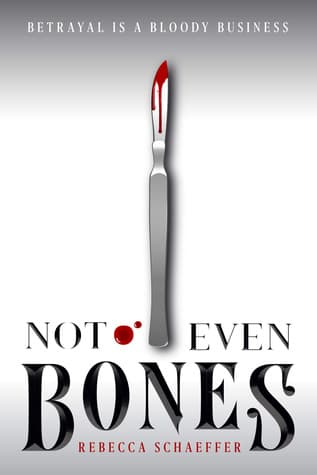
Rebecca Schaeffer (2018)
Genre
Thriller / Fantasy / Young Adult
Reading Time
360 min
Key Themes
See below
Sign in to track this book
A black market dissector of supernatural creatures becomes the merchandise herself, forced to embrace her monstrous nature to survive and escape a world where every body part has a price.
Nita is an 'unnatural' who works for her mother, dissecting the bodies of various supernatural creatures—called 'unnaturals'—that her mother gets from the black market. They move often to avoid being found by groups like the International Unnatural Police (IUP) and other black market dealers. Nita is good at her work, preparing the parts for sale online. Her only friend is her online contact, 'Fennel,' who helps sell the parts. Nita has a rule: she will dissect the dead, but she will not harm the living. This rule is tested when her mother brings home a live, sentient unnatural, a zombified man named Fabricio, wanting Nita to prepare him while he is conscious. Nita is horrified at the thought of hurting a living being.
Nita cannot bring herself to harm Fabricio, so she tries to free him. While doing so, she accidentally touches him, and Fabricio’s zombified state seems to lessen, his skin looking more human. This shows Nita's own hidden unnatural ability: she can transfer pain and heal others, though it hurts her. Her mother catches her. Angry about Nita's actions and the possible loss of a valuable 'product,' Nita's mother drugs her. Nita wakes up tied and gagged, realizing her mother betrayed her and sold her to the black market she once supplied. She is now a captive, meant to be dissected and sold for her own unique parts.
Nita is taken to a 'white market' facility in a hidden location. Unlike the black market which sells dead unnaturals, the white market sells live ones, often torturing them for valuable fluids or for entertainment. She is held in a cell with other unnaturals, including a girl named Mirella. Here, she meets Kovit, a young, calm boy who works as a torturer for the market. Kovit is an 'unnatural' himself, able to absorb and redirect pain, which makes him effective at his job. He is assigned to Nita, tasked with 'processing' her and testing her ability to transfer pain and heal. Nita quickly learns the brutal rules of her new prison and the market operators' ruthlessness.
Nita undergoes Kovit's 'interrogations,' where he hurts her, forcing her to use her ability to transfer pain and heal. She finds she can transfer pain not only to herself but also to other living beings, including Kovit. This shared experience of pain creates a strange, dependent connection between them. Kovit sees Nita's ability as a tool for his own survival and advancement in the market, while Nita sees Kovit as her only possible ally in a dangerous place. They begin to talk and subtly manipulate each other, both seeking an advantage in their desperate situations. Nita learns that Kovit is also a prisoner in his own way, forced to do his gruesome duties.
As Nita endures more torture, she gathers information about the facility, its layout, and its routines. She uses her talks with Kovit to learn details about the market's operations, security, and the types of unnaturals held there. She realizes her unique ability, though painful, could be key to her freedom, especially if she can use it as a weapon. Nita also learns about the market's owner, a mysterious and powerful person known as 'the Doctor.' Her resolve to escape grows, driven by a desire for revenge against her mother and a strong will to never be a victim again. She starts to see Kovit not just as her tormentor, but as a dangerous asset.
Nita is introduced to the Doctor, the cruel owner of the white market. The Doctor is interested in Nita's ability and performs various experiments on her, trying to understand and copy her pain transfer. Nita also learns more about Kovit's past. He was captured as a child and forced into his role as a torturer, becoming numb to suffering. He reveals that the Doctor does horrifying experiments on unnaturals, creating hybrids and taking valuable parts. Nita realizes how bad the market is and the danger she is in. She understands that just escaping is not enough; she needs to make sure she is never caught again, which means becoming more ruthless than her captors.
Nita and Kovit's complex relationship deepens as they realize they need each other to survive and escape. Nita convinces Kovit to help her, promising him a better life outside the market, or at least a chance at one. They plan to fake a severe injury to Kovit, making it seem like Nita's ability went wrong, causing him permanent harm. This is a big risk, as failure would mean severe punishment, likely death, for both. They carry out the plan, with Nita using her ability to transfer a large amount of pain into Kovit, making his injuries look very bad. The trick works, buying them time and creating a distraction in the market.
Using the confusion from Kovit's 'injury' and the Doctor's distraction, Nita begins to encourage an uprising among the other captive unnaturals. She uses her healing ability to gain their trust and rally them, promising freedom. The unnaturals, desperate and abused, agree to fight. The escape plan starts, leading to a violent fight with the market's guards. However, during the escape, Mirella, one of the unnaturals Nita had befriended, betrays them. Mirella reveals she is an IUP agent, working undercover to get into the market. Her betrayal puts Nita and Kovit in even more danger, as they are now chased by both the market's forces and the authorities.
Despite Mirella's betrayal and the difficult odds, Nita and Kovit manage to fight their way out of the white market, leaving destruction behind. They are now fugitives, with no safe place. Nita, changed by her experiences, realizes her mother's betrayal and her time in the white market have changed her deeply. She cannot return to her old life. Instead, she uses the darker parts of her abilities and her new ruthlessness. She decides to become a hunter herself, seeking out those who profit from the suffering of unnaturals, starting with her own mother. Kovit, with no other choice, stays with her, their bond strengthened by shared trauma and understanding of their new, dangerous life.
Nita and Kovit find Nita's mother, who is still involved in the black market. The confrontation is brutal and emotional. Nita, no longer the naive girl who dissected dead bodies, uses her abilities and cleverness to defeat her mother. She gets her revenge, not by killing her, but by leaving her in a position where she will suffer the results of her actions, perhaps even becoming a victim of the market she supplied. With this act, Nita fully changes. She is no longer a victim or a passive participant; she is a predator, determined to control her own future and ensure no one ever captures her again. She and Kovit, now a strong and scary pair, start a new, dangerous life as they navigate the world of unnaturals and the black market, hunting those who hunt others.
The Protagonist
Transforms from a morally guided dissector into a hardened, vengeful hunter who embraces her darker instincts for survival.
The Supporting/Anti-Hero
Develops from a seemingly emotionless torturer into Nita's co-dependent, pragmatic ally, seeking freedom from his own enslavement.
The Antagonist
Remains a static antagonist, embodying the corrupt and exploitative forces Nita fights against.
The Antagonist
Remains a static, powerful antagonist, a symbol of the institutionalized cruelty Nita must overcome.
The Supporting/Catalyst
His role is primarily as a plot device to initiate Nita's journey, with his fate remaining uncertain after Nita's capture.
The Supporting/Antagonist
Initially appears as an ally, then reveals her true identity as an undercover agent, betraying Nita's trust.
The Mentioned/Supporting
Maintains a static role as Nita's online contact, representing her former life before her betrayal.
The Mentioned/Antagonist
Serves as a background threat, reinforcing the dangerous nature of the black market.
The novel shows Nita's self-discovery, especially her identity as an 'unnatural' and her changing moral views. At first, Nita defines herself by her job as a dissector and her rule against harming the living. Her betrayal and capture force her to face her hidden abilities and the darker parts of her nature. She leaves her innocent self behind, embracing a more ruthless identity needed for survival in a brutal world. This theme is central as Nita redefines who she is, not just as an unnatural, but as a survivor and a hunter.
““She didn’t want to be good anymore. Good had gotten her here.””
The book explores the complex and often unclear lines of morality. Nita starts with a clear ethical boundary, refusing to harm the living, but this line is tested and broken. The world of unnaturals and the black/white markets works outside common ethics, forcing characters like Nita and Kovit to make difficult choices to survive. The story questions what 'good' and 'bad' mean when survival is most important, and when the 'good guys' (like the IUP) can also be deceptive and violent. It explores the cost of staying human in inhumane conditions.
““There were no good guys here, just shades of grey and blood.””
Betrayal is a main part, driving much of the plot and Nita's character growth. Nita's mother betrays her by selling her to the white market, breaking their family bond. Later, Mirella's betrayal as an undercover IUP agent further makes it hard for Nita to trust. These betrayals force Nita to rely on herself and be cautious, making it difficult for her to form real connections. On the other hand, the reluctant alliance between Nita and Kovit shows how trust can be built even in the most unlikely and dangerous situations, coming from mutual need and understanding rather than natural goodness.
““Her own mother. The thought was a bitter, poisoned pill.””
The main theme is survival, both physical and mental. Nita and Kovit are constantly fighting for their lives in a world where unnaturals are products. They must adapt to extreme situations, learning new skills and letting go of old beliefs to endure. Nita adapts by using her abilities and becoming more ruthless, while Kovit has adapted by becoming a torturer to survive. This theme shows how far people will go to protect themselves, even if it means changing who they are or doing morally questionable things.
““Survival wasn’t pretty. It was sharp teeth and bloody claws.””
The novel clearly shows how living beings are treated as objects. Both the black market (selling dead unnaturals) and especially the white market (selling live ones) treat unnaturals as products to be bought, sold, dissected, and used for their parts or fluids. Nita's first job, her mother's business, and her own experience of being sold all show this theme. It criticizes a society where sentient life can be reduced to mere resources, asking questions about value, exploitation, and putting profit over people.
““You’re a product, Nita. A very valuable one.””
The power to transfer pain and heal, acting as both a curse and a weapon.
Nita's unique ability to transfer pain and heal is the central plot device. Initially, it is a hidden power that, when revealed, leads to her capture. Once enslaved, it becomes the focus of the Doctor's experiments and Kovit's tortures. However, Nita eventually learns to control and weaponize this ability, using it to manipulate Kovit, orchestrate her escape, and later, to exact her revenge. It's a double-edged sword that defines her identity and drives much of the action, evolving from a passive function to an active, dangerous skill.
Two contrasting yet interconnected illegal systems for exploiting unnaturals.
The distinction between the black market (dead unnaturals) and the white market (live unnaturals) serves as a key plot device to escalate the stakes and highlight the varying degrees of cruelty. Nita's initial involvement in the 'lesser evil' black market establishes her background, while her forced entry into the 'greater evil' white market thrusts her into extreme danger and catalyzes her transformation. This contrast underscores the pervasive nature of exploitation and provides different settings for Nita to navigate and ultimately rebel against.
An unnatural ability that facilitates torture and creates a unique bond with Nita.
Kovit's unnatural ability to absorb and redirect pain is crucial for his role as a torturer in the white market. This device not only makes him highly effective at his job but also creates the twisted dynamic between him and Nita. Since he can absorb her pain, it allows for prolonged torture sessions and a shared, intimate experience of suffering that ultimately forges their strange alliance. His ability also makes him vulnerable to Nita's pain transfer, turning his strength into a potential weakness she can exploit.
An ambiguous authority figure that adds complexity to the moral landscape.
The IUP acts as a background threat and a force that adds moral ambiguity to the narrative. Initially presented as the 'good guys' who hunt illegal unnatural dealers, their methods and the revelation of Mirella as an undercover agent demonstrate that even the authorities are not entirely benevolent. They are another powerful faction in a world where trust is scarce, complicating Nita's escape and future. The IUP represents the larger societal structure that regulates (or fails to regulate) the existence of unnaturals.
Nita's journey from innocent dissector to ruthless survivor.
Nita's radical character transformation is a fundamental plot device that drives the entire narrative. Her initial moral code and passive role are systematically stripped away through betrayal and torture. This arc allows for a profound exploration of identity, morality, and survival. Each traumatic event pushes Nita further along this path, justifying her increasingly ruthless decisions and demonstrating the psychological toll of her environment. Her final embracing of a predatory identity signifies the completion of this intense, dark journey.
“I wasn't a monster. I just did monstrous things to survive.”
— Nita's internal struggle with her family's business and her own morality.
“The worst monsters weren’t the ones with fangs and claws. They were the ones who looked just like you.”
— Nita reflecting on the human capacity for cruelty, particularly in the black market.
“There was a line, and I’d crossed it so many times I couldn’t even see it anymore.”
— Nita's growing desensitization to the gruesome aspects of her work.
“Pain was a language everyone understood, even if they didn't want to.”
— Nita observing the reactions of others to suffering, both physical and emotional.
“You don't get to choose who you are, but you do get to choose what you do.”
— Kovit offering Nita a perspective on agency despite her circumstances.
“Freedom isn't free. Someone always pays the price.”
— Nita realizing the cost of escaping her old life and the sacrifices involved.
“The world was full of monsters, and sometimes, you had to become one to fight them.”
— Nita's justification for her actions in a dangerous world.
“Fear was a powerful motivator, but so was desperation.”
— Nita considering the driving forces behind her and others' actions.
“Sometimes the only way to save yourself was to let go of everything you thought you were.”
— Nita undergoing a transformation and shedding her past identity.
“There’s always a price. Always. Even for doing the right thing.”
— Kovit's cynical view on the nature of morality and consequences.
“You can't escape your past, but you can choose what you do with it.”
— Nita's struggle to reconcile with her history and move forward.
“The hardest part wasn't doing the deed, it was living with it afterward.”
— Nita grappling with the psychological aftermath of her actions.
“Everyone had a breaking point. The trick was finding it before they found yours.”
— Nita's strategic thinking in dangerous situations, understanding human limits.
“Monsters were made, not born. And I was learning how to make them.”
— Nita's evolving understanding of the world and her own potential for cruelty.
“In this world, the only thing more dangerous than a monster was a person who thought they weren't one.”
— Nita's observation about self-deception and the true nature of evil.
Ready to see how well you understood this book? Take our interactive quiz with 10 questions.

Biography coming soon.







