“There is no peace for me in this world. I am like a man who has been trying to climb a wall, and has fallen back, and has broken his leg. I can do no more.”
— Gould's reflection on his life's work and the futility of his efforts.

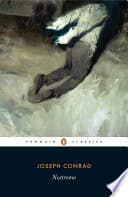
Joseph Conrad (2021)
Genre
Literary Fiction / Historical Fiction
Reading Time
12-15 hours (estimated)
Key Themes
See below
Sign in to track this book
In the South American republic of Costaguana, the longshoreman Nostromo, tasked with moving a fortune in silver during a civil war, eventually gives in to the corruption he first resisted, leading to his tragic end.
The story begins in the fictional South American country of Costaguana, in the Occidental Province of Sulaco. Charles Gould, an English-descended mine owner, has revived the San Tomé silver mine, making Sulaco a center of economic activity and European influence. His wife, Emilia Gould, is kind and observes the complex social dynamics and political currents with a sharp, often sad, eye. The mine's great wealth brings order and infrastructure, but it also makes Sulaco a desired prize in Costaguana's always unstable political situation. Dr. Monygham, a cynical doctor, and Captain Mitchell, the port's superintendent, are also important figures in this early picture of Sulaco's uneasy prosperity, which is always threatened by distant revolutionary movements.
Martin Decoud, a Parisian-educated journalist and a native Costaguanan, arrives in Sulaco. He is drawn by his love for Antonia Avellanos, the daughter of the influential historian Don Jose Avellanos. Decoud, an intellectual, quickly supports separating Sulaco from the rest of Costaguana. He imagines an independent 'Occidental Republic' that would protect its wealth and stability from the constant corruption and civil wars in the nation. Meanwhile, the central government in Costaguana's capital is overthrown, and the new dictatorial regime of Montero threatens to extend its power to Sulaco, putting the San Tomé mine and its European interests at serious risk. The various groups in Sulaco, including the Europeans, the local aristocracy, and the growing working class, start to prepare for conflict.
Nostromo, the 'Capataz de Cargadores' (Chief Stevedore) of Sulaco, is shown as a man of great physical strength, courage, and charm. The European community, especially Captain Mitchell and Charles Gould, trusts him completely. They rely on his organizing skills and his influence over the local people. His reputation for honesty and his ability to get things done make him essential. As the Monterist revolution moves towards Sulaco, panic spreads among the wealthy residents and the foreign community. The silver mine is in danger of falling into rebel hands, leading to desperate measures to protect its vast fortune from being seized or used to fund the revolution.
With Montero's forces quickly approaching Sulaco, a desperate plan is made to protect the San Tomé silver. Charles Gould, fearing the mine's wealth will be used by the revolutionaries, decides that the large amounts of refined silver must be hidden or removed. He gives this dangerous mission to Nostromo, the only man believed capable of it. Nostromo is told to transport a large shipment of silver bars by lighter (a small boat) to a point down the coast, where it is hoped it can be safely stored or later retrieved. Martin Decoud, seeing this as a key step in establishing Sulaco's independence, insists on going with Nostromo on this dangerous trip, even though he lacks practical experience.
Nostromo and Decoud start their mission at night, navigating the dangerous waters of the Golfo Placido. Their lighter is accidentally hit by General Sotillo's escaping steamer. Sotillo is a Monterist commander looking for the silver. In the confusion, Decoud manages to sink the lighter with all the silver, to keep it from Sotillo. Nostromo, a strong swimmer, believes Decoud died in the collision. He swims ashore to the deserted Great Isabel island, exhausted but alive. He is later rescued and returns to Sulaco, where he is celebrated as a hero, though the silver's fate remains a secret known only to him and the now-missing Decoud.
Unknown to Nostromo, Decoud had also survived the collision and reached the Great Isabel island. He managed to get a small part of the silver from the sunken lighter and hid it. Alone and surrounded by the vast, indifferent sea, Decoud's intellectual detachment gives way to deep despair. He realizes his grand political plans were pointless and his own life hollow without Antonia. After several days of agonizing solitude, believing himself forgotten and without hope, Decoud kills himself, weighing himself down with the recovered silver bars and sinking into the Gulf. He becomes the first victim of the silver's corrupting power.
After returning to Sulaco, Nostromo makes a dangerous overland journey to get help for the counter-revolution. He successfully brings General Barrios and his forces to Sulaco, turning the tide against the Monterists. His actions are crucial in securing Sulaco's independence and creating the Occidental Republic. However, despite his clear heroism, Nostromo feels bitter. The European elite and the new government of the Occidental Republic praise him but do not acknowledge his true sacrifice or reward him in a way he feels is fair. He remains the 'man of the people,' but is never truly accepted as an equal by those in power, increasing his sense of disappointment.
Bitter about the lack of real recognition and the perceived ingratitude of the Europeans, Nostromo decides to get his own reward. He returns to the Great Isabel island, where he knows the silver is submerged. Over the next few years, he secretly starts to retrieve the bars, becoming the only guardian and owner of the vast fortune. This secret act of taking the silver marks a deep change in Nostromo. The once honest 'Capataz de Cargadores' becomes obsessed with his hidden wealth, his character twisted by greed and suspicion. The silver, meant to secure Sulaco's future, now ties Nostromo to a life of secrecy and moral compromise.
Years pass, and Sulaco thrives as the independent Occidental Republic. A lighthouse is planned for the Great Isabel island, threatening Nostromo's secret access to the silver. The lighthouse keeper is Giorgio Viola, an old Garibaldino revolutionary, and his two daughters, Linda and Giselle. Nostromo, now a shadowy figure known as a smuggler, becomes romantically involved with both sisters. He is unofficially engaged to the older, watchful Linda, but is secretly attracted to the younger, more lively Giselle. This complicated love triangle, set around the isolated lighthouse, creates new dangers for Nostromo's hidden life and his growing paranoia, as Linda's jealousy and Giorgio's watchfulness constantly threaten his secret.
Nostromo's obsession with the silver and his divided affections eventually lead to his death. One night, while trying to secretly visit Giselle at the lighthouse, Giorgio Viola, the aging lighthouse keeper, mistakes him for a prowler or a rival, possibly one of the local bandits he always fears. Giorgio, always alert and fiercely protective of his daughters, fires his rifle. Nostromo is fatally wounded. In his last moments, he confesses his secret about the silver to Dr. Monygham, revealing the full extent of his corruption and the burden he carried. His death symbolizes the destructive power of greed and the ultimate futility of his life built on a secret fortune.
Nostromo's death, though tragic, does not end the silver's influence. Dr. Monygham, now knowing the secret, is burdened by the information. The silver, first meant as a sign of progress and stability for Sulaco, ultimately brought corruption, isolation, and death to Nostromo. The San Tomé mine continues to operate, fueling the Occidental Republic's prosperity, but the moral cost of that wealth is always present in the lives of the remaining characters. Emilia Gould, in particular, thinks about the 'material interests' that have shaped and ultimately warped the lives of those around her, including her husband, Charles, who has become increasingly absorbed by the mine, losing touch with his earlier ideals and even his wife.
The Protagonist
Nostromo transforms from a publicly adored, seemingly incorruptible hero into a secretive, isolated, and morally corrupted individual, driven by greed and a sense of unacknowledged sacrifice.
The Supporting
Charles Gould begins as an idealist seeking to bring order through industry but becomes increasingly consumed and isolated by his devotion to the mine, losing his personal warmth and connection.
The Supporting
Emilia Gould starts as a hopeful supporter of her husband's venture but becomes increasingly melancholic and disillusioned as she witnesses the corrupting influence of wealth and power on Sulaco and its people.
The Supporting
Decoud moves from a confident, intellectual idealist to a desperate, isolated figure who takes his own life, proving his theories insufficient against raw human experience.
The Supporting
Dr. Monygham remains a cynical observer but reveals a core of integrity and compassion, especially when entrusted with Nostromo's secret, becoming a keeper of moral burdens.
The Supporting
Captain Mitchell remains largely static, a figure of unwavering, if often misguided, loyalty and an unreliable narrator of events, his idealized view of Nostromo never truly shattered.
The Supporting
Giorgio Viola remains a steadfast idealist, never compromising his revolutionary principles, ultimately becoming an instrument of tragic fate for Nostromo.
The Supporting
Antonia Avellanos remains a steadfast idealist, her principles untarnished by the corruption around her, serving as a constant, if ultimately unfulfilled, beacon for Decoud.
The novel explores how seeking and owning wealth, especially the San Tomé silver, corrupts individuals and societies. Charles Gould's early idealism is slowly taken over by his dedication to the mine, making him emotionally distant. Nostromo, once honest, changes into a paranoid, secretive, and ultimately tragic figure because of his hidden silver. The wealth, meant to bring stability and progress to Sulaco, instead causes moral decay, political instability, and personal destruction. This shows that 'material interests' can overshadow and destroy human values.
“There is a curse of corruption in this country upon anything that may be called a treasure.”
Conrad contrasts the high ideals of various characters with the harsh realities of politics and human nature. Martin Decoud's intellectual vision for an independent Sulaco, though well-intentioned, collapses under isolation and despair. Don Jose Avellanos's lifelong commitment to his country's history and future faces constant political upheaval. Even Charles Gould's ideal of bringing order through industry ultimately leads to a sterile, unfulfilling life. The novel suggests that grand ideals are often fragile and easily crushed or twisted by self-serving actions and the relentless forces of political ambition.
“A man that is not a fool can have no imagination.”
The novel examines the idea of heroism, especially through Nostromo. He is a public hero, praised for his courage and deeds, but his heroism is largely superficial, based on outside approval and others' views. When his true sacrifice is ignored, he feels betrayed, leading to his moral decline. Conrad suggests that true heroism is complex and often goes unrewarded, while public reputation can be a fragile thing that hides deeper truths. Nostromo's tragedy highlights the emptiness of a life lived only for public praise and the bitterness that can come from unappreciated service, leading him to seek his own, secret reward.
“He was a man who could not be discomposed by the trifles of this world, not even by the thought of death.”
Set in a fictional South American country, the novel implicitly criticizes the effects of European involvement and 'progress' on developing nations. The San Tomé mine, owned by an English-descended family, brings European money and technology but also fuels internal conflicts and political instability. The European characters, while bringing order, often remain separate from the true cultural and political complexities of Costaguana, seeing locals as either tools or obstacles. The creation of the Occidental Republic, though seemingly a step towards self-governance, is still deeply influenced and ultimately controlled by foreign 'material interests,' showing the lasting impact and subtle forms of colonial power.
“The only form of political idea they have is to get as much as they can for themselves out of the country.”
Many characters in Nostromo feel deep isolation. Martin Decoud, alone on the Great Isabel, gives in to existential loneliness and kills himself. Nostromo, after taking the silver, lives a life of secrecy and paranoia, isolated by his hidden wealth and unable to share his true self with anyone. Charles Gould, consumed by his mine, becomes emotionally isolated from his wife. Emilia Gould, despite her compassion, often feels a deep loneliness, watching the moral decay around her without being able to truly help. This theme emphasizes the psychological cost of ambition, secrecy, and the failure of human connection in the face of overwhelming outside forces.
“There is no peace for me in this world.”
The story jumps backward and forward in time, revealing events out of chronological order.
Conrad employs a complex non-linear narrative structure, frequently shifting between past and present events, and from one character's perspective to another. This technique creates a sense of historical depth and allows the reader to gradually piece together the full story, revealing the long-term consequences of actions and the intricate web of cause and effect. It also mirrors the fragmented and often chaotic nature of memory and historical truth, enhancing the novel's thematic exploration of fate and human agency.
A narrator with comprehensive knowledge, but who often filters events through specific characters' consciousnesses.
The novel is told by an omniscient narrator who possesses knowledge of all events and characters' inner thoughts. However, this omniscience is often filtered through the perspectives of various characters (e.g., Emilia Gould's observations, Dr. Monygham's cynicism, Captain Mitchell's idealizations). This shifting focalization allows for multiple interpretations of events and characters, creating a nuanced and often ambiguous portrayal of truth. It reinforces the idea that reality is subjective and that no single character, or even the narrator, holds a complete understanding of the complex forces at play.
The San Tomé silver represents not just wealth, but also the corrupting influence of 'material interests'.
The silver from the San Tomé mine is the central symbolic object in the novel. It initially represents progress, stability, and the potential for a better future for Sulaco. However, as the narrative unfolds, it increasingly symbolizes the corrupting power of wealth, greed, and 'material interests.' It drives political conflict, isolates individuals, and ultimately destroys Nostromo. The silver is not just a commodity; it is a moral force that tests and often breaks the characters, revealing the dark side of human ambition and the destructive potential of an object valued above all else.
Geographical features that symbolize isolation, concealment, and the vast indifference of nature.
The Golfo Placido (Pacific Gulf) and the Great Isabel island serve as powerful symbolic settings. The vast, often calm, but ultimately indifferent Gulf conceals the sunken silver and acts as a stage for pivotal events, including Decoud's demise. The Great Isabel, a desolate island, becomes a place of profound isolation for Decoud and later a secret sanctuary for Nostromo's hidden wealth. These locations symbolize the isolation of characters from society, the concealment of truth, and the overwhelming, indifferent power of nature that dwarfs human endeavors and secrets, ultimately claiming lives and secrets alike.
“There is no peace for me in this world. I am like a man who has been trying to climb a wall, and has fallen back, and has broken his leg. I can do no more.”
— Gould's reflection on his life's work and the futility of his efforts.
“A man's character is his fate.”
— A general observation on human nature and destiny within the narrative.
“Action is the first word of the world.”
— A philosophical statement highlighting the importance of doing over thinking.
“The greatest joy in life is to be used for a purpose recognized by yourself as a mighty one.”
— Often attributed to Gould, reflecting on the drive behind his endeavors.
“Material interests. The only morality of the state. The only morality of men.”
— A cynical view on the driving forces behind political and personal actions.
“He was a man who had never been able to believe in anything but himself, and in his own fortune.”
— Describing Nostromo's self-reliance and his ultimate downfall.
“The great silver mine was a provider of wealth, but also a source of endless trouble and moral corruption.”
— Reflecting on the dual nature of the San Tomé mine's influence.
“There is no virtue in being a victim.”
— A harsh but pragmatic perspective on personal agency in difficult circumstances.
“The world is a bad place for a man to live in who has no money.”
— A stark observation on the realities of poverty and social standing.
“He had an immense contempt for the forms of government, for the forms of society, for the forms of human virtue.”
— Describing a character's deep cynicism towards societal structures.
“Nobody can be more professional than a man who is paid for it.”
— A comment on the nature of professionalism driven by financial incentive.
“The earth is a tomb, and men are its worms.”
— A bleak, existential reflection on human existence and mortality.
“It was not a question of principles, but of fact; not of right or wrong, but of success or failure.”
— Highlighting the pragmatic and often amoral focus on outcomes in political struggles.
“The only thing that stands between us and the horrors of a world in chaos is the strength of our own hands.”
— A call to self-reliance and human effort in the face of disorder.
“The true peace of God begins at any spot a thousand miles from the nearest railway station.”
— A longing for untouched nature and escape from civilization's complexities.
Ready to see how well you understood this book? Take our interactive quiz with 10 questions.
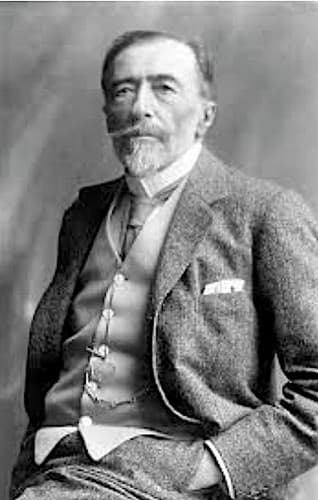
Joseph Conrad was a Polish-British novelist and short story writer. He is regarded as one of the greatest writers in the English language; though he did not speak English fluently until his twenties, he came to be regarded a master prose stylist who brought a non-English sensibility into English literature. He wrote novels and stories, many in nautical settings, that depict crises of human individuality in the midst of what he saw as an indifferent, inscrutable and amoral world.







