“No, I am sure I never shall be worth any thing, till I have been a few months in Bath.”
— Catherine Morland's initial longing for the fashionable life of Bath.

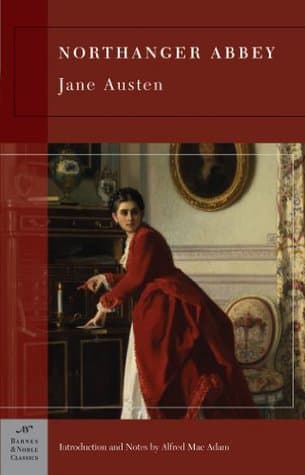
Jane Austen (2017)
Genre
Historical Fiction / Romance
Reading Time
251 min
Key Themes
See below
Sign in to track this book
A young woman's innocent infatuation with the dramatic flair of gothic novels leads her through social blunders and romantic misunderstandings, revealing the realities of polite society and genuine affection.
Catherine Morland is a plain, unremarkable girl from a large family in Fullerton. She shows little early promise, preferring boyish games to feminine accomplishments. At seventeen, she begins to show signs of beauty and an interest in novels. A wealthy neighbor, Mrs. Allen, invites Catherine to accompany her and her husband to Bath for the social season. This is Catherine's first trip into the world beyond her quiet home. The invitation excites Catherine, who expects the romance and adventure she has read about.
In Bath, Catherine quickly becomes close friends with Isabella Thorpe, a lively, fashionable young woman who also loves gothic novels. Isabella's brother, John Thorpe, a boisterous and conceited young man, begins to pursue Catherine, though she finds him tiresome. More importantly, Catherine meets Henry Tilney, a charming, witty, and intelligent clergyman, and his elegant sister, Eleanor Tilney. Catherine is immediately captivated by Henry's conversation and kind manner, finding him much more agreeable than John Thorpe. She joins the Tilney's sophisticated circle, much to John Thorpe's annoyance, as he tries to monopolize her time.
Catherine's time in Bath includes social calls, dances, and walks, often complicated by her new friends' conflicting demands. John Thorpe repeatedly tries to stop her from joining the Tilneys, often making up stories or rude remarks about Henry. Despite his efforts, Catherine's affection for Henry grows with each meeting. She enjoys his playful teasing and insightful observations, finding him a refreshing change from the superficiality she sees in others. Isabella, meanwhile, gets engaged to Catherine's brother, James Morland, and the two friends delight in their shared family connection, discussing future plans and their love for novels.
General Tilney, Henry and Eleanor's father, takes a sudden interest in Catherine, believing her to be a wealthy heiress because of John Thorpe's exaggerated claims about her family's fortune. Impressed by her perceived wealth and gentle nature, he invites Catherine to accompany Eleanor and Henry to their family estate, Northanger Abbey, for several weeks. Catherine is overjoyed, especially as it means more time with Henry and exploring a real abbey, which her gothic novel-fueled imagination has filled with romantic and mysterious expectations. She eagerly accepts, unaware of the General's true motives.
Upon arriving at Northanger Abbey, Catherine's imagination runs wild. The old architecture, secluded rooms, and historical atmosphere fuel her gothic fantasies. She immediately starts looking for hidden passages, secret documents, and evidence of past tragedies, much to Henry's amusement. He playfully teases her about her expectations, gently reminding her that reality often differs from fiction. Despite her initial disappointment that the abbey is not as terrifying as she hoped, Catherine enjoys Eleanor and Henry's company, and the beauty of the surrounding countryside. Her innocent nature, however, continues to lead her to misinterpret events.
Catherine's gothic reading leads her to a dangerous conclusion: she suspects General Tilney of having murdered his late wife, Henry and Eleanor's mother, or at least of having imprisoned her. Driven by these theories, she secretly explores the General's private rooms, looking for clues. Henry finds her and, though initially amused, becomes seriously displeased and gives her a stern lecture. He reminds her of the difference between fiction and reality, and the impropriety of her suspicions, especially about his own family. Catherine is deeply mortified by her foolishness and ashamed of her wild imagination.
While at Northanger Abbey, Catherine receives upsetting letters from her brother, James. He reveals that Isabella Thorpe has broken off their engagement. Isabella, always seeking social climbing and wealth, had become infatuated with Captain Frederick Tilney, Henry's older brother, a known flirt. She pursued him relentlessly, hoping for a better match. When Captain Tilney eventually leaves Bath without proposing, Isabella tries to rekindle her engagement with James, but he, deeply hurt and disillusioned, refuses. Catherine is shocked and saddened by her friend's betrayal and her brother's heartbreak.
General Tilney eventually learns the truth about Catherine's financial situation from John Thorpe, who, out of spite and a desire to harm Catherine's reputation, reveals that the Morlands are not wealthy. Realizing he has been misled and that Catherine is not the heiress he imagined, the General's behavior toward her drastically changes. Without explanation or regard for proper conduct, he rudely orders Catherine to leave Northanger Abbey immediately. He arranges for her to travel home alone in a common carriage, an act of extreme disrespect and cruelty that deeply humiliates Catherine and distresses Eleanor.
Catherine arrives home in Fullerton, mortified and heartbroken by the General's harsh treatment. Shortly after, to her astonishment and relief, Henry Tilney arrives at the Morland parsonage. He apologizes for his father's behavior and explains that he was unaware of the General's cruel actions until after Catherine had left. Henry then confesses his love for Catherine, stating that despite his father's disapproval of her lack of fortune, he wishes to marry her. Catherine, who has long loved Henry, joyfully accepts his proposal, marking a turning point in her emotional journey.
Initially, General Tilney opposes Henry and Catherine's marriage because of her lack of fortune. However, Eleanor Tilney's own happiness is secured when she gets engaged to a wealthy nobleman, Lord Chetwynd. With Eleanor's marriage providing the General with a satisfactory alliance, and perhaps softened by time and a growing realization of Henry's steadfast love for Catherine, he eventually relents. The novel ends with General Tilney giving his grudging consent to the union, allowing Catherine and Henry to marry and live happily, having overcome social prejudice and Catherine's youthful naivety.
The Protagonist
Catherine transforms from a naive, easily swayed girl obsessed with gothic fantasies into a discerning young woman who understands the nuances of human nature and society.
The Love Interest, Mentor
Henry remains consistently honorable and discerning, his character arc primarily involves overcoming his father's mercenary views to pursue love.
The Supporting
Eleanor's arc culminates in her finding happiness and freedom through marriage, providing a contrast to Catherine's own romantic struggles.
The Antagonist
General Tilney remains largely unchanged in his mercenary nature, but is eventually forced to concede to his son's wishes due to external circumstances.
The Antagonist/Supporting
Isabella's arc is one of decline, as her manipulative nature leads to her social downfall and loss of both engagements.
The Antagonist/Supporting
John Thorpe's character remains static in his boorishness and deceit, ultimately failing in his attempts to secure Catherine.
The Supporting
James experiences the pain of betrayal, leading to a loss of his initial naivety regarding romantic attachments.
The Supporting/Mentioned
Frederick Tilney remains a static character, serving as a catalyst for Isabella's downfall rather than undergoing personal development.
This theme is central to Catherine's journey. Her love for gothic novels leads her to project dramatic, often sinister, fantasies onto real-life situations, especially during her stay at Northanger Abbey. She imagines General Tilney to be a murderer and the abbey to hold dark secrets, a direct result of her undiscriminating reading. Henry Tilney acts as the voice of reason, gently guiding her to understand the difference between sensational literature and the more mundane, yet complex, realities of human behavior. Her eventual disillusionment with her gothic theories shows her growth into a more discerning person, learning to observe and judge actual events rather than fictional constructs. The novel itself satirizes the excesses of gothic literature while subtly warning against its potential to distort perception.
“"Charming as were all these things, and charming as were many others, they were at present nothing more than an amusement to Catherine, while she was to learn the real art of being happy herself."”
The novel examines how social class and financial standing influence marriage and social interactions in Georgian England. General Tilney's interest in Catherine is based entirely on the mistaken belief that she is a wealthy heiress, and his cruel expulsion of her is solely due to his discovery of her modest fortune. Isabella Thorpe's mercenary pursuit of Captain Tilney over James Morland further highlights how deeply ingrained the pursuit of wealth and status was in marital decisions. Austen contrasts these superficial motives with the genuine affection between Catherine and Henry, suggesting that true love and virtue should go beyond social calculations, though societal pressures ultimately force even Henry to delay his proposal until his father's consent is secured.
“"A family of ten children will always be called a poor family, whatever its income may be."”
Catherine's development throughout the novel comments on female education, particularly the role of reading. Initially, Catherine's education is haphazard, and her reading is largely confined to sensational gothic novels, which leave her ill-equipped to navigate the complexities of society. Her experiences in Bath and at Northanger Abbey, along with Henry Tilney's insightful guidance, teach her crucial lessons in discernment. She learns to judge character more accurately, to see through superficial charm (like Isabella's) and boorishness (like John Thorpe's), and to understand people's motives. Her journey emphasizes the importance of developing critical thinking and a balanced perspective, rather than relying solely on romanticized ideals.
“"She was heartily ashamed of her folly. A moment’s reflection was enough to convince her of such a monstrous absurdity."”
The novel explores the contrast between superficial friendships and genuine connections. Catherine's initial friendship with Isabella Thorpe appears intense but is revealed to be entirely one-sided and self-serving on Isabella's part. Isabella's betrayal of Catherine's brother, James, and her general fickleness show the dangers of trusting those motivated purely by self-interest. In contrast, Catherine's relationship with Eleanor Tilney is marked by mutual respect and kindness, while her love for Henry Tilney is built on intellectual compatibility, shared humor, and deep affection, enduring despite social obstacles and financial differences. The novel champions the lasting power of sincere affection and loyalty over fleeting infatuations and mercenary motives.
“"To be disgraced in the eyes of a man with whom she had just been on the point of union, was something to which she had never been used, and which she could not immediately get over."”
The novel satirizes the conventions and excesses of popular gothic literature.
Austen uses gothic elements not to create genuine suspense, but to poke fun at the genre. Catherine's overactive imagination, fueled by novels like 'The Mysteries of Udolpho,' leads her to expect secret passages, imprisoned wives, and murderous villains at Northanger Abbey. The reality, however, is far more mundane. Henry Tilney's playful teasing about Catherine's gothic theories and the narrator's ironic commentary constantly highlight the absurdity of her expectations, contrasting them with the more subtle, psychological dramas of real life. This parody serves to both entertain and to make a point about the dangers of an undiscriminating imagination.
The audience is aware of information that Catherine, the protagonist, is not.
Dramatic irony is frequently employed, particularly regarding General Tilney's motives and John Thorpe's character. The reader quickly discerns General Tilney's mercenary intentions when he invites Catherine to Northanger Abbey, knowing he believes her to be wealthy, while Catherine remains blissfully unaware. Similarly, the reader sees through Isabella and John Thorpe's superficiality and manipulative natures long before Catherine does. This creates a sense of tension and anticipation, as the reader waits for Catherine to realize the truth, thereby highlighting her innocence and providing insight into the deceptive nature of some characters.
The narrative focuses on Catherine Morland's psychological and moral growth.
Northanger Abbey is fundamentally a bildungsroman, charting Catherine Morland's development from a naive, impressionable girl into a more mature, discerning young woman. Her journey begins with her sheltered life in Fullerton, progresses through her social education in Bath, and culminates in her challenging experiences at Northanger Abbey. Through her interactions with various characters, her misjudgments, and her ultimate realization of her own follies, Catherine learns valuable lessons about human nature, social dynamics, and the difference between fiction and reality. Her transformation is central to the novel's purpose, emphasizing the importance of experience and critical thought in personal growth.
The narrator blends their voice with the character's thoughts and feelings.
Austen frequently employs free indirect discourse, allowing the reader direct access to Catherine's thoughts and perceptions while maintaining the narrator's distinct voice. This technique immerses the reader in Catherine's innocent worldview, making her gothic fantasies and naive interpretations feel immediate and understandable, even as the narrator subtly critiques or gently mocks them. It allows for a nuanced portrayal of Catherine's internal state and her gradual shift in perspective without explicit narration of her thoughts, creating a close bond between the reader and the protagonist.
“No, I am sure I never shall be worth any thing, till I have been a few months in Bath.”
— Catherine Morland's initial longing for the fashionable life of Bath.
“A young man does not like to have his company solicited.”
— Isabella Thorpe's manipulative advice to Catherine regarding John Thorpe.
“I cannot speak well enough to be unintelligible.”
— Henry Tilney's witty self-deprecation during a conversation with Catherine.
“To sit in idleness over your book, regardless of what is passing around you, is a habit I have never been able to acquire.”
— John Thorpe's boastful and dismissive attitude towards reading.
“The person, be it gentleman or lady, who has not pleasure in a good novel, must be intolerably stupid.”
— Henry Tilney defending the value of novels to Catherine.
“A woman, especially, if she have the misfortune of knowing any thing, should conceal it as well as she can.”
— Isabella Thorpe's cynical advice on how women should present themselves.
“I have no idea of there being any romance in Bath.”
— Catherine's initial disappointment that Bath lacks the gothic drama she expects.
“The advantages of natural good taste are not to be purchased with money.”
— General Tilney's snobbish reflection on the lack of taste in others.
“Where people are really attached, poverty itself is wealth.”
— Catherine's romanticized view of love overcoming financial hardship.
“Remember the country and the age in which we live. Remember that we are English, that we are Christians.”
— Henry Tilney's rational argument to Catherine about the unlikelihood of real-life gothic horrors.
“The greatest blessing of life is to be able to do without being beholden to anybody for anything.”
— Mrs. Allen's practical, if somewhat materialistic, view on independence.
“It is a truth universally acknowledged, that a single man in possession of a good fortune, must be in want of a wife.”
— A famous opening line from 'Pride and Prejudice', humorously misattributed or referenced, highlighting Austen's style.
“I am not fond of the country. I think it very dull.”
— John Thorpe expressing his disdain for rural life, contrasting with Catherine's background.
“To look almost pretty is an acquisition of higher delight to a girl who has been looking plain the first fifteen years of her life, than almost any other that could befall her.”
— Narrator's observation on Catherine's gradual improvement in appearance.
Ready to see how well you understood this book? Take our interactive quiz with 10 questions.

Jane Austen was an English novelist known primarily for her six major novels, which implicitly interpret, critique, and comment upon the British landed gentry at the end of the 18th century. Austen's plots often explore the dependence of women on marriage for the pursuit of favourable social standing and economic security. Her works are an implicit critique of the novels of sensibility of the second half of the 18th century and are part of the transition to 19th-century literary realism. Her deft use of social commentary, realism and biting irony have earned her acclaim among critics and scholars.







