“Before the beginning, after the end, there is a place of terrible silence and terrible cold, called Ginnungagap. It is the void. The gapes and yawns. The great nothing.”
— Describing the primordial void before creation.

Neil Gaiman (2016)
Genre
Fantasy / Historical Fiction / Spirituality
Reading Time
300 min
Key Themes
See below
Sign in to track this book
Neil Gaiman retells the lives of Odin, Thor, and Loki, bringing the ancient Norse myths to life from creation to Ragnarok.
Before anything existed, there was Ginnungagap, a vast void. To the north lay Niflheim, a realm of ice, and to the south, Muspell, a realm of fire. When ice and fire met, the giant Ymir formed, and other giants came from his sweat. A cosmic cow, Audhumla, fed Ymir and licked the ice to reveal Buri, the first god. Buri had a son, Bor, who married Bestla, a giantess; they had three sons: Odin, Vili, and Ve. These three brothers killed Ymir, and from his body, they made the Nine Worlds, including Midgard for humans, Asgard for the gods, and Jotunheim for the giants. Odin, Vili, and Ve then created the first humans, Ask and Embla, from two trees.
Odin, seeking knowledge, traveled to the roots of Yggdrasil, the World Tree. There, he found the Well of Urd, guarded by Mimir, a wise being with great knowledge. Mimir asked for a great sacrifice for a drink from the well: one of Odin's eyes. Odin plucked out his eye and dropped it into the well, gaining insight into the past, present, and future. Later, after a war between the Aesir and Vanir gods, Mimir's head was cut off by the Vanir. Odin preserved the head with herbs and magic, carrying it with him for advice, establishing his role as the All-Father.
Loki, being mischievous, cut off Sif's golden hair, insulting Thor. To calm Thor and avoid his anger, Loki promised to get better hair for Sif and other treasures for the gods. He challenged the dwarf brothers Brokkr and Sindri (Eitri) to a crafting contest against the sons of Ivaldi. Loki tried to mess up Brokkr and Sindri's work by turning into a fly and biting them, but they continued. The dwarves created Gullinbursti (Frey's golden-bristled boar), Draupnir (Odin's gold-dropping ring), and Mjolnir (Thor's hammer). Loki also presented Sif's new golden hair, Odin's spear Gungnir, and Frey's ship Skidbladnir. Mjolnir was considered the greatest treasure, and Loki lost the bet, leading to his lips being sewn shut by Brokkr.
A builder offered to construct a wall around Asgard in three seasons, asking for Freyja, the sun, and the moon as payment. The gods agreed, on Loki's advice, thinking it was an impossible task. The builder, however, had a strong and fast horse, Svadilfari, which did most of the work. As the deadline neared and the wall was almost done, the gods realized they would lose their bet. They threatened Loki, who had promised the builder would fail, to prevent the wall's completion. Loki turned into a mare and lured Svadilfari away, delaying the builder. Angered, the builder showed his true giant form, and Thor quickly killed him with Mjolnir.
After the Aesir-Vanir war, the gods made a truce by spitting into a vat, creating Kvasir, a being of great wisdom. Kvasir traveled the world, sharing his knowledge, until two dwarves, Fjalar and Galar, murdered him. They brewed his blood into the Mead of Poetry, which gave poetic inspiration to anyone who drank it. The dwarves then tricked and killed the giant Gilling and his wife. Gilling's son, Suttung, captured the dwarves and demanded the Mead of Poetry as payment. Odin, disguised as Bolverk, worked for Suttung for a year, then tricked Suttung's daughter, Gunnlod, into letting him drink all the mead. He escaped as an eagle, pursued by Suttung, and spit out the mead for the gods, though some spilled, becoming the portion available to human poets.
Thor, Loki, and two human servants, Thialfi and Roskva, traveled to Jotunheim. They met the giant Skrymir, who later revealed himself to be Utgard-Loki, the king of Utgard. At Utgard's hall, Utgard-Loki challenged them to contests. Loki tried an eating contest against Logi but lost. Thialfi raced Hugi and lost. Thor tried to empty a drinking horn, lift a cat, and wrestle an old woman, failing each time. The next morning, Utgard-Loki revealed that all their challenges were illusions: Logi was wildfire, Hugi was thought, the horn was connected to the ocean, the cat was the Midgard Serpent, and the old woman was Old Age itself. Thor was angry but Utgard-Loki and his hall vanished before he could strike.
Balder, the most beautiful and beloved god, started having dreams of his own death. His mother, Frigg, made every living thing and object in the Nine Worlds swear an oath not to harm Balder, except for mistletoe, which she considered too young and small. The gods celebrated Balder's invulnerability by throwing objects at him, which bounced off harmlessly. Loki, jealous, learned about the mistletoe from Frigg. He made a dart from it and tricked the blind god Hodr into throwing it at Balder. The mistletoe pierced Balder, killing him instantly, causing great grief in Asgard. Hermod rode Sleipnir to Hel to ask for Balder's return.
After Balder's death, the gods found out about Loki's betrayal. They hunted him down as he tried to escape by turning into a salmon. Thor eventually caught him in a fishing net. The gods brought Loki to a cave. They turned his son, Narfi, into a wolf, who tore apart his brother, Vali. Using Vali's entrails, the gods tied Loki to three rocks. Skadi placed a venomous serpent above his head, which dripped poison onto him. Loki's wife, Sigyn, stayed by his side, catching the venom in a bowl, but whenever she emptied it, the poison dripped on Loki, causing him great pain and making the earth tremble. This punishment was set to last until Ragnarok.
The prophecy of Ragnarok tells of events leading to the world's destruction and rebirth. It begins with Fimbulvetr, a three-year winter without summer, followed by moral decay and societal collapse among humans. Loki's children – the Fenris Wolf, the Midgard Serpent, and Hel – will break free. Naglfar, a ship made from the nails of the dead, will sail, carrying giants. Heimdall will blow his horn, Gjallarhorn, signaling the final battle. Odin will fight Fenris, Thor the Midgard Serpent, Frey against Surt, and Loki against Heimdall. Most of the gods and giants will die in this conflict, and the world will be consumed by fire and submerged in water.
After the fiery destruction and submersion of the world during Ragnarok, a new, fertile land rises from the ocean. Some gods survive: Vidar and Vali, sons of Odin; Modi and Magni, sons of Thor, who inherit Mjolnir; and Balder and Hodr, who return from Hel. Two humans, Lif and Lifthrasir, also survive by hiding in Hoddmímis Holt and repopulate the earth. The new world is peaceful, and the surviving gods find the golden gaming pieces of the old gods, hinting at a new beginning. The cycle of creation and destruction ends, and a fresh era begins, free from the past's shadows.
The Protagonist
Odin begins as a creator god and evolves into a ceaseless seeker of wisdom, ultimately embracing his fated demise in Ragnarok.
The Protagonist
Thor consistently acts as Asgard's bulwark against chaos, growing in experience but never truly escaping his fated struggle with the Midgard Serpent.
The Antagonist/Supporting
Loki transitions from a mischievous but helpful trickster to a malevolent force, directly causing the death of Balder and becoming the ultimate antagonist leading to Ragnarok.
The Supporting
Frigg's arc is marked by her desperate attempt to avert Balder's death, highlighting the inevitability of fate despite her efforts.
The Supporting
Balder's arc is tragically cut short by Loki's machinations, making him a symbol of innocence lost and a harbinger of Ragnarok, though he is destined to return in the new world.
The Supporting
Freyja consistently represents beauty, desire, and powerful feminine agency, often sought after but rarely truly vulnerable.
The Supporting
Heimdall's arc is one of unwavering vigilance, culminating in his fated confrontation with Loki at Ragnarok.
The Antagonist
Fenris's arc is one of growing power and inescapable destiny, from being a feared pup to the slayer of the All-Father.
Fate is a central theme, even for the gods. Despite their power, many events, especially Ragnarok, are foretold and cannot be changed. Odin's search for knowledge often tries to understand and alter fate, but he ultimately accepts his destiny. Balder's death, despite Frigg's efforts, shows that even the most loved cannot escape their prophesied end. The gods prepare for Ragnarok knowing they will fall, showing a calm acceptance of a fixed cosmic order.
“This is the way the world ends. Not with a bang, but with a clang. Not with a whimper, but with a roar. Not with a whisper, but with a scream. And then silence.”
The myths explore the blurry lines between good and evil, often through Loki. While he sometimes helps the gods, his actions often cause chaos and destruction. The giants represent primal chaos and destructive forces, always threatening the order the gods have made. The gods themselves are not perfect; they can be deceitful, jealous, and violent, yet they work to maintain cosmic order against growing chaos. This struggle ends in Ragnarok, where chaos wins for a time before a new order can emerge.
“Loki was a god, of course, but he was also a giant, and sometimes the giant part of him was uppermost.”
Many gods, especially Odin, make sacrifices to gain wisdom or power. Odin famously sacrifices an eye for knowledge from Mimir's well and hangs himself on Yggdrasil to learn the runes. Tyr sacrifices his hand to bind the Fenris Wolf, ensuring Asgard's safety, though temporarily. These acts show that true wisdom and the ability to maintain order come at a high cost, requiring personal suffering and loss. The sacrifices are often for a deeper understanding of the world and its future.
“He knew that wisdom had a price, and that the price was always paid in pain.”
The story begins with the creation of the Nine Worlds from Ymir's body and ends with Ragnarok, the destruction of the old world. However, Ragnarok is not a final end; a new, fertile world emerges, and a few gods and humans survive to start again. This cyclical nature suggests that destruction is not final but a necessary step for rebirth and renewal. It highlights a cosmic pattern where life, death, and regeneration are linked, reflecting the natural cycles of seasons and the universe.
“This was not the end. This was the end of the beginning. The world would be born anew. It would be a world of green, a world of hope, a world of peace.”
Foreshadowing of future events, especially Ragnarok.
Prophecy is a pervasive device, shaping the actions and anxieties of the gods. The most significant is the detailed foretelling of Ragnarok, which colors every major event and decision. Odin's quest for wisdom is largely driven by his desire to understand and prepare for this ultimate fate. The prophecies, particularly those concerning Loki's children and Balder's death, create a sense of impending doom and inevitability, building tension and guiding the narrative towards its dramatic conclusion, even as characters attempt to defy or fulfill them.
Characters' ability to change physical form.
Shape-shifting is predominantly used by Loki, allowing him to instigate mischief, escape danger, or achieve his goals through deception. He transforms into a mare to distract Svadilfari, a salmon to evade capture, and an old woman to trick Frigg. Odin also uses disguises to travel incognito among mortals and giants. This device highlights the trickster nature of some characters and allows for complex plot developments and unexpected twists, often blurring the lines between appearance and reality and enabling characters to manipulate situations.
Powerful artifacts with supernatural properties.
Magical objects are crucial to the gods' power and the unfolding of events. Mjolnir, Thor's hammer, is indispensable for fighting giants. Odin's spear Gungnir always hits its mark, and his ring Draupnir multiplies itself. Freyja's necklace Brisingamen is a symbol of her beauty and power. These objects are often acquired through cunning, contests, or great effort, and their presence defines the capabilities of their wielders, serving as both plot drivers (like the creation of the treasures) and symbols of divine authority and might.
“Before the beginning, after the end, there is a place of terrible silence and terrible cold, called Ginnungagap. It is the void. The gapes and yawns. The great nothing.”
— Describing the primordial void before creation.
“Odin, chief of the Aesir, wise beyond measure, but always seeking more wisdom. He is the All-Father, and he is a wanderer.”
— Introducing Odin, highlighting his key attributes.
“Loki was a god, of course, but he was also a giant, or at least half a giant, and he was a trickster. He was not evil, not exactly, but he was not good either.”
— Characterizing Loki's complex nature and lineage.
“The world tree, Yggdrasil, connected everything. It was the axis of the cosmos, its branches reaching into the heavens, its roots deep in the underworld.”
— Explaining the significance and structure of Yggdrasil.
“Ragnarok. The Twilight of the Gods. The end of the world. Not an end, perhaps, but a change. A wiping clean. A new beginning.”
— Describing the ultimate fate of the gods and the world.
“Thor was a god of strength, of thunder, and of storms. He was the protector of Midgard, and his hammer, Mjolnir, was the greatest weapon ever forged.”
— Introducing Thor and his iconic weapon.
“To be a god is to be part of a story, to be part of a myth. And to be remembered, that is what truly matters.”
— A reflection on the nature of divinity and legacy in myth.
“There are nine worlds, and they are all connected by the roots and branches of Yggdrasil.”
— Stating the number and connection of the Norse realms.
“Odin had given one of his eyes for wisdom. He was not afraid to pay a price for knowledge.”
— Referencing Odin's sacrifice at Mimir's well.
“The gods were not perfect. They made mistakes. They were flawed, like humans, but on a grander scale.”
— Highlighting the relatable imperfections of the Norse deities.
“Death is not an ending. It is a journey. A passage.”
— A philosophical take on death within the Norse worldview.
“The wolf Fenrir was growing larger and larger, and the gods grew afraid. They tried to bind him, but he broke every chain.”
— Describing the fear surrounding Fenrir and the attempts to shackle him.
“Sif's golden hair was her pride and joy. To cut it off was a terrible insult, a prank that had grave consequences.”
— Referring to Loki's infamous prank that led to the creation of many treasures.
“Baldur was the best of the gods. The most beautiful, the gentlest, the wisest. He was beloved by all.”
— Introducing Baldur, emphasizing his universally loved nature.
“The serpent Jormungandr was so immense that he encircled the entire world, biting his own tail.”
— Describing the World Serpent, Jormungandr.
Ready to see how well you understood this book? Take our interactive quiz with 10 questions.
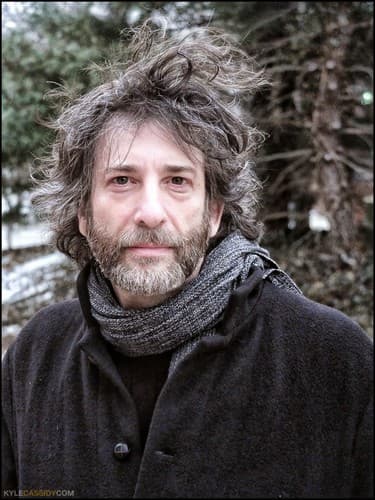
Neil Richard MacKinnon Gaiman is an English author of short fiction, novels, comic books, graphic novels, audio theatre, and a screenwriter. His works include the comic book series The Sandman and the novels Good Omens, Stardust, Anansi Boys, American Gods, Coraline, and The Graveyard Book. He has won numerous awards, including the Hugo, Nebula, and Bram Stoker awards, as well as the Newbery and Carnegie medals. He is the first author to win both the Newbery and the Carnegie medals for the same work, The Graveyard Book (2008). In 2013, The Ocean at the End of the Lane was voted Book of the Year in the British National Book Awards. It was later adapted into a critically acclaimed stage play at the Royal National Theatre in London.







