“The past is never really gone. It's always there, lurking, waiting for the right moment to jump out and grab you.”
— Cynthia reflects on her family's disappearance and how it still affects her.

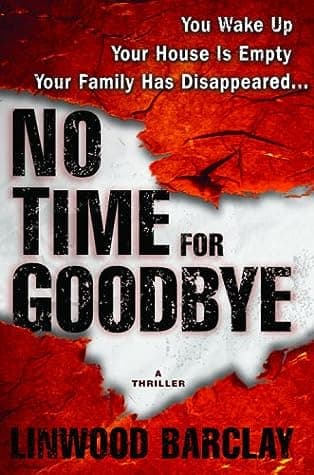
Linwood Barclay (2007)
Genre
Thriller / Mystery
Reading Time
700 min
Key Themes
See below
Sign in to track this book
Twenty-five years after her family vanished, Cynthia is pulled back into a web of secrets and deadly truths as the past returns, threatening her new life and forcing her to confront a killer closer than she imagined.
On a summer morning in 1983, fourteen-year-old Cynthia Bigge wakes up to an empty house. Her parents, Jim and Anne, and her younger brother, Todd, have vanished without a trace, leaving no note. The police investigation finds nothing, and Cynthia lives with her aunt and uncle, haunted by the disappearance. Twenty-five years later, Cynthia is a freelance writer, married to Terry, and raising their ten-year-old daughter, Grace, in the same town of Grandview. Despite her normal life, the trauma of her family's disappearance makes her wary.
Cynthia's peace begins to unravel when she receives anonymous, unsettling gifts and phone calls. A strange car is seen near her home, and she feels watched. Terry, her husband, first dismisses her fears as paranoia, but Cynthia's instincts tell her something more sinister is happening. She revisits old memories and news articles about her family's disappearance, trying to find forgotten details. The escalating incidents, including a threatening note, convince her that someone connected to her family's vanishing has returned and is targeting her.
Driven by fear for her family's safety, Cynthia begins her own investigation, which Terry dislikes. She reconnects with her childhood best friend, Paul, now a police officer, hoping for insight. Cynthia remembers a former neighbor, Rick, a troubled young man who had a crush on her. She also recalls her father, Jim, having shady dealings and a quick temper, especially with a local mechanic, Jack. As she digs deeper, Cynthia discovers that her father had borrowed a lot of money from dangerous people and had a secret life involving gambling debts and illegal activities, which changes her view of him.
As Cynthia's investigation continues, she notices Terry behaving strangely. He becomes secretive with his phone, makes unexplained trips, and seems agitated by her pursuit of the truth. His dismissive attitude towards her fears turns into anger when she presses him for information. Cynthia discovers that Terry has been secretly meeting with someone and hiding information, leading her to question his loyalty and even suspect his involvement in the threats. The tension between them grows, and Cynthia feels isolated, unsure whom to trust, even at home.
Cynthia tracks down Rick, her former neighbor, who is now a seemingly reformed, though still eccentric, person. Rick admits to having been obsessed with Cynthia but denies any involvement in the threats or her family's disappearance. He gives vague hints about her father's past. Cynthia also confronts Jack, the mechanic, who reveals that Jim Bigge had owed him money and was known for being involved with unsavory characters. These encounters add more pieces to the puzzle but also introduce new complexities, making Cynthia question if she is following the right leads or being misled.
The mystery takes a dark turn when Cynthia's daughter, Grace, innocently mentions seeing Terry with a man she recognizes from a photograph of Cynthia's missing father, Jim. This revelation shocks Cynthia, confirming her suspicions about Terry's deception and suggesting a deeper, more sinister connection to her past. The possibility that Terry is involved with someone from her missing family is terrifying. Cynthia realizes she has been living with a man who has been hiding the truth from her, possibly for years, and that her entire life might be a lie.
Cynthia confronts Terry with Grace's observation. Under pressure, Terry confesses that he has been in contact with Jim Bigge, Cynthia's father. He explains that Jim, having faked his death to escape his debts and criminal associates, resurfaced years ago and blackmailed Terry into helping him stay anonymous. Terry claims he was trying to protect Cynthia and Grace from Jim's dangerous past, but his confession only raises more questions. Cynthia is furious and heartbroken by his betrayal and the years of lies. She struggles to reconcile the man she loves with the man who kept such a profound secret.
As Cynthia deals with Terry's confession, she uncovers the truth. Her father, Jim, wasn't just hiding; he had orchestrated his family's disappearance to escape his debts and start a new life with another woman, taking Todd and Anne with him. He had convinced them to fake their deaths. The recent threats against Cynthia were not from Jim, but from his new wife, who saw Cynthia as a threat to their new life and wanted to eliminate her. Jim had been trying to protect Cynthia from his new wife's murderous intentions, using Terry as an intermediary.
The climax happens when Cynthia is confronted by her father's new wife, who tries to kill her to keep Jim's past buried. In a terrifying confrontation, Cynthia fights for her life and Grace's safety. Jim Bigge, realizing the extent of his new wife's actions and the danger to his original daughter, steps in. The confrontation is violent, leading to the death of Jim's new wife. Jim is forced to face the consequences of his actions and the impact his choices had on Cynthia and her family.
Afterward, Cynthia deals with the truth about her family. Her father, Jim, is arrested for his past crimes and his role in the scheme. Cynthia learns that her mother, Anne, and brother, Todd, are alive and living under new identities, having been part of the deception. The revelation leaves Cynthia with anger, grief, and a sense of closure. She and Terry begin to rebuild their relationship, acknowledging the wounds caused by his deception but also his desire to protect her. Cynthia finds a fragile peace, understanding that she can never truly recover what was lost, but she can build a new future with her husband and daughter, free from the past's shadow.
The Protagonist
Cynthia transforms from a woman living under the shadow of an unsolved mystery to one who confronts the horrifying truth, learning to trust her instincts and rebuild her life.
The Supporting/Antagonist (initially)
Terry transitions from a seemingly supportive husband to a conflicted figure harboring a major secret, eventually confessing and seeking redemption.
The Supporting
Grace remains a constant, innocent presence, serving as a catalyst for her mother's discoveries.
The Antagonist
Jim is initially a missing person, then revealed as a manipulative figure who orchestrated a grand deception, and finally faces the repercussions of his choices.
The Supporting
Initially a missing person, Anne is revealed to be alive and complicit in her husband's deception, forcing Cynthia to confront a painful reality.
The Supporting
Todd is a missing person who is later revealed to be alive and part of his father's new life, further complicating Cynthia's emotional landscape.
The Supporting
Paul provides a consistent, albeit somewhat peripheral, source of support and information for Cynthia.
The Mentioned/Supporting
Rick is introduced as a suspicious character, then cleared, offering a minor piece of the puzzle.
The Mentioned
Jack serves as a source of information about Jim Bigge's past, helping Cynthia piece together the truth.
The novel explores how individuals create and hide their identities, especially through Jim Bigge's plan to fake his family's death and start over. Cynthia grapples with the realization that her entire family lived a hidden life, and that the father she knew was not real. This theme also applies to Terry, who maintains a hidden identity as Jim's intermediary, showing how secrets are widespread and how hard it is to truly know someone.
“What if the truth was so ugly that it was better left buried?”
Cynthia's life is deeply shaped by the trauma of her family's disappearance. For twenty-five years, she lives with unresolved grief and a sense of distrust and paranoia, which affects her relationships and how she sees the world. The story shows how unresolved past events continue to haunt and influence the present, driving Cynthia's search for answers, even at great personal cost. Her journey is about confronting and beginning to heal from this deep trauma.
“Sometimes, when she was alone, she would still feel that fourteen-year-old girl, waking up to an empty house, her heart pounding with a fear she couldn't name.”
This theme is central to the entire story, as Cynthia uncovers layers of lies and deception that have surrounded her family for decades. From her father's initial hoax to Terry's complicity in maintaining the secret, the book questions the nature of truth and the reasons for hiding it. It explores the painful results of deception, both for those who do it and those who are its victims, and the moral choices involved in picking between a comforting lie and a painful truth.
“The truth was a weapon, and it had just been aimed straight at her heart.”
The novel examines the complex dynamics of family loyalty and betrayal. Cynthia's father, mother, and brother betray her by faking their deaths and abandoning her. Terry's actions, while meant to protect Cynthia, are also a betrayal of trust in their marriage. The story explores the devastating impact of these betrayals on Cynthia, forcing her to redefine what family means and to face the painful reality that those closest to her can be capable of deep deceptions.
“How could the people you loved the most be the ones who hurt you the deepest?”
A core theme is that the past always resurfaces, no matter how carefully it is buried. Jim Bigge's attempt to erase his old life and start anew ultimately fails, as his past catches up to him and, more importantly, to Cynthia. The anonymous threats and escalating events are all signs that the past refuses to stay hidden, forcing Cynthia to confront the unresolved mysteries that have bothered her for twenty-five years. The story shows that secrets unravel, and true closure often requires facing uncomfortable truths.
“The past was a shark, always circling, always waiting for its moment to strike.”
Cynthia's perspective is influenced by trauma and initial ignorance of the full truth.
While not overtly unreliable, Cynthia's perspective as the protagonist is shaped by her deep-seated trauma and her lack of complete information about her family's past. Her interpretation of events and suspicions towards characters like Terry are colored by her emotional state and the gaps in her knowledge. This subtle unreliability builds suspense, as the reader experiences the unraveling mystery alongside Cynthia, questioning who can be trusted and what the true motives are, much like she does.
Misleading clues and characters divert attention from the true antagonist.
The novel employs several red herrings to keep the reader guessing and to heighten the mystery. Characters like Rick, Cynthia's obsessed former neighbor, and Jack, the mechanic Jim Bigge owed money to, are initially presented as potential suspects or sources of danger. These characters and their backstories divert Cynthia's (and the reader's) attention, making the eventual revelation of the true, more complex conspiracy and the identity of the real threats more shocking and unexpected. They effectively build suspense and complicate the investigative process.
Grace's unwitting observations provide crucial plot advancements.
Cynthia's daughter, Grace, serves as an 'innocent observer' whose simple, unadulterated observations inadvertently provide critical breakthroughs in Cynthia's investigation. Her casual remark about seeing Terry with a man resembling Cynthia's father is a pivotal moment that shatters Cynthia's perception of her husband and propels the plot towards its climax. This device highlights how seemingly minor details from an unbiased source can hold immense significance in uncovering complex deceptions, adding a layer of poignant irony to the narrative.
Cynthia's fragmented memories offer clues to her family's past.
Throughout the novel, Cynthia experiences fragmented memories and moments of recall from her childhood surrounding the disappearance. These aren't extensive flashbacks but brief, vivid snippets of her past interactions with her family or observations from the time. These memories serve as crucial clues, prompting her to revisit specific events or people, and providing pieces of the puzzle that, when put together, begin to reveal the true nature of her family's secrets and the events leading up to their vanishing. They emphasize the lasting psychological impact of the event.
“The past is never really gone. It's always there, lurking, waiting for the right moment to jump out and grab you.”
— Cynthia reflects on her family's disappearance and how it still affects her.
“You can spend your whole life trying to forget something, but it doesn't mean it's not still happening inside you.”
— Cynthia struggles with repressed memories and the emotional weight of her childhood.
“Sometimes the biggest lies are the ones we tell ourselves.”
— A character grapples with self-deception and denial regarding past events.
“Fear has a way of making you see things that aren't there, and not see the things that are.”
— Cynthia's heightened anxiety influences her perception during the investigation.
“The truth is rarely simple, and almost never convenient.”
— An investigator comments on the complexity of the case and the challenges of uncovering the truth.
“Every family has its secrets. Some are just bigger than others.”
— A general observation made about the nature of families and the hidden aspects of their lives.
“It's amazing how much you can forget when you really want to.”
— Cynthia considers the mind's ability to compartmentalize or suppress traumatic memories.
“The silence was the loudest sound of all.”
— Describing the eerie quiet after her family's disappearance, emphasizing the void they left.
“You never really know someone, not completely, not even the people you love the most.”
— A character reflects on the hidden lives and unknown aspects of their loved ones.
“Sometimes, the answers you're looking for are right in front of you, if you just know where to look.”
— A piece of advice given to Cynthia about paying attention to details.
“Grief is a strange thing. It doesn't always get easier, it just changes shape.”
— Cynthia's ongoing struggle with the unresolved grief of her family's disappearance.
“The past has a way of repeating itself if you don't confront it.”
— A thematic statement about the cyclical nature of unresolved trauma and secrets.
“There are some things you can't outrun, no matter how fast you go.”
— Cynthia realizes the futility of escaping her past and the need to face it.
“Hope can be a dangerous thing. It can keep you clinging to something that's already gone.”
— A character's cynical view on the persistence of hope in the face of long-lost loved ones.
Ready to see how well you understood this book? Take our interactive quiz with 10 questions.

Biography coming soon.







