“No talking. No words at all. That's the rule.”
— Dave Packer introduces the contest to his classmates.

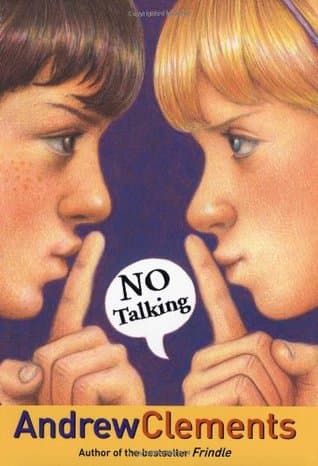
Andrew Clements (2007)
Genre
Children's / Young Adult
Reading Time
120 min
Key Themes
See below
Sign in to track this book
When a boisterous fifth-grade boy challenges his class to a two-day no-talking contest against the girls, the resulting silence unexpectedly amplifies the power of unspoken words and the surprising impact of kindness amidst the chaos.
Laketon Elementary School's fifth-grade class, particularly the boys and girls, are known for being loud, often disrupting lunch and class. Principal Hiatt, a strict figure, often uses her red plastic bullhorn to command order, which annoys the students. During a very loud lunch period, Dave Packer, a very talkative fifth-grader, is singled out by Principal Hiatt for his constant chatter. Later, while working on a social studies report about Mahatma Gandhi's silent day of protest, Dave has an idea: what if he tried to go a whole day without talking? He decides to try it, finding it difficult but also strangely empowering. This personal challenge sets the stage for a much larger school event.
The next day, Dave is set on his silent protest. He gets through his morning classes without speaking, communicating only with gestures and written notes. During lunch, the silence is a struggle, but he continues. However, Lynsey Burgess, an equally talkative girl from the fifth grade, is seated nearby, chatting with her friends. Dave, unable to stand her constant talking while he is trying so hard, finally breaks his silence and sarcastically asks if she can ever shut up. Lynsey, offended and quick-witted, responds by challenging Dave and the boys to a 'no talking' contest: which team, boys or girls, can say the fewest words over the next two school days? Both sides quickly accept the challenge, turning Dave's personal experiment into a full fifth-grade war of silence.
The fifth graders quickly set the rules for their 'no talking' contest: each spoken word counts, except for responses in class directly asked by a teacher, or during emergencies. They appoint scorekeepers to count words for each team. The teachers, Mrs. Marlow, Mr. Burton, and Mrs. Rourke, are initially confused by the sudden quietness of their usually noisy students. They notice the students communicating through elaborate hand gestures, notes, and even charades. Some teachers find it amusing, while others, like Mrs. Marlow, worry about the learning impact. The principal, seeing the unusual calm, is both pleased and suspicious, wondering what new prank the fifth graders are planning.
As the silence continues, Principal Hiatt grows more suspicious. She initially enjoys the peace but soon realizes that the quiet is too consistent and too intentional to be natural. She observes the students' intense focus, their secret signals, and their determined expressions. Her instinct tells her that this is not just good behavior, but a coordinated effort, a 'conspiracy of silence' that she cannot control with her bullhorn. The lack of noise, instead of reassuring her, makes her feel like she is losing control of the school, and she begins to investigate the cause of this unusual phenomenon, determined to find out the truth behind the fifth grade's sudden quiet.
The first day of the contest ends with surprisingly low word counts for both teams, though the boys are slightly ahead. The fifth graders celebrate their achievement, feeling a sense of unity and defiance. However, the sustained silence is hard. Students find it difficult to express themselves fully, to ask for help, or to simply chat with friends. Some, like Lynsey, who is naturally very expressive, feel the strain more than others. Despite their commitment, the initial excitement starts to fade for a few, replaced by a growing awareness of the difficulty of true, prolonged silence, especially when they have much they want to say.
On the second day, Principal Hiatt, unable to tolerate the unnerving silence any longer, calls the entire fifth grade to an assembly. She confronts them directly, asking why they are so quiet. She suspects a trick, a prank, or even a form of rebellion. After a tense silence, a brave student, prompted by Dave and Lynsey, explains the 'no talking' contest. Principal Hiatt is initially angry, feeling her authority undermined. She sees it as a direct challenge to her control and the school's order. The revelation changes the atmosphere, as the students prepare for her punishment, but also feel relief that their secret is out.
After the initial shock and anger, Principal Hiatt thinks about the situation. She realizes that while the contest was unauthorized, the students had, in fact, been exceptionally well-behaved and focused. She recognizes the genuine effort and self-discipline involved. Instead of shutting it down, she announces that the contest can continue, but with new rules. She declares that she, too, will participate, and will keep a tally of her own words. This unexpected decision surprises the students and teachers alike, showing a different side of the stern principal and turning the contest into a school-wide experiment in self-control and communication.
The final hours of the contest are filled with tension and amusement. Principal Hiatt struggles to keep her own word count low, often using gestures and notes, much like the students. The boys and girls are very close, each team determined to win. As time runs out, the students discover new ways to communicate effectively without speaking, creating a sense of camaraderie and cleverness. When the final tallies are revealed, the boys win by a narrow margin, but the victory feels secondary. The real outcome is the shared experience, the unexpected insights into the power of words, and the surprising connection formed between the students and their principal.
After the contest, the fifth graders are tired but also excited. They have proven a point, not just to each other, but to themselves and their principal. While the silence was hard, it also made them more careful about the words they chose to speak. Principal Hiatt, too, has changed. She uses her bullhorn less often, and when she does speak, her words carry more weight. The students, in turn, are still capable of being loud, but they now understand better when to speak and when to listen. The experience creates a more respectful and thoughtful atmosphere in the fifth grade, showing the strong impact of conscious communication.
The Protagonist
From a loud and often disruptive student, Dave learns the value of silence and the impact of chosen words, becoming more mindful of his speech.
The Protagonist
Lynsey, a natural conversationalist, learns the discipline of silence and the power of non-verbal communication, gaining a new perspective on speech.
The Antagonist/Supporting
Principal Hiatt evolves from an authoritarian figure primarily focused on control to one who appreciates the students' initiative and the deeper meaning of their 'no talking' experiment.
The Supporting
She adapts to the students' silent protest, learning to facilitate learning in unconventional ways.
The Supporting
He observes and adapts to the students' unique contest, finding humor and interest in their self-imposed silence.
The Supporting
She navigates the challenge of teaching a silent class, adapting her methods to the students' unique commitment.
The Supporting
He actively participates in the contest, diligently upholding its rules and contributing to the team's effort.
The Supporting
She actively participates in the contest, diligently upholding its rules and contributing to the team's effort.
The Mentioned
His historical actions serve as a catalyst for the main plot, inspiring the central conflict and theme.
The main theme explores the impact of both spoken words and deliberate silence. The students' initial loud behavior shows the chaos of unbridled speech, while their 'no talking' contest shows the effect of silence – it helps self-control, forces creative communication, and makes spoken words more meaningful when they are finally used. Principal Hiatt's experience with the bullhorn versus her own silence during the contest further shows how silence can get attention and respect more effectively than constant noise or authoritative commands.
“And the silence had become a thing, almost like another person in the room, a person who was watching them and waiting.”
The contest makes individual students, especially Dave and Lynsey, face their own habits and develop self-control. Dave, a known talker, finds a new identity in his ability to remain silent. The collective effort of the fifth graders to control their speech defines their class, setting them apart and creating a unique sense of group identity. The struggle to stay silent shows inner strength and discipline, changing how the students see themselves and each other.
“It was amazing how much control he had over his own mouth. He could just not talk if he decided not to.”
The book looks at different forms of communication, from loud chatter and sarcastic insults to elaborate gestures, written notes, and the strong message conveyed by collective silence. The initial conflict between Dave and Lynsey comes from miscommunication and irritation. As the contest goes on, students learn to communicate effectively without words, showing the importance of non-verbal cues. The principal's initial misunderstanding of the silence as defiance, and her eventual understanding, shows how intentions behind communication can be easily misunderstood.
“Words were powerful things, and when they were not spoken, they became even more powerful.”
The interaction between Principal Hiatt's authority and the fifth graders' desire for independence is a core theme. Principal Hiatt tries to control the students with her bullhorn, representing traditional top-down authority. The 'no talking' contest, started by the students, is an act of collective independence and self-governance, challenging the principal's control. Her eventual decision to join the contest shows a shift from rigid authority to a more collaborative and understanding leadership, recognizing the students' ability for self-direction and initiative.
“She was losing control of her school. Or at least, she was losing control of the fifth grade.”
A symbolic representation of Principal Hiatt's authority and the school's noise problem.
The bullhorn is a recurring symbol throughout the book, representing Principal Hiatt's attempts to enforce order through sheer volume and authority. Its frequent use highlights the prevalent noise issue among the fifth graders. As the story progresses and the students embrace silence, the bullhorn becomes increasingly redundant, symbolizing a shift from external, imposed control to internal, self-imposed discipline. When Principal Hiatt herself struggles to avoid using it during the contest, it underscores her own journey of understanding and adaptation, and the limitations of relying solely on vocal command.
The central conflict and narrative driver.
The contest itself serves as the primary plot device, propelling the narrative forward and creating the central conflict. It shifts Dave's personal experiment into a class-wide competition, generating tension between the boys and girls, and eventually between the students and Principal Hiatt. The rules of the contest and the tallying of words provide concrete stakes and a measurable goal, allowing for clear progression and resolution. It functions as an extended metaphor for the power of self-control and the impact of communication choices.
An inspirational catalyst for Dave's initial idea.
The historical reference to Mahatma Gandhi's silent day of protest acts as a powerful catalyst for Dave Packer's initial decision to try a day without talking. It grounds the seemingly whimsical idea in a historical and philosophical context, giving it a deeper meaning beyond a mere prank. This device introduces the concept of purposeful silence as a form of protest and communication, elevating the children's contest from simple mischief to a thoughtful exploration of language and self-discipline.
A quantitative measure of the contest's progress and a source of tension.
The word tally, meticulously kept by student scorekeepers, is a crucial plot device that quantifies the progress of the 'no talking' contest. It creates concrete stakes, allowing the boys and girls to track their performance and fostering competitive tension. The act of counting words makes the abstract concept of silence tangible and highlights the conscious effort required by the students. When Principal Hiatt joins, her own word count becomes a point of shared vulnerability and connection with the students.
“No talking. No words at all. That's the rule.”
— Dave Packer introduces the contest to his classmates.
“Words are like tools. If you use them right, they can build things. If you use them wrong, they can break things.”
— Dave reflects on the power of language.
“It's not about winning. It's about thinking.”
— Dave explains the purpose of the no-talking contest.
“Silence is a kind of sound, too.”
— Lynsey Burgess observes the quiet during the contest.
“Sometimes the loudest thing in the room is what isn't being said.”
— Narrator describes the tension in the classroom.
“You don't need words to be a friend.”
— Students communicate through gestures and notes.
“The quiet made the noise inside my head even louder.”
— A student describes the internal experience of silence.
“We were so busy not talking, we started really listening.”
— Dave realizes an unexpected benefit of the contest.
“Three words can change everything. Or no words at all.”
— Reflection on the impact of speech and silence.
“It's amazing what you notice when you stop talking.”
— Lynsey observes details in the environment she previously missed.
“The principal thought we were being defiant. We were just being thoughtful.”
— Students defend their silent behavior to the school administration.
“Our words had become like background noise. Now the silence had a voice.”
— Narrator contrasts habitual talking with intentional quiet.
“We weren't just not talking. We were communicating in a whole new way.”
— Dave describes the creative methods students develop.
Ready to see how well you understood this book? Take our interactive quiz with 10 questions.

Andrew Clements was a prolific author of children's literature, celebrated for his engaging and relatable stories. His notable works include the beloved "Frindle," "A Week in the Woods," and the "Jake Drake" series, which often explored themes of school, friendship, and growing up. Clements' accessible writing style and keen understanding of young readers earned him widespread critical acclaim and a dedicated fanbase.

Dan Gemeinhart
4.5

Kate O'Hearn
4.4

Jeanne Birdsall
4.4

Jen Wang
4.4

Wendelin Van Draanen
4.3

John Marsden
4.3

Chris Van Allsburg
4.3
Jennifer A. Nielsen
4.2