BookBrief
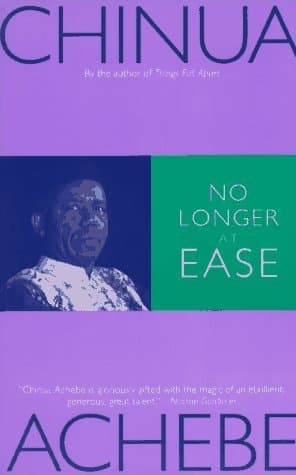
No Longer at Ease cover
Archivist's Choice

No Longer at Ease

Chinua Achebe (1960)

Genre

Historical Fiction

Reading Time

240 min

Key Themes

See below

Track Your Reading

Sign in to track this book

Obi Okonkwo, a Western-educated Nigerian, struggles with bribery and the societal rules against his forbidden love, eventually giving in to the corruption he swore to fight.

Synopsis

Obi Okonkwo, a young Nigerian educated in England, returns home full of ideals and a scholarship debt. He gets a good civil service job, determined to avoid the widespread corruption he sees. At first, he refuses bribes, but his personal life soon complicates things. He falls in love with Clara, a woman from the 'Osu' caste, considered an untouchable. His family and community, especially his parents, strongly disapprove. As financial pressures grow from his scholarship repayment, family expectations, and the costs of his relationship with Clara, Obi becomes desperate. The forbidden love leads to Clara's pregnancy and a forced abortion, increasing Obi's emotional and financial problems. His mother's death adds to his burdens, and his resolve weakens. Obi slowly gives in to the corruption he first condemned, taking bribes to pay his debts. His decline ends in a sting operation, leading to his arrest and trial. Both the public and the court wonder how such a promising young man could fall so far.
Reading time
240 min
Difficulty
Medium
Pacing
Moderate
Mood
Melancholy, Reflective, Tragic, Social Commentary
✓ Read this if...
You're interested in post-colonial Nigerian society, the clash between traditional values and modern aspirations, and a character study of moral compromise.
✗ Skip this if...
You prefer fast-paced plots with clear-cut heroes and villains, or find stories of gradual moral decay too disheartening.

Plot Summary

The Trial and Public Opinion

The novel begins with the trial of Obi Okonkwo, a young Nigerian civil servant, for taking bribes. The story quickly moves to the Umuofia Progressive Union (UPU) meeting, where members discuss Obi's conviction with disappointment and confusion. They had paid for his education in England, expecting him to be honest and help their community. The elders, in particular, struggle to understand how the idealistic, educated Obi became the corrupt man now facing judgment. They remember the great sacrifices made to send him abroad, emphasizing the community's high hopes and the feeling of betrayal.

Obi's Return and Initial Ideals

After four years of studying in England, Obi Okonkwo returns to Nigeria, full of youthful ideals and strong morals. He has a First Class Honours degree in English and gets a good job as a Scholarship Secretary in the federal civil service in Lagos. His Umuofia relatives, who pooled their money to send him abroad, greet him with great pride and high expectations. Obi knows about the widespread corruption in the colonial government but is determined to stay honest, seeing himself as a new kind of Nigerian professional who will improve his country through integrity.

Financial Pressures Mount

Almost immediately upon his return, Obi faces serious financial problems. His parents, especially his father, expect him to support his younger siblings' education and help with family expenses. The Umuofia Progressive Union also expects him to repay his scholarship loan quickly and contribute generously to community projects. Obi's salary, though seemingly good, is quickly used up by these obligations, the cost of living in Lagos, and the need to keep up appearances for his status. He constantly borrows money and struggles to manage, a stark contrast to his initial hopes for financial stability.

The Forbidden Love with Clara

Obi falls deeply in love with Clara Okeke, a nurse he meets in Lagos. Their relationship quickly becomes serious, and Obi imagines a future with her. However, Clara reveals a difficult truth: she is an 'Osu,' an outcast in Igbo society, traditionally dedicated to a god and forbidden from marrying free-born individuals. Despite Obi's modern education and his rejection of such old customs, this revelation creates a huge barrier. He is deeply conflicted, torn between his love for Clara and the deeply ingrained societal taboos that his family and community will never accept, hinting at great personal struggle.

Parental Disapproval and Osu Taboo

When Obi tells his parents, Isaac and Hannah Okonkwo, that he plans to marry Clara, they are horrified by her Osu status. His deeply religious Christian father, a former catechist, argues that while all are equal in God's eyes, the Osu custom is a deep tradition that cannot be easily ignored, even by Christians. His mother, Hannah, is even more firm, threatening to die if Obi marries an Osu. This parental opposition crushes Obi, who respects his parents deeply but cannot leave Clara. The conflict shows the clash between modern education and old cultural beliefs.

Clara's Pregnancy and Abortion

Amidst ongoing family and societal pressures, Clara discovers she is pregnant. This news further complicates their already difficult situation. Obi, overwhelmed by his financial troubles and the idea of raising a child with an Osu wife against his family's wishes, cannot fully commit to marriage. Clara, feeling the weight of the stigma and Obi's hesitation, decides to have an abortion. The procedure is traumatic and painful, both physically and emotionally. After the abortion, their relationship completely breaks down, and Clara leaves Obi, unable to bear the burden and the lack of full support.

Increased Financial Desperation

With Clara gone, Obi's emotional state worsens, and his financial problems become even more severe. He continues to send money home, pay his loan, and cover his living expenses in Lagos. The UPU's constant demands for contributions and the expectation of lavish entertaining further deplete his money. He takes out more loans, falling deeper into debt. The pressure to maintain his image as a successful, educated man, combined with the heavy burden of his obligations and the loss of Clara, leaves him feeling trapped and increasingly desperate. He starts to see the bribes he once rejected as a possible solution.

Succumbing to Corruption

Despite his strong moral convictions, Obi begins to weaken under the constant financial strain. He initially rejects bribes from scholarship applicants, but the temptation grows. He sees his colleagues openly taking gifts and money, and their comfortable lives contrast sharply with his struggles. He tells himself that taking small amounts might be a temporary solution, a way to clear his debts and meet his obligations, promising himself he will stop once he is financially stable. This marks a significant change, as Obi compromises his integrity, slowly falling into the corruption he swore to fight.

His Mother's Death and Further Decline

Obi receives the terrible news that his mother, Hannah, has died. This loss greatly affects him, adding more grief and guilt to his already fragile state. He blames himself for her death, believing his defiance regarding Clara contributed to her sorrow and eventual passing. His mother's death removes a significant moral guide in his life. The emotional toll, combined with his growing debts and Clara's absence, leaves him feeling completely alone and lost. His resolve to resist corruption weakens further, and he becomes more careless and frequent in accepting bribes.

The Sting Operation and Arrest

Unknown to Obi, the authorities are aware of the growing corruption in the civil service. He falls victim to a carefully planned sting operation. A female applicant, working as an informant, offers him a bribe for a scholarship. Obi, now used to the practice and desperate for money, accepts it. He is immediately arrested by plainclothes police officers who were waiting in an adjacent room. This arrest abruptly ends his career and leads directly to the public trial for bribery, bringing shame to himself and the Umuofia community.

Principal Figures

Obi Okonkwo

The Protagonist

Obi starts as an idealist determined to resist corruption but gradually succumbs to financial and emotional pressures, compromising his integrity and ultimately facing imprisonment.

Clara Okeke

The Supporting

Clara endures the societal prejudice of her Osu status and the emotional pain of a forbidden love, ultimately choosing self-preservation over a doomed relationship.

Isaac Okonkwo

The Supporting

Isaac remains steadfast in his traditional beliefs, highlighting the generational and cultural divide that Obi struggles against.

Hannah Okonkwo

The Supporting

Hannah's unwavering adherence to tradition leads to a deep conflict with Obi and ultimately contributes to her own demise, highlighting the destructive power of rigid customs.

Joseph Okonkwo

The Supporting

Joseph remains a consistent voice of traditional and pragmatic counsel, serving as a foil to Obi's idealism.

Mr. Green

The Supporting

Mr. Green remains a static character, representing the unchanging prejudiced views of the colonial administration.

Christopher

The Supporting

Christopher serves as a contrasting figure to Obi, demonstrating how easily one can adapt to the corrupt environment.

Umuofia Progressive Union (UPU)

The Supporting

The UPU's role remains consistent, representing the collective expectations and judgment of the community on Obi.

Themes & Insights

Clash of Cultures (Traditional vs. Modern)

The novel clearly shows the conflict between traditional Igbo customs and Western education and modern life. Obi, educated in England, rejects the Osu caste system as cruel, yet his parents and community stick to it, leading to the tragic end of his relationship with Clara. This theme also appears in Obi's struggle to balance his Western ideals with the widespread corruption he finds in the modern Nigerian civil service, which blends colonial history and local practices. The clash ultimately overwhelms Obi, who feels 'no longer at ease' in either world.

The Osu is like a leper in the minds of our people. If you marry an Osu, your children and your children's children will be Osu.

Obi's mother, Hannah Okonkwo

Corruption and Moral Compromise

Corruption is a main theme, showing how an idealistic person can give in to systemic pressures. Obi returns to Nigeria determined to be honest, but he faces constant financial demands from his family and community, along with the high cost of living in Lagos. He sees his colleagues casually accepting bribes and the general expectation of 'gifts.' The slow loss of Obi's moral strength, from refusing bribes to justifying taking them, illustrates how financial desperation and the acceptance of unethical practices can lead to someone's downfall. His initial honesty crumbles under the weight of societal expectations.

Everybody is doing it. If you are not doing it, you are a fool.

Christopher to Obi

Individual vs. Community

The novel explores the great pressure placed on an individual by community duties. The Umuofia Progressive Union collectively pays for Obi's education, expecting him to succeed and be a financial asset to the community. This creates a heavy burden of expectation and repayment that Obi struggles to meet. His desire for personal happiness, especially his love for Clara, directly clashes with the community's strict traditional values about the Osu caste. Obi's inability to balance his personal desires with these overwhelming community demands contributes to his isolation and moral collapse.

He was their star; they had seen to his going overseas and his coming home. He was the Umuofia man of the future.

Narrator

The Burden of Expectations

Obi carries many expectations: his family's hope for financial support, the UPU's demand for repayment and contributions, and the general societal expectation that an educated man should live a certain way. These expectations, combined with his moderate salary and high expenses, create an unsustainable financial and emotional strain. The sad irony is that the same community that invested in his education also unintentionally creates the conditions that lead to his downfall, as he turns to corruption to meet these overwhelming demands. This theme highlights the destructive nature of unrealistic pressures.

The Umuofia Progressive Union was like a second government to the people of Umuofia living in Lagos.

Narrator

Plot Devices & Literary Techniques

Foreshadowing

The opening trial scene hints at Obi's tragic fate from the very beginning.

The novel opens with Obi's trial for bribery, immediately revealing his downfall before delving into the events that led to it. This structural choice creates a sense of tragic inevitability, making the reader aware of Obi's ultimate fate even as they witness his initial idealism. It heightens the tension and irony as Obi struggles against the very forces that the reader knows will eventually consume him, emphasizing the pervasive nature of corruption and societal pressure. The opening sets a somber tone for the unfolding narrative.

Irony

Obi, sent to England to gain knowledge and integrity, returns only to succumb to corruption and tradition.

The novel is replete with irony, particularly situational irony. Obi is sent to England by his community to acquire education and to return as an upright, incorruptible leader, yet he ultimately succumbs to the very corruption he initially despises. Furthermore, he, an educated man who rejects the Osu taboo, is ironically destroyed by it through his love for Clara, and by the financial pressures arising from his community's expectations. The community's investment in his future ironically leads to his ruin, highlighting the tragic clash of ideals and reality.

Symbolism of the 'Osu' Caste

The Osu caste system symbolizes the enduring power of tradition and its conflict with modernity.

The Osu caste system, which declares Clara an outcast, serves as a powerful symbol throughout the novel. It represents the deeply entrenched, ancient traditions of Igbo society that resist change, even in the face of modern education and Christianity. For Obi, rejecting the Osu taboo is a symbol of his modernity and idealism. However, the system's unyielding power, as manifested in his parents' and community's fierce opposition, ultimately destroys his personal happiness and contributes to his moral decline, demonstrating the limitations of individual will against collective societal norms.

Financial Pressure as a Catalyst

Obi's mounting financial obligations act as the primary catalyst for his moral compromise.

The relentless financial pressure on Obi, stemming from his scholarship repayment, family support, and community contributions, acts as the primary catalyst that pushes him towards corruption. Despite his initial strong moral compass, the constant struggle to make ends meet, coupled with the need to maintain appearances, slowly erodes his resistance to bribery. The financial burden is not merely a background element but an active force that directly drives Obi's decisions, ultimately leading him to compromise his integrity and succumb to the pervasive corrupt system.

Critical analysis

Notable Quotes

The white man is very clever. He came quietly and peaceably with his religion. We were amused at his foolishness and allowed him to stay. Now he has won our brothers and our clan can no longer act like one. He has put a knife on the things that held us together and we have fallen apart.

Obi Okonkwo reflects on the impact of colonialism on his community, echoing his grandfather's sentiments.

It was like the story of the young man who was given a soiled garment to wash. He washed and washed but the stain was still there. So he went to his mother and asked her what he should do. His mother told him to wash it again, but this time to wash it with sand. He did so and the garment became clean. 'That is what you should do,' his mother said. 'Wash it with sand.'

Obi's mother uses a parable to advise him on how to deal with the difficulties and temptations of his new job.

A man who has nowhere to lay his head must find a way of hanging it.

Obi's father, Isaac, reflects on the difficult choices and compromises one must make in life.

The important thing is that we should be able to look our children in the face.

Obi's father emphasizes the importance of integrity and setting a good example for the next generation.

It was not right that a man should abandon the ways of his people. It was like a tree cutting its own root.

A Umuofia elder expresses disapproval of Obi's assimilation into Western culture and his disregard for tradition.

What is good in one place is bad in another.

Obi struggles with conflicting moral codes and expectations between his traditional upbringing and Western education.

The Public Service is a place where you are expected to take bribes. It is the custom.

A senior colleague explains the pervasive culture of corruption within the Nigerian civil service to Obi.

He was a product of an age in which the cream of the country's youth was given the best education that money could buy, in preparation for the great day when they would take over the reins of government from the colonial masters.

The narrator describes Obi's background and the high expectations placed upon him as an educated African.

The world has changed. Our people have changed. We must change with them.

Obi's father, though traditional, acknowledges the inevitability of change and the need for adaptation.

I am a man of honour. I cannot take what is not mine.

Obi initially resists the temptation to accept bribes, clinging to his ideals of honesty.

It is not right that a man should marry a woman who has no people. A woman should have a family, a clan, behind her.

The Umuofia Progressive Union discusses the unsuitability of Clara as a wife for Obi due to her Osu status.

He was a man of the new dispensation, but his roots were in the old. And the two did not mix.

The narrator encapsulates Obi's internal conflict between his modern education and his traditional heritage.

The white man's law is for the white man. Our law is for us.

An elder expresses the enduring belief in traditional justice systems over colonial ones.

He was a leopard in the trap. And the trap was his own making.

A metaphor for Obi's predicament, highlighting his responsibility for his downfall.

Quiz

Test Your Knowledge

Ready to see how well you understood this book? Take our interactive quiz with 10 questions.

10
Questions
~5
Minutes
?
Best Score

Key Questions (FAQ)

Obi Okonkwo, educated in England, returns to Nigeria with idealistic notions of integrity and service. He quickly confronts the pervasive corruption within the Nigerian civil service, where accepting bribes is an entrenched expectation, creating a moral dilemma for him between his principles and the societal norm.

About the author

Chinua Achebe

Chinua Achebe was a Nigerian novelist, poet, and critic who is regarded as a central figure of modern African literature. His first novel and magnum opus, Things Fall Apart (1958), occupies a pivotal place in African literature and remains the most widely studied, translated, and read African novel. Along with Things Fall Apart, his No Longer at Ease (1960) and Arrow of God (1964) complete the "African Trilogy". Later novels include A Man of the People (1966) and Anthills of the Savannah (1987). In the West, Achebe is often referred to as the "father of African literature", although he vigorously rejected the characterization.