“You can't stop what's comin'. It ain't all waitin' on you. That's vanity.”
— Sheriff Bell reflecting on the nature of evil and his own limitations.

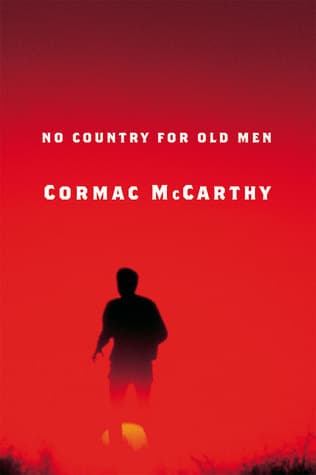
Cormac McCarthy (2005)
Genre
Thriller / Mystery
Reading Time
300 min
Key Themes
See below
Sign in to track this book
A hunter finds a drug deal gone wrong in Texas, starting a brutal chase with a coin-flipping killer and pulling an aging sheriff into a new, amoral world.
While hunting, Vietnam veteran Llewellyn Moss finds a grim scene: dead men, a truck with heroin, and another dead man with two million dollars. He also sees a wounded Mexican man asking for water. Moss, wanting money and a better life for his wife Carla Jean, takes the cash and goes home. Later, feeling guilty, he returns to the scene with water, but armed men ambush him. He barely escapes. This act starts the relentless pursuit that shapes the story.
Sheriff Ed Tom Bell arrives at the crime scene Moss found. He sees the dead bodies, drug items, and missing money, struck by the violence's scale and brutality, which he knows is worse than typical border conflicts. He talks to deputies to understand what happened, but the lack of witnesses and the methodical killings disturb him. Bell thinks about how crime is changing, the increasing evil he sees, and his own growing inability to handle it, hinting at his future disillusionment.
Anton Chigurh, a cold hitman, is introduced after escaping a police station by strangling a deputy. He gets his unique captive bolt pistol and starts his mission to find the stolen money. Chigurh tracks Moss by following the violence left by the drug deal. He shows his disturbing way of deciding fates by flipping a coin for strangers' lives, highlighting his nihilistic view. His first victims are the men sent by his employers to get the money, whom he kills for failing.
Llewellyn Moss knows he is in danger. He sends his wife, Carla Jean, to her mother's house for safety. He then prepares for his escape, using his Vietnam War experience to predict his pursuers. He goes to Del Rio and checks into a motel, thinking he is safe. However, Chigurh, using a transponder hidden in the briefcase, tracks him. A violent shootout happens at the motel. Moss is shot but escapes by jumping out a window, leaving the briefcase behind, but not for long.
Wounded, Llewellyn Moss is in a hospital in Mexico. While he recovers, Chigurh, still tracking the briefcase, finds and takes the money. But Moss, resourceful, steals the briefcase back from Chigurh's car in the hospital parking lot that night, despite his injuries. This cat-and-mouse game grows more intense, showing Moss's persistence and Chigurh's pursuit. Moss's actions, though brave, pull him deeper into a deadly fight he cannot win, as Chigurh is unyielding.
Sheriff Bell's investigation moves forward, but he feels outmatched by the new criminals and their brutality. He visits a crime scene where Chigurh left dead bodies, sensing an almost supernatural evil. He talks with other law enforcement officers about the changing times and growing violence, expressing his weariness and sense of being obsolete. Bell's internal thoughts show his struggle to understand such senseless acts and his growing fear for the future.
Llewellyn Moss, still running, plans to meet Carla Jean at a bus station, hoping to convince her to join him or understand his situation. He tries to explain that he cannot give up the money and the fight, fearing for their lives. Carla Jean is scared and begs him to surrender the money, sensing their lives are ruined. Their talk shows the strain his actions put on their marriage and her growing awareness of the danger, which Moss, despite his confidence, cannot fully grasp.
Llewellyn Moss hides in a secluded desert hotel near El Paso, thinking he is safe. However, a large group of Mexican hitmen, likely hired by the cartel to get their money, corners him. A large and brutal shootout occurs, with Moss fighting hard against many enemies. The hotel becomes a war zone, showing Moss's combat skills but also the sheer number of enemies he faces. This fight, though not involving Chigurh directly, shows the wide danger Moss has created for himself.
After the shootout at the desert hotel, Llewellyn Moss is badly wounded and dies, killed by the Mexican hitmen he fought. Sheriff Bell arrives soon after the massacre, finding Moss's body and the battle's aftermath. The scene fills Bell with despair; he was too late to save Moss, and the violence he tracked claimed another victim, deepening his sense of failure and the spread of evil.
After Moss's death, Anton Chigurh finds Carla Jean Moss at her mother's house. He confronts her, explaining he promised Moss that if he did not return the money, Carla Jean would face the consequences. He offers her a coin flip for her life, but she refuses, saying the coin has no power over her fate. Chigurh then kills her, keeping his promise and showing his rigid adherence to his own code. This act highlights Chigurh's lack of empathy and his role as an agent of unavoidable, arbitrary violence.
After killing Carla Jean, Anton Chigurh is in a severe car accident when another vehicle hits him. He is badly hurt, with a broken arm. Despite his injuries, Chigurh, resourceful and determined, escapes the scene before authorities can catch him. He pays two boys to remove his sling and walks away into the night, symbolizing his continued freedom and the elusive nature of the evil he represents. His survival and escape emphasize how futile it is to try to stop him.
Overwhelmed by the growing violence, and feeling less effective, Sheriff Ed Tom Bell decides to retire. He visits his uncle Ellis, a former lawman, and talks about his disillusionment, his inability to understand modern evil, and his fear for the future. Bell says he is 'not equal to it.' His retirement is the result of his moral fatigue and his recognition that the world has changed in ways he cannot grasp or fight. He feels he is an outdated figure, in a 'country for old men' where his values no longer fit.
In retirement, Sheriff Bell continues to narrate, sharing his thoughts on life, morality, and good and evil. He describes two recurring dreams. In the first, he loses money his father gave him. In the second, he dreams of his father riding ahead of him on horseback through a cold, snowy pass, carrying fire in a horn, preparing a place for him. These dreams show his worries about his legacy, his fear of failure, and his wish for a simpler time, as well as hope for guidance and warmth in a world he sees as increasingly dark. The dreams provide a poignant end to his narrative, capturing his deep sense of loss and uncertainty.
The Protagonist
Moss transforms from an ordinary man into a hunted fugitive, constantly fighting for survival, ultimately succumbing to the violence he unwittingly unleashed.
The Antagonist
Chigurh remains largely static, a force of nature whose methods and beliefs are consistent throughout, serving as an immutable agent of fate and violence.
The Protagonist/Narrator
Bell's arc is one of increasing disillusionment and resignation, leading to his retirement as he realizes he can no longer effectively combat the new forms of evil.
The Supporting
Carla Jean's arc is one of increasing fear and resignation, culminating in her tragic and unjust death.
The Supporting
Loretta remains a constant, supportive figure, representing the stability Bell seeks to preserve.
The Supporting
Ellis remains a static, wise elder figure, embodying the historical perspective of the 'old men'.
The Mentioned
Not applicable, as he is largely unseen and his motivations are purely transactional.
The Supporting
They serve as a persistent, lethal threat, collectively representing the overwhelming power of the cartels.
The novel explores how evil changes, from understandable crimes to a senseless, nihilistic violence seen in Anton Chigurh. Sheriff Bell struggles to understand this shift, a world where evil acts have no clear motive beyond their happening. Chigurh's coin flips for life and his remorseless killings show this arbitrary evil. The graphic violence, from the initial massacre to Moss's last stand, highlights the destructive power of this new evil, which traditional law and morals cannot handle.
“What he found there was beyond his understanding. Beyond his experience. He saw that the world was changing. And he could not change with it.”
A main theme is the conflict between human choice and an unyielding, predetermined fate. Anton Chigurh's coin tosses directly show this, suggesting that lives are subject to random chance or an indifferent power. Llewellyn Moss tries to escape his fate, making choices he thinks will save him, only to be caught in a cycle of violence. Sheriff Bell, in his thoughts, questions if humans have real control or if they are simply part of a larger, inescapable current of history and violence. The novel suggests that fate strongly influences events, where characters' choices, while seemingly free, lead them to their predetermined ends.
“You cant stop what's comin'. It aint all waitin on you. That's vanity.”
Sheriff Ed Tom Bell represents the 'old men' of the title, an earlier time when law and order worked within a clear moral framework. His narrations regret the decline of traditional values, the rise of drug violence, and the loss of respect for human life. West Texas, once a place for individual spirit, becomes a battleground for drug runners. Bell's retirement signifies the defeat of these older values against a new, incomprehensible brutality, suggesting that the 'country' no longer has a place for men like him.
“The crime you see now, it's not the same. It's not like the old days.”
The novel blurs the lines between right and wrong, showing how simple choices can lead to terrible outcomes. Llewellyn Moss's decision to take the money, though understandable, starts a chain of events that destroys his life and the lives of innocent people like Carla Jean. Even Sheriff Bell, a good man, feels a deep sense of failure. The story suggests that even good intentions or failures to act can have devastating, far-reaching consequences, creating a world where clear moral victories are impossible.
“I think if you were Satan and you were settin around tryin to think up somethin that would just bring the most misery to mankind you'd probably come up with money.”
Anton Chigurh's method of deciding a victim's fate, symbolizing arbitrary chance and predetermined doom.
Anton Chigurh uses a coin toss to determine whether certain individuals live or die, most notably with the gas station owner and Carla Jean Moss. This device serves multiple functions: it highlights Chigurh's nihilistic philosophy, where life and death are subject to arbitrary chance rather than moral judgment; it underscores the theme of fate versus free will, suggesting that some destinies are predetermined; and it amplifies the chilling, inhuman nature of Chigurh, who reduces complex moral decisions to a simple game of chance, stripping his victims of their agency and hope.
Chigurh's unique and horrifying weapon, representing an impersonal, industrial form of killing.
Anton Chigurh's primary weapon is a captive bolt pistol, an air-powered device designed for slaughtering cattle. Its use is profoundly disturbing: it's not a traditional firearm, making it difficult to trace, and it kills with an impersonal, almost mechanical efficiency. This weapon symbolizes the cold, dispassionate, and industrial nature of the violence Chigurh embodies. It reflects a detachment from the human element of killing, reducing it to a task, much like a cattle processing plant. It further solidifies Chigurh's character as an agent of a new, dehumanized form of evil.
The philosophical reflections of Sheriff Bell, offering commentary on the changing world and the nature of evil.
Interspersed throughout the novel are Sheriff Ed Tom Bell's first-person narrations and philosophical musings. These monologues serve as a Greek chorus, providing a moral and historical framework for the events. Bell reflects on the escalating violence, the decline of societal values, and his own struggles to comprehend the new forms of evil he encounters. This device allows McCarthy to explore the novel's central themes directly, giving voice to the 'old men's' perspective and contrasting it with the brutal, senseless reality of the plot. It deepens the novel's thematic resonance beyond a simple crime thriller.
The inciting incident and MacGuffin that drives the entire plot.
The two million dollars in the briefcase serves as the central MacGuffin of the novel. It is the object that Llewellyn Moss takes, setting the entire violent chain of events into motion, and it is the object that Anton Chigurh relentlessly pursues. While the money itself is a powerful motivator, its true significance lies in its role as a catalyst for revealing character, exposing the depths of human greed and violence, and driving the relentless pursuit narrative. Its presence creates the moral dilemma for Moss and the existential threat for everyone involved, becoming a symbol of the destructive power of avarice.
“You can't stop what's comin'. It ain't all waitin' on you. That's vanity.”
— Sheriff Bell reflecting on the nature of evil and his own limitations.
“What you got ain't nothin new. This country is hard on people.”
— A deputy speaking to Sheriff Bell about the changing nature of crime.
“The truth is that what you do is not a matter of what you do but of what's done to you.”
— Llewelyn Moss contemplating the forces that have shaped his life.
“I always thought when I got older that God would sort of come into my life in some way. He never did.”
— Sheriff Bell's internal monologue about his faith and the absence of divine intervention.
“You dont have to do this. I know. I been thinkin about it a long time.”
— Chigurh's chilling response to a gas station proprietor who questions his intentions.
“It's a poor thing to be so poor that you have to sell your soul for a dollar.”
— A character's observation on the desperation that drives people to crime.
“I think it is more like the world has moved on and I didn't get the memo.”
— Sheriff Bell expressing his feeling of being out of touch with the modern world.
“You know, if you'd have left that money it would be yours right now.”
— Anton Chigurh's ironic statement to Llewelyn Moss, highlighting the consequences of his choices.
“The crime you see now, it's just a whole other level.”
— Sheriff Bell discussing the escalating brutality and senselessness of contemporary crime.
“I'm not going to sit here and try and talk you out of your decision. I know better.”
— Carla Jean Moss's resigned acceptance of her fate when confronted by Chigurh.
“A man's got to do what a man's got to do.”
— A common phrase repeated throughout the book, often with a sense of grim necessity.
“I just don't want to see a man like you get in over his head.”
— A character's warning to Llewelyn Moss about the dangerous path he's chosen.
“It's all one day, one night. The sun comes up, the sun goes down.”
— A philosophical reflection on the cyclical nature of time and existence.
“He knew that he was not going to be able to save her. He knew it with a certainty that was bone deep.”
— Llewelyn Moss's grim realization about Carla Jean's unavoidable fate.
“There's no problem that can't be solved by a little violence.”
— A dark, cynical perspective on problem-solving, reflecting the world's brutality.
Ready to see how well you understood this book? Take our interactive quiz with 10 questions.
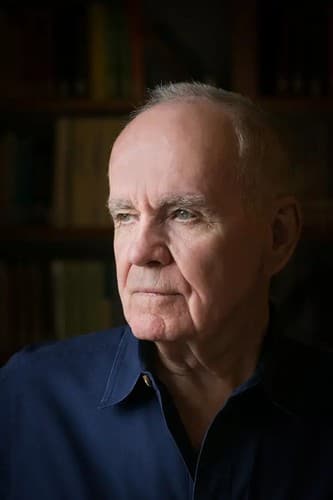
Cormac McCarthy was an American writer who authored twelve novels, two plays, five screenplays, and three short stories, spanning the Western and postapocalyptic genres. He was known for his graphic depictions of violence and his unique writing style, recognizable by a sparse use of punctuation and attribution. McCarthy is widely regarded as one of the greatest American novelists.







